
Tabla de contenidos
Es probable que lo primero que aprendiste del futuro en inglés fuera will: I will, you will, he will… Es la forma más sencilla (no cambia con la persona) y, a la vez, la que más cosas hace: promete, ofrece, predice, supone, amenaza, pide, invita y hasta se niega. Por eso es también el future simple que más se pregunta en los exámenes y el que más errores genera cuando intentas mezclarlo con otros modales. Un solo verbo auxiliar para tantas funciones merece una guía a fondo.
En esta guía te explico cómo se forma el future simple (will + verbo), todos sus usos con ejemplos (incluidos los que casi nadie cuenta, como suponer algo del presente o hablar de hábitos), qué pasa con shall y con won’t, cómo funciona en condicionales y oraciones de tiempo, los errores típicos del hispanohablante, cómo te ayuda en Cambridge y una pitonisa que se equivoca mucho. Al final hay treinta frases de ejercicios con soluciones. ¡Vamos allá! 🙂
El future simple de un vistazo
| Future simple | |
|---|---|
| Forma | will + verbo en infinitivo (sin to) |
| Para qué sirve | Decisiones del momento, promesas, ofrecimientos, predicciones, hechos futuros, peticiones |
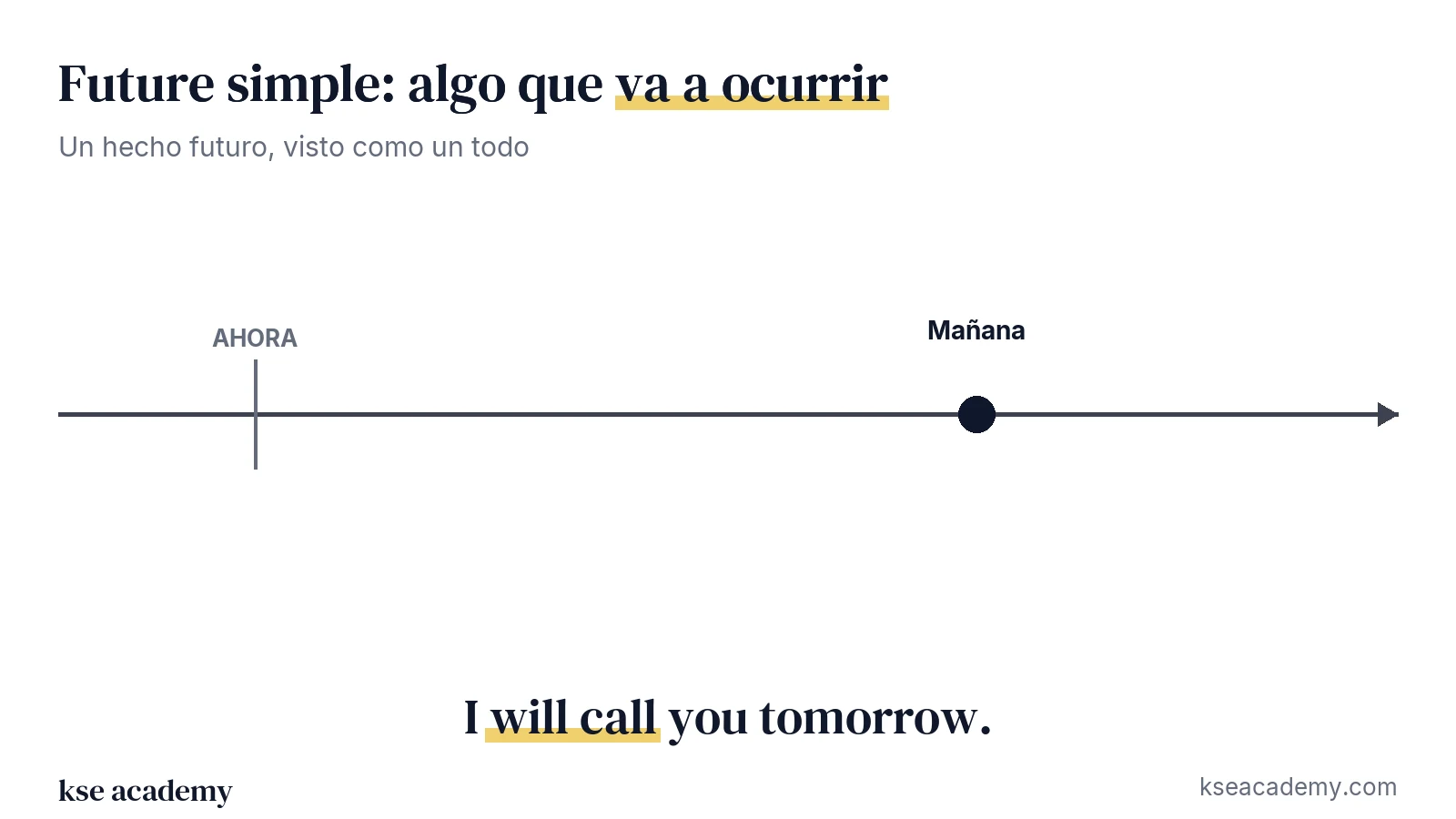
| Ejemplo | I will call you tomorrow. / I’ll call you tomorrow. |
| Español | futuro simple: «te llamaré mañana» |
| Palabras que lo acompañan | tomorrow, next week, soon, probably, I think, I promise, perhaps |
Cómo se forma el future simple
La forma es siempre will + verbo en infinitivo sin to, para todas las personas. No hay -s en la tercera persona ni nada que conjugar:
| Forma | Estructura | Ejemplo |
|---|---|---|
| Afirmativa | sujeto + will + verbo | She will help us. |
| Negativa | sujeto + will not (won’t) + verbo | She won’t help us. |
| Pregunta | Will + sujeto + verbo…? | Will she help us? |
| Con palabra interrogativa | palabra interrogativa + will + sujeto + verbo…? | When will she help us? |
| Respuesta corta | Yes, she will. / No, she won’t. | Will you come? Yes, I will. |
Contracciones y pronunciación
| Forma completa | Contracción |
|---|---|
| I will, you will, he will, she will, it will, we will, they will | I’ll, you’ll, he’ll, she’ll, it’ll, we’ll, they’ll |
| will not | won’t /wəʊnt/ |
| that will, there will | that’ll, there’ll |
En el habla, will suena débil, /wəl/ o /l/ (I’ll /aɪl/, she’ll /ʃiːl/). Es una palabra funcional: la explico en la guía de la schwa y las formas débiles. Un detalle: won’t no sigue la regla (will not → won’t, no willn’t).
Cuándo se usa el future simple
1. Decisiones del momento
Decides algo en el instante de hablar, sin haberlo pensado antes:
- The phone’s ringing. I’ll answer it.
- It’s cold. I’ll close the window.
- I’m hungry. I think I’ll make a sandwich.
2. Promesas y amenazas
- I promise I’ll call you every day.
- I won’t tell anyone your secret.
- If you touch that, you’ll regret it. (Amenaza o advertencia.)
3. Ofrecimientos, invitaciones y peticiones
- That looks heavy. I’ll carry it for you. (Ofrecimiento.)
- Will you come to my party? (Invitación.)
- Will you pass me the salt, please? (Petición.)
4. Predicciones basadas en una opinión
- I think it will be a great year.
- She’ll probably win.
- Tomorrow will be sunny.
Suelen llevar I think, I’m sure, probably o perhaps. Si la predicción se apoya en algo que ves ahora, se usa going to (lo tienes en la guía de will y going to).
5. Hechos futuros que no dependen de nadie
- The sun will rise at 7:15.
- I’ll be 40 next year.
- The train will arrive at 6. (Un horario.)
6. Suposiciones sobre el presente
Un uso que casi nadie cuenta: will sirve para suponer algo que está ocurriendo ahora, igual que el español («será el cartero»):
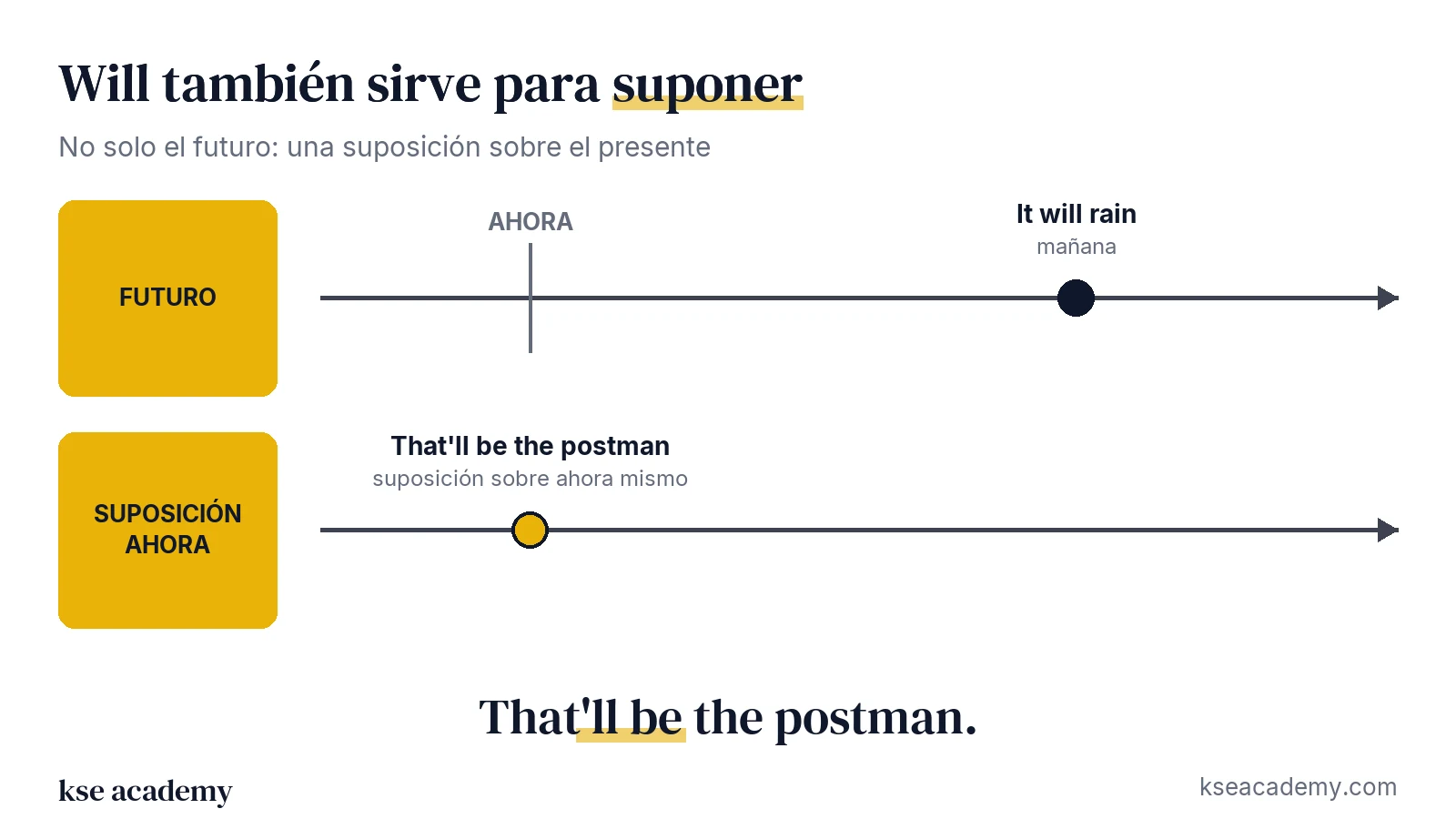
- That’ll be the postman. (Será el cartero.)
- It’s Friday night. She’ll be at the cinema.
- Don’t ring him: he’ll be at work.
7. Hábitos y comportamientos típicos
Con will también describimos lo que alguien hace habitualmente, como característica suya:
- On Sundays she’ll sit for hours reading in the garden.
- Accidents will happen. (Los accidentes ocurren.)
- Boys will be boys.
8. Negativa de rechazo: «won’t»
- The car won’t start. (Se niega a arrancar.)
- He won’t listen to anyone. (No hay manera de que escuche.)
Will en condicionales y oraciones de tiempo
Aquí es donde más se falla. Will va en la oración principal, pero no después de if, when, as soon as, before, after o until: ahí va el presente simple.
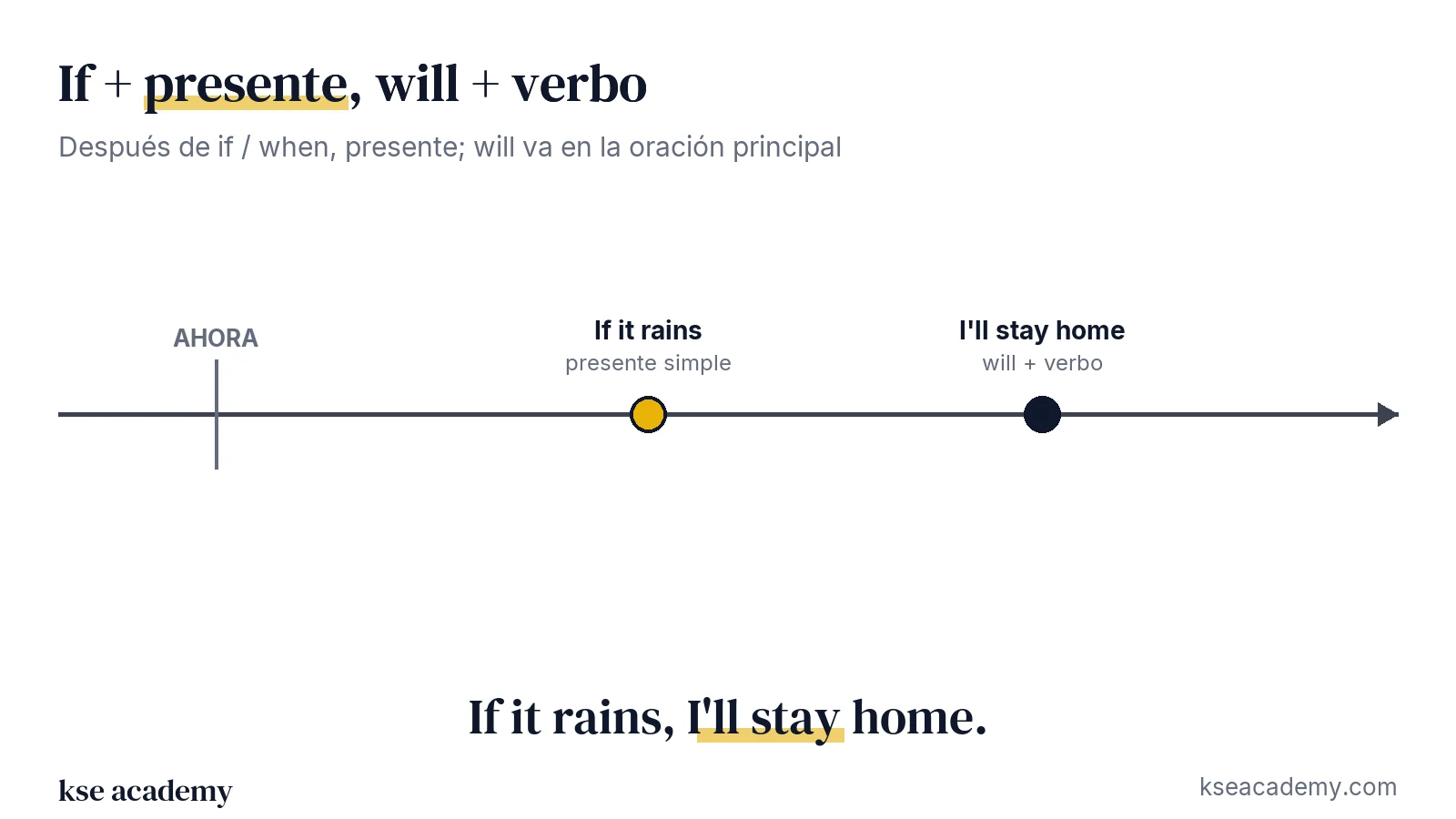
| Parte | Tiempo | Ejemplo |
|---|---|---|
| Condición o momento (if / when / as soon as…) | Presente simple | If it rains… / When I get home… |
| Resultado | will + verbo | …I’ll stay home. / …I’ll call you. |
Más ejemplos: If you study, you’ll pass. As soon as she arrives, we’ll start. I won’t go until he calls. Los condicionales los tienes a fondo en la guía de oraciones condicionales.
Una excepción: will puede ir después de if en peticiones muy corteses y formales: If you will follow me, please… (Si me hace el favor de seguirme). No es el uso normal.
Shall: cuándo se usa
Shall existe, pero se usa poco. Lo habitual es encontrarlo así:
- Ofrecimientos con I / we: Shall I open the window? (¿Abro la ventana?)
- Sugerencias con we: Shall we go? (¿Nos vamos?)
- En inglés formal o jurídico («el arrendatario shall pagar…») y en I shall como variante formal de I will en inglés británico.
En el día a día, will es lo normal y shall lo reservas para ofrecimientos y sugerencias.
Will y los otros modales
Will es un verbo modal, así que no se combina con otros modales. Se usa la perífrasis equivalente:
| ❌ Incorrecto | ✅ Correcto | Por qué |
|---|---|---|
| I will can help you. | I will be able to help you. | Can no tiene futuro: will be able to. |
| We will must leave early. | We will have to leave early. | Must no tiene futuro: will have to. |
| She will may come. | She may come. / She will probably come. | May ya habla del futuro. |
Los modales y sus perífrasis, a fondo, en mis guías de verbos modales y de can, could y be able to.
Español frente a inglés: dónde nos confundimos
El español tiene futuro simple («cantaré») y se parece mucho, pero hay diferencias que importan:
| 🇪🇸 Español | 🇬🇧 Inglés | Qué pasa |
|---|---|---|
| Te llamaré mañana. | I will call you tomorrow. | Equivalencia directa. |
| Cuando llegue, te llamaré. | When I arrive, I will call you. | Español: subjuntivo; inglés: presente. Nunca when I will arrive. |
| Será el cartero. | That’ll be the postman. | El futuro de suposición existe en las dos lenguas. |
| Mañana voy a ir al médico. | I’m going to see the doctor tomorrow. | Si ya lo tenías decidido, en inglés going to, no will. |
| Si puedo, iré. | If I can, I’ll go. | Después de if, presente. |
Errores comunes con el future simple
| ❌ Incorrecto | ✅ Correcto | Por qué |
|---|---|---|
| I will to go to the party. | I will go to the party. | Después de will, infinitivo sin to. |
| He will goes tomorrow. | He will go tomorrow. | Después de will, verbo base, sin -s. |
| If it will rain, we’ll stay. | If it rains, we’ll stay. | Después de if, presente. |
| I’ll call you when I will arrive. | I’ll call you when I arrive. | Después de when, presente. |
| Will you to help me? | Will you help me? | En preguntas, Will + sujeto + verbo base. |
| I won’t to go. | I won’t go. | Igual que en afirmativa: verbo base. |
| I will can come. | I will be able to come. | Can no se combina con will. |
El future simple en los exámenes de Cambridge
Es la base del futuro en Cambridge, desde el A2 Key hasta el C1 Advanced:
- Reading y Use of English: en B2 First, la Part 4 (key word transformations) pide muchas veces will frente a going to, o los condicionales.
- Speaking: predicciones, promesas y decisiones en las preguntas sobre el futuro.
- Writing: en emails y cartas, I’ll send you the details tomorrow o We will contact you soon suenan naturales.
Dos ejemplos del estilo del Use of English Part 4:
- I promise to call you as soon as I arrive. WILL
I promise that I ______ you as soon as I arrive. → will call - I expect she is at home now. WILL
She ______ at home now. → will be
Usos divertidos: la pitonisa que siempre se equivoca
El future simple es el tiempo de los adivinos. Un pequeño repertorio de profecías (que casi nunca se cumplen):
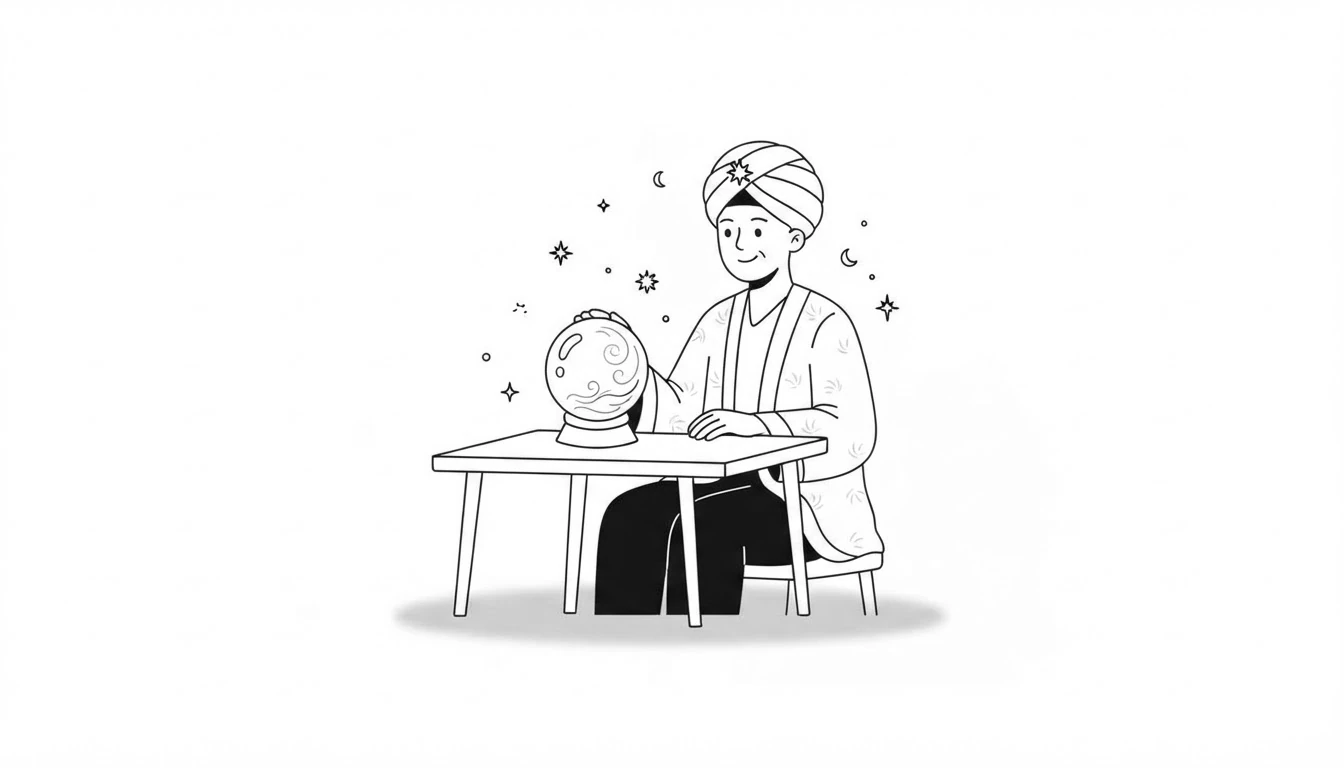
| La pitonisa dice… | Traducción |
|---|---|
| You will meet a tall, dark stranger. | Conocerás a un desconocido alto y moreno. |
| You will be rich and famous. | Serás rico y famoso. (Algún día.) |
| You will travel to a distant land. | Viajarás a una tierra lejana. (A Valencia.) |
| You won’t pass your next exam. I’m joking! | No aprobarás tu próximo examen. ¡Es broma! |
| The lottery will be yours next week. | La lotería será tuya la semana que viene. |
| Your boss will give you a pay rise. One day. | Tu jefe te subirá el sueldo. Algún día. |
Tabla resumen del future simple
| Función | Ejemplo |
|---|---|
| Decisión del momento | I’ll answer it. |
| Promesa | I won’t tell anyone. |
| Ofrecimiento | I’ll carry it for you. |
| Petición o invitación | Will you come to my party? |
| Predicción (opinión) | I think it will be fine. |
| Hecho futuro | The sun will rise at 7. |
| Suposición sobre ahora | That’ll be the postman. |
| Hábito típico | She’ll sit for hours reading. |
| Rechazo | The car won’t start. |
Preguntas frecuentes sobre el future simple
¿Cuándo se usa el future simple?
Para decisiones del momento, promesas, ofrecimientos, peticiones, predicciones basadas en opinión, hechos futuros y suposiciones sobre el presente.
¿Cómo se forma el future simple?
Con will + verbo en infinitivo sin to: I will go. Para negar, won’t; para preguntar, Will you go?
¿Cuál es la diferencia entre will y going to?
Will es para decisiones del momento, promesas y opiniones; going to para planes ya decididos y predicciones con una prueba delante. Lo tienes con detalle en la guía de will y going to.
¿Se puede usar will después de «if»?
No, salvo en peticiones muy formales (If you will follow me…). Lo normal: If it rains, I’ll stay home.
¿Qué es «shall» y cuándo se usa?
Es la variante de will con I y we, y hoy se reserva para ofrecimientos y sugerencias (Shall I help? Shall we go?) y para inglés formal.
¿Por qué no se dice «I will can»?
Porque can y will son modales y no se combinan. Se usa will be able to. Igual con must → will have to.
¿«Won’t» siempre es negativa de will?
Sí: es la contracción de will not. Con cosas, además, puede expresar rechazo (The door won’t open).
Ejercicios de future simple
Treinta frases para comprobar que lo tienes claro. Aquí abajo tienes tres ejercicios interactivos que se corrigen solos, así que sabrás al momento qué tal lo has hecho.
Y si prefieres una versión en texto que puedas copiar y pegar, la tienes aquí abajo 👇
Exercise 1: choose the correct form
Choose the correct option to complete each sentence.
- If it (rains / will rain) tomorrow, we’ll stay at home.
- When I (get / will get) home, I’ll call you.
- «Is that the doorbell?» «Yes, that (will be / is being) the postman.»
- I’m sure you (will can / will be able to) do it.
- Tomorrow I (will must / will have to) get up early.
- (Will you / Do you) open the window, please?
- (Shall I / Will I) open the window? It’s very hot in here.
- I promise I (won’t / don’t) tell anyone.
- If you (will study / study) hard, you’ll pass the exam.
- «Don’t worry.» «I (will / am going to) help you. I promise.»
Ver respuestas
- rains
- get
- will be
- will be able to
- will have to
- Will you
- Shall I
- won’t
- study
- will
Exercise 2: complete the sentences
Complete each sentence with will (or won’t) or the present simple, and the verb in brackets. Write only the missing words.
- I think it _______________ (be) a great party.
- If you miss the bus, you _______________ (be) late.
- I promise I _______________ (not / tell) anyone.
- _______________ (you / lend) me your pen, please?
- The shop _______________ (open) at 9 tomorrow.
- «It’s getting dark.» «I _______________ (turn on) the light.»
- When she _______________ (arrive), we’ll have dinner.
- She _______________ (not / pass) the exam if she doesn’t study.
- I _______________ (be able to) help you tomorrow.
- What time _______________ (the concert / start) tomorrow?
Ver respuestas
- will be
- will be
- won’t tell
- Will you lend
- will open
- will turn on
- arrives
- won’t pass
- will be able to
- will the concert start
Exercise 3: correct or incorrect?
Decide whether each sentence is correct. If it is incorrect, rewrite it correctly.
- I will can help you tomorrow.
- If it will rain, we’ll stay at home.
- I’ll call you when I will arrive.
- She won’t tell anybody.
- I will to go to the party.
- Will you help me, please?
- He will goes to school tomorrow.
- I think it will be cold tonight.
- We will must leave early.
- Don’t worry. I’ll be there at eight.
Ver respuestas
- I will be able to help you tomorrow.
- If it rains, we’ll stay at home.
- I’ll call you when I arrive.
- Correct
- I will go to the party.
- Correct
- He will go to school tomorrow.
- Correct
- We will have to leave early.
- Correct
Conclusión
Resumiendo en tres ideas: el future simple (will + verbo) sirve para decisiones del momento, promesas, ofrecimientos, peticiones y predicciones basadas en opinión, y también para suponer lo que pasa ahora y para hábitos típicos; después de if, when y as soon as va el presente, nunca will; y will no se combina con otros modales: se usa will be able to y will have to.
Si quieres seguir con el futuro, tienes la guía del futuro en inglés, la de will y going to y la del future continuous. ¿Tienes dudas con el future simple? Escríbeme y te ayudo.
¿Te ha parecido útil este post? Compártelo con otros estudiantes y profesores de inglés. Y si quieres más contenido como este, suscríbete a mi newsletter y sígueme en Facebook, Twitter, Pinterest, Instagram y YouTube.
Nos vemos en el próximo post. Hasta entonces, don’t forget to keep smiling! 🙂
