
Tabla de contenidos
Si te estás preparando el B2 Communicator de LanguageCert, seguro que ya sabes que el examen escrito tiene tres partes: Listening, Reading y Writing. Y si eres como la mayoría de mis alumnos, el Writing es la parte que más dudas te genera: ¿qué tipos de texto me pueden pedir?, ¿cuántas palabras tengo que escribir?, ¿cómo me van a corregir?
La buena noticia es que, desde mi punto de vista como preparador de exámenes, el Writing es una de las partes que más rápido se puede mejorar, porque las tareas son muy predecibles y los criterios de corrección son muy claros. En esta guía te explico cómo es el Writing del B2 Communicator, qué te piden en la Part 1 y en la Part 2, cómo se evalúa y, sobre todo, te enseño un ejemplo de Writing de cada tipo de tarea, con su análisis. ¡Vamos allá!
Writing B2 Communicator: qué es el nivel B2
El B2 Communicator certifica, como su nombre indica, un nivel B2 según el Marco Común Europeo de Referencia para las Lenguas (MCER). Es un nivel intermedio-alto, y en lo que a expresión escrita se refiere, el MCER lo describe así:
Escribe textos claros y detallados sobre una variedad de temas relacionados con su especialidad, sintetizando y evaluando información y argumentos procedentes de varias fuentes.
LanguageCert concreta un poco más qué espera de ti en el Writing de este nivel. En resumen, tienes que ser capaz de:
- Escribir textos coherentes sobre temas de interés general, enlazando bien las ideas.
- Escribir cartas, emails, reports y articles formales con fines prácticos.
- Escribir cartas personales sobre experiencias, personas o acontecimientos importantes para ti.
- Describir personas o hechos, reales o imaginarios, y argumentar a favor y en contra de una idea.
- Adaptar el registro (formal o informal) al lector y al propósito del texto.
- Usar una buena variedad de conectores, organizar el texto en párrafos y puntuar correctamente.
- Controlar la gramática para comunicarte con eficacia, aunque cometas algún error al usar estructuras complejas.
Como ves, no se te pide escribir como un nativo, pero sí demostrar que sabes adaptarte a distintos tipos de texto y lectores. Veamos ahora cómo es exactamente el examen.
Cómo es el Writing del B2 Communicator
El Writing forma parte del Written Exam del B2 Communicator, junto con el Listening y el Reading. El Listening siempre va primero, y después tienes 2 horas y 10 minutos para hacer el Reading y el Writing, en el orden que prefieras. Es decir, no hay un tiempo fijo para el Writing: eres tú quien decide cómo repartirlo (luego te doy mis consejos para hacerlo bien).
En el Writing tienes que escribir dos textos:
| Part 1 | Part 2 | |
|---|---|---|
| Palabras | 100–150 | 150–200 |
| Registro | neutro o formal | informal |
| Lector | un público general (una revista, una empresa, un periódico…) | un lector concreto (un amigo, los lectores de una revista…) |
| Qué tienes que hacer | responder a un texto breve tratando 3 puntos de contenido | escribir sobre un tema general tratando 2 puntos de contenido |
| Tipos de texto | carta o email formal, review, article, report | carta o email personal, story, descriptive composition |
| Puntuación | 12 puntos | 12 puntos |
En las dos partes solo hay una tarea, así que no puedes elegir: escribes lo que te pidan. Por eso es tan importante que conozcas bien todos los tipos de texto.
Tipos de Writing B2 Communicator
Veamos qué te pueden pedir en cada parte. Todas las tareas que vas a ver en esta guía las he escrito yo siguiendo el formato del examen, así que no son tareas oficiales, pero son exactamente del mismo estilo.
Writing B2 Communicator: Part 1
En la Part 1 lees un texto breve (un anuncio, un aviso, un fragmento de un artículo…) y tienes que responder con un registro neutro o formal a un público general. Las instrucciones siempre te dan tres puntos de contenido que tienes que tratar, normalmente en una lista con viñetas. Si te dejas uno, perderás puntos en Task Fulfilment, así que márcalos bien antes de empezar.
Formal letter / formal email
Es la tarea más clásica de la Part 1: escribir a una empresa, a una institución o a un periódico para dar tu opinión, quejarte, hacer una sugerencia o participar en un concurso. Un email formal y una carta formal son, a efectos prácticos, lo mismo. Aquí tienes un ejemplo de tarea:
You have seen the notice below at your local library. Write an email to the library manager. Mention:
- how you use the library at the moment
- how the new opening hours would affect you
- what the library could do instead.
Changes to our opening hours
From next month, the library will close at 5 p.m. on weekdays and will no longer open on Saturdays. We would welcome your comments on this change.
Write to: Mr David Hale, Library Manager
Write between 100 and 150 words.
Review
En una review tienes que valorar algo que has probado o visitado (un restaurante, un curso, un hotel, un centro deportivo…) para los lectores de una web o una revista. En la Part 1 el texto de partida suele ser un anuncio de ese sitio:
You recently attended the workshop advertised below. Write a review of it for an English-language website for students. Mention:
- the teacher
- the dishes you prepared
- whether it was good value for money.
Learn to cook like a local!
Our three-hour Mediterranean cooking workshop is perfect for beginners. Small groups, a professional chef and all ingredients included.
Only €45 per person. Book on our website today!
Write between 100 and 150 words.
Article
En un article escribes para los lectores de una revista, una newsletter o una web sobre un tema de interés general. En la Part 1, el punto de partida suele ser un fragmento de una noticia o los resultados de un estudio sobre los que tienes que opinar:
You read the extract below on a news website. Write an article for your college’s English newsletter. Mention:
- whether this is true where you live
- the benefits of volunteering for young people
- how more young people could be encouraged to volunteer.
A recent survey suggests that young people today spend less time volunteering than they did ten years ago. Many of them say they are simply too busy with their studies, part-time jobs and social media.
Write between 100 and 150 words.
Report
Un report es un informe objetivo dirigido a alguien con un cargo (un director, un jefe, un responsable…) en el que describes una situación y haces recomendaciones. Es el texto más formal e impersonal de todos:
The director of your language school has put up the notice below. Write a report for the director. Mention:
- what students use the study centre for
- the main problems at the moment
- your recommendations.
Help us improve the study centre!
This year we have some money to spend on the study centre. Please tell us how you use it and what we should change.
The Director
Write between 100 and 150 words.
Writing B2 Communicator: Part 2
En la Part 2 tienes que escribir un texto informal, algo más largo (150–200 palabras), para un lector concreto, normalmente un amigo o los lectores de una revista. Aquí no suele haber un texto de partida: las instrucciones te dan el tema y dos puntos de contenido (por ejemplo, describe… y explain why…).
Personal letter / informal email
Escribir a un amigo para contarle una novedad, invitarle, darle un consejo o explicarle una experiencia. El registro es relajado: contracciones, preguntas al lector, expresiones coloquiales…
You have just moved into a new flat. Write an email to your English friend, Jack, describing your new flat and inviting him to come and stay.
Write between 150 and 200 words.
Story
Una story (o narrative composition) es un relato, normalmente en pasado, sobre algo que te ocurrió a ti o a otra persona. Las instrucciones suelen pedirte que cuentes qué pasó y cómo te sentiste o qué aprendiste:
Write a story for your college magazine about a day when everything seemed to go wrong. Describe what happened and explain what you learnt from the experience.
Write between 150 and 200 words.
Descriptive composition
En una descriptive composition tienes que describir un lugar, una persona, un objeto o un acontecimiento y explicar por qué es importante para ti:
Write a composition for your English class describing a place in your town where you like to spend time. Describe the place and explain why it is special to you.
Write between 150 and 200 words.
Ahora que ya conoces todos los tipos de tarea, vamos a lo más interesante: cómo responderlas.
Ejemplos de Writing B2 Communicator
En esta sección tienes una respuesta modelo para cada una de las tareas anteriores. Todas son originales y están escritas para simular un nivel B2, sin llegar a un nivel C1, para que veas qué se espera de ti de forma realista. Debajo de cada una te explico por qué funciona.
Ejemplo de Writing B2 Communicator: formal email
Respuesta a la tarea de la biblioteca. Fíjate en que cada uno de los tres puntos de contenido tiene su propio párrafo:
Dear Mr Hale,
I am writing in response to the notice about the library’s new opening hours.
At the moment, I visit the library three or four times a week. I usually study in the reading room after work, and on Saturdays I borrow books for my children.
Unfortunately, the new timetable would make this very difficult for me. I do not finish work until half past five, so I would not be able to use the library at all during the week, and my Saturday visits with my children would also stop.
I understand that the library may need to reduce costs. However, would it be possible to open later in the morning and close at 8 p.m. instead? Alternatively, the library could stay open on Saturday mornings and close on Mondays, when it is usually quieter.
I hope you will consider these suggestions.
Yours sincerely,
Laura Martín
- Saludo y despedida formales: Dear Mr Hale y Yours sincerely, porque conocemos el nombre del destinatario. Si no lo supiéramos, usaríamos Dear Sir or Madam y Yours faithfully.
- Primer párrafo con el motivo del email: I am writing in response to…
- Los tres puntos cubiertos, uno por párrafo: cómo uso la biblioteca, cómo me afectarían los cambios y qué propongo.
- Registro formal: sin contracciones (I do not finish), con una pregunta educada (would it be possible to…?) y conectores como Unfortunately, However o Alternatively.
Ejemplo de Writing B2 Communicator: review
Respuesta a la tarea del taller de cocina. Una review puede ser algo menos formal que una carta, porque va dirigida a otros estudiantes, pero sigue siendo un texto para un público general:
A Tasty Afternoon at the Mediterranean Cooking Workshop
If you have ever wanted to cook proper Mediterranean food, this workshop is a great place to start.
Our teacher, Chef Marco, was patient and funny, and he explained every step clearly. Even though there were ten of us, he found time to help everyone individually.
During the three hours, we prepared a fresh tomato soup, a seafood rice dish and a lemon dessert. The rice was definitely the highlight, although it was also the most challenging part, as timing is everything!
At €45, the workshop is not exactly cheap. However, all the ingredients were included and we took the recipes home, so I think it was good value for money.
Overall, I would highly recommend it to anyone who enjoys cooking, especially beginners. Just make sure you arrive hungry!
- Título atractivo y una primera frase que se dirige directamente al lector (If you have ever wanted to…).
- Un párrafo para cada punto: el profesor, los platos y la relación calidad-precio.
- Vocabulario de valoración en lugar de palabras vagas como good o nice: patient, the highlight, challenging, good value for money.
- Recomendación final clara, que es lo que el lector de una review espera encontrar.
Ejemplo de Writing B2 Communicator: article
Respuesta a la tarea sobre el voluntariado. Un article debe enganchar al lector desde el título, y es perfectamente válido usar preguntas para hacerlo:
Is Volunteering Going Out of Fashion?
According to a recent survey, young people volunteer less than they used to. In my town, I am afraid this seems to be true. Most of the volunteers at our local food bank, for example, are retired people.
This is a pity, because volunteering has a lot to offer. Apart from helping others, it allows you to meet new people, gain confidence and develop skills that employers really value, such as teamwork.
So how can we get more young people involved? Firstly, organisations could offer shorter, more flexible tasks that fit around classes and jobs. Secondly, colleges could recognise volunteering with certificates or extra credits.
After all, most of us want to make a difference. Perhaps we just need someone to show us how easy it can be. Why not give it a try?
- Título en forma de pregunta y una pregunta retórica en el tercer párrafo (So how can we get more young people involved?) para mantener el interés.
- Los tres puntos del enunciado, en orden: si es verdad donde vivo, los beneficios y cómo animar a los jóvenes.
- Ejemplos concretos (our local food bank) que hacen el texto más creíble.
- Conectores de B2: Apart from, Firstly, Secondly, After all.
Ejemplo de Writing B2 Communicator: report
Respuesta a la tarea del centro de estudio. Lo más característico de un report es su estructura con subtítulos y su tono objetivo:
Report on the Study Centre
Introduction
The aim of this report is to describe how students use the study centre and to suggest some improvements. The information comes from a short survey of 40 students.Current use
Most students use the centre to do their homework and to prepare for exams. Some also come in to watch films in English during their breaks.Main problems
The biggest complaint is the lack of computers, as there are only four for the whole school. In addition, many students find the room too noisy, especially in the afternoons.Recommendations
I would recommend buying at least six new computers and creating a separate quiet area for students who need to concentrate.Conclusion
If these changes are made, I am sure that more students will use the centre regularly.
- Título y subtítulos para cada sección, que facilitan la lectura al director.
- Introducción con el objetivo del informe y de dónde sale la información (a short survey of 40 students).
- Lenguaje objetivo e impersonal: The biggest complaint is…, It would also be useful to…
- Recomendaciones concretas con estructuras típicas: I would recommend buying… y una condicional en la conclusión.
Ejemplo de Writing B2 Communicator: informal email
Respuesta a la tarea del piso nuevo. Aquí el registro cambia por completo: estamos escribiendo a un amigo.
Hi Jack,
Sorry I haven’t written for ages, but I’ve been really busy. Guess what? I’ve finally moved into my own flat!
It’s on the fourth floor of an old building right in the city centre, so I can walk everywhere. It isn’t huge, but it’s really bright, because the living room has two big windows that look out over a little square. The kitchen is quite small, to be honest, but it’s got everything I need. My favourite part is the tiny balcony, where I have breakfast every morning when the weather’s nice.
Anyway, the main reason I’m writing is to invite you to come and stay! The sofa turns into a bed, so you’d be really comfortable. If you came in May, we could go to the food festival in the square, which is always great fun. We could also take the train to the coast for a day, since it’s only an hour away.
Let me know what you think and when you might be free. I can’t wait to show you around!
Take care,
Pablo
- Saludo y despedida informales: Hi Jack y Take care.
- Contracciones y expresiones coloquiales: for ages, Guess what?, to be honest, Anyway, show you around.
- Los dos puntos de contenido bien separados: la descripción del piso y la invitación.
- Gramática variada: presente perfecto (I’ve finally moved), relativos (where I have breakfast) y una segunda condicional (If you came in May, we could…).
Ejemplo de Writing B2 Communicator: story
Respuesta a la tarea del día en que todo salió mal. En una story lo importante es que se lea con fluidez y que haya una secuencia clara de acontecimientos:
The Worst Day of My Life (or So I Thought)
It all started when my alarm didn’t go off. I woke up at quarter past eight, which meant I had exactly fifteen minutes to get to my first job interview.
I jumped out of bed, got dressed in a hurry and ran to the bus stop, only to see my bus disappearing round the corner. While I was waiting for the next one, it started to pour with rain. By the time I arrived at the office, I was soaking wet and twenty minutes late.
I was sure they wouldn’t even see me. However, the receptionist smiled, handed me a towel and told me that the manager was running late too. When the interview finally started, I was so relieved after all that drama that I didn’t feel nervous at all. A week later, they offered me the job.
That day taught me an important lesson: things rarely go exactly as planned, but staying calm can turn a disaster into a success. I still set two alarms, though!
- Tiempos narrativos bien combinados: past simple para la acción principal, past continuous para el contexto (While I was waiting) y estructuras como only to see o which meant.
- Expresiones de tiempo que ordenan la historia: It all started when, By the time, When… finally, A week later.
- Vocabulario expresivo: pour with rain, soaking wet, running late.
- Los dos puntos cubiertos: qué pasó y qué aprendí, este último en el párrafo final, con un toque de humor.
Ejemplo de Writing B2 Communicator: descriptive composition
Respuesta a la tarea del lugar favorito. En una descripción tienes que conseguir que el lector «vea» lo que describes:
My Favourite Corner of Town
If you walk past the cathedral and turn down a narrow street, you will find a small, peaceful garden that most tourists never notice. For me, it is the best place in the whole town.
The garden is surrounded by old stone walls covered in ivy, and in the middle there is a fountain with a little statue of a fish. There are only four wooden benches, all in the shade of an enormous orange tree, so in spring the air smells wonderful. Apart from the sound of the water and a few birds, it is completely silent, even though the busy main square is only a few metres away.
This place is special to me because it is where I go when I need to think. When I was preparing for my university exams, I used to sit there for hours with my notes. Now I go there to read or simply to relax after a long day.
Whenever life feels too busy, I know that a quiet bench is waiting for me behind the cathedral.
- Adjetivos y detalles concretos: narrow, peaceful, covered in ivy, an enormous orange tree.
- Los sentidos: lo que se ve, lo que se oye y hasta lo que se huele (the air smells wonderful).
- El segundo punto de contenido, por qué es especial, en un párrafo propio, con used to para hablar de hábitos del pasado.
- Un cierre redondo que vuelve a la imagen del principio.
Cómo se evalúa el Writing del B2 Communicator
Cada una de las dos tareas se corrige por separado según cuatro criterios, y en cada uno puedes sacar de 0 a 3 puntos. Es decir, cada tarea vale 12 puntos y el Writing completo, 24.
| Criterio | Qué se valora |
|---|---|
| Task Fulfilment | Si haces lo que te pide la tarea: los puntos de contenido, el tipo de texto, el registro adecuado para el lector y el número de palabras. |
| Accuracy and Range of Grammar | Si usas una variedad de estructuras gramaticales adecuadas al nivel y con pocos errores. |
| Accuracy and Range of Vocabulary | Si tu vocabulario es variado, preciso y adecuado al tema, incluida la ortografía. |
| Organisation | Si el texto está bien organizado en párrafos, si las ideas se enlazan con conectores y si la puntuación es correcta. |
Después, los puntos del Writing se convierten a una escala sobre 50 y se suman a los del Listening y el Reading. Para aprobar el Written Exam necesitas 75 de 150 en total (Pass), y a partir de 101 obtienes un High Pass. Te lo explico con un ejemplo práctico en mi guía completa del B2 Communicator.
¿Me penalizan si me paso o me quedo corto de palabras?
Esta es una de las preguntas que más me hacéis. Según los criterios de LanguageCert:
- Si no llegas al mínimo de palabras, se tiene en cuenta al puntuar el Task Fulfilment, así que sí, te puede costar puntos.
- Si te pasas, no hay una penalización directa, pero cuanto más escribes, más probable es que cometas errores y que el texto pierda calidad.
- Si el texto no trata el tema que te piden (off-topic), no recibe ningún punto.
Mi recomendación: apunta siempre a la zona alta del rango (unas 130–145 palabras en la Part 1 y 180–195 en la Part 2) y no más. Por cierto, se acepta tanto la ortografía británica como la americana, siempre que seas coherente.
Consejos para el Writing del B2 Communicator
Estos son los consejos que doy siempre a mis alumnos de B2 Communicator:
- Controla el tiempo del Reading. Como el Reading y el Writing comparten 2 horas y 10 minutos, el error más típico es quedarse atascado en el Reading y llegar al Writing sin tiempo. Haz primero lo que te resulte fácil del Reading y pasa al Writing cuando todavía te quede tiempo de sobra. Si lo necesitas, siempre puedes volver al Reading al final.
- Planifica antes de escribir. Dedica unos minutos a hacer un esquema: un párrafo para cada punto de contenido, una introducción y un cierre. Así evitarás olvidarte de algún punto y que el texto quede descompensado.
- Piensa en quién lee tu texto. En la Part 1 el registro es formal: escribe I would like to en lugar de I want to, o I have received en lugar de I’ve got. En la Part 2, en cambio, las contracciones y las expresiones coloquiales son perfectamente naturales.
- Cubre todos los puntos de contenido. Subráyalos en el enunciado y táchalos a medida que los tratas. Es la forma más fácil de asegurar puntos en Task Fulfilment.
- Usa vocabulario preciso. Sustituye palabras generales como nice, good o big por otras más específicas, como pleasant, outstanding o enormous. Es una forma muy sencilla de demostrar tu nivel.
- Demuestra lo que sabes. Si has estudiado las condicionales, la pasiva o los relativos, úsalos. No hace falta forzarlo, pero el examinador necesita ver estructuras de nivel B2.
- Revisa siempre. Reserva un par de minutos al final para buscar errores de concordancia, de ortografía y de puntuación. Son errores tontos que cuestan puntos.
Si estás dudando entre exámenes, también tienes mi guía del Writing del B2 First de Cambridge, para que compares los dos formatos. Y si tu objetivo es el siguiente nivel, aquí tienes la guía del Writing del C1 Expert.
Guía para el Writing B2 Communicator con ejemplos
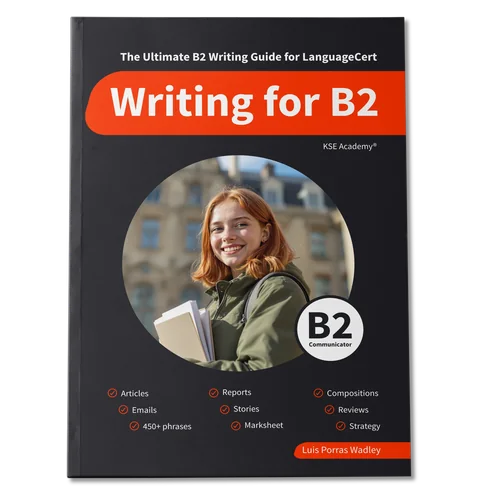
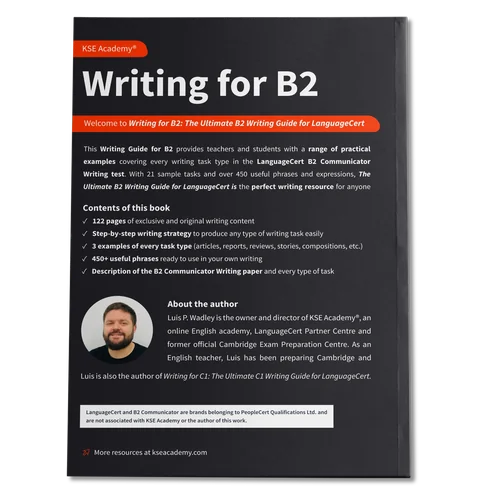
Si quieres seguir practicando con muchos más ejemplos, tienes la guía de KSE Academy para el Writing B2 de LanguageCert. En ella encontrarás:
- Todos los tipos de tarea de la Part 1 y la Part 2, explicados paso a paso.
- 3 tareas de ejemplo con su respuesta modelo para cada tipo de texto.
- Más de 450 expresiones útiles para tus writings.
- Una estrategia de escritura paso a paso y respuestas a las dudas más frecuentes.
- Un B2 Toolkit con inglés formal e informal, errores comunes y una misma tarea resuelta a nivel Pass y High Pass.
- Los criterios de corrección y una hoja de evaluación fotocopiable.
Y con esto ya tienes todo lo que necesitas saber del Writing del B2 Communicator. Si te queda alguna duda, déjame un comentario y te respondo encantado, que para eso estoy aquí. 🙂
