
Table of contents
If you’re preparing for LanguageCert B2 Communicator, you’ll know that the written exam has three sections: Listening, Reading and Writing. And if you’re like most of my students, Writing is the part that raises the most questions: what kinds of text can they ask for? How many words do I need to write? How will I be marked?
The good news is that, in my experience as an exam trainer, Writing is one of the quickest sections to improve, because the tasks are very predictable and the marking criteria are very clear. In this guide I’ll explain what the B2 Communicator Writing paper is like, what you have to do in Part 1 and Part 2, how it’s assessed and, above all, I’ll show you a sample answer for every type of task, with an analysis of each one. Let’s get started!
Writing B2 Communicator: what B2 level means
As its name suggests, B2 Communicator certifies a B2 level according to the Common European Framework of Reference for Languages (CEFR). It’s an upper-intermediate level, and when it comes to writing, the CEFR describes it like this:
Can write clear, detailed texts on a variety of subjects related to their field of interest, synthesising and evaluating information and arguments from a number of sources.
LanguageCert spells out in a bit more detail what it expects from you in Writing at this level. In short, you need to be able to:
- Write coherent texts on topics of general interest, linking your ideas well.
- Write formal letters, emails, reports and articles for practical purposes.
- Write personal letters about experiences, people or events that matter to you.
- Describe real or imaginary people and events, and argue for and against an idea.
- Adapt your register (formal or informal) to the reader and the purpose of the text.
- Use a good range of linking words, organise your text into paragraphs and punctuate correctly.
- Control your grammar well enough to communicate effectively, even if you make the odd mistake with complex structures.
As you can see, nobody expects you to write like a native speaker, but you do need to show that you can adapt to different types of text and readers. Now let’s look at exactly what the exam involves.
What the B2 Communicator Writing paper is like
Writing is part of the B2 Communicator Written Exam, together with Listening and Reading. Listening always comes first, and after that you have 2 hours and 10 minutes for Reading and Writing, in whichever order you prefer. In other words, there’s no fixed time for Writing: it’s up to you how you divide it (I’ll give you some tips on that later).
In the Writing section you have to write two texts:
| Part 1 | Part 2 | |
|---|---|---|
| Words | 100–150 | 150–200 |
| Register | neutral or formal | informal |
| Reader | a general audience (a magazine, a company, a newspaper…) | a specific reader (a friend, the readers of a magazine…) |
| What you do | respond to a short text, covering 3 content points | write about a general topic, covering 2 content points |
| Text types | formal letter or email, review, article, report | personal letter or email, story, descriptive composition |
| Marks | 12 | 12 |
There’s only one task in each part, so there’s no choice: you write whatever they ask for. That’s why it’s so important to be familiar with every type of text.
Types of Writing in B2 Communicator
Let’s see what you might be asked to write in each part. I’ve written all the tasks in this guide myself, following the exam format, so they aren’t official tasks, but they’re exactly the same style.
B2 Communicator Writing: Part 1
In Part 1 you read a short text (an advert, a notice, an extract from an article…) and respond to it in a neutral or formal register for a general audience. The instructions always give you three content points to cover, usually in a bulleted list. If you leave one out, you’ll lose marks for Task Fulfilment, so highlight them before you start.
Formal letter / formal email
This is the classic Part 1 task: writing to a company, an organisation or a newspaper to give your opinion, complain, make a suggestion or enter a competition. For practical purposes, a formal email and a formal letter are the same thing. Here’s a sample task:
You have seen the notice below at your local library. Write an email to the library manager. Mention:
- how you use the library at the moment
- how the new opening hours would affect you
- what the library could do instead.
Changes to our opening hours
From next month, the library will close at 5 p.m. on weekdays and will no longer open on Saturdays. We would welcome your comments on this change.
Write to: Mr David Hale, Library Manager
Write between 100 and 150 words.
Review
In a review you give your opinion of something you’ve tried or visited (a restaurant, a course, a hotel, a sports centre…) for the readers of a website or a magazine. In Part 1 the input is usually an advert for that place:
You recently attended the workshop advertised below. Write a review of it for an English-language website for students. Mention:
- the teacher
- the dishes you prepared
- whether it was good value for money.
Learn to cook like a local!
Our three-hour Mediterranean cooking workshop is perfect for beginners. Small groups, a professional chef and all ingredients included.
Only €45 per person. Book on our website today!
Write between 100 and 150 words.
Article
In an article you write for the readers of a magazine, a newsletter or a website about a topic of general interest. In Part 1 the starting point is usually an extract from a news story or the results of a study that you have to comment on:
You read the extract below on a news website. Write an article for your college’s English newsletter. Mention:
- whether this is true where you live
- the benefits of volunteering for young people
- how more young people could be encouraged to volunteer.
A recent survey suggests that young people today spend less time volunteering than they did ten years ago. Many of them say they are simply too busy with their studies, part-time jobs and social media.
Write between 100 and 150 words.
Report
A report is an objective document for someone in a position of responsibility (a director, a manager…) in which you describe a situation and make recommendations. It’s the most formal and impersonal text of all:
The director of your language school has put up the notice below. Write a report for the director. Mention:
- what students use the study centre for
- the main problems at the moment
- your recommendations.
Help us improve the study centre!
This year we have some money to spend on the study centre. Please tell us how you use it and what we should change.
The Director
Write between 100 and 150 words.
B2 Communicator Writing: Part 2
In Part 2 you write a slightly longer informal text (150–200 words) for a specific reader, usually a friend or the readers of a magazine. There’s usually no input text here: the instructions give you the topic and two content points (for example, describe… and explain why…).
Personal letter / informal email
Writing to a friend to share some news, invite them, give them advice or tell them about an experience. The register is relaxed: contractions, questions to the reader, colloquial expressions…
You have just moved into a new flat. Write an email to your English friend, Jack, describing your new flat and inviting him to come and stay.
Write between 150 and 200 words.
Story
A story (or narrative composition) tells what happened to you or to someone else, usually in the past. The instructions often ask you to say what happened and how you felt or what you learnt:
Write a story for your college magazine about a day when everything seemed to go wrong. Describe what happened and explain what you learnt from the experience.
Write between 150 and 200 words.
Descriptive composition
In a descriptive composition you describe a place, a person, an object or an event and explain why it matters to you:
Write a composition for your English class describing a place in your town where you like to spend time. Describe the place and explain why it is special to you.
Write between 150 and 200 words.
Now that you know all the task types, let’s move on to the most interesting part: how to answer them.
B2 Communicator Writing examples
In this section you’ll find a model answer for each of the tasks above. They’re all original and written to simulate a B2 level, without reaching C1, so that you get a realistic idea of what’s expected. Under each one I explain why it works.
B2 Communicator Writing example: formal email
An answer to the library task. Notice how each of the three content points has its own paragraph:
Dear Mr Hale,
I am writing in response to the notice about the library’s new opening hours.
At the moment, I visit the library three or four times a week. I usually study in the reading room after work, and on Saturdays I borrow books for my children.
Unfortunately, the new timetable would make this very difficult for me. I do not finish work until half past five, so I would not be able to use the library at all during the week, and my Saturday visits with my children would also stop.
I understand that the library may need to reduce costs. However, would it be possible to open later in the morning and close at 8 p.m. instead? Alternatively, the library could stay open on Saturday mornings and close on Mondays, when it is usually quieter.
I hope you will consider these suggestions.
Yours sincerely,
Laura Martín
- Formal opening and closing: Dear Mr Hale and Yours sincerely, because we know the reader’s name. If we didn’t, we’d use Dear Sir or Madam and Yours faithfully.
- A first paragraph stating the reason for writing: I am writing in response to…
- All three points covered, one per paragraph: how I use the library, how the changes would affect me and what I suggest instead.
- Formal register: no contractions (I do not finish), a polite question (would it be possible to…?) and linkers such as Unfortunately, However and Alternatively.
B2 Communicator Writing example: review
An answer to the cooking workshop task. A review can be slightly less formal than a letter, because it’s aimed at other students, but it’s still a text for a general audience:
A Tasty Afternoon at the Mediterranean Cooking Workshop
If you have ever wanted to cook proper Mediterranean food, this workshop is a great place to start.
Our teacher, Chef Marco, was patient and funny, and he explained every step clearly. Even though there were ten of us, he found time to help everyone individually.
During the three hours, we prepared a fresh tomato soup, a seafood rice dish and a lemon dessert. The rice was definitely the highlight, although it was also the most challenging part, as timing is everything!
At €45, the workshop is not exactly cheap. However, all the ingredients were included and we took the recipes home, so I think it was good value for money.
Overall, I would highly recommend it to anyone who enjoys cooking, especially beginners. Just make sure you arrive hungry!
- An eye-catching title and an opening sentence that speaks directly to the reader (If you have ever wanted to…).
- One paragraph per content point: the teacher, the dishes and value for money.
- Evaluative vocabulary instead of vague words like good or nice: patient, the highlight, challenging, good value for money.
- A clear recommendation at the end, which is exactly what readers of a review are looking for.
B2 Communicator Writing example: article
An answer to the volunteering task. An article has to catch the reader’s attention from the title onwards, and questions are a perfectly good way to do that:
Is Volunteering Going Out of Fashion?
According to a recent survey, young people volunteer less than they used to. In my town, I am afraid this seems to be true. Most of the volunteers at our local food bank, for example, are retired people.
This is a pity, because volunteering has a lot to offer. Apart from helping others, it allows you to meet new people, gain confidence and develop skills that employers really value, such as teamwork.
So how can we get more young people involved? Firstly, organisations could offer shorter, more flexible tasks that fit around classes and jobs. Secondly, colleges could recognise volunteering with certificates or extra credits.
After all, most of us want to make a difference. Perhaps we just need someone to show us how easy it can be. Why not give it a try?
- A title in the form of a question and a rhetorical question in the third paragraph (So how can we get more young people involved?) to keep the reader interested.
- The three points from the task, in order: whether it’s true where I live, the benefits and how to encourage young people.
- Concrete examples (our local food bank) that make the text more convincing.
- B2 linkers: Apart from, Firstly, Secondly, After all.
B2 Communicator Writing example: report
An answer to the study centre task. The most distinctive features of a report are its headings and its objective tone:
Report on the Study Centre
Introduction
The aim of this report is to describe how students use the study centre and to suggest some improvements. The information comes from a short survey of 40 students.Current use
Most students use the centre to do their homework and to prepare for exams. Some also come in to watch films in English during their breaks.Main problems
The biggest complaint is the lack of computers, as there are only four for the whole school. In addition, many students find the room too noisy, especially in the afternoons.Recommendations
I would recommend buying at least six new computers and creating a separate quiet area for students who need to concentrate.Conclusion
If these changes are made, I am sure that more students will use the centre regularly.
- A title and headings for each section, which make it easy for the director to read.
- An introduction stating the purpose of the report and where the information comes from (a short survey of 40 students).
- Objective, impersonal language: The biggest complaint is…, It would also be useful to…
- Specific recommendations using typical structures: I would recommend buying… and a conditional in the conclusion.
B2 Communicator Writing example: informal email
An answer to the new flat task. Here the register changes completely: we’re writing to a friend.
Hi Jack,
Sorry I haven’t written for ages, but I’ve been really busy. Guess what? I’ve finally moved into my own flat!
It’s on the fourth floor of an old building right in the city centre, so I can walk everywhere. It isn’t huge, but it’s really bright, because the living room has two big windows that look out over a little square. The kitchen is quite small, to be honest, but it’s got everything I need. My favourite part is the tiny balcony, where I have breakfast every morning when the weather’s nice.
Anyway, the main reason I’m writing is to invite you to come and stay! The sofa turns into a bed, so you’d be really comfortable. If you came in May, we could go to the food festival in the square, which is always great fun. We could also take the train to the coast for a day, since it’s only an hour away.
Let me know what you think and when you might be free. I can’t wait to show you around!
Take care,
Pablo
- Informal opening and closing: Hi Jack and Take care.
- Contractions and colloquial expressions: for ages, Guess what?, to be honest, Anyway, show you around.
- Both content points clearly separated: describing the flat and the invitation.
- A range of grammar: present perfect (I’ve finally moved), relative clauses (where I have breakfast) and a second conditional (If you came in May, we could…).
B2 Communicator Writing example: story
An answer to the day-when-everything-went-wrong task. What matters most in a story is that it reads smoothly and has a clear sequence of events:
The Worst Day of My Life (or So I Thought)
It all started when my alarm didn’t go off. I woke up at quarter past eight, which meant I had exactly fifteen minutes to get to my first job interview.
I jumped out of bed, got dressed in a hurry and ran to the bus stop, only to see my bus disappearing round the corner. While I was waiting for the next one, it started to pour with rain. By the time I arrived at the office, I was soaking wet and twenty minutes late.
I was sure they wouldn’t even see me. However, the receptionist smiled, handed me a towel and told me that the manager was running late too. When the interview finally started, I was so relieved after all that drama that I didn’t feel nervous at all. A week later, they offered me the job.
That day taught me an important lesson: things rarely go exactly as planned, but staying calm can turn a disaster into a success. I still set two alarms, though!
- Narrative tenses used well: past simple for the main events, past continuous for the background (While I was waiting) and structures such as only to see and which meant.
- Time expressions that order the story: It all started when, By the time, When… finally, A week later.
- Expressive vocabulary: pour with rain, soaking wet, running late.
- Both points covered: what happened and what I learnt, the latter in the final paragraph, with a touch of humour.
B2 Communicator Writing example: descriptive composition
An answer to the favourite place task. In a description you have to make the reader «see» what you’re describing:
My Favourite Corner of Town
If you walk past the cathedral and turn down a narrow street, you will find a small, peaceful garden that most tourists never notice. For me, it is the best place in the whole town.
The garden is surrounded by old stone walls covered in ivy, and in the middle there is a fountain with a little statue of a fish. There are only four wooden benches, all in the shade of an enormous orange tree, so in spring the air smells wonderful. Apart from the sound of the water and a few birds, it is completely silent, even though the busy main square is only a few metres away.
This place is special to me because it is where I go when I need to think. When I was preparing for my university exams, I used to sit there for hours with my notes. Now I go there to read or simply to relax after a long day.
Whenever life feels too busy, I know that a quiet bench is waiting for me behind the cathedral.
- Adjectives and concrete details: narrow, peaceful, covered in ivy, an enormous orange tree.
- The senses: what you can see, hear and even smell (the air smells wonderful).
- The second content point, why it’s special, in a paragraph of its own, with used to for past habits.
- A neat ending that goes back to the image at the start.
How the B2 Communicator Writing paper is marked
Each of the two tasks is marked separately against four criteria, and you can get 0 to 3 marks for each one. So each task is worth 12 marks, and the whole Writing section 24.
| Criterion | What it looks at |
|---|---|
| Task Fulfilment | Whether you do what the task asks: the content points, the type of text, the right register for the reader and the word count. |
| Accuracy and Range of Grammar | Whether you use a range of grammatical structures suitable for the level, with few errors. |
| Accuracy and Range of Vocabulary | Whether your vocabulary is varied, precise and suitable for the topic, including spelling. |
| Organisation | Whether the text is well organised into paragraphs, whether ideas are linked with cohesive devices and whether the punctuation is accurate. |
Your Writing marks are then converted to a scale out of 50 and added to your Listening and Reading scores. To pass the Written Exam you need 75 out of 150 overall (Pass), and from 101 you get a High Pass. I explain it with a worked example in my complete guide to B2 Communicator.
Will I lose marks if I write too much or too little?
This is one of the questions I’m asked most often. According to LanguageCert’s criteria:
- If you don’t reach the minimum word count, this is taken into account when marking Task Fulfilment, so yes, it can cost you marks.
- If you go over the maximum, there’s no direct penalty, but the more you write, the more likely you are to make mistakes and lower the quality of your text.
- If your text is off topic, it gets no marks at all.
My advice: always aim for the top of the range (around 130–145 words in Part 1 and 180–195 in Part 2) and no more. By the way, both British and American spelling are accepted, as long as you’re consistent.
Tips for the B2 Communicator Writing paper
These are the tips I always give my B2 Communicator students:
- Keep an eye on your Reading time. As Reading and Writing share 2 hours and 10 minutes, the most common mistake is getting stuck in Reading and reaching Writing with no time left. Do the parts of the Reading that you find easy first and move on to Writing while you still have plenty of time. If you need to, you can always go back to the Reading at the end.
- Plan before you write. Spend a few minutes on a quick outline: a paragraph for each content point, an introduction and an ending. That way you won’t forget a point and your text will be well balanced.
- Think about who’s reading your text. In Part 1 the register is formal: write I would like to rather than I want to, or I have received rather than I’ve got. In Part 2, on the other hand, contractions and colloquial expressions are perfectly natural.
- Cover every content point. Underline them in the task and tick them off as you go. It’s the easiest way to secure marks for Task Fulfilment.
- Use precise vocabulary. Replace general words like nice, good or big with more specific ones, such as pleasant, outstanding or enormous. It’s a very simple way to show your level.
- Show what you know. If you’ve studied conditionals, the passive or relative clauses, use them. There’s no need to force it, but the examiner needs to see B2 structures.
- Always check your work. Save a couple of minutes at the end to look for mistakes with agreement, spelling and punctuation. They’re silly mistakes that cost marks.
If you’re still deciding which exam to take, have a look at my guide to Cambridge B2 First Writing to compare the two formats. And if you’re aiming for the next level, here’s my guide to C1 Expert Writing.
B2 Communicator Writing guide with examples
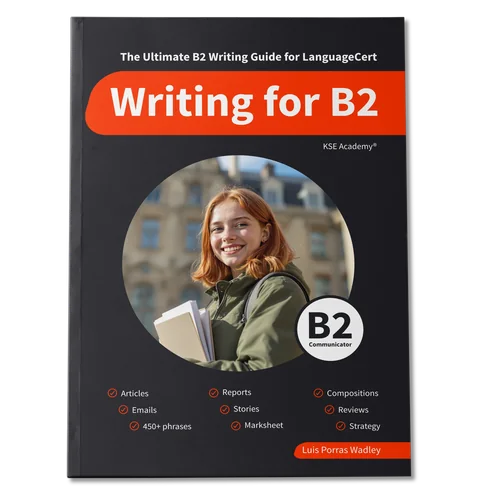
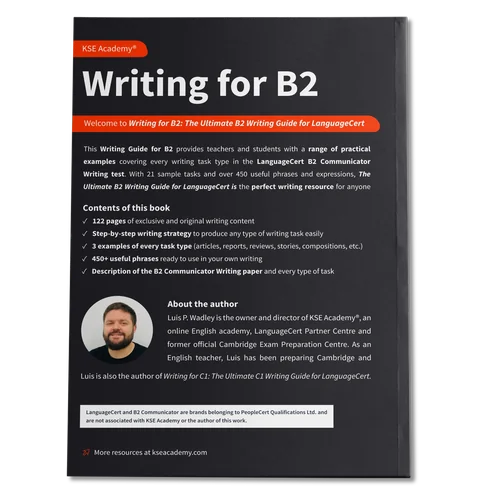
If you’d like to keep practising with many more examples, have a look at the KSE Academy guide to LanguageCert B2 Writing. In it you’ll find:
- Every Part 1 and Part 2 task type, explained step by step.
- 3 sample tasks with model answers for each type of text.
- Over 450 useful expressions for your writing.
- A step-by-step writing strategy and answers to the most common questions.
- A B2 Toolkit with formal and informal English, common mistakes and the same task answered at Pass and High Pass level.
- The marking criteria and a photocopiable assessment sheet.
And that’s everything you need to know about the B2 Communicator Writing paper. If you still have any questions, leave me a comment and I’ll be happy to help. 🙂
