
Table of contents
Of the four skills tested in the B1 Preliminary, Listening is usually the one that makes students most nervous, because you can’t re-read a sentence you didn’t catch: it plays once, it plays again, and that’s it. The good news is that the exam follows a very clear logic once you know it, and your ear can be trained exactly like any other skill.
In this guide I’ll explain exactly what the B1 Preliminary Listening paper looks like: its four parts, what each one tests, and I’ll leave you an official Cambridge sample test with real audio to listen to yourself, commented with concrete examples from each part. 🙂
What the B1 Preliminary Listening paper looks like
Listening is one of the four components of the exam, along with Reading, Writing and Speaking, and it’s worth 25% of the final score, just like the other three.
| Fact | B1 Preliminary Listening |
|---|---|
| Length | About 35 minutes, including 6 minutes to transfer your answers |
| Number of parts | 4 |
| Number of questions | 25 (numbered 1 to 25) |
| Scoring | 1 point per correct answer |
| Recordings | Each recording is played twice |
| Weight in the final score | 25% |
Notice one detail that puts a lot of people at ease: every recording is played twice. The first listen is for getting the general idea; the second is for confirming or correcting your answer. This completely changes your strategy: you don’t need to catch everything the first time round.
Listen to an official Cambridge sample test
Before going part by part, here’s the full audio from an official sample test. Listen to it calmly, ideally with headphones, exactly as you would on exam day:
From here we’ll comment on a real example from each of the four parts, with images from the official sample and excerpts from the transcript.
Part 1: seven short recordings with three pictures
In the first part you listen to seven short recordings (monologues or very short exchanges), and for each one you choose, from three pictures (A, B or C), the one that correctly answers the question.
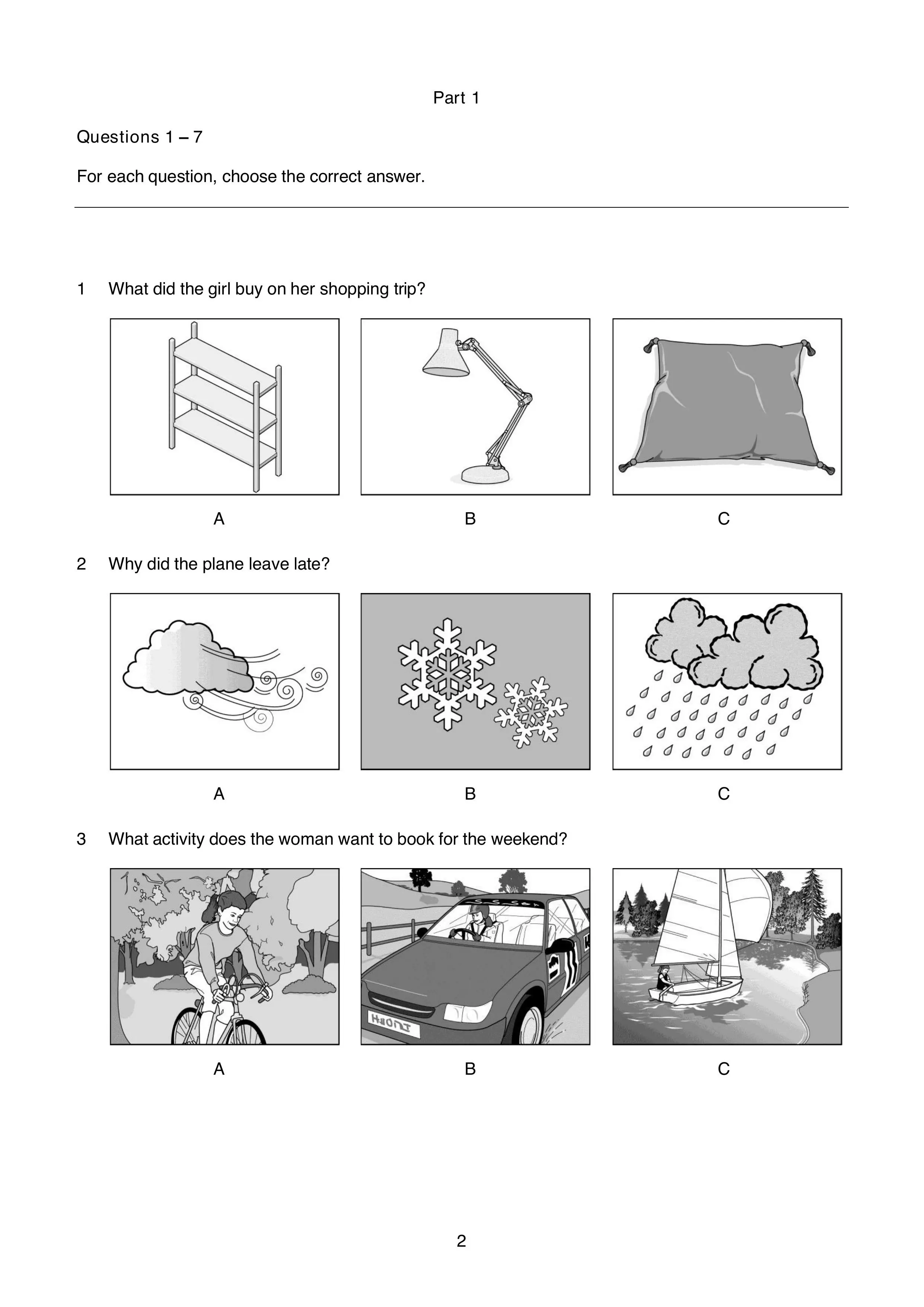
Take question 1: «What did the girl buy on her shopping trip?», with a bookshelf (A), a desk lamp (B) and a cushion (C). The girl says her room only has one light in the ceiling and she’d prefer a lamp on her desk, «so that’s what I got today», so that’s what she bought today. She’ll get the bookshelves next week if she has enough money, and as for the cushion, «I nearly got one today actually»: she almost bought it, but didn’t. Correct answer: B.
This example shows the most typical trap in Part 1: the recording mentions all three options, but only one describes what actually happened. The other two are things she considered doing, will do in the future, or almost did.
Part 2: six short dialogues between two people
Part 2 is six short dialogues between two people. For each one you first read a context sentence and a question (or a sentence to complete), then choose the correct option out of three (A, B or C), this time written text, not a picture.
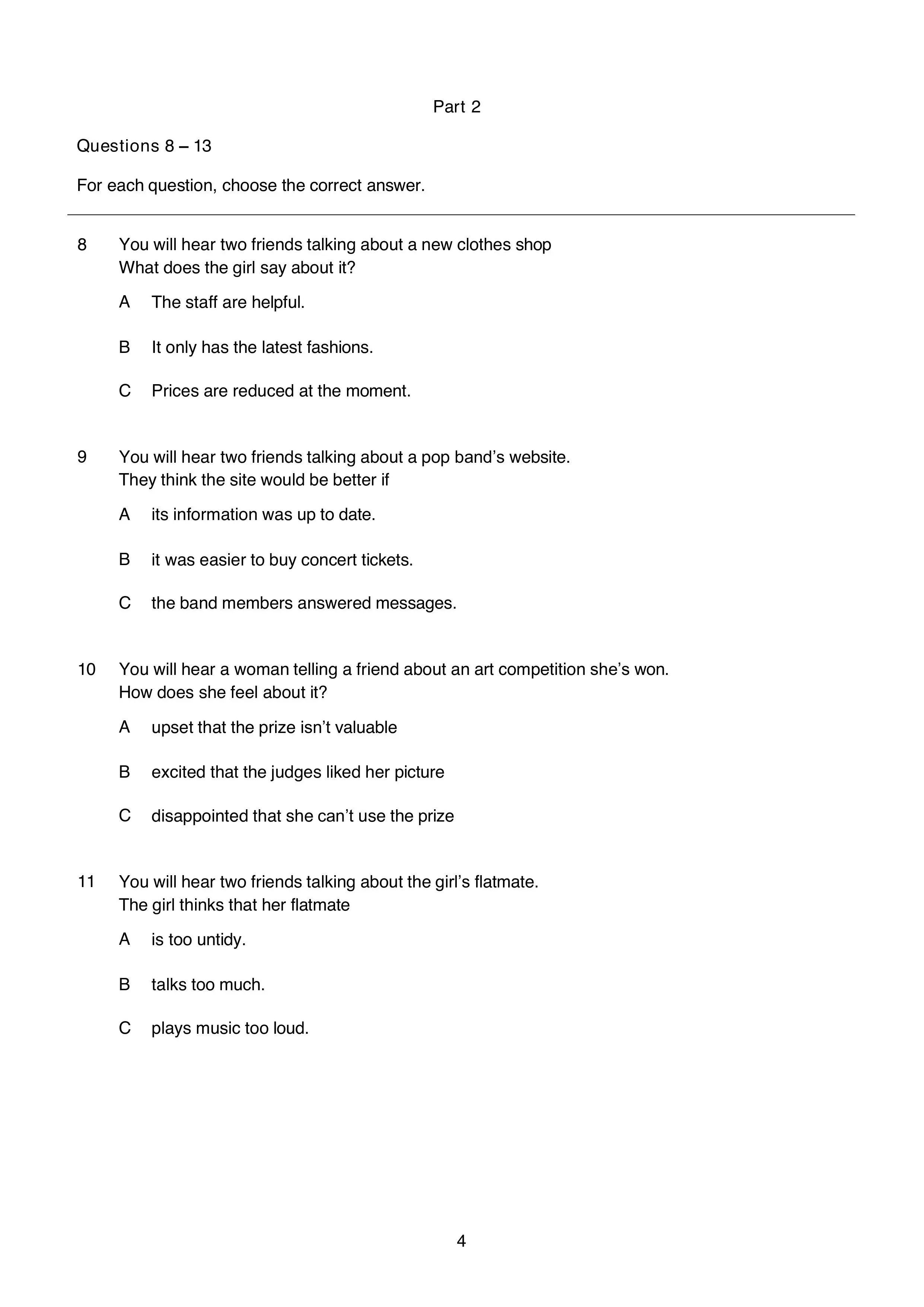
In question 8, two friends talk about a new clothes shop, and the question is «What does the girl say about it?», with the options: A) the staff are helpful, B) it only has the latest fashions, C) prices are reduced at the moment. She says «the assistants were nice» (the staff were helpful) and that the coolest, most fashionable stuff had already sold out, but that she found things that weren’t expensive compared to other things in the shop, not that prices were reduced. Correct answer: A.
The trap here is more subtle: B and C use words that genuinely appear in the recording (fashion, prices), but they say something different from what’s actually stated. You need to focus on the exact nuance, not just the topic.
Part 3: one longer monologue with notes to complete
In Part 3 you listen to a single, longer monologue and fill in six gaps on a page of notes, writing one or two words, a number, a date or a time, never full sentences.
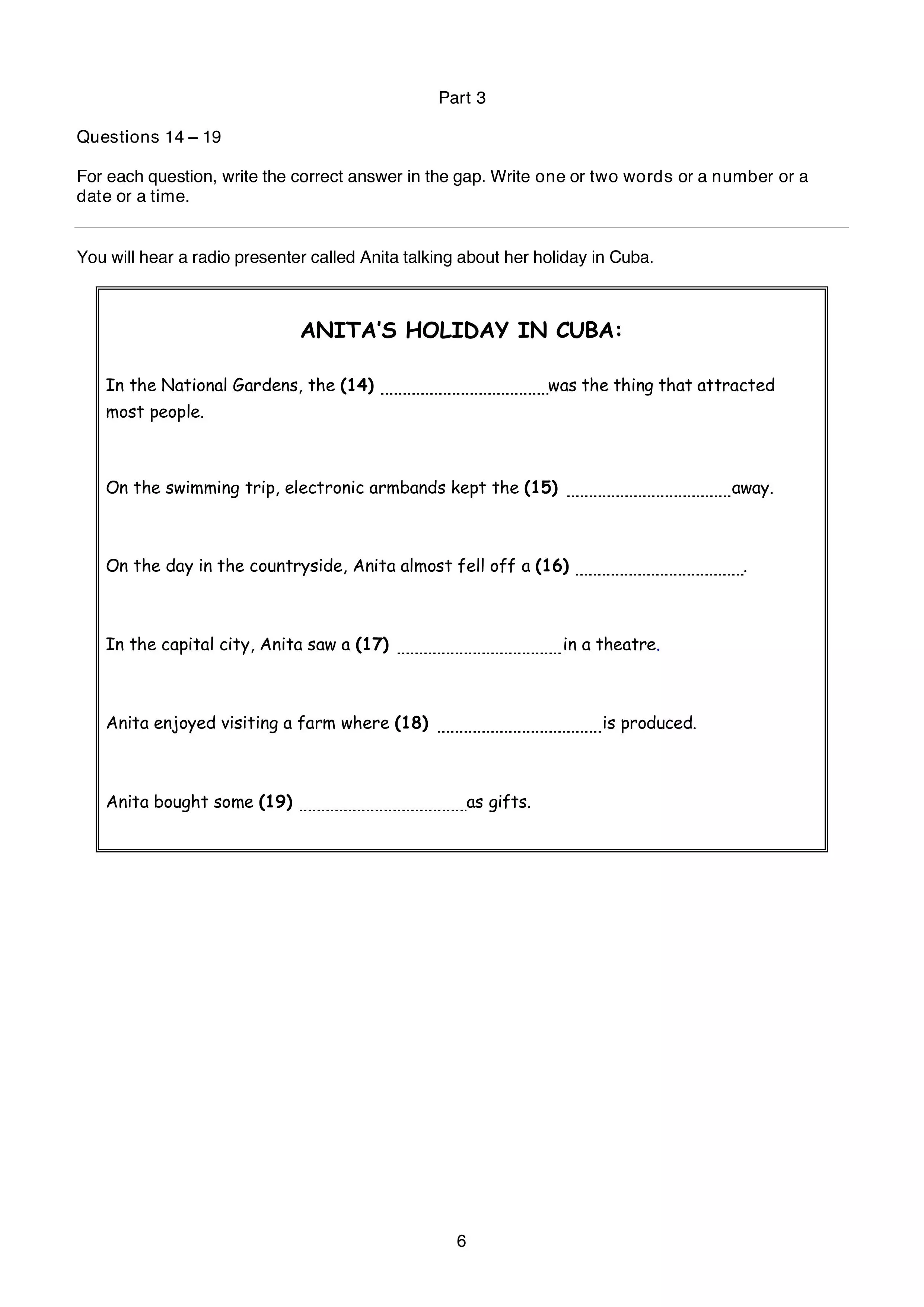
In the sample, a radio presenter called Anita talks about her trip to Cuba. Gap 14 asks what was «the thing that attracted most people» at the National Gardens. Anita says there was «a fantastic waterfall that everyone stopped to admire», even though what she personally liked best was the rainforest exhibition. Correct answer: waterfall.
This gap is a perfect example of another common trap: the question asks for a general fact (what attracted most people), and the recording also mentions the narrator’s own personal opinion (what she liked). These are two different things, and only one is the answer.
Part 4: a longer interview with six questions
The final part is a longer interview, with six multiple-choice questions (A, B or C) about details and opinions expressed by the person being interviewed.
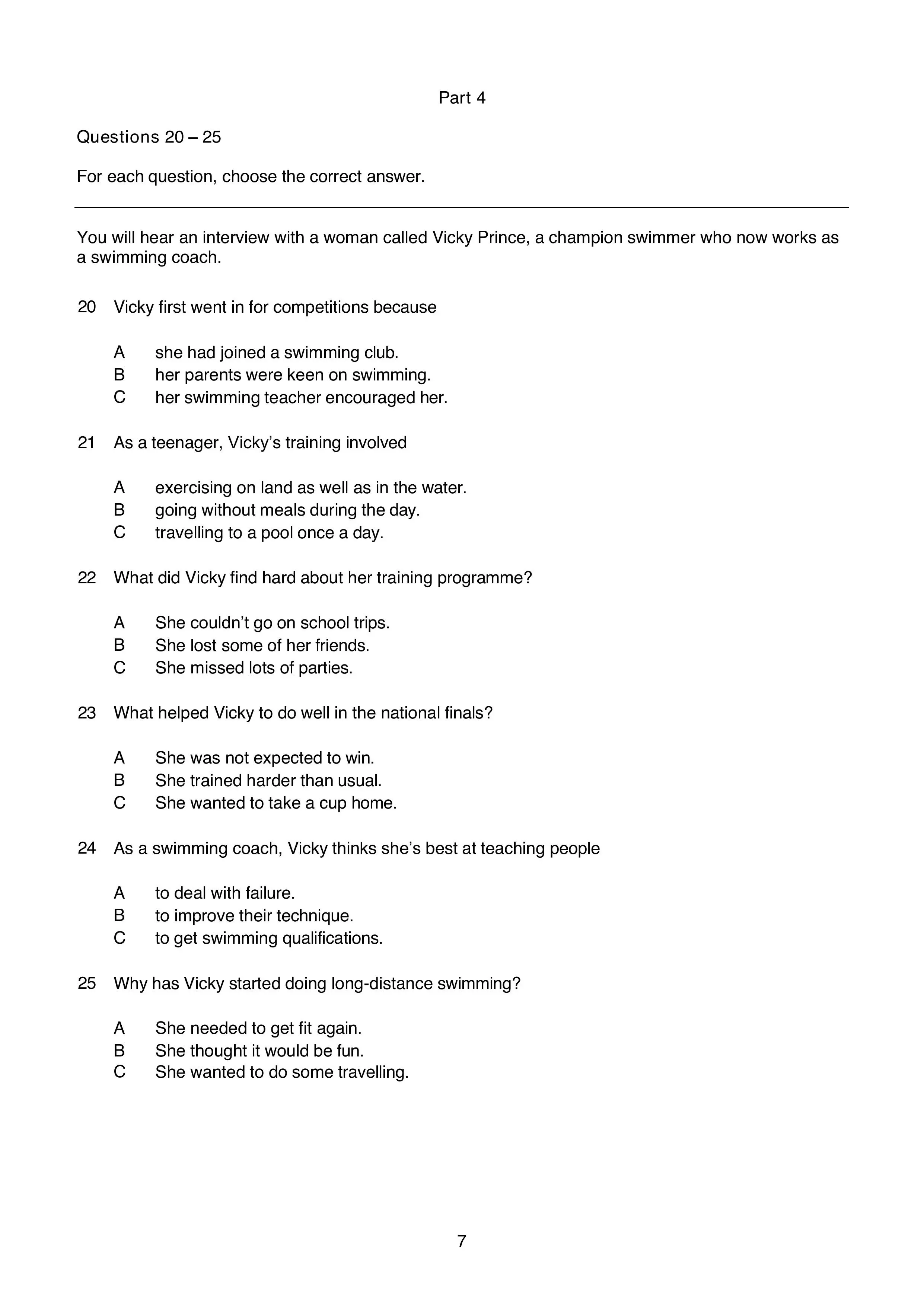
In the sample, former professional swimmer Vicky Prince is interviewed. Question 20 is «Vicky first went in for competitions because», with the options: A) she had joined a swimming club, B) her parents were keen on swimming, C) her swimming teacher encouraged her. Vicky explains that her parents were interested in sport but not specifically swimming, that she learnt at school «like everyone else», and that it was her teacher who encouraged her to compete. She adds: «I did join a swimming club later, but that wasn’t where it all started»: she did join a club, but afterwards. Correct answer: C.
It’s the same time-sequencing trap that shows up so often in the Reading paper: something that did happen, but after the event the question is actually asking about.
Full answers to the sample test, in case you want to check your own: 1B, 2B, 3A, 4C, 5B, 6B, 7C, 8A, 9B, 10C, 11A, 12A, 13A, 14 waterfall, 15 shark(s), 16 horse, 17 musical (show/play), 18 sugar, 19 ring(s), 20C, 21A, 22B, 23A, 24A, 25C.
General strategy for B1 Preliminary Listening
- Always use the first listen for the general idea and the second to confirm the detail. Don’t try to catch everything the first time.
- Read the questions before the recording starts. Cambridge gives you a pause for exactly this in every part: use it to underline key words and, in Part 3, to think about what type of word is missing in each gap (a number? a place? an object?).
- Be suspicious of options that only echo words from the recording. As you’ve seen in the examples, Cambridge mentions all three options almost every time: the trap is in the nuance, not in whether the word sounds familiar.
- Watch out for time order. Something that happened afterwards isn’t the cause of what the question is actually asking, even if it’s mentioned in the recording.
- In Part 3, write exactly what you hear, without translating or rephrasing, and check your spelling at the end: it’s the only part where you write the answer yourself.
- Always answer. There’s no penalty for wrong answers, so if you’re unsure, go with the option that fits best.
Common mistakes in B1 Preliminary Listening
- Getting stuck on a word you don’t understand. The recording keeps going: it’s better to miss one word than to miss the rest of the sentence because you’re still thinking about it.
- Deciding your answer on the first listen without confirming on the second. Many questions have a trap you only notice on the second listen, once you already have an answer in mind.
- Writing full sentences in Part 3 instead of one or two words. Cambridge states this clearly in the instructions: go over that, and the answer can be marked wrong.
- Leaving the transfer of answers until the very last second. You get 6 minutes at the end of the exam to copy your answers onto the answer sheet, so don’t waste them second-guessing questions instead of copying calmly.
Frequently asked questions about B1 Preliminary Listening
How many parts and questions does B1 Preliminary Listening have?
Four parts with 25 questions in total: 7 in Part 1, 6 in Part 2, 6 in Part 3 and 6 in Part 4.
How long is the exam?
About 35 minutes in total, the last 6 minutes of which are for transferring your answers to the answer sheet.
Is each recording played only once?
No, each recording is played twice in full, with a pause in between.
Is there a part where I have to write the answer myself?
Yes, Part 3: there you write one or two words, a number, a date or a time in each gap. The other three parts are multiple choice.
Are wrong answers penalised?
No. There’s no deduction for wrong answers, so it’s worth answering every question, even if it’s with the option that fits best.
Can I take notes while I listen?
Yes, in fact it’s recommended: you can write directly on the question booklet as you listen, and only transfer your final answers to the answer sheet at the end. If you’re taking the digital version of the exam, you can take notes on the sheet with your login credentials, or ask the supervisor or invigilator for an extra sheet of paper.
Keep preparing for B1 Preliminary
This is the general guide to Listening; there’s a guide for each of the four parts, with the sample test solved question by question: Listening Part 1, Part 2, Part 3 and Part 4. You can also keep preparing the rest of the exam with the guides to Reading, Writing and Speaking, or go back to the main B1 Preliminary page for the overall picture of the exam.
Did you find this guide useful? Share it with other students and teachers preparing for the PET. And if you’re left with any doubts, leave them in the comments. I read every one.
See you in the next guide. Until then, don’t forget to keep smiling! 🙂
