

Table of contents
B1 Preliminary Listening Part 3 is the only part of the Listening paper where you don’t choose between A, B or C: here you write. You get a page of notes with six gaps, you listen to one person talking for a couple of minutes, and you write down the missing word in each gap. It sounds harder, but it has one big advantage: the answer is always said in the recording, word for word.
The trap is somewhere else. In almost every gap, the speaker mentions two things that would fit, and only one of them is the answer. In this guide I’ll explain how this part works and what you can and can’t write, and we’ll go through the six gaps of an official Cambridge sample test together, with the real audio so you can try it before reading my explanation. 🙂
What B1 Listening Part 3 looks like
B1 Preliminary Listening has four parts, 25 questions and takes about 35 minutes, and it’s worth 25% of your final mark. This is the third part:
| Detail | B1 Listening Part 3 |
|---|---|
| What you do | Listen to a monologue (a talk, a radio programme, an announcement) and complete 6 gaps on a page of notes |
| Number of questions | 6 (numbered 14 to 19) |
| What you write | One or two words, a number, a date or a time |
| Reading time | 20 seconds before the recording starts |
| Marks | 1 mark per correct answer |
| Recordings | You hear the monologue twice |
| What it tests | Finding and writing down specific information, without changing the words |
Before you listen: predict what’s missing in each gap
Those 20 seconds of reading time are gold. The notes follow the same order as the recording and nearly always tell you what kind of word is missing: a noun, a number, a place. If you start listening already knowing what you’re looking for, you’ll catch it much sooner. This is the page from the sample test:
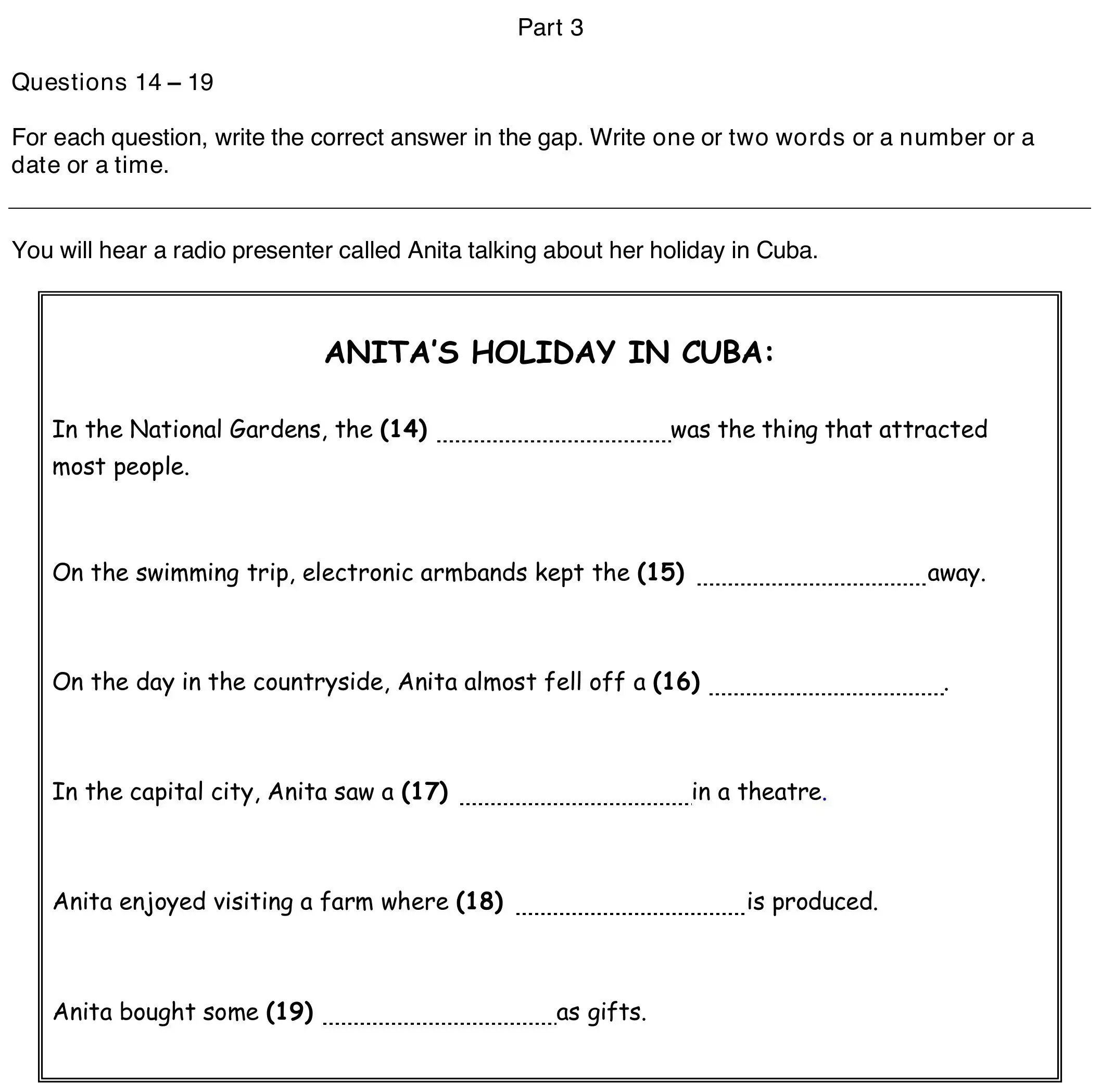
Look at what each sentence tells you before you hear anything:
- 14, «the ___ was the thing that attracted most people»: a singular noun (it goes with was), something you could see in gardens.
- 15, «kept the ___ away»: something you’d want to keep away while you’re swimming. Probably an animal.
- 16, «almost fell off a ___»: something you can fall off: a horse, a bike, a motorbike.
- 17, «saw a ___ in a theatre»: a type of show: a play, a concert, a musical.
- 18, «a farm where ___ is produced»: an uncountable product (it goes with is): coffee, sugar, cheese.
- 19, «bought some ___ as gifts»: a plural or uncountable noun, something you’d buy as a present.
Now you’re no longer listening to «see what she says», but looking for something very specific at each point.
Listen to the sample test for this part
Try to fill in all six gaps from the recording before you read the explanations.
The six gaps, one by one
Question 14: the National Gardens

Anita says the gardens are full of trees and flowers, and there was «a fantastic waterfall that everyone stopped to admire». Straight after that, she adds that the bit she liked best was «the rainforest exhibition».
Correct answer: waterfall. The note asks what attracted most people (everyone stopped to admire), not what Anita preferred. The rainforest exhibition is the distractor: it’s in the same place and mentioned in the same sentence.
Question 15: the swimming trip

The trip was on a sailing boat «to swim with dolphins», and they had to wear «special electronic arm-bands to keep off any sharks». Then, with a bit of humour: no one saw any, fortunately.
Correct answer: sharks. The dolphins are the distractor: they’re the star of the trip, but people swam with them, nobody needed to keep them away. Notice too that the recording says keep off and the note says kept away: same meaning, different words.
Question 16: the day in the countryside

The programme included crossing some hills «by horse», and Anita was worried because she hasn’t ridden much. Then they met «a noisy motorbike» on the track, «but I managed to stay on somehow!»
Correct answer: horse. The motorbike is the perfect distractor: it’s also something you can fall off, and it appears at exactly the key moment. But Anita wasn’t on the motorbike; the motorbike is what nearly threw her off the horse. «I managed to stay on somehow» is how the recording says «almost fell off».
Question 17: the capital city

In the capital she loved the atmosphere of the shops and restaurants, and in the afternoon they went to a theatre «to see a musical». She immediately adds: «luckily not a serious play», because that would have been hard to follow in Spanish.
Correct answer: musical. If you write play, you lose the mark: the serious play is exactly what she didn’t see. Cambridge also accepts musical show or musical play, because the key word is still musical.
Question 18: the farm

Anita thought they were going to see coffee being grown: «I thought we were going to see coffee being grown». But «in the end we went to a farm that produces sugar».
Correct answer: sugar. Coffee is the classic expectation-versus-reality distractor: what someone thought would happen isn’t what happened. Phrases like I thought…, I expected… or in the end warn you that a change is coming.
Question 19: the gifts

On Saturday she found a street full of jewellery workshops and bought «a few rings to take back as presents». Later she regrets not buying «any of the beautiful leather belts».
Correct answer: rings. The leather belts are what she didn’t buy. And watch out for jewellery: it’s mentioned, but it describes the street of workshops, not what she bought. The answer is the specific word, not the category.
Answers, in case you’ve been keeping track: 14 waterfall, 15 sharks, 16 horse, 17 musical, 18 sugar, 19 rings.
The pattern that keeps coming back: two candidates for every gap
If you put the six gaps side by side, you’ll see Cambridge has used the same technique in all of them:
| Gap | Answer | Distractor | Why it’s wrong |
|---|---|---|---|
| 14 | waterfall | rainforest exhibition | It’s what Anita preferred, not what attracted most people |
| 15 | sharks | dolphins | They swam with the dolphins; the sharks had to be kept away |
| 16 | horse | motorbike | The motorbike nearly threw her off, but she was on a horse |
| 17 | musical | serious play | The serious play is what she didn’t see |
| 18 | sugar | coffee | Coffee is what she expected to see, not what she saw |
| 19 | rings | leather belts | The belts are what she didn’t buy |
The practical takeaway: don’t write the first word that fits. Listen to the whole sentence, because the distractor usually comes just before or just after the answer, and what decides it is a small detail: not, I thought, I was sorry I hadn’t, the bit I liked best.
What you can and can’t write
- Write the word you hear. Don’t swap it for a synonym or summarise it: the answer is in the recording, word for word. The sentences in the notes are paraphrased, but the word in the gap isn’t.
- One or two words, a number, a date or a time. If you find yourself writing a whole sentence, something’s gone wrong.
- Articles don’t matter. waterfall and the waterfall are both fine. Singular or plural usually doesn’t matter either if the meaning is the same (shark or sharks).
- Check it fits the sentence. If the note says «fell off a ___», the answer has to be singular after a.
- Spelling counts. Common words must be spelled correctly, and if a word is spelled out in the recording (a name, a street), it has to be exact. In the sample test Cambridge accepted waterfal and suger, but don’t count on that kind of leniency.
- In the paper-based exam, transfer your answers in CAPITAL LETTERS. That’s what the Part 3 answer sheet asks for, and it stops a badly formed letter costing you the mark. In the digital exam, you simply type them.
Strategy for Listening Part 3
- Use the 20 seconds to predict. Read each sentence and decide what kind of word is missing (noun, number, place, object) and whether it’s singular or plural.
- Follow the order of the notes. The recording goes in the same order as the gaps, so if you miss one, leave it and focus on the next. You’ll get it back on the second listening.
- On the first listening, write fast. One word per gap, even if you’re not sure. If you hear two candidates, jot down both and decide later.
- On the second listening, check. Make sure each answer makes sense in its sentence and rule out the distractors: what was expected, what didn’t happen, what someone else preferred.
- Check your spelling before transferring your answers. You get 6 minutes at the end of the paper-based exam; use them for this too.
Most common mistakes in Listening Part 3
- Writing the first word that fits. There are almost always two candidates, and the first one you hear isn’t always the right one.
- Paraphrasing the answer. If you hear sharks, write sharks, not dangerous fish. Cambridge rewards the exact word from the recording.
- Writing too much. A full sentence where one or two words belong usually includes extra or wrong information.
- Writing the category instead of the specific word. jewellery instead of rings doesn’t count: the note asks exactly what she bought.
- Being careless with easy spellings. A mistake in a common word, or in something that was spelled out for you, costs you the mark even if you understood the answer.
Frequently asked questions about B1 Listening Part 3
How many questions are there in B1 Preliminary Listening Part 3?
Six questions (numbered 14 to 19). Each one is a gap in a page of notes that you complete with one or two words, a number, a date or a time.
Do spelling mistakes count?
Yes. Common words must be spelled correctly, and anything spelled out in the recording must be exact. Cambridge sometimes accepts a small mistake in a harder word, but don’t take it for granted: always check your spelling.
Can I write the answer in my own words?
No. The answer is in the recording and you have to write that word, without changing it. What you can leave out are articles: a, an or the won’t win or lose you the mark.
Do I have to write in capital letters?
In the paper-based exam, yes: the answer sheet asks you to write your Part 3 answers in capital letters. In the digital exam you just type them.
Do wrong answers lose marks?
There’s no penalty in B1 Preliminary, so write something in all six gaps even if you’re not sure.
Can I take notes while I listen?
Yes, you can write directly on the question paper while you listen. If you’re taking the digital exam, you can make notes on the sheet with your login details, or ask the invigilator for an extra sheet of paper.
Keep preparing B1 Listening
This is the third in a series dedicated to each part of B1 Preliminary Listening. If you haven’t already, check out the guide to Listening Part 1 and the guide to Listening Part 2. And when you’ve finished this one, carry on with the guide to Listening Part 4, the last in the series. You can also go back to the general guide to Listening, or review the rest of the exam on the main B1 Preliminary page.
Did you find this guide useful? Share it with other students and teachers preparing for the PET. And if you’re left with any doubts, leave them in the comments. I read every one.
See you in Part 4, the last one. Until then, don’t forget to keep smiling! 🙂
