
Table of contents
LanguageCert C2 Mastery Reading is demanding, but also very predictable: there are always four texts with four types of task, and the format is the same as at C1. What changes is the density: literary texts full of metaphor, essays with tightly linked arguments and nuances that hinge on a single word. It also shares its time with Writing, so managing the clock well is half the battle.
In my experience as an exam trainer, at C2 hardly anyone loses marks by not understanding the text: they’re lost on a nuance, an adverb or a piece of irony read too quickly. So in this guide I explain what C2 Mastery Reading is like, what you have to do in each of its four parts, how it’s marked and, most importantly, I give you an example of every part, written by me, with every answer explained. Let’s get started!
C2 Mastery Reading: what C2 level means
C2 Mastery certifies C2 on the Common European Framework of Reference for Languages (CEFR), the highest level. In reading, that means you read virtually any text with ease, including abstract, literary and highly idiomatic ones, and you pick up fine shades of meaning, tone and the writer’s intention.
In exam terms, in C2 Mastery Reading you need to be able to:
- Understand a literary or academic text, with metaphors, similes and idiomatic language, and decide whether a statement about it is true or false.
- See how discourse is built: references, contrasts, examples and transitions between ideas.
- Find specific information across several short texts and tell their purposes apart.
- Answer questions with short, precise answers, often rephrasing what the text says.
What C2 Mastery Reading is like
Reading is part of the Written Exam, together with Listening and Writing. These are its main features:
- It comes after Listening, and you have 2 hours 40 minutes for Reading and Writing together, in whichever order you like.
- It has four parts and 26 questions, and each correct answer is worth 1 mark.
- You transfer your answers to an Answer Sheet within that time.
- You can take it on paper at a centre or online from home, in the same format.
| Part | Text | Task | Questions |
|---|---|---|---|
| Part 1 | One text with idiomatic language, narrative or academic ideas, arguments and opinions | Decide whether 5 statements are true or false | 5 |
| Part 2 | A text with 6 sentences removed | Choose the sentence for each gap from 8 (two are extra) | 6 |
| Part 3 | Four short texts on the same theme, with different purposes | Decide which text (A to D) contains each piece of information | 7 |
| Part 4 | One continuous text: narrative, descriptive, explanatory, biographical… | Answer open questions in five words or fewer | 8 |
The four parts of C2 Mastery Reading
Part 1
You read a text with idiomatic language, narrative or academic ideas, arguments and opinions, and decide whether 5 statements about it are true (T) or false (F). It looks like the easiest task, but it isn’t: the statements paraphrase the text, and a single word (always, never, only, altogether) can turn an almost correct statement into a false one. There are only two options: there’s no ‘not given’.
Part 2
You get a text with 6 sentences removed and a list of 8 sentences to fill the gaps. Two are extra, so the distractors are harder to rule out. Understanding the sentence isn’t enough: you have to see how it fits with what comes before and after. Pay close attention to pronouns (it, this, they), linkers (however, for example, instead) and ideas that are repeated.
Part 3
You read four short texts (an advert, an email, an article, a leaflet…) on the same theme but with different purposes, and answer 7 questions like «Which text mentions…?». You can use each text more than once. It’s a task about finding information quickly, with a catch: the questions are paraphrased and several texts talk about similar things.
Part 4
You read one continuous text (a story, a biography, an explanatory text…) and answer 8 open questions (what, why, where…) in five words or fewer. You don’t need full sentences, but your answer must respond exactly to the question.
C2 Mastery Reading examples
I’ve written these examples following the exam format, with C2-level texts and questions. Try them without looking at the answers, then read the explanation for each one: that’s where you learn how the exam thinks.
C2 Mastery Reading example: Part 1
A narrative text about a lighthouse keeper’s daughter, with five statements to mark true or false:
Read the text and the statements. Decide whether each statement is true (T) or false (F).
The keeper’s daughter
My father kept the light on Carrick Point for thirty-one years, and in all that time I never once heard him call it a job. It was, he said, a conversation: the lamp spoke to the ships, and the ships, by passing safely, answered. As a child I took this for the kind of thing fathers say, a pleasant varnish over long nights and cold mornings. It was only after he died, when I sat alone in the lamp room with the lens dark for the first time in a century, that I understood he had meant it quite literally, and that the silence was now mine to keep.
The tower itself was never beautiful. Squat, salt-bitten and painted a white that the weather turned the colour of old teeth, it crouched on the headland like something waiting to be forgiven. Visitors expected romance and found instead a kitchen that smelt of paraffin and a staircase that punished the knees. My mother, who had married a lighthouse without quite realising it, spent her first winter there, she later told me, ‘learning to be lonely on purpose’. By the second winter she had stopped counting the days until spring and started counting the birds instead, filling notebook after notebook with a tally so meticulous that ornithologists still cite it.
I left at eighteen, as the young do, convinced that the world was somewhere else. I studied, married, moved cities twice and acquired the habit, common among the children of remote places, of describing my childhood as though it had happened to someone braver. The truth was more prosaic. I had been neither brave nor deprived; I had simply been somewhere that asked very little of me except attention, and I had given it grudgingly.
When the lighthouse was automated, the authorities offered my father a cottage in the village and a small pension. He accepted both with a courtesy that I now recognise as grief. He walked out to the point every evening for the rest of his life, not to check on the light, which no longer needed him, but, I suspect, to be there when it spoke.
- The writer’s father regarded his work as a kind of communication rather than an occupation.
- As a child, the writer believed her father’s description of his work was entirely accurate.
- The writer’s mother adapted to life at the lighthouse more quickly than she had expected.
- The writer suggests that she exaggerated the hardships of her childhood when describing it to others.
- After the lighthouse was automated, the writer’s father continued to check that the light was working properly.
Show answers
- T: ‘I never once heard him call it a job. It was, he said, a conversation’: the lamp ‘spoke’ to the ships.
- F: As a child she took it for ‘the kind of thing fathers say’, a pleasant varnish; she only understood it much later.
- F: Her first winter was spent ‘learning to be lonely on purpose’, and only in the second did she stop counting the days: adapting wasn’t quick, and the text says nothing about what she expected.
- T: She described her childhood ‘as though it had happened to someone braver’, when the truth was more prosaic.
- F: The light no longer needed him: he walked to the point every evening not to check on it, but ‘to be there when it spoke’.
C2 Mastery Reading example: Part 2
An essay about the idea that a child’s mind is a blank slate. Read the whole text first, gaps and all, and then look for the sentences:
Read the text. Six sentences have been removed. Choose the correct sentence (A to H) for each gap. There are two extra sentences you do not need.
The myth of the blank slate
For much of the twentieth century, a seductive idea dominated discussions of how children learn: that the infant mind is essentially empty, waiting to be written on by experience. (1) _______________ If every capacity is learnt, then every failure is a failure of teaching, and every success a triumph of method.
The difficulty is that the evidence has steadily refused to cooperate. (2) _______________ Babies only a few days old will look longer at a face than at a scrambled arrangement of the same features, and they appear to register when a quantity of objects has changed, long before they could possibly have been taught to count.
None of this means that experience is unimportant. (3) _______________ A child born with the capacity for language will still learn Finnish rather than Swahili only if Finnish is what she hears, and a predisposition to notice faces is of little use in a world without people.
The more interesting question, then, is not whether nature or nurture matters, but how the two interact. (4) _______________ Children who are naturally drawn to books, for example, tend to be given more of them, so that an initial inclination is amplified by the very environment it helps to create.
This has uncomfortable implications for anyone who would like to measure the effect of a particular school or teaching method. (5) _______________ Disentangling cause from consequence in such circumstances is less a matter of better statistics than of better questions.
(6) _______________ It suggests that the most effective teaching may be less about filling an empty vessel than about recognising what is already there and giving it something worth growing towards.
- A. The appeal of this view was as much moral as scientific.
- B. Here the picture becomes considerably more intricate, since the two rarely operate independently.
- C. On the contrary, innate capacities appear to function less as finished products than as starting points.
- D. Few parents, however, would be willing to accept such a conclusion.
- E. If children partly select their own environments, then differences between groups of pupils may reflect choices as much as instruction.
- F. Research on very young infants suggests that they arrive equipped with surprisingly specific expectations about the world.
- G. None of this should be read as an argument for fatalism.
- H. Teachers have long complained that they are blamed for problems they cannot control.
Show answers
- A: It explains why the idea was appealing: if everything is learnt, everything depends on teaching (‘moral as much as scientific’).
- F: ‘The evidence has steadily refused to cooperate’, followed by the examples with babies: sentence F introduces them.
- C: ‘None of this means that experience is unimportant’: innate capacities are starting points, not finished products, and what follows illustrates it.
- B: Having asked how the two interact, sentence B announces that the picture gets more intricate, and the book example shows it.
- E: The implications for measuring schools: if children partly choose their environment, differences may reflect choices.
- G: It closes the text: none of this is an argument for fatalism, but for a different way of teaching.
The extra sentences are D (parents) and H (teachers’ complaints): they’re on related topics, but neither fits what comes before and after any gap.
C2 Mastery Reading example: Part 3
Four short texts about a valley rewilding project, each with a different purpose:
Read the four texts (A to D) and the questions. For each question, choose the correct text. You can use each text more than once. Which text:
A
From the Upper Wyre Rewilding Trust: annual report Five years after the last sheep were removed from the valley, the transformation has exceeded our projections. Scrub has colonised over forty per cent of the former grazing land, and surveys recorded eleven breeding pairs of a warbler previously absent from the county. We remain committed to our principle of minimal intervention, though we have, reluctantly, fenced the river corridor to protect young trees from deer.
B
Letter to the Wyre Valley Gazette I have farmed on the edge of the Upper Wyre for thirty years, and I am tired of being told that what my family did for generations was a form of vandalism. The so-called wilderness is a monoculture of bramble. Meanwhile the village school has lost two pupils this year because their parents’ jobs went with the flocks. Nobody asked us.
C
Walking the Wild Wyre: guided days Join our naturalists for a full day exploring one of Britain’s most talked-about landscapes. Expect rough ground and no facilities beyond the visitor hut. Groups are limited to twelve, and dogs cannot be accommodated during the nesting season (March to July). Booking essential; all profits support local conservation.
D
Review: ‘The Unfarmed Valley’ (documentary) The film is at its best when it resists easy conclusions. The director gives the Trust’s ecologists and the remaining farmers equal time, and the most affecting scene shows both sides walking the same hillside in near silence. Where it falters is in its final ten minutes, which abandon nuance for an overwrought soundtrack and a sunset that tells us what to feel.
- acknowledges a departure from an organisation’s stated approach?
- warns that animals will not be permitted at certain times of year?
- criticises a lack of consultation with the local community?
- praises an attempt to present opposing views fairly?
- mentions a species returning to the area?
- suggests that the change has had social consequences?
- objects to a manipulative use of music and imagery?
Show answers
- A: ‘Minimal intervention, though we have, reluctantly, fenced the river corridor’: they admit a departure from their principle.
- C: Dogs can’t be accommodated during the nesting season.
- B: ‘Nobody asked us.’
- D: The director gives ‘equal time’ to ecologists and farmers.
- A: Eleven pairs of a warbler previously absent from the county.
- B: The school has lost two pupils because the jobs went with the flocks.
- D: The ending turns to an overwrought soundtrack and a sunset that tells us what to feel.
C2 Mastery Reading example: Part 4
A text about how Britain moved from local time to a single standard time, with eight open questions. Remember: five words or fewer per answer.
Read the text and answer the questions. Use a maximum of five words for each answer.
When time was local
Until the middle of the nineteenth century, every town in Britain kept its own time. Noon was simply the moment when the sun stood highest over the local church, which meant that Bristol ran roughly ten minutes behind London and Plymouth a further few minutes behind that. For most people this was not a problem. Few journeys were fast enough for the discrepancy to matter, and a traveller arriving by stagecoach would adjust their watch as naturally as they adjusted to the local accent.
The railways changed that almost overnight. A timetable is a promise made in advance, and a promise that means one thing in the town where it is printed and another at the next station is hardly a promise at all. Passengers missed connections, and, more seriously, signalmen working to different clocks on the same line were a recipe for collision. The Great Western Railway responded in 1840 by imposing London time across its entire network, and other companies soon followed.
Towns were slower to fall into line. Some installed clocks with two minute hands, one showing local time and the other ‘railway time’, an arrangement that satisfied tradition and timetables alike while satisfying no one completely. Others refused outright, regarding the change as an imposition by the capital on matters that were properly local. Exeter’s dean famously kept the cathedral clock on local time for several years after the rest of the city had conceded.
The question was only settled in law in 1880, when Parliament made Greenwich Mean Time the legal standard for the whole of Great Britain. By then, however, the law was largely confirming what had already happened in practice. The telegraph, which could transmit a time signal instantly from Greenwich to any station in the country, had made local time not merely inconvenient but faintly absurd.
What is striking, in retrospect, is how quickly a convention that had seemed rooted in nature itself came to seem arbitrary. Time had always been something read from the sky. Within a single generation it became something agreed upon, distributed by wire and enforced by timetable, and very few people noticed the moment at which the sun stopped being the final authority.
- What determined noon in each town before standardisation?
- Why did the time differences rarely matter to people before the railways?
- What safety risk did different clocks create on the railways?
- What did the Great Western Railway do in 1840?
- How did some towns try to respect both systems?
- Why did some towns reject railway time?
- What made it possible to send the exact time across the country instantly?
- According to the writer, what had people previously believed time was based on?
Show answers
- the sun’s highest point
- journeys were too slow
- collisions (between trains)
- imposed London time
- clocks with two minute hands
- it was imposed by London
- the telegraph
- the sky / the sun
Remember: five words maximum, no full sentences needed. For 6, seen as interference from London or similar is also fine: what’s tested is the idea (an imposition by the capital on a local matter).
How C2 Mastery Reading is marked
Reading has 26 questions and each correct answer is worth 1 mark, so the maximum is 26 marks. There’s no penalty for wrong answers, so never leave a question blank.
That mark is then converted to a score out of 50, just like Listening and Writing. The three add up to a score out of 150 for the whole Written Exam, and you need 75/150 to pass (Pass). From 101/150 you get a High Pass. In other words, you pass the Written Exam as a whole, not each part separately: a good Reading score can make up for a weaker Listening, and vice versa.
In Part 4, your answer has to respond exactly to the question and stay within five words: copying a long chunk of the text «just in case» won’t guarantee the mark.
Tips for C2 Mastery Reading
These are the tips I give my students for C2 Mastery Reading:
- Decide in advance how long you’ll spend on each part. Reading and Writing share 2 hours 40 minutes, and C2 Writing is long. A good rule of thumb is to leave at least an hour and a quarter for Writing.
- In Part 1, find the part of the text that matches each statement and compare them carefully. A statement is true only if the text says exactly that.
- Watch out for idiomatic language. Expressions like throw the baby out with the bathwater or get carried away often hide the key to a question.
- In Part 2, check what comes before and after the gap. A sentence that fits what comes before but not what comes after isn’t the right one.
- In Part 3, underline the key idea in each question and look for its equivalent, not the exact word.
- In Part 4, count your words. Copy from the text if you need to, but only what you need to answer.
- Leave time to transfer your answers. An answer that isn’t on the Answer Sheet doesn’t count.
For the full exam, here’s my guide to LanguageCert C2 Mastery, with the official sample papers to download. And if you’re choosing between exams, you also have my guide to Cambridge C2 Proficiency.
And for C2 Mastery Writing…
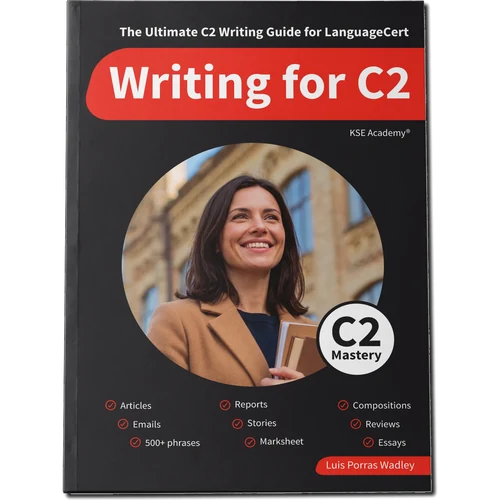
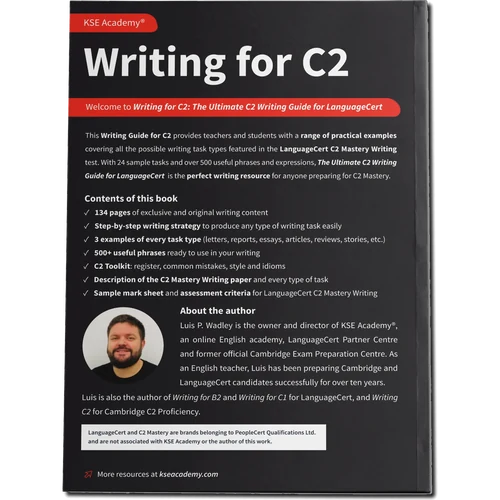
For Reading, what helps most is reading a lot and practising with past papers. But because Reading shares its time with Writing, being well prepared for Writing will save you precious minutes. For that, you have my guide to C2 Mastery Writing and the KSE Academy book for LanguageCert C2 Writing, with every task type, model answers and useful language. It’s a Writing book, not a Reading one, but it’ll help you finish the Writing faster and with more confidence.
And that’s everything you need to know about C2 Mastery Reading. If you have any questions, leave me a comment and I’ll be happy to answer. 🙂
