
Table of contents
LanguageCert C1 Expert has become one of the most popular alternatives to Cambridge C1 Advanced, and its Writing paper is undoubtedly the section candidates find most daunting. It’s not hard to see why: you have to write two fairly long texts, one formal and one informal, and prove that your English is genuinely at C1 level.
But don’t worry, because in my experience as an exam trainer, Writing is also the section where good preparation pays off soonest. In this guide I’ll explain what the C1 Expert Writing paper is like, what you have to do in Part 1 and Part 2, how it’s marked and, most importantly, I’ll show you a sample answer for every type of task, with an analysis of what makes it a C1 text. Let’s get started!
Writing C1 Expert: what C1 level means
C1 Expert certifies a C1 level according to the Common European Framework of Reference for Languages (CEFR). It’s an advanced level, and when it comes to writing, the CEFR describes it like this:
Can write clear, well-structured texts on complex subjects, underlining the relevant salient issues, expanding and supporting points of view at some length with subsidiary points, reasons and relevant examples, and rounding off with an appropriate conclusion.
LanguageCert spells out what it expects from you in Writing at this level. In short, you need to be able to:
- Write well-structured, detailed texts on complex subjects, communicating ideas, impressions, feelings and opinions.
- Write complex narratives and descriptions, varying your style appropriately.
- Develop an argument, emphasising the important points and supporting them with relevant ideas.
- Write formal letters, reports and articles for a wide range of functions, including those that require tact.
- Use a wide range of vocabulary and complex structures with few errors, and use idiomatic expressions naturally.
- Adapt your register effectively to the purpose of the text.
- Organise your text and link your ideas with a good range of linking words and cohesive devices, and punctuate accurately.
As you can see, the difference from B2 lies not so much in the types of text as in their quality: more precision, more range, more nuance and much finer control of register. Now let’s look at the exam itself.
What the C1 Expert Writing paper is like
Writing is part of the C1 Expert Written Exam, together with Listening and Reading. Listening always comes first, and after that you have 2 hours and 40 minutes for Reading and Writing, in whichever order you prefer. There’s no fixed time for Writing, so managing your time well is part of the challenge (you’ll find my tips further down).
In the Writing section you have to write two texts:
| Part 1 | Part 2 | |
|---|---|---|
| Words | 150–200 | 250–300 |
| Register | formal | informal |
| Reader | a general audience (a newspaper, a magazine, an organisation…) | a specific reader (a friend, a teacher, the readers of a website…) |
| What you do | respond to a written, graphic or visual input, expressing and justifying your position | write a more personal or creative text in which you persuade, argue, evaluate, hypothesise… |
| Text types | formal letter or email, article, report, review | personal letter or email, story, argumentative essay, descriptive composition, review |
| Marks | 12 | 12 |
There’s only one task in each part, so there’s no choice. Unlike B2, at C1 the points you have to cover don’t usually appear as bullet points: they’re built into the instructions (summarising the main findings and recommending two measures…). That’s why it’s essential to read the task very carefully.
Types of Writing in C1 Expert
Let’s see what you might be asked to write in each part. I’ve written all the tasks in this guide myself, following the exam format, so they aren’t official, but they’re exactly the same style. The figures in the inputs are invented too.
C1 Expert Writing: Part 1
In Part 1 you respond formally to some input material, which can be written, graphic or visual: an article, two opinions from a newspaper, survey results, a table, a leaflet… As well as using the information, you have to take a position: give your opinion, justify it, make recommendations or argue a point.
Report
The report is the most typical text type when the input is a chart or a table. You have to summarise the most relevant data and make recommendations, in an objective, impersonal tone:
Your local council recently carried out a survey on how residents travel to work or college. Study the results below and write a report for the council summarising the main findings and recommending two measures to reduce car use in the town.
How do residents travel to work or college?
| 2016 | 2026 | |
|---|---|---|
| Car | 58% | 52% |
| Bus | 21% | 16% |
| Bicycle | 6% | 14% |
| On foot | 15% | 18% |
Main reasons given for not cycling (2026): roads feel unsafe (61%), no secure bicycle parking (27%), distance (12%).
Write between 150 and 200 words.
Article
In an article for a magazine or a website, you use the input to develop a topic and give your opinion while keeping the reader engaged:
You read the following findings from a trial of a four-day working week. Using this information, write an article for an online business magazine discussing the possible advantages and drawbacks of the idea and saying whether you think it could work in your country.
Four-day week trial: the results
- 40 companies took part for one year.
- Productivity remained stable.
- Sick days fell by half.
- 85% of companies chose to keep the four-day week after the trial.
- Small shops and clinics found it harder to cover their usual opening hours.
Write between 150 and 200 words.
Formal letter / formal email
A very common Part 1 task is a letter to the editor of a newspaper commenting on two opposing opinions and giving your own. It can also be a formal email to a company or an organisation:
You read the following two opinions in your local newspaper about plans to close the old town centre to cars. Write a letter to the editor commenting on both views and expressing your own opinion.
«Closing the old town to traffic is long overdue. The streets are too narrow, the air is dirty and pedestrians are constantly in danger. Other cities have done it successfully.»
«This plan will be the end of local businesses. Shoppers will simply drive to the out-of-town shopping centre instead, and older residents will find it impossible to get around.»
Write between 150 and 200 words.
Review
In a review you evaluate something you’ve visited or tried (an exhibition, a hotel, a service…) for the readers of a website or a magazine. In Part 1 it’s usually based on an advert, and the register is neutral or formal:
You recently visited the exhibition advertised below. Write a review for an arts and culture website, commenting on the content of the exhibition, the way it was presented and whether you would recommend it.
Light and Shadow: A Century of Street Photography
City Art Gallery, until 30 June. Over 200 photographs from around the world, interactive displays and free audio guides. Open daily from 10 a.m. to 8 p.m.
Write between 150 and 200 words.
C1 Expert Writing: Part 2
In Part 2 you write a longer text (250–300 words) that is more personal or creative and informal in register, for a specific reader. The instructions ask you to perform C1 functions: persuading, arguing, hypothesising, expressing mood, evaluating or justifying.
Personal letter / informal email
Writing to a friend to advise them, persuade them of something or tell them about an experience and what it meant to you:
Your friend has been offered a job in another country but cannot decide whether to accept it. Write a letter to your friend, helping them weigh up the decision and persuading them to make the choice you think is right.
Write between 250 and 300 words.
Story
A narrative about something that happened to you (or that you make up), with a reflection on why it mattered:
Write a story for a creative writing website about an unexpected encounter with a stranger during a journey. Describe what happened and explain why the experience has stayed with you.
Write between 250 and 300 words.
Argumentative essay
A text in which you analyse both sides of an issue and give your opinion. Although it’s in Part 2, it’s usually written for a teacher or a class, so the register is neutral:
Your teacher has asked you to write an essay for a class debate with the title ‘Social media has done more to divide people than to bring them together’. Discuss both sides of the argument and give your own opinion.
Write between 250 and 300 words.
Descriptive composition
Describing a person, a place or an experience and explaining what it has meant to you:
Write a composition for a collection of student writing describing a person who has had a strong influence on you and explaining how they have shaped the way you see the world.
Write between 250 and 300 words.
A review can also appear in Part 2, but with a more personal, informal tone. The structure is the same as in the Part 1 example below.
C1 Expert Writing examples
In this section you’ll find a model answer for each task. They’re all original and written to simulate a C1 level, without reaching C2, so that you get a realistic idea of what’s expected. Under each one I explain what makes it work.
C1 Expert Writing example: report
An answer to the transport survey task. Notice that the data isn’t simply copied: it’s selected and interpreted.
Reducing Car Use in Our Town
Introduction
This report summarises the findings of the recent survey on residents’ travel habits and puts forward two measures aimed at reducing car use.Main findings
Although the car remains by far the most common means of transport, its share has fallen from 58% to 52% over the past decade. Cycling has seen the most significant growth, more than doubling to 14%, whereas bus use has declined noticeably and walking has risen slightly to 18%. The survey also reveals that the main obstacle to cycling is the perception that the roads are unsafe, cited by 61% of those who do not cycle, followed by a lack of secure bicycle parking.Recommendations
In light of these results, it is recommended that the council first invest in a network of protected cycle lanes linking residential areas with the town centre. Secondly, installing secure bicycle parking at key locations, such as the railway station and the college, would address the second most common concern.Conclusion
Should these measures be implemented, the upward trend in cycling is likely to continue, which would in turn ease congestion and improve air quality.
- Headings and a completely impersonal tone: there isn’t a single I think.
- Data selected and compared, not copied: has fallen from 58% to 52%, more than doubling to 14%, cited by 61% of those who do not cycle.
- Recommendations linked to the data: each measure responds to one of the reasons in the survey.
- C1 structures: an impersonal passive (it is recommended that the council invest), conditional inversion (Should these measures be implemented) and linkers such as In light of these results and in turn.
C1 Expert Writing example: article
An answer to the four-day week task. A C1 article combines information, opinion and a style that holds the reader’s interest:
Is the Four-Day Week Too Good to Be True?
Imagine working one day less every week for the same salary. It sounds like a fantasy, yet a recent year-long trial involving 40 companies suggests that it may be more realistic than many of us assume.
The headline figures are certainly striking. Not only did productivity remain stable, but sick days were cut by half, and 85% of the firms chose to keep the scheme. For employees, the benefits are obvious: more time for family, rest and personal projects, which in turn seems to make them more focused at work.
That said, the four-day week is no miracle cure. Small shops and clinics struggled to stay open for their usual hours, and it is hard to see how hospitals or schools could adopt the model without hiring more staff.
In my country, where long working days are still the norm, I suspect the idea would initially be met with scepticism. Nevertheless, if office-based companies were willing to lead the way, it could become far more widespread than we might expect.
- An engaging opening: an imperative (Imagine working…) followed by an immediate contrast (It sounds like a fantasy, yet…).
- Critical use of the data: advantages and drawbacks, not just a summary of the figures.
- C1 structures: inversion with Not only did…, That said, no miracle cure, would initially be met with scepticism.
- A nuanced opinion in the final paragraph, linked to the writer’s own country, as the task requires.
C1 Expert Writing example: formal letter
An answer to the old town task. This task calls for tact: you need to acknowledge both sides before giving your opinion.
Dear Editor,
I am writing in response to the two opinions published in last Friday’s edition regarding the proposal to close the old town centre to cars.
I wholeheartedly agree with the first writer that the current situation is unsustainable. Anyone who has tried to walk along the main street at rush hour will know how narrow the pavements are and how unpleasant the fumes can be. Moreover, experience elsewhere suggests that pedestrianised areas tend to become more attractive, not less.
Nevertheless, the concerns raised by the second writer should not be dismissed. Many shops in the old town depend on passing trade, and older residents with limited mobility could indeed find themselves isolated.
In my view, the solution lies in introducing the scheme gradually and with the right support. Frequent electric minibuses, car parks on the edge of the centre and access permits for residents and deliveries would go a long way towards addressing these concerns.
I would therefore urge the council to go ahead with the plan, provided that local people are properly consulted beforehand.
Yours faithfully,
Ana Torres
- An opening paragraph stating the reason for writing, with a specific reference to the two published opinions.
- One paragraph for each opinion, evaluated in a balanced way: I wholeheartedly agree with… / should not be dismissed.
- A proposal of the writer’s own that tries to reconcile both positions (the solution lies in…, would go a long way towards…).
- Flawless formal register: no contractions, Yours faithfully and a closing with a clear request (I would therefore urge the council…).
C1 Expert Writing example: review
An answer to the photography exhibition task. A good C1 review doesn’t just say whether you liked something: it evaluates with nuance.
Light and Shadow: A Century of Street Photography
Anyone with even a passing interest in photography will find plenty to admire in this ambitious exhibition at the City Art Gallery, although it is not without its flaws.
The collection itself is outstanding. Spanning more than a hundred years, it ranges from grainy shots of 1920s Paris to vivid scenes of present-day Lagos. What makes it so compelling is the way ordinary moments, such as a child chasing a pigeon or a couple arguing at a bus stop, are turned into something quietly extraordinary.
Where the exhibition falls short is in its presentation. The rooms are rather crowded, and the interactive displays, while well-intentioned, feel more like a distraction than a genuine addition. The free audio guide, on the other hand, is excellent, offering insightful background on each photographer without ever becoming tedious.
On balance, this is an exhibition well worth seeing, provided you go early in the day to avoid the crowds. Allow at least two hours: you will need them.
- An opening sentence that sums up the verdict with nuance: plenty to admire… although it is not without its flaws.
- Precise evaluative vocabulary: outstanding, compelling, quietly extraordinary, falls short, insightful, tedious.
- The three aspects of the task in order: content, presentation and recommendation.
- C1 structures: What makes it so compelling is…, Where the exhibition falls short is…, while well-intentioned.
C1 Expert Writing example: personal letter
An answer to the job abroad task. The main function here is persuasion, without losing the natural tone of a letter to a friend:
Dear Marta,
I’ve just read your letter, and I can only imagine how torn you must be feeling. A job offer in Copenhagen isn’t something that comes along every day, so let me tell you what I honestly think.
Let’s start with the obvious: this is exactly the kind of role you’ve been dreaming about since university. You’d be working for a company that’s leading the way in renewable energy, and from what you’ve told me, the salary would be considerably higher than what you’re earning now. If you turned it down, I suspect you’d spend years wondering «what if?».
I know what’s holding you back, though. Leaving your family and friends behind is a huge step, and I completely understand your worries about the language and the long, dark winters. But think about it: you wouldn’t be moving to the other side of the world. Flights home are cheap and fairly short, and with video calls you’d hardly have time to miss us! As for the language, most Danes speak excellent English, and you’ve always picked things up incredibly quickly.
Had I been offered an opportunity like this, I’d have jumped at the chance. Besides, nothing is set in stone. If, after a year or two, you decided it wasn’t for you, you could always come back with valuable experience and a few great stories to tell.
So my advice is simple: say yes. You’ll regret the chances you didn’t take far more than the ones you did. And of course, I’m already planning my first visit!
Write back soon and let me know what you decide.
Lots of love,
Elena
- Informal but rich register: contractions and expressions such as torn, comes along, what’s holding you back, set in stone, jumped at the chance.
- A persuasive structure: the advantages, anticipated objections and answers to them, and clear final advice (So my advice is simple: say yes).
- Hypothesising with a range of conditionals, including an inversion: Had I been offered an opportunity like this…
- A warm ending that returns to the personal tone of the opening.
C1 Expert Writing example: story
An answer to the unexpected encounter task. In a C1 story, how you tell it matters as much as what happens:
The Man with the Paper Birds
It was close to midnight when my train ground to a halt in the middle of nowhere. An announcement crackled through the speakers: a fallen tree was blocking the line, and we would be stuck for at least three hours. Around me, passengers groaned and began complaining to anyone who would listen.
Everyone, that is, except the elderly man sitting opposite me. Without a word, he took a sheet of paper from his coat pocket and began folding it with remarkable precision. Within minutes, he had made a tiny, perfect bird, which he placed silently on the table between us.
Curiosity got the better of me, and I asked him where he had learnt to do it. He told me that his late wife had taught him when they were young, and that he had made one on every journey since she passed away. «Delays are a gift,» he said with a smile. «They’re the only time nobody expects anything from you.»
For the next three hours, he taught me how to fold birds, boats and even a slightly lopsided frog. By the time the train finally started moving again, our table was covered in paper animals, and I had almost forgotten I had somewhere to be.
When we reached the city, he wished me luck and disappeared into the crowd. I never even asked his name. Yet whenever I find myself stuck in traffic or waiting in an endless queue, I think of him and reach for a scrap of paper. What could have been a thoroughly frustrating night turned into a lesson in patience I have never forgotten.
- Narrative and descriptive vocabulary: ground to a halt, crackled through the speakers, with remarkable precision, lopsided.
- A mix of narrative tenses, including the past perfect (he had made one on every journey), and direct speech to bring the character to life.
- Stylistic devices: Everyone, that is, except…, Curiosity got the better of me.
- A final reflection that answers the second part of the task: why the experience has stayed with the writer.
C1 Expert Writing example: argumentative essay
An answer to the social media task. The key is to present both sides with solid arguments before reaching your own conclusion:
Connected but Divided?
When social media first appeared, it promised to bring the world closer together. Two decades later, many people believe it has had precisely the opposite effect. So which view is closer to the truth?
There is no denying that social media can drive people apart. Algorithms are designed to keep us scrolling, and they do so by showing us content that confirms what we already believe. As a result, users can end up trapped in «echo chambers», where opposing views are either invisible or presented as ridiculous. Add to this the anonymity that encourages aggressive comments, and it is hardly surprising that online debates so often descend into insults.
On the other hand, it would be unfair to ignore the ways in which these platforms have connected people. Families separated by thousands of kilometres can share their daily lives, and people with rare illnesses or unusual interests can find communities that simply would not exist offline. What is more, social media has given a voice to groups traditionally ignored by the mainstream press.
In my view, the problem lies not so much in social media itself as in the way it is designed and used. A tool that rewards outrage will inevitably amplify division, but the same tool can foster genuine connection when people use it with a little more critical thinking. Rather than simply blaming the platforms, then, we should demand greater transparency from the companies behind them and teach young people how to navigate them wisely.
Ultimately, social media is a mirror: it reflects, and sometimes magnifies, who we already are.
- An introduction that sets up the debate and ends with a question the essay goes on to answer.
- One paragraph for each side, with developed arguments and examples (echo chambers, communities for people with rare illnesses).
- C1 linkers and structures: There is no denying that, Add to this…, it is hardly surprising, What is more, not so much… as…
- A nuanced opinion and a memorable final sentence with a metaphor (social media is a mirror).
C1 Expert Writing example: descriptive composition
An answer to the influential person task. The key is to combine description with reflection on how that person changed you:
The Woman Who Taught Me to Look Closer
My grandmother Rosa was not the kind of person who stood out in a crowd. She was small and softly spoken, with silver hair always tied back in a neat bun and hands roughened by decades of gardening. Yet, looking back, nobody has influenced me more.
What struck me most about her was her extraordinary ability to pay attention. While the rest of us rushed from one task to the next, she would stop in the middle of a walk to examine the pattern on a leaf or listen to a blackbird singing on a rooftop. As a restless ten-year-old, I found this incredibly frustrating. Only years later did I realise that she was teaching me something far more valuable than patience.
She also had a remarkable gift for listening. Whenever I came to her with a problem, she would let me talk for as long as I needed before asking a single question that somehow made everything clearer. She never told me what to do; she simply helped me work it out for myself.
It is largely thanks to her that I have learnt to slow down and notice the small details that most people overlook, whether it is the changing light on a winter afternoon or the hesitation in a friend’s voice. In a world that constantly pushes us to move faster, she showed me that the most meaningful things are often found when we pause.
She passed away three years ago, but every time I stop to watch the sky change colour at sunset, I feel as if she is standing right beside me.
- Physical and character description with concrete details: softly spoken, a neat bun, hands roughened by decades of gardening.
- Anecdotes that illustrate personality instead of a list of adjectives.
- C1 structures: What struck me most about her was…, Only years later did I realise…, whether it is… or…
- The second point of the task (how she shaped the writer’s view of the world) developed in the penultimate paragraph, and a moving ending.
How the C1 Expert Writing paper is marked
Each task is marked separately against four criteria, and you can get 0 to 3 marks for each one. So each task is worth 12 marks, and the whole Writing section 24.
| Criterion | What it looks at |
|---|---|
| Task Fulfilment | Whether you fully satisfy the task: the reader is well informed, the genre and tone are appropriate and you respect the word count. |
| Accuracy and Range of Grammar | Whether you use a wide range of simple and complex structures with control and flexibility. |
| Accuracy and Range of Vocabulary | Whether you use varied, precise vocabulary, including less common words and expressions. |
| Organisation | Whether the text is well organised and coherent, with a variety of cohesive devices and a structure that suits the type of text. |
To get top marks on each criterion, any errors should be no more than slips, and advanced vocabulary and complex structures should appear naturally, not forced.
Your Writing marks are then converted to a scale out of 50 and added to your Listening and Reading scores. To pass the Written Exam you need 75 out of 150 overall (Pass), and from 101 you get a High Pass. I explain it with an example in my complete guide to C1 Expert.
Will I lose marks if I write too much or too little?
According to LanguageCert’s criteria:
- If you don’t reach the minimum, this is taken into account when marking Task Fulfilment, so it can cost you marks.
- If you go over the maximum, there’s no direct penalty, but writing too much usually means more mistakes and a weaker text.
- If your text is off topic, it gets no marks at all.
My advice: aim for around 180–195 words in Part 1 and 270–295 in Part 2. Both British and American spelling are accepted, as long as you’re consistent.
Tips for the C1 Expert Writing paper
These are the tips I give my C1 Expert students:
- Leave plenty of time for Writing. Between the two tasks you have to write up to 500 words, and that takes time. As Reading and Writing share 2 hours and 40 minutes, I recommend spending at least an hour and a quarter on Writing. Don’t get stuck on a difficult Reading question: you can always come back to it at the end.
- Read the task very carefully. At C1 the content points are built into the instructions. Underline every verb (summarise, recommend, comment on, explain…) and make sure each one has its place in your text.
- Don’t copy the input. In Part 1, especially in reports, use the information, but in your own words: select, compare and interpret.
- Pay attention to register. Part 1 is formal and Part 2 informal, but at C1 you’re expected to show fine control: a report doesn’t sound like an article, and a letter to a friend doesn’t sound like an essay for your teacher.
- Show your level naturally. Inversions, cleft sentences, impersonal passives, idiomatic expressions… Use them, but only where they fit. A text full of forced structures reads worse than a simple, well-written one.
- Plan and check. Make a quick outline before you start and save a few minutes at the end to check your grammar, spelling and punctuation.
If you’re still deciding which exam to take, have a look at my guide to Cambridge C1 Advanced Writing to compare the two formats. And if you’re preparing for the level below, here’s my guide to B2 Communicator Writing.
C1 Expert Writing guide with examples
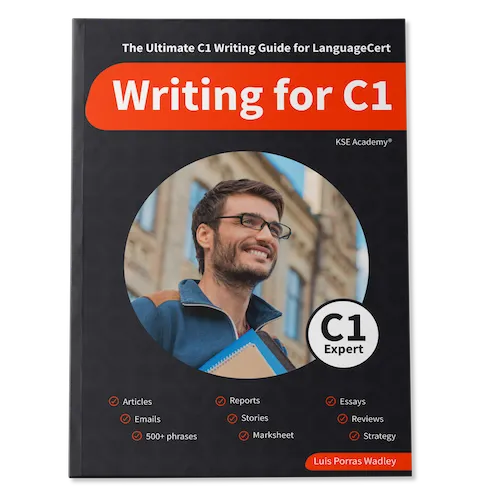
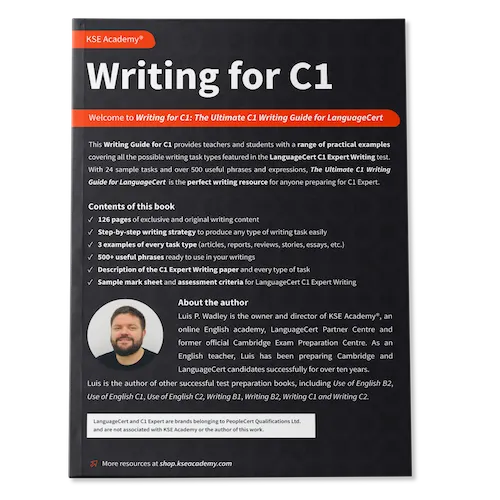
If you’d like to practise with many more examples, have a look at the KSE Academy guide to LanguageCert C1 Writing. In it you’ll find:
- Every Part 1 and Part 2 task type, explained in detail.
- 3 sample tasks with model answers for each type of text.
- Over 500 useful expressions for your writing.
- A step-by-step writing strategy for any type of task.
- The marking criteria and a sample assessment sheet.
And that’s everything you need to know about the C1 Expert Writing paper. If you still have any questions, leave me a comment and I’ll be happy to help. 🙂
