
Table of contents
LanguageCert A1 Preliminary Listening is the first part of the written exam and, for many students, the one that causes the most nerves. The good news: the recordings are slow and clear, with pauses, and you hear everything twice. What matters is knowing what you’ll hear in each part and what you have to do.
In my experience as an exam trainer, the way to pass A1 Listening is to practise with real recordings. So in this guide I explain how A1 Preliminary Listening works, what you have to do in each of its four parts and how it’s marked. And so you can practise with the real thing, I’ve included all four parts of the official LanguageCert Practice Paper 1, with the audio, the questions and the answers explained. Let’s go!
A1 Preliminary Listening: what A1 level means
A1 Preliminary certifies A1 level on the Common European Framework of Reference for Languages (CEFR). In listening, it means you understand very basic words and phrases about yourself, your family and your surroundings, as long as people speak slowly and clearly.
In exam terms, in A1 Preliminary Listening you need to be able to:
- Recognise key information in short sentences: numbers, times, places, spellings.
- Understand what a sentence is for (a question, an apology, an offer) and know how to reply.
- Pick up the topic, the place and the relationship between the people in a short conversation.
- Get specific details from a conversation to complete a simple form.
How A1 Preliminary Listening works
Listening is part of the Written Exam, together with Reading and Writing. These are its main features:
- It’s the first part of the written exam and lasts about 20 minutes.
- It has four parts and 26 questions, and each correct answer is worth 1 mark.
- You hear each recording twice, with pauses to read the questions and check your answers.
- You then transfer your answers to the Answer Sheet.
- You can take it at a centre or online from home, with the same format.
| Part | What you hear | Task | Questions |
|---|---|---|---|
| Part 1 | 7 short sentences | Choose the picture, word or number that matches each one (a, b or c) | 7 |
| Part 2 | 7 short sentences | Choose the best reply to each one (a, b or c) | 7 |
| Part 3 | 6 short conversations | One multiple-choice question per conversation (a, b or c) | 6 |
| Part 4 | A conversation between two people | Mark the correct information on a form with 6 headings | 6 |
The four parts of A1 Preliminary Listening
Part 1
You hear seven short sentences and, for each one, choose from three options, which are usually pictures, numbers, letters or symbols. For example, you hear a house number or a time and choose the right picture. Before each recording, look carefully at the three options and think about how they’re different.
Part 2
You hear seven sentences (a question, a comment, an apology…) and choose the most natural reply from three. The key is understanding the intention: if someone asks Can you…?, the logical reply is Yes, I can or No, I can’t.
Part 3
You hear six short conversations and answer one question about each: what they’re talking about, where they are, who the people are or what one of them wants.
Part 4
You hear one conversation between two people (for example, someone booking a holiday) and complete a form with six headings, marking the correct option for each. Watch out for corrections: sometimes someone says one thing and then changes it.
A1 Preliminary Listening examples
For Listening, the best practice is with official recordings, so instead of writing my own examples I’ve included all four parts of the official LanguageCert Practice Paper 1 for A1 Preliminary: the audio and the questions are LanguageCert’s, and the explanations of the answers are mine. You can download the full paper, with the other sample papers, from the official A1 Preliminary page or from my A1 Preliminary guide.
Do each part as in the exam: look at the questions, listen to the whole recording (in the exam you hear everything twice) and then check your answers.
A1 Preliminary Listening example: Part 1
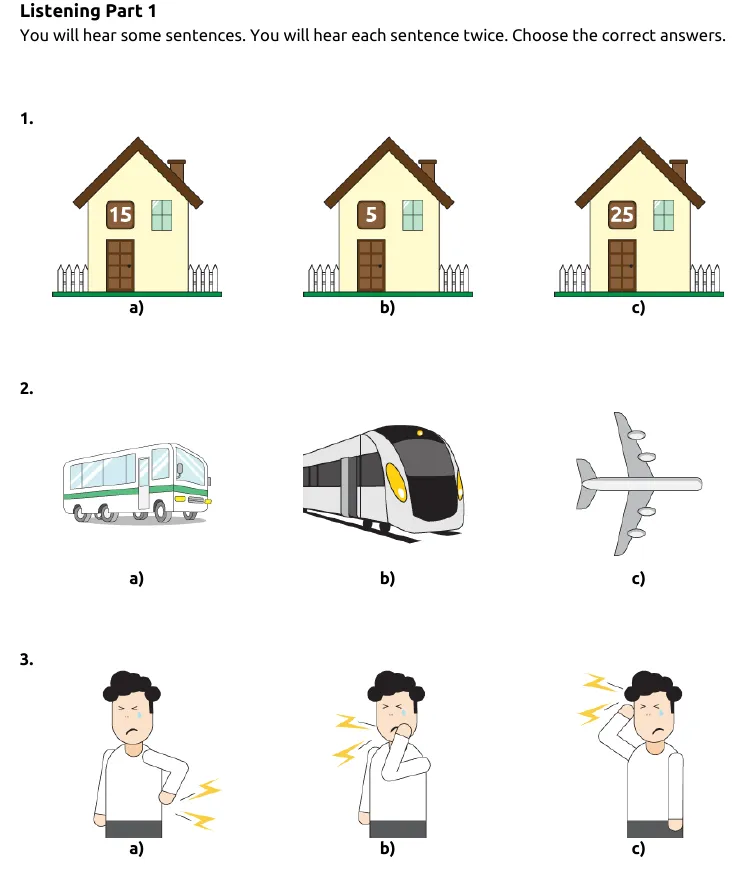
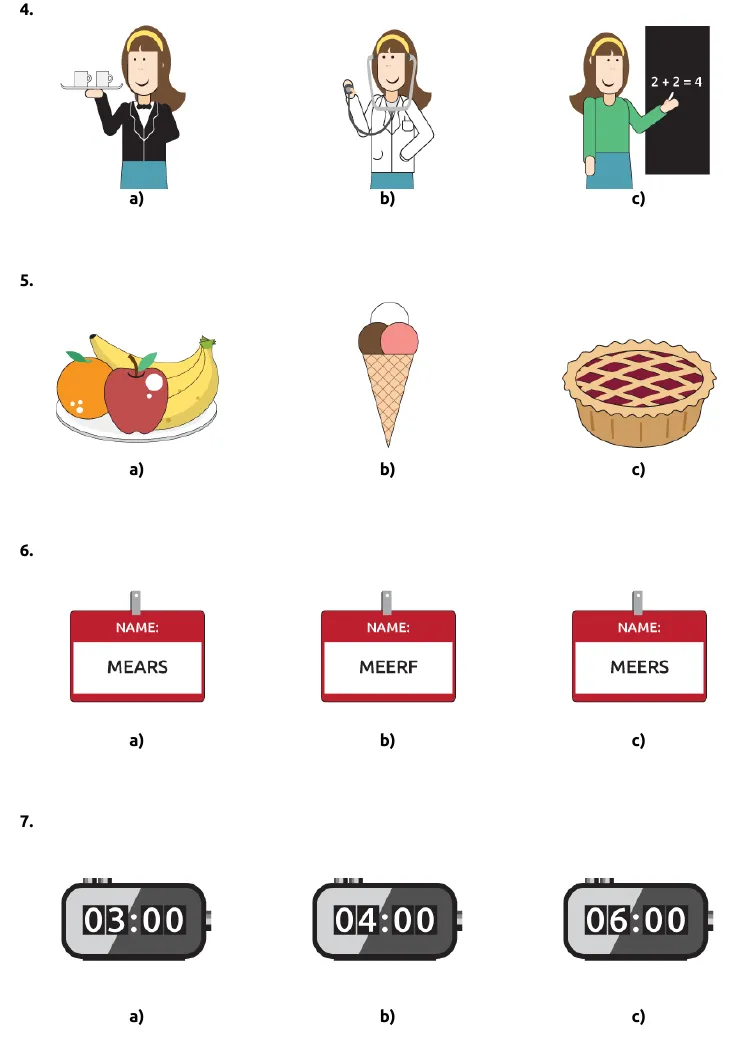
Seven short sentences. Choose the right picture for each one:
You will hear some sentences. You will hear each sentence twice. Choose the correct answers.
Show answers
- c: ‘He lives at number twenty-five’: the house with 25.
- b: ‘We’re going by train.’
- a: ‘My back hurts.’
- a: ‘I work in a restaurant’: the waitress.
- b: ‘We’re having ice-cream.’
- c: It’s spelt out: M-E-E-R-S.
- b: ‘Come at 4 o’clock’: 04:00.
A1 Preliminary Listening example: Part 2
Seven sentences. Choose the best reply to each one:
You will hear some sentences. You will hear each sentence twice. Choose the best reply to each sentence.
- a) No, I can’t.
- b) Well, it is.
- c) Yes, I have.
- a) I want one too.
- b) I love you too.
- c) I like it too.
- a) In my kitchen.
- b) Two more, please.
- c) A double room.
- a) It isn’t here.
- b) Thank you.
- c) There it is.
- a) It’s an apple.
- b) It’s a word.
- c) It’s not here.
- a) Yes, that’s right.
- b) I know the way.
- c) It’s Cambridge.
- a) That’s OK.
- b) Yes, I can.
- c) That’s nice.
Show answers
- a: ‘Can you play the piano?’: you answer Yes, I can or No, I can’t.
- c: ‘I love sunny weather’: the natural reply is I like it too.
- c: ‘What kind of room do you want?’: a kind of room, a double room.
- b: Someone gives you a birthday present: you say thank you.
- a: They can’t remember what something is called: you tell them, It’s an apple.
- c: They ask whether it’s Cambridge or Pembridge Road: the reply picks one, It’s Cambridge.
- a: They apologise for not coming: That’s OK.
A1 Preliminary Listening example: Part 3
Six short conversations with one question each:
You will hear some short conversations. You will hear each conversation twice. Choose the correct answer for each conversation.
- Conversation 1. The man is asking about the
- a) bus stop.
- b) bus number.
- c) bus station.
- Conversation 2. The woman wants to know what the man likes to
- a) eat.
- b) see.
- c) drink.
- Conversation 3. Mark wants Jane to
- a) write something.
- b) phone someone.
- c) go somewhere.
- Conversation 4. The woman is
- a) learning something.
- b) asking something.
- c) thanking someone.
- Conversation 5. The woman is a
- a) student.
- b) teacher.
- c) doctor.
- Conversation 6. The speakers are talking about
- a) money.
- b) hobbies.
- c) films.
Show answers
- b: He asks which bus goes to the town centre and ends by repeating ‘number twenty-nine’.
- a: ‘What’s your favourite food?’: she asks what he likes to eat.
- c: Mark wants Jane to come to his party.
- b: Penny asks her boss for some holiday.
- b: He thanks her for her lessons: she’s the teacher.
- b: They talk about what they do at the weekend: shopping, swimming, reading, the cinema.
A1 Preliminary Listening example: Part 4
A woman books a holiday at a travel agent’s. Choose the correct option for each heading on the form:
You will hear a conversation. You will hear the conversation twice. Choose the correct answers.
World Travel: Holiday Booking Form
| 1. Number of people: | 2 | 3 | 4 |
| 2. Month of travel: | October | November | December |
| 3. How long: | 2 weeks | 3 weeks | 4 weeks |
| 4. Travelling by: | Ship | Plane | Bus |
| 5. Kind of holiday: | Sightseeing | Camping | Sports |
| 6. Special activities: | Walking | Boat trip | Swimming |
Show answers
- 2: She’s going with her sister: ‘two travellers’.
- December: He says November, but she corrects him: ‘next month’.
- 2 weeks: ‘Two weeks.’
- Plane: ‘We’re flying.’
- Sightseeing: She hesitates, but says ‘sightseeing’.
- Boat trip: No skiing: they’re going on a cruise up the Nile.
Notice the typical traps in this part: the assistant says one month and she corrects him, and things are mentioned (a bicycle, skiing) that aren’t the answer.
How A1 Preliminary Listening is marked
Listening has 26 questions and each correct answer is worth 1 mark, so the maximum is 26 marks. There are no penalties for wrong answers, so always answer.
That mark is then converted to a score out of 50, like Reading and Writing. The three add up to a score out of 150 for the whole Written Exam, and you need 75 out of 150 to pass. From 101 out of 150 you get a High Pass. There’s no pass mark for each skill: a weak Listening can be made up for with good Reading or Writing.
Tips for A1 Preliminary Listening
These are the tips I give my students for A1 Preliminary Listening:
- Look at the options before you listen. In Part 1, think about what’s different in the three pictures: a number, a place, a time.
- Revise numbers, times, days, months and the alphabet. They come up in almost every paper.
- In Part 2, think about what you would say. The right answer is the most natural one in that situation.
- Listen out for corrections. In Part 4, someone sometimes says one thing and then changes it.
- Use the second listening to check. The first time, mark what you’re sure of; the second time, focus on what’s missing.
- Listen to simple English often. Videos for beginners, songs or easy audiobooks will get you used to the sound of the language.
For the full exam, here’s my guide to LanguageCert A1 Preliminary, with all the official sample papers to download.
Next step
If you’re preparing for A1 Preliminary, you may also find my guides to A1 Preliminary Writing and A1 Preliminary Speaking useful, with examples of every part. And when you’re ready for the next level, there’s my guide to A2 Access Listening.
And that’s everything you need to know about A1 Preliminary Listening. If you have any questions, leave me a comment and I’ll be happy to answer. 🙂
