
Table of contents
LanguageCert B2 Communicator Listening is the first part of the written exam, which has an upside and a downside. The upside: you start fresh and you hear everything twice. The downside: you can’t pause or go back, and if you don’t know the format well, first-minute nerves can cost you marks.
In my experience as an exam trainer, Listening is where practising with real recordings shows the most. So in this guide I explain what B2 Communicator Listening is like, what you have to do in each of its four parts and how it’s marked. And so you can practise with the real thing, I’ve included all four parts of the official LanguageCert Practice Paper 1, with the audio, the questions and every answer explained. Let’s get started!
B2 Communicator Listening: what B2 level means
B2 Communicator certifies B2 on the Common European Framework of Reference for Languages (CEFR), an upper-intermediate level. In listening, that means you understand fairly long conversations and talks on familiar and less familiar topics, you can follow a reasonably complex argument and you pick up the speakers’ attitudes and points of view, as long as they speak standard English.
In exam terms, in B2 Communicator Listening you need to be able to:
- Understand the context and purpose of a short conversation well enough to know how it would continue.
- Pick up the topic, purpose, relationship between the speakers and their attitudes.
- Extract specific information from a talk or a radio programme.
- Follow a longer conversation between two people, with opinions, examples, causes and effects.
What B2 Communicator Listening is like
Listening is part of the Written Exam, together with Reading and Writing. These are its main features:
- It’s the first part of the written exam and lasts about 30 minutes.
- It has four parts and 26 questions, and each correct answer is worth 1 mark.
- You hear each recording twice, with pauses to read the questions and check your answers.
- You then transfer your answers to the Answer Sheet.
- You can take it at a centre or online from home, in the same format.
| Part | What you hear | Task | Questions |
|---|---|---|---|
| Part 1 | 7 short unfinished conversations, one of them formal | Choose the best continuation (a, b or c) | 7 |
| Part 2 | 3 conversations between two people | 2 multiple-choice questions per conversation | 6 |
| Part 3 | A monologue: a radio programme, a presentation, a narrative… | Complete notes with 7 headings, in 1 to 5 words | 7 |
| Part 4 | A longer conversation between two people | Multiple choice (a, b or c) | 6 |
The four parts of B2 Communicator Listening
Part 1
You hear seven very short conversations between two people that are left unfinished, and you choose the sentence that best continues each one. One of them is formal. There are no questions to read, just the three options for each number. The key is to understand what the last speaker wants (are they asking for something, complaining, insisting?) and choose the most natural reaction.
Part 2
You hear three conversations between two people and answer two multiple-choice questions about each one. The questions can be about the topic, the purpose, where the speakers are, their relationship or how they feel. Often the answer isn’t said in those words but has to be worked out from the tone.
Part 3
You hear one person talking (a talk, a radio programme, a presentation…) and complete a set of notes with seven headings, writing answers of one to five words. The headings follow the order of the recording. It’s the most fact-based part, but be careful: the speaker usually mentions several similar things, and only one answers the heading exactly.
Part 4
You hear a longer conversation between two people and answer six multiple-choice questions. This part is about following the discussion: who thinks what, which examples they give, what causes what. The wrong options often mention things that are actually said but don’t answer the question.
B2 Communicator Listening examples
For Listening, the best practice is official recordings, so instead of writing my own examples I’ve included all four parts of the official LanguageCert Practice Paper 1 for B2 Communicator: the audio and the questions are LanguageCert’s, and the explanations of the answers are mine. You can download the full paper, along with the other sample papers, from the official B2 Communicator page or from my B2 Communicator guide.
Do each part as you would in the exam: read the questions, listen to the whole recording (in the exam you hear everything twice) and then check your answers.
B2 Communicator Listening example: Part 1
Seven unfinished conversations. Choose the sentence that best continues each one:
You will hear some short conversations. You will hear each conversation twice. Choose the correct answer to complete each conversation.
- a) I didn’t enjoy it so much last year.
- b) I’ve never thought of that before.
- c) I didn’t know what you meant.
- a) I really don’t have the time.
- b) I’ve got nothing better to do.
- c) When will you write it?
- a) It’s absolutely brilliant, isn’t it?
- b) We’ve already talked about that.
- c) I’m afraid I’ve lost it somewhere.
- a) No, I didn’t want to go.
- b) Sorry, I didn’t realise.
- c) Yes, it’s still a bit loud.
- a) I do meet her every year.
- b) I’d totally forgotten that.
- c) It must be the same girl.
- a) Come back later. I’ll think about it.
- b) You’ll need a pen; I’ll get one.
- c) No, really. It’s not necessary.
- a) Well, I wish I could stay here too.
- b) Oh, there’s nothing to worry about.
- c) Yes, I would be too if it was me.
Show answers
- a: He suggests going where she goes every year; the logical reply is a reason not to: ‘I didn’t enjoy it so much last year’.
- a: She insists ‘it’ll only take a few minutes’, and he, having already said he’s busy, sticks to his answer.
- c: She asks about the book she lent him, and he has been avoiding the subject: the problem is that he’s lost it.
- b: ‘But you’re not allowed in here’: the natural response is to apologise for not knowing.
- b: ‘But you do. You met her last year’: he had forgotten.
- c: He asks whether he needs to sign the contract, and she has already told him he doesn’t.
- b: She’s worried about his trip, and he reassures her.
B2 Communicator Listening example: Part 2
Three conversations with two questions each:
You will hear some conversations. You will hear each conversation twice. Choose the correct answers for each conversation.
Conversation 1
- The woman thinks Noel’s ex-girlfriend
- a) spent too little time with him.
- b) always agreed with him.
- c) made all the couple’s plans.
- How do the speakers feel about Noel’s new relationship? They’re
- a) hopeful.
- b) worried.
- c) excited.
Conversation 2
- The speakers are discussing the
- a) shopping facilities in their local area.
- b) supermarket’s car parking problems.
- c) growing number of High Street shops.
- What’s the man’s reaction when the woman says she has problems parking?
- a) He’s not interested in her view.
- b) He thinks she has a good point.
- c) He’s surprised by her comment.
Conversation 3
- The woman is calling because
- a) there’s a problem with her map.
- b) she’s run out of other options.
- c) she needs help in an emergency.
- At the end of the conversation, the woman is
- a) relieved.
- b) grateful.
- c) embarrassed.
Show answers
- c: ‘They always did what she wanted, never what he wanted’: she decided everything.
- a: ‘I’m sure they’ll be fine. But it’s early days yet’: they’re hopeful, though it’s early.
- a: They talk about the new supermarket and the small High Street shops: the shopping options in their area.
- b: ‘I agree with you about the parking’: he thinks she’s right.
- b: She has asked several people and ‘couldn’t think what else to do’: she had no other option. It isn’t an emergency, as the police officer points out.
- c: She apologises again and again (‘I’m sorry… Sorry’): she’s embarrassed about calling the emergency number.
B2 Communicator Listening example: Part 3
Someone explains the rules of a college library. Complete the notes with answers of one to five words:
You will hear someone talking. You will hear the person twice. Complete the information. Write short answers of one to five words.
College Library Rules and Regulations
- Place to show identity cards: _______________
- When to check out Reserves: _______________
- Where to read reference books: _______________
- Punishment for damaging books: _______________
- Where to put unwanted paper: _______________
- Maximum time for computer use: _______________
- Who are computers sometimes reserved for: _______________
Show answers
- control desk / at the entrance
- after 4 pm
- (in the) library (only)
- dismissed / dismissal (from college)
- (in the) recycling bin(s)
- 30 minutes / half an hour
- teachers / High School Faculty
These are the answers from the official key, with the accepted variants. Notice you don’t have to write exactly what you hear: ‘at the entrance’ is also accepted for item 1. In this part, the official key accepts minor spelling mistakes as long as the word is recognisable (it says so for dismissed and recycling bin).
B2 Communicator Listening example: Part 4
A conversation between Fran and Jim about how office work has changed:
You will hear a conversation. You will hear the conversation twice. Choose the correct answers.
- Fran knows about ‘typing pools’ because
- a) she used to work in one.
- b) her mother was a typist.
- c) they were popular with typists.
- When he watched the programme, Jim was impressed by people’s
- a) long working hours in the office.
- b) workload in their homes.
- c) separation of work and home.
- Jim is always in contact with his company because
- a) the company insists he is.
- b) he wants to be like everyone else.
- c) he enjoys knowing what’s happening.
- Fran believes that bringing one’s work home
- a) makes people’s work more interesting.
- b) means working less time in the office.
- c) has an impact on people’s home life.
- Jim says that, as a result of technology,
- a) office work can be done more quickly.
- b) some work is now done less efficiently.
- c) there are fewer jobs for office workers.
- Fran and Jim both give examples of people who
- a) now sell antique objects through the Internet.
- b) have found the Internet useful for business.
- c) should get good websites for their businesses.
Show answers
- b: ‘I remember my mother worked in one’: she knows through her mother, not because she worked there herself.
- c: What strikes Jim is that people finished work and ‘left their work at the office’.
- a: ‘I’m afraid I have no choice. It’s company policy’: his company requires it.
- c: ‘It must have an effect on family life’: it affects life at home.
- a: Jim gives two examples: information is now found instantly, and tasks like pay records are done automatically.
- b: Both mention someone whose business works thanks to the Internet: Jim’s antiques seller and Fran’s friend who sells jewellery.
How B2 Communicator Listening is marked
Listening has 26 questions and each correct answer is worth 1 mark, so the maximum is 26 marks. There’s no penalty for wrong answers, so always answer, even if you have to guess.
That mark is then converted to a score out of 50, just like Reading and Writing. The three add up to a score out of 150 for the whole Written Exam, and you need 75/150 to pass (Pass). From 101/150 you get a High Pass. In other words, there’s no pass mark per skill: a weaker Listening can be made up for with a good Reading or Writing.
Tips for B2 Communicator Listening
These are the tips I give my students for B2 Communicator Listening:
- Use the pauses to read. Before each recording, read the questions and underline the key words.
- In Part 1, think about intention. Ask yourself what the last speaker wants and how a polite person would reply.
- In Part 2, listen to the tone. Questions about feelings and attitudes are answered more by tone than by words.
- In Part 3, write only what you need. One to five words. If you’re not sure how to spell something, write it as it sounds: if it’s recognisable, it usually counts.
- Use the second listening to check. The first time, mark what you’re sure of; the second time, focus on what’s missing.
- Don’t get stuck. If you miss an answer, move on: the recording won’t wait.
- Practise with a variety of audio. Podcasts, news and interviews in British English will get you used to the speed and the accents.
For the full exam, here’s my guide to LanguageCert B2 Communicator, with all the official sample papers to download.
And for B2 Communicator Writing…
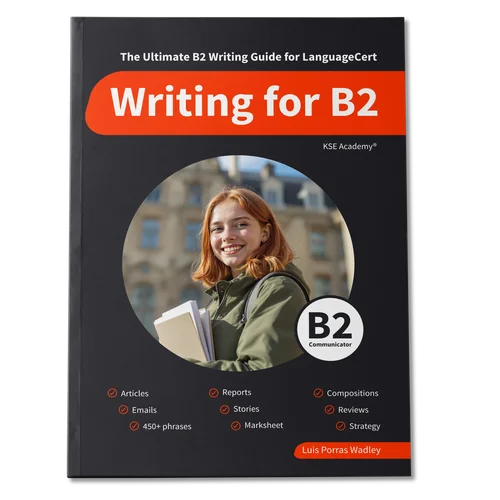
For Listening there are no shortcuts: you need to listen a lot. But if you’re also preparing the written part of the exam, you have my guide to B2 Communicator Writing and the KSE Academy book for LanguageCert B2 Writing, with every task type, model answers and useful language. It’s a Writing book, not a Listening one, but since you pass the written exam as a whole, a strong Writing gives you a margin elsewhere.
And that’s everything you need to know about B2 Communicator Listening. If you have any questions, leave me a comment and I’ll be happy to answer. 🙂
