


Table of contents
LanguageCert B2 Communicator Reading has a reputation for being the «calm» part of the exam: there’s no recording to miss and nobody waiting for your answer. But calm doesn’t mean easy. There are four texts with four very different tasks, and Reading shares its time with Writing, so managing the clock matters as much as your level of English.
In my experience as an exam trainer, most of the marks lost in Reading aren’t lost because candidates don’t understand the text, but because they don’t know exactly what each task is asking for. So in this guide I explain what B2 Communicator Reading is like, what you have to do in each of its four parts, how it’s marked and, most importantly, I give you an example of every part, written by me, with every answer explained. Let’s get started!
B2 Communicator Reading: what B2 level means
B2 Communicator certifies B2 on the Common European Framework of Reference for Languages (CEFR), an upper-intermediate level. In reading, that means you can read articles, reports and opinion pieces on current topics fairly independently, understand the writer’s point of view and adapt the way you read to the type of text and to what you’re looking for.
In exam terms, in B2 Communicator Reading you need to be able to:
- Understand a long text in detail, including its ideas and opinions, not just the facts.
- See how a text is built: which sentence introduces an idea, which develops it and which moves on to the next one.
- Find specific information across several short texts and tell their purposes apart.
- Answer questions with short, precise answers.
What B2 Communicator Reading is like
Reading is part of the Written Exam, together with Listening and Writing. These are its main features:
- It comes after Listening, and you have 2 hours 10 minutes for Reading and Writing together, in whichever order you like.
- It has four parts and 26 questions, and each correct answer is worth 1 mark.
- You transfer your answers to an Answer Sheet within that time.
- You can take it on paper at a centre or online from home, in the same format.
| Part | Text | Task | Questions |
|---|---|---|---|
| Part 1 | One long text: news story, article, review or proposal | Multiple choice (a, b or c) | 6 |
| Part 2 | A text with 6 sentences removed | Choose the sentence for each gap from 7 (one is extra) | 6 |
| Part 3 | Four short texts on the same theme, with different purposes | Decide which text (A to D) contains each piece of information | 7 |
| Part 4 | One continuous text: narrative, descriptive, explanatory, biographical… | Answer open questions in five words or fewer | 7 |
The four parts of B2 Communicator Reading
Part 1
You read one long text (a news story, an article, a review or a proposal) and answer 6 multiple-choice questions. The questions follow the order of the text and go beyond facts: they ask about opinions, the reason for something or what the writer means by a sentence. The wrong options often use words from the text, but in a different context.
Part 2
You get a text with 6 sentences removed and a list of 7 sentences to fill the gaps. One is extra. Understanding the sentence isn’t enough: you have to see how it fits with what comes before and after. Pay close attention to pronouns (it, this, they), linkers (however, for example, instead) and ideas that are repeated.
Part 3
You read four short texts (an advert, an email, an article, a leaflet…) on the same theme but with different purposes, and answer 7 questions like «Which text mentions…?». You can use each text more than once. It’s a task about finding information quickly, with a catch: the questions are paraphrased and several texts talk about similar things.
Part 4
You read one continuous text (a story, a biography, an explanatory text…) and answer 7 open questions (what, why, where…) in five words or fewer. You don’t need full sentences, but your answer must respond exactly to the question.
B2 Communicator Reading examples
I’ve written these examples following the exam format, with B2-level texts and questions. Try them without looking at the answers, then read the explanation for each one: that’s where you learn how the exam thinks.
B2 Communicator Reading example: Part 1
An article about repair cafés, with six multiple-choice questions:
Read the text and the questions. Choose the correct answer for each question.
Fixing things, together
When Martha Ellison’s toaster stopped working last winter, her first instinct was to throw it away and order a new one. Instead, a neighbour persuaded her to take it to the repair café in the church hall at the end of her street. ‘I expected a couple of retired engineers and a kettle,’ she admits. ‘What I found was a room full of people of all ages, laughing, arguing about screwdrivers and drinking far too much tea.’ Her toaster was working again within twenty minutes, and the volunteer who fixed it refused to accept any money.
Repair cafés are not a new idea. The first one opened in Amsterdam in 2009, and there are now thousands around the world. The principle is simple: volunteers with practical skills give up a few hours a month to mend whatever visitors bring in, from lamps and bicycles to jumpers with holes in them. Visitors are expected to stay and watch, and ideally to help, so that next time they might be able to do the job themselves.
Supporters argue that the cafés tackle two problems at once. The first is waste. Many of the objects people throw away have only a minor fault, such as a broken switch or a loose wire, but manufacturers often make them difficult to open, and replacement parts can be hard to find. The second problem is less obvious. Organisers say that for many visitors, particularly people who live alone, the social side matters as much as the repair. ‘Some of our regulars bring the same radio every month,’ jokes one organiser. ‘I’m fairly sure there’s nothing wrong with it.’
Not everyone is convinced, however. Some critics point out that a few hundred repaired kettles will hardly change the habits of an entire consumer society, and that real change will only come when governments force companies to design products that last. Several countries have recently introduced ‘right to repair’ laws with exactly this aim, requiring manufacturers to make spare parts and repair manuals available for a number of years.
The volunteers themselves tend to see no contradiction. As one retired electrician puts it, ‘Laws take years. Fixing a lamp takes ten minutes, and in the meantime somebody has learnt how to do it.’ For Martha, the experience has changed more than her breakfast routine. She now volunteers at the café once a month, mainly making tea, but she has also learnt to replace a plug. ‘It’s a small thing,’ she says, ‘but I no longer feel helpless when something breaks.’
- What surprised Martha when she first visited the repair café?
- a) how few people were there
- b) how lively the atmosphere was
- c) how much the repair cost
- Visitors to a repair café are expected to
- a) pay the volunteers for their time.
- b) bring an object every month.
- c) learn something from the repair.
- According to the text, many objects are thrown away because
- a) they are too badly damaged to repair.
- b) they are hard to open and fix.
- c) new ones are very cheap.
- What does the organiser’s joke about the radio suggest?
- a) Some visitors come mainly for the company.
- b) Old radios are difficult to repair.
- c) The volunteers lack the right skills.
- What do critics of repair cafés believe?
- a) They encourage people to buy cheaper products.
- b) Their effect on consumer habits is too small.
- c) They should be run by governments.
- How has Martha changed since her first visit?
- a) She now repairs electrical goods for her neighbours.
- b) She has decided to stop buying new appliances.
- c) She feels more confident when things go wrong.
Show answers
- b: Martha expected ‘a couple of retired engineers and a kettle’ and found a room full of people laughing and arguing: what surprised her was the atmosphere. The repair was free, so c doesn’t fit.
- c: Visitors stay and watch, and ideally help, ‘so that next time they might be able to do the job themselves’. Option b is a trap: ‘every month’ only appears later, in the joke about the radio.
- b: Many objects have only a minor fault, but manufacturers make them hard to open and parts are hard to find. Nothing is said about them being badly damaged or about new ones being cheap.
- a: If someone brings a radio that isn’t broken every month, they’re coming for the company. Just before, the text says that for many people who live alone ‘the social side matters as much as the repair’.
- b: Critics say a few hundred repaired kettles ‘will hardly change the habits of an entire consumer society’. They mention laws, but never say that governments should run repair cafés.
- c: ‘I no longer feel helpless when something breaks.’ She volunteers, but mainly making tea, and she has only learnt to replace a plug, not to repair things for her neighbours.
B2 Communicator Reading example: Part 2
A text about why we put things off. Read the whole text first, gaps and all, and then look for the sentences:
Read the text. Six sentences have been removed. Choose the correct sentence (A to G) for each gap. There is one extra sentence you do not need.
Why do we put things off?
Most of us know the feeling. There is an important task to do, plenty of time to do it, and yet we find ourselves tidying a drawer or checking our phones instead. (1) _______________ For a long time, procrastination was seen simply as a problem of time management or, less kindly, as plain laziness.
Psychologists now see it rather differently. (2) _______________ In other words, we do not avoid the task itself so much as the unpleasant feelings we connect with it, such as boredom, anxiety or a fear of doing it badly. Tidying the drawer makes us feel better immediately, even though it makes things worse in the long run.
This explains why procrastination is so common among people who care a lot about their work. (3) _______________ If the report never gets written, at least nobody can say it is not good enough.
So what can be done about it? One popular technique is to make the first step as small as possible. (4) _______________ Once people have started, they often find that the task is far less unpleasant than they had imagined, and they carry on.
Another approach is to be kinder to ourselves. (5) _______________ Researchers have found that students who forgave themselves for putting off revision before one exam were less likely to do the same before the next one.
None of this means that the drawer will never get tidied again. (6) _______________ The important thing is to recognise when we are using it to hide from something we would rather not face.
- A. Perfectionists, for example, may delay starting because a finished piece of work can be judged, whereas an unfinished one cannot.
- B. Instead of ‘write the report’, the goal becomes ‘open the document and write one sentence’.
- C. Most researchers now describe it as a way of managing our mood rather than our time.
- D. It may seem strange, but blaming ourselves for past delays tends to make the next delay more likely, not less.
- E. It is one of the most common human habits: surveys suggest that around one in five adults regularly put off important tasks.
- F. Sometimes a short break from a difficult task is exactly what we need.
- G. That is why the best way to deal with it is to plan every hour of the day in detail.
Show answers
- E: After describing the situation, E presents it as a very common habit, and its ‘it’ links to ‘procrastination’ in the next sentence.
- C: ‘Psychologists now see it rather differently’ calls for a new definition, and the next sentence rephrases it: ‘In other words, we do not avoid the task itself…’. C is about managing our mood, not our time.
- A: The sentence before mentions people who care a lot about their work, and the next one (‘If the report never gets written, at least nobody can say it is not good enough’) explains A’s idea.
- B: ‘Make the first step as small as possible’ is illustrated by B’s example: instead of ‘write the report’, ‘open the document and write one sentence’.
- D: ‘Be kinder to ourselves’, then the study on forgiving yourself: D explains why blaming ourselves makes things worse.
- F: ‘None of this means that the drawer will never get tidied again’: F adds that a break is sometimes useful, and the ‘it’ in the next sentence refers to that break.
The extra sentence is G: planning every hour of the day contradicts the text’s idea of starting small and being kinder to yourself.
B2 Communicator Reading example: Part 3
Four short texts about learning to cook, each with a different purpose:
Read the four texts (A to D) and the questions. For each question, choose the correct text. You can use each text more than once.
A
Cook with Confidence: evening classes at Riverside College
Ten Tuesday evenings, 6.30 to 9 pm, starting 14 January. Whether you have never boiled an egg or you simply want to stop relying on ready meals, this course is for you: no experience is required. Each week you will prepare a complete two-course meal under the guidance of a professional chef, and take home whatever you cook. All ingredients and equipment are provided. The course costs £240, but anyone who books before 1 December will receive 15% off. Places are limited to twelve per group, so early booking is strongly recommended.
B
Hi Sam,
Remember how we said we’d finally learn to cook properly this year? Well, I’ve found the perfect thing. There’s a course at Riverside College on Tuesday evenings, and I think it would be much more fun if we did it together. I know you said Tuesdays were difficult because of football, but the season finishes in December, doesn’t it? I’ve had a look at the menus and they sound amazing: Thai curry, fresh pasta, even a chocolate tart. Have a think and let me know by the weekend. To be honest, I’d rather not go on my own!
Jess
C
When I left home at nineteen, my cooking skills began and ended with toast. My first attempts at a proper meal were, frankly, disasters: rice that was somehow both burnt and raw, and a soup my flatmates still talk about. What changed things was not a course or an expensive book, but my grandmother, who refused to measure anything. ‘Taste it,’ she would say, ‘and then decide.’ Recipes are useful, of course, especially for baking, where a little too much flour really does matter. But for most everyday dishes, I’ve learnt that it is far more useful to understand why you are doing something than to follow every instruction to the gram.
D
The Weeknight Kitchen promises ‘100 quick meals for busy people’, and in many ways it delivers. The recipes are clearly written, the photographs are beautiful and, unlike many cookery books, most dishes really can be made in under half an hour. My main complaint is the shopping list. Too many recipes depend on expensive ingredients that you are unlikely to find in an ordinary supermarket, which rather defeats the purpose of a book for everyday cooking. It is also frustrating that the index lists dishes only by name, so finding something to do with the half bag of spinach in your fridge is harder than it should be. Still, for confident beginners, this is a useful addition to the shelf.
- Which text mentions that the writer’s first efforts were unsuccessful?
- Which text offers a reduced price for booking early?
- Which text criticises the cost of what you need to buy?
- Which text is trying to persuade someone to do something with the writer?
- Which text says that beginners are welcome?
- Which text suggests that following instructions exactly is not always necessary?
- Which text mentions a problem with the way information is organised?
Show answers
- C: ‘My first attempts at a proper meal were, frankly, disasters.’
- A: 15% off if you book before 1 December.
- D: The reviewer complains that many recipes need expensive ingredients.
- B: Jess is trying to talk Sam into doing the course together, and even deals with the football excuse.
- A: ‘No experience is required.’ In B, Jess says nothing about the level of the course.
- C: Her grandmother never measured anything, and the writer thinks understanding why you do something matters more than following every instruction ‘to the gram’.
- D: The index lists dishes only by name, so you can’t search by ingredient.
B2 Communicator Reading example: Part 4
A short story with seven open questions. Remember: five words or fewer per answer.
Read the text and answer the questions. Use a maximum of five words for each answer.
The storm
Priya had been travelling since six that morning, and by the time the interview finished she was exhausted. The firm’s offices were in Ashford Bay, a small coastal town three hours from the city, and she had planned everything carefully: the interview at two, a quick look around the town and the 7.15 train home. What she had not planned for was the storm.
By half past six the wind was so strong that the station master had closed the waiting room, and at seven a notice appeared on the board: all services cancelled until morning. Priya’s phone was almost out of battery, and the only hotel in town, she soon discovered, was full of stranded passengers like herself.
She was sitting on a bench outside the station, wondering what to do, when an elderly man with a large umbrella stopped beside her. He introduced himself as Walter and explained that he ran a small bookshop on the harbour front. ‘There’s a sofa in the back room,’ he said, ‘and a kettle. It’s not the Ritz, but it’s dry.’ Priya hesitated. Her mother had always told her not to accept offers from strangers. But the rain was coming down harder than ever, and something about the way Walter apologised for the state of his umbrella made her trust him.
The bookshop turned out to be warm and full of the smell of old paper. Walter’s daughter, Jo, who lived above the shop, brought down blankets and a plate of sandwiches, and found a charger for Priya’s phone. The three of them talked until well after midnight, mostly about books, but also about Priya’s interview. When Priya admitted that she was not sure she wanted to leave the city, Jo laughed. ‘That’s exactly what I said fifteen years ago,’ she said. ‘Now I can’t imagine living anywhere else.’
The next morning the storm had passed. Walter insisted on walking Priya to the station, and as the train pulled out, she realised she was already hoping the firm would offer her the job. Two weeks later, it did. On her first Saturday in Ashford Bay, before she had even unpacked, she went down to the harbour and bought a book. She paid full price, although Walter tried very hard to refuse.
- Why was Priya in Ashford Bay?
- Why could Priya not get home that evening?
- Why could she not stay at the hotel?
- What kind of business did Walter have?
- What made Priya decide to trust Walter?
- What did Jo give Priya apart from blankets and food?
- What did Priya do on her first Saturday in the town?
Show answers
- (for) a job interview
- the trains were cancelled / because of the storm
- it was full
- a (small) bookshop
- the way he apologised (for his umbrella)
- a (phone) charger
- (she) bought a book
Notice that you don’t need full sentences: just the information asked for, in five words or fewer. If you write more, the answer may not count.
How B2 Communicator Reading is marked
Reading has 26 questions and each correct answer is worth 1 mark, so the maximum is 26 marks. There’s no penalty for wrong answers, so never leave a question blank.
That mark is then converted to a score out of 50, just like Listening and Writing. The three add up to a score out of 150 for the whole Written Exam, and you need 75/150 to pass (Pass). From 101/150 you get a High Pass. In other words, you pass the Written Exam as a whole, not each part separately: a good Reading score can make up for a weaker Listening, and vice versa.
In Part 4, your answer has to respond exactly to the question and stay within five words: copying a long chunk of the text «just in case» won’t guarantee the mark.
Tips for B2 Communicator Reading
These are the tips I give my students for B2 Communicator Reading:
- Decide in advance how long you’ll spend on each part. Reading and Writing share 2 hours 10 minutes. A good rule of thumb is to leave at least an hour for Writing.
- In Part 1, read the questions before the text. That way you know what you’re looking for and in what order it appears.
- Be suspicious of options that repeat words from the text. The right answer is usually paraphrased.
- In Part 2, check what comes before and after the gap. A sentence that fits what comes before but not what comes after isn’t the right one.
- In Part 3, underline the key idea in each question and look for its equivalent, not the exact word.
- In Part 4, count your words. Copy from the text if you need to, but only what you need to answer.
- Leave time to transfer your answers. An answer that isn’t on the Answer Sheet doesn’t count.
For the full exam, here’s my guide to LanguageCert B2 Communicator, with the official sample papers to download. And if you’re choosing between exams, you also have my guide to Cambridge B2 First Reading.
And for B2 Communicator Writing…
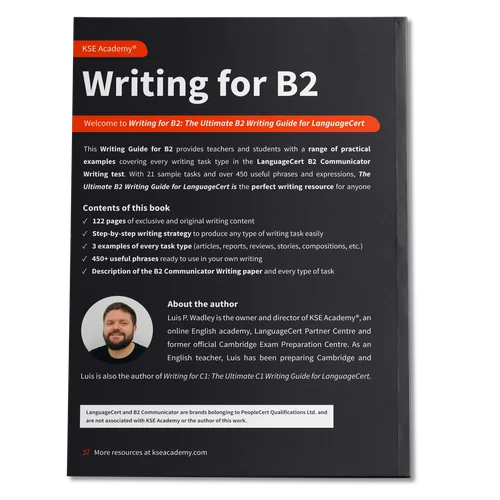
For Reading, what helps most is reading a lot and practising with past papers. But because Reading shares its time with Writing, being well prepared for Writing will save you precious minutes. For that, you have my guide to B2 Communicator Writing and the KSE Academy book for LanguageCert B2 Writing, with every task type, model answers and useful language. It’s a Writing book, not a Reading one, but it’ll help you finish the Writing faster and with more confidence.
And that’s everything you need to know about B2 Communicator Reading. If you have any questions, leave me a comment and I’ll be happy to answer. 🙂
