

Tabla de contenidos
El Reading del B2 Communicator de LanguageCert tiene fama de ser la parte más «tranquila» del examen: no hay audio que se te escape ni nadie esperando tu respuesta. Pero que sea tranquila no quiere decir que sea fácil. Son cuatro textos con cuatro tipos de tarea muy distintos, y comparte tiempo con el Writing, así que la gestión del reloj importa tanto como tu nivel de inglés.
Desde mi experiencia como preparador de exámenes, la mayoría de los puntos que se pierden en el Reading no se pierden por no entender el texto, sino por no saber exactamente qué pide cada tarea. Por eso, en esta guía te explico cómo es el Reading del B2 Communicator, qué tienes que hacer en cada una de sus cuatro partes, cómo se corrige y, lo más importante, te dejo un ejemplo de cada parte, escrito por mí, con las respuestas explicadas. ¡Vamos allá!
Reading B2 Communicator: qué es el nivel B2
El B2 Communicator certifica un nivel B2 del Marco Común Europeo de Referencia para las Lenguas (MCER), un nivel intermedio alto. En comprensión lectora, eso significa que eres capaz de leer con bastante autonomía artículos, informes y textos de opinión sobre temas actuales, entender la postura del autor y adaptar tu forma de leer al tipo de texto y a lo que buscas.
Traducido al examen, en el Reading del B2 Communicator tienes que ser capaz de:
- Entender en detalle un texto largo, con sus ideas y opiniones, no solo los datos.
- Ver cómo se construye un texto: qué frase introduce una idea, cuál la desarrolla y cuál da paso a otra.
- Localizar información concreta en varios textos cortos y distinguir su propósito.
- Responder a preguntas con respuestas cortas y precisas.
Cómo es el Reading del B2 Communicator
El Reading forma parte del Written Exam, junto con el Listening y el Writing. Estas son sus características principales:
- Se hace después del Listening, y tienes 2 horas y 10 minutos para el Reading y el Writing juntos, en el orden que prefieras.
- Tiene cuatro partes y 26 preguntas, y cada respuesta correcta vale 1 punto.
- Las respuestas se pasan a una hoja de respuestas (Answer Sheet) dentro de ese tiempo.
- Puedes hacerlo en papel en un centro o online desde casa, con el mismo formato.
| Parte | Texto | Tarea | Preguntas |
|---|---|---|---|
| Part 1 | Un texto largo: noticia, artículo, reseña o propuesta | Opción múltiple (a, b o c) | 6 |
| Part 2 | Un texto al que le faltan 6 frases | Elegir la frase de cada hueco entre 7 (sobra una) | 6 |
| Part 3 | Cuatro textos cortos sobre un mismo tema, con propósitos distintos | Decidir en qué texto (A a D) está cada información | 7 |
| Part 4 | Un texto continuo: narrativo, descriptivo, explicativo, biográfico… | Responder a preguntas abiertas en 5 palabras como máximo | 7 |
Las cuatro partes del Reading B2 Communicator
Part 1
Lees un texto largo (una noticia, un artículo, una reseña o una propuesta) y respondes a 6 preguntas de opción múltiple. Las preguntas siguen el orden del texto y no se quedan en los datos: te preguntan por opiniones, por el motivo de algo o por lo que el autor quiere decir con una frase. Las opciones incorrectas suelen usar palabras que aparecen en el texto, pero en otro contexto.
Part 2
Tienes un texto al que le han quitado 6 frases, y una lista de 7 frases para completar los huecos. Sobra una. Aquí no basta con entender la frase: tienes que ver cómo encaja con lo que va antes y con lo que va después. Fíjate mucho en los pronombres (it, this, they), en los conectores (however, for example, instead) y en las repeticiones de ideas.
Part 3
Lees cuatro textos cortos (un anuncio, un email, un artículo, un folleto…) que tratan el mismo tema pero tienen propósitos distintos, y respondes a 7 preguntas del tipo «¿En qué texto se menciona…?». Puedes usar cada texto más de una vez. Es una tarea de buscar información rápido, pero con trampa: las preguntas están parafraseadas y varios textos hablan de cosas parecidas.
Part 4
Lees un texto continuo (una historia, una biografía, un texto explicativo…) y respondes a 7 preguntas abiertas (what, why, where…) con cinco palabras como máximo. No hace falta escribir frases completas, pero la respuesta tiene que contestar exactamente a lo que se pregunta.
Ejemplos de Reading B2 Communicator
Estos ejemplos los he escrito yo siguiendo el formato del examen, con textos y preguntas de nivel B2. Intenta hacerlos sin mirar las respuestas y, después, lee la explicación de cada una: es ahí donde se aprende cómo piensa el examen.
Ejemplo de Reading B2 Communicator: Part 1
Un artículo sobre los repair cafés, con seis preguntas de opción múltiple:
Read the text and the questions. Choose the correct answer for each question.
Fixing things, together
When Martha Ellison’s toaster stopped working last winter, her first instinct was to throw it away and order a new one. Instead, a neighbour persuaded her to take it to the repair café in the church hall at the end of her street. ‘I expected a couple of retired engineers and a kettle,’ she admits. ‘What I found was a room full of people of all ages, laughing, arguing about screwdrivers and drinking far too much tea.’ Her toaster was working again within twenty minutes, and the volunteer who fixed it refused to accept any money.
Repair cafés are not a new idea. The first one opened in Amsterdam in 2009, and there are now thousands around the world. The principle is simple: volunteers with practical skills give up a few hours a month to mend whatever visitors bring in, from lamps and bicycles to jumpers with holes in them. Visitors are expected to stay and watch, and ideally to help, so that next time they might be able to do the job themselves.
Supporters argue that the cafés tackle two problems at once. The first is waste. Many of the objects people throw away have only a minor fault, such as a broken switch or a loose wire, but manufacturers often make them difficult to open, and replacement parts can be hard to find. The second problem is less obvious. Organisers say that for many visitors, particularly people who live alone, the social side matters as much as the repair. ‘Some of our regulars bring the same radio every month,’ jokes one organiser. ‘I’m fairly sure there’s nothing wrong with it.’
Not everyone is convinced, however. Some critics point out that a few hundred repaired kettles will hardly change the habits of an entire consumer society, and that real change will only come when governments force companies to design products that last. Several countries have recently introduced ‘right to repair’ laws with exactly this aim, requiring manufacturers to make spare parts and repair manuals available for a number of years.
The volunteers themselves tend to see no contradiction. As one retired electrician puts it, ‘Laws take years. Fixing a lamp takes ten minutes, and in the meantime somebody has learnt how to do it.’ For Martha, the experience has changed more than her breakfast routine. She now volunteers at the café once a month, mainly making tea, but she has also learnt to replace a plug. ‘It’s a small thing,’ she says, ‘but I no longer feel helpless when something breaks.’
- What surprised Martha when she first visited the repair café?
- a) how few people were there
- b) how lively the atmosphere was
- c) how much the repair cost
- Visitors to a repair café are expected to
- a) pay the volunteers for their time.
- b) bring an object every month.
- c) learn something from the repair.
- According to the text, many objects are thrown away because
- a) they are too badly damaged to repair.
- b) they are hard to open and fix.
- c) new ones are very cheap.
- What does the organiser’s joke about the radio suggest?
- a) Some visitors come mainly for the company.
- b) Old radios are difficult to repair.
- c) The volunteers lack the right skills.
- What do critics of repair cafés believe?
- a) They encourage people to buy cheaper products.
- b) Their effect on consumer habits is too small.
- c) They should be run by governments.
- How has Martha changed since her first visit?
- a) She now repairs electrical goods for her neighbours.
- b) She has decided to stop buying new appliances.
- c) She feels more confident when things go wrong.
Ver respuestas
- b: Martha esperaba «un par de ingenieros jubilados y una tetera», y se encontró una sala llena de gente riendo y discutiendo: lo que le sorprendió fue el ambiente. La reparación fue gratis, así que la c no encaja.
- c: El texto dice que los visitantes se quedan a mirar y, si pueden, ayudan, «para que la próxima vez sepan hacerlo ellos». La b es una trampa: lo de «cada mes» aparece después, en la broma de la radio.
- b: Muchos objetos solo tienen una avería pequeña, pero los fabricantes los hacen difíciles de abrir y cuesta encontrar piezas. Nadie habla de que estén muy rotos ni de que los nuevos sean baratos.
- a: Si alguien trae cada mes una radio que no está rota, es que viene por la compañía. Justo antes, el texto dice que para mucha gente que vive sola «lo social importa tanto como la reparación».
- b: Los críticos dicen que unos cientos de teteras reparadas «apenas cambiarán los hábitos de toda una sociedad de consumo». Hablan de leyes, pero no dicen que los gobiernos deban organizar los repair cafés.
- c: «Ya no me siento impotente cuando algo se rompe». Ayuda en el café, pero sobre todo haciendo té, y solo dice que ha aprendido a cambiar un enchufe, no que repare cosas para sus vecinos.
Ejemplo de Reading B2 Communicator: Part 2
Un texto sobre por qué dejamos las cosas para más tarde. Lee primero el texto entero, aunque tenga huecos, y después busca las frases:
Read the text. Six sentences have been removed. Choose the correct sentence (A to G) for each gap. There is one extra sentence you do not need.
Why do we put things off?
Most of us know the feeling. There is an important task to do, plenty of time to do it, and yet we find ourselves tidying a drawer or checking our phones instead. (1) _______________ For a long time, procrastination was seen simply as a problem of time management or, less kindly, as plain laziness.
Psychologists now see it rather differently. (2) _______________ In other words, we do not avoid the task itself so much as the unpleasant feelings we connect with it, such as boredom, anxiety or a fear of doing it badly. Tidying the drawer makes us feel better immediately, even though it makes things worse in the long run.
This explains why procrastination is so common among people who care a lot about their work. (3) _______________ If the report never gets written, at least nobody can say it is not good enough.
So what can be done about it? One popular technique is to make the first step as small as possible. (4) _______________ Once people have started, they often find that the task is far less unpleasant than they had imagined, and they carry on.
Another approach is to be kinder to ourselves. (5) _______________ Researchers have found that students who forgave themselves for putting off revision before one exam were less likely to do the same before the next one.
None of this means that the drawer will never get tidied again. (6) _______________ The important thing is to recognise when we are using it to hide from something we would rather not face.
- A. Perfectionists, for example, may delay starting because a finished piece of work can be judged, whereas an unfinished one cannot.
- B. Instead of ‘write the report’, the goal becomes ‘open the document and write one sentence’.
- C. Most researchers now describe it as a way of managing our mood rather than our time.
- D. It may seem strange, but blaming ourselves for past delays tends to make the next delay more likely, not less.
- E. It is one of the most common human habits: surveys suggest that around one in five adults regularly put off important tasks.
- F. Sometimes a short break from a difficult task is exactly what we need.
- G. That is why the best way to deal with it is to plan every hour of the day in detail.
Ver respuestas
- E: Después de describir la situación, E la presenta como un hábito muy común, y el «it» de E conecta con «procrastination» en la frase siguiente.
- C: «Psychologists now see it rather differently» pide una nueva definición, y la siguiente frase la reformula: «In other words, we do not avoid the task itself…». C habla de controlar el estado de ánimo, no el tiempo.
- A: La frase anterior habla de gente a la que le importa mucho su trabajo, y la siguiente («If the report never gets written, at least nobody can say it is not good enough») explica la idea de A.
- B: «Make the first step as small as possible» se ilustra con el ejemplo de B: en lugar de «escribe el informe», «abre el documento y escribe una frase».
- D: «Be kinder to ourselves» y, después, el estudio sobre perdonarse a uno mismo: D explica por qué culparse empeora las cosas.
- F: «None of this means that the drawer will never get tidied again»: F matiza que un descanso a veces viene bien, y el «it» de la frase siguiente se refiere a ese descanso.
La frase que sobra es la G: planificar cada hora del día contradice la idea del texto de empezar con pasos pequeños y tratarse mejor.
Ejemplo de Reading B2 Communicator: Part 3
Cuatro textos cortos sobre aprender a cocinar, cada uno con un propósito distinto:
Read the four texts (A to D) and the questions. For each question, choose the correct text. You can use each text more than once.
A
Cook with Confidence: evening classes at Riverside College
Ten Tuesday evenings, 6.30 to 9 pm, starting 14 January. Whether you have never boiled an egg or you simply want to stop relying on ready meals, this course is for you: no experience is required. Each week you will prepare a complete two-course meal under the guidance of a professional chef, and take home whatever you cook. All ingredients and equipment are provided. The course costs £240, but anyone who books before 1 December will receive 15% off. Places are limited to twelve per group, so early booking is strongly recommended.
B
Hi Sam,
Remember how we said we’d finally learn to cook properly this year? Well, I’ve found the perfect thing. There’s a course at Riverside College on Tuesday evenings, and I think it would be much more fun if we did it together. I know you said Tuesdays were difficult because of football, but the season finishes in December, doesn’t it? I’ve had a look at the menus and they sound amazing: Thai curry, fresh pasta, even a chocolate tart. Have a think and let me know by the weekend. To be honest, I’d rather not go on my own!
Jess
C
When I left home at nineteen, my cooking skills began and ended with toast. My first attempts at a proper meal were, frankly, disasters: rice that was somehow both burnt and raw, and a soup my flatmates still talk about. What changed things was not a course or an expensive book, but my grandmother, who refused to measure anything. ‘Taste it,’ she would say, ‘and then decide.’ Recipes are useful, of course, especially for baking, where a little too much flour really does matter. But for most everyday dishes, I’ve learnt that it is far more useful to understand why you are doing something than to follow every instruction to the gram.
D
The Weeknight Kitchen promises ‘100 quick meals for busy people’, and in many ways it delivers. The recipes are clearly written, the photographs are beautiful and, unlike many cookery books, most dishes really can be made in under half an hour. My main complaint is the shopping list. Too many recipes depend on expensive ingredients that you are unlikely to find in an ordinary supermarket, which rather defeats the purpose of a book for everyday cooking. It is also frustrating that the index lists dishes only by name, so finding something to do with the half bag of spinach in your fridge is harder than it should be. Still, for confident beginners, this is a useful addition to the shelf.
- Which text mentions that the writer’s first efforts were unsuccessful?
- Which text offers a reduced price for booking early?
- Which text criticises the cost of what you need to buy?
- Which text is trying to persuade someone to do something with the writer?
- Which text says that beginners are welcome?
- Which text suggests that following instructions exactly is not always necessary?
- Which text mentions a problem with the way information is organised?
Ver respuestas
- C: «My first attempts at a proper meal were, frankly, disasters».
- A: Un 15% de descuento si reservas antes del 1 de diciembre.
- D: Se queja de que muchas recetas necesitan ingredientes caros.
- B: Jess intenta convencer a Sam para hacer el curso juntos, y hasta le resuelve la excusa del fútbol.
- A: «No experience is required». En B, Jess no dice nada del nivel del curso.
- C: La abuela no medía nada, y la autora cree que es mejor entender por qué haces algo que seguir cada instrucción «al gramo».
- D: El índice solo ordena los platos por nombre, así que no puedes buscar por ingrediente.
Ejemplo de Reading B2 Communicator: Part 4
Una historia corta con siete preguntas abiertas. Recuerda: cinco palabras como máximo por respuesta.
Read the text and answer the questions. Use a maximum of five words for each answer.
The storm
Priya had been travelling since six that morning, and by the time the interview finished she was exhausted. The firm’s offices were in Ashford Bay, a small coastal town three hours from the city, and she had planned everything carefully: the interview at two, a quick look around the town and the 7.15 train home. What she had not planned for was the storm.
By half past six the wind was so strong that the station master had closed the waiting room, and at seven a notice appeared on the board: all services cancelled until morning. Priya’s phone was almost out of battery, and the only hotel in town, she soon discovered, was full of stranded passengers like herself.
She was sitting on a bench outside the station, wondering what to do, when an elderly man with a large umbrella stopped beside her. He introduced himself as Walter and explained that he ran a small bookshop on the harbour front. ‘There’s a sofa in the back room,’ he said, ‘and a kettle. It’s not the Ritz, but it’s dry.’ Priya hesitated. Her mother had always told her not to accept offers from strangers. But the rain was coming down harder than ever, and something about the way Walter apologised for the state of his umbrella made her trust him.
The bookshop turned out to be warm and full of the smell of old paper. Walter’s daughter, Jo, who lived above the shop, brought down blankets and a plate of sandwiches, and found a charger for Priya’s phone. The three of them talked until well after midnight, mostly about books, but also about Priya’s interview. When Priya admitted that she was not sure she wanted to leave the city, Jo laughed. ‘That’s exactly what I said fifteen years ago,’ she said. ‘Now I can’t imagine living anywhere else.’
The next morning the storm had passed. Walter insisted on walking Priya to the station, and as the train pulled out, she realised she was already hoping the firm would offer her the job. Two weeks later, it did. On her first Saturday in Ashford Bay, before she had even unpacked, she went down to the harbour and bought a book. She paid full price, although Walter tried very hard to refuse.
- Why was Priya in Ashford Bay?
- Why could Priya not get home that evening?
- Why could she not stay at the hotel?
- What kind of business did Walter have?
- What made Priya decide to trust Walter?
- What did Jo give Priya apart from blankets and food?
- What did Priya do on her first Saturday in the town?
Ver respuestas
- (for) a job interview
- the trains were cancelled / because of the storm
- it was full
- a (small) bookshop
- the way he apologised (for his umbrella)
- a (phone) charger
- (she) bought a book
Fíjate en que no hace falta escribir frases completas: basta con la información que se pide, en cinco palabras como máximo. Si escribes más, te arriesgas a que la respuesta no cuente.
Cómo se evalúa el Reading del B2 Communicator
El Reading tiene 26 preguntas y cada respuesta correcta vale 1 punto, así que la nota máxima es de 26 puntos. No se resta por los errores, así que no dejes ninguna pregunta en blanco.
Esa nota se convierte después a una puntuación sobre 50, igual que la del Listening y la del Writing. Las tres suman una nota sobre 150 para todo el Written Exam, y para aprobar necesitas 75 sobre 150 (Pass). A partir de 101 sobre 150 obtienes un High Pass. Es decir, el aprobado es del examen escrito completo, no de cada parte por separado: un buen Reading puede compensar un Listening flojo, y al revés.
En la Part 4, la respuesta tiene que contestar exactamente a lo que se pregunta y no pasar de cinco palabras: copiar un trozo largo del texto «por si acaso» no te asegura el punto.
Consejos para el Reading del B2 Communicator
Estos son los consejos que doy a mis alumnos para el Reading del B2 Communicator:
- Decide antes cuánto tiempo le das a cada parte. El Reading y el Writing comparten 2 horas y 10 minutos. Una buena referencia es dejar al menos una hora para el Writing.
- En la Part 1, lee las preguntas antes que el texto. Así sabes qué buscar y en qué orden aparece.
- Desconfía de las opciones que repiten palabras del texto. La respuesta correcta suele estar parafraseada.
- En la Part 2, comprueba lo que va antes y lo que va después del hueco. Una frase que encaja con lo anterior pero no con lo siguiente no es la buena.
- En la Part 3, subraya la idea clave de cada pregunta y busca su equivalente, no la palabra exacta.
- En la Part 4, cuenta las palabras. Copia del texto si hace falta, pero solo lo justo para responder.
- Pasa las respuestas a la hoja con tiempo. Una respuesta que no está en la hoja no cuenta.
Para ver el examen completo, aquí tienes la guía del LanguageCert B2 Communicator, con los exámenes de muestra oficiales para descargar. Y si dudas entre exámenes, también tienes mi guía del Reading del B2 First de Cambridge.
Y para el Writing del B2 Communicator…
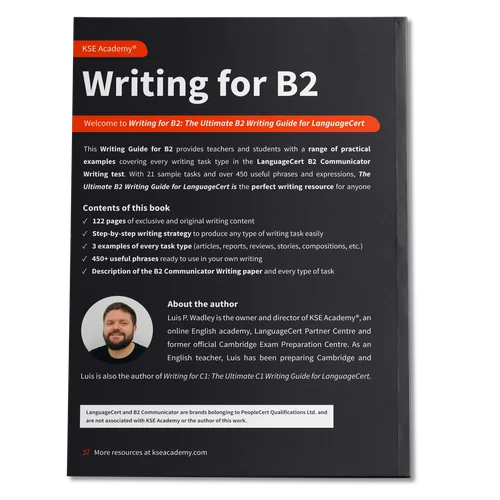
Para el Reading, lo que más ayuda es leer mucho y practicar con exámenes. Pero como el Reading comparte tiempo con el Writing, prepararte bien el Writing te dará minutos de oro. Para eso tienes mi guía del Writing del B2 Communicator y el libro de KSE Academy para el Writing B2 de LanguageCert, con todos los tipos de tarea, respuestas modelo y expresiones útiles. Es un libro de Writing, no de Reading, pero te ayudará a terminar el Writing más rápido y con más seguridad.
Y con esto ya tienes todo lo que necesitas saber del Reading del B2 Communicator. Si te queda alguna duda, déjame un comentario y te respondo encantado. 🙂
