
Tabla de contenidos
El Speaking del C2 Mastery de LanguageCert es el examen oral más largo y exigente de la serie: dura 17 minutos, lo haces tú solo con un interlocutor y termina con un turno largo de tres minutos sobre un tema abstracto. Aquí ya no basta con comunicarse bien: se espera que argumentes con matices, que adaptes el registro a cada situación y que lleves tú la conversación.
Desde mi experiencia como preparador de exámenes, en el C2 la diferencia no la marca el vocabulario raro, sino la capacidad de organizar ideas complejas mientras hablas. Por eso, en esta guía te explico cómo es el Speaking del C2 Mastery, qué tienes que hacer en cada una de sus cuatro partes, cómo se corrige y, lo más importante, te enseño un ejemplo de cada parte con una respuesta modelo de nivel C2 y un breve análisis. ¡Vamos allá!
Speaking C2 Mastery: qué es el nivel C2
El C2 Mastery certifica un nivel C2 del Marco Común Europeo de Referencia para las Lenguas (MCER), el más alto de la escala. En lo que a la conversación se refiere, el MCER dice que un hablante de C2:
Toma parte sin esfuerzo en cualquier conversación o debate y conoce bien modismos, frases hechas y expresiones coloquiales. Se expresa con fluidez y transmite matices sutiles de sentido con precisión. Si tiene un problema, sortea la dificultad con tanta discreción que los demás apenas se dan cuenta.
Traducido al examen, en el Speaking del C2 Mastery tienes que ser capaz de:
- Dar opiniones elaboradas sobre temas de actualidad, reconociendo la complejidad del asunto.
- Manejar situaciones delicadas con el tono y el registro adecuados: disculparte de verdad, dar una mala noticia, negociar con tacto…
- Debatir y priorizar opciones, justificando tu postura, rebatiendo la del interlocutor y matizando cuando hace falta.
- Hablar tres minutos seguidos sobre un tema abstracto con una estructura clara y una conclusión.
Lo que distingue a un C2 no es no cometer ningún error, sino la precisión, la naturalidad y la facilidad con la que manejas ideas complejas.
Cómo es el Speaking del C2 Mastery
El Speaking es el Spoken Exam del C2 Mastery y es un examen independiente del Written Exam (Listening, Reading y Writing), así que puedes hacerlo otro día. Estas son sus características principales:
- Es individual: estáis tú y un interlocutor, sin compañero.
- Dura 17 minutos y tiene cuatro partes.
- Puedes hacerlo en un centro, cara a cara, o online desde casa. En los dos casos, el interlocutor está contigo en directo.
- Se graba, y no te evalúa el interlocutor, sino un examinador de LanguageCert que escucha la grabación después.
- En la Part 2 el interlocutor interpreta un papel (tu vecino, tu jefe, un organizador…), pero tú nunca tienes que hacer de otra persona: siempre hablas como tú mismo.
- En el C2, el interlocutor deja que seas tú quien guíe la conversación.
| Parte | Duración | Qué tienes que hacer |
|---|---|---|
| Part 1 | 4 minutos | Deletrear tu apellido, decir de dónde eres y responder hasta 5 preguntas de opinión sobre temas de actualidad. |
| Part 2 | 4 minutos | Dos role plays en los que cuentan el tono y el registro: en uno empieza el interlocutor y en el otro empiezas tú. |
| Part 3 | 4 minutos | Tras 20 segundos para pensar, debatir con el interlocutor una lista de opciones para ordenarlas o priorizarlas. |
| Part 4 | 5 minutos | Tras 30 segundos para tomar notas, hablar 3 minutos sobre un tema abstracto y responder preguntas de seguimiento. |
Las cuatro partes del Speaking C2 Mastery
Part 1
Empieza como en todos los niveles: el interlocutor te pide que deletrees tu apellido y te pregunta de dónde eres. Después te hace hasta cinco preguntas, cada una de un tema distinto, pero en el C2 no son preguntas sobre tu rutina, sino sobre cuestiones de actualidad: la educación, la tecnología, el turismo… Se espera una opinión matizada, con argumentos y algún ejemplo, en tres o cuatro frases.
Part 2
Aquí se evalúa cómo te desenvuelves en situaciones reales con cierta complejidad. El interlocutor te plantea al menos dos situaciones:
- En la primera, empieza él («I start.») y tú respondes.
- En la segunda, empiezas tú («You start.»), así que eres tú quien abre la conversación.
Los intercambios son más largos que en los niveles inferiores, y en el C2 lo que marca la diferencia es el registro y el tono: cuánto suavizas una queja, cómo das una mala noticia, cómo propones una solución sin sonar ni demasiado brusco ni demasiado servil.
Part 3
Es un debate o una negociación a partir de un texto escrito, normalmente una lista de opciones. Tienes 20 segundos para pensar y después tenéis que ordenarlas, priorizarlas, descartar alguna o plantear hipótesis. Para hacerlo bien tienes que justificar tu postura, rebatir la del interlocutor, pedir aclaraciones y, a ser posible, resumir lo que habéis decidido al final.
Part 4
Es tu turno largo, y en el C2 es de verdad largo. El interlocutor elige uno de tres temas, normalmente abstractos, y te da papel y bolígrafo para que tomes notas durante 30 segundos. Después tienes que hablar tres minutos sin ayuda y, al terminar, responder a algunas preguntas de seguimiento (follow-up questions).
Ejemplos de Speaking C2 Mastery
Ahora vamos a lo práctico. Te enseño una tarea de cada parte, escrita por mí siguiendo el formato del examen, con una respuesta modelo de nivel C2 y un análisis de por qué funciona. En el examen real hablarás, así que no se trata de memorizar estas respuestas, sino de fijarte en cómo están construidas.
Ejemplo de Speaking C2 Mastery: Part 1
Estas serían las preguntas de la Part 1:
Part 1. The interlocutor asks you to spell your surname and says Where are you from? Then you’ll be asked up to five questions on different topics, for example:
- Education: Should universities focus on preparing students for the job market?
- Technology: Have we given up too much privacy in exchange for convenience?
- Tourism: Is mass tourism doing more harm than good to the places people visit?
- Ageing: How should society adapt to people living much longer?
- Language: To what extent does the language we speak shape the way we think?
Y así podría responderlas un candidato de nivel C2:
Interlocutor: Should universities focus on preparing students for the job market?
Candidate: Up to a point. It would be naive to pretend graduates don’t need to earn a living, but if universities turn into glorified training centres, we lose the very thing that makes them valuable: the space to think critically about ideas that have no immediate market value. Ironically, that’s often what employers end up wanting most.
Interlocutor: Have we given up too much privacy in exchange for convenience?
Candidate: I’d say we have, largely without noticing. Each individual trade-off seems trivial, a postcode here, a fingerprint there, but taken together they amount to a remarkably detailed portrait of our lives, held by companies whose interests don’t necessarily coincide with ours.
Interlocutor: Is mass tourism doing more harm than good to the places people visit?
Candidate: In some places it has clearly tipped the balance. When residents are priced out of their own neighbourhoods and city centres become theme parks, the very charm that attracted visitors in the first place starts to evaporate. That said, for many smaller towns tourism is a lifeline, so it’s more a question of management than of tourism as such.
Interlocutor: How should society adapt to people living much longer?
Candidate: We’ll have to rethink the whole idea of a single career followed by retirement. A more flexible model, where people can retrain in their fifties or work part-time well into their seventies, strikes me as both fairer and more realistic.
Interlocutor: To what extent does the language we speak shape the way we think?
Candidate: I’m sceptical of the strong version of that claim, but having lived in two languages, I’m convinced it shapes what we notice. Spanish, for instance, forces you to decide how formal to be with someone straight away, whereas in English that negotiation is far more subtle.
Por qué funciona:
Por qué funciona:
Por qué funciona:
Por qué funciona:
- Nunca responde con un sí o un no: matiza desde la primera palabra (Up to a point., I’d say we have, largely without noticing.).
- Reconoce la otra postura antes de dar la suya (That said, for many smaller towns…), que es una marca muy clara de C2.
- Vocabulario preciso e idiomático sin forzar: glorified training centres, tipped the balance, priced out of, a lifeline.
Expresiones útiles: Up to a point., It would be naive to pretend…, That said,…, …strikes me as…, I’m sceptical of…, but…, It’s more a question of… than of…
Ejemplo de Speaking C2 Mastery: Part 2
En la primera situación empieza el interlocutor:
Part 2, first situation. We’re neighbours. I start.
I hope you don’t mind me mentioning it, but your builders have been parking across my drive all week.
Interlocutor: I hope you don’t mind me mentioning it, but your builders have been parking across my drive all week.
Candidate: Not at all, I’m glad you told me, and I’m really sorry. I had no idea. They’re supposed to use the space round the corner, so I’ll have a word with them first thing tomorrow.
Interlocutor: The thing is, I nearly missed an appointment yesterday because I couldn’t get my car out.
Candidate: That’s completely unacceptable, and I can only apologise. Look, let me give you my number. If it happens again, even once, ring me straight away and I’ll get them to move the van there and then. And if there’s anything I can do to make up for yesterday, please do let me know.
En la segunda, eres tú quien tiene que empezar:
Part 2, second situation. I’m organising a conference where you’re due to give a talk next week. You have to pull out. You start.
Candidate: Hello, Ms Clarke. I’m afraid I’m calling with some rather awkward news. Owing to a family emergency, I’m not going to be able to give my talk next week, and I wanted to let you know as soon as possible.
Interlocutor: Oh, dear. I’m sorry to hear that. It does leave us in a difficult position, though, with the programme already printed.
Candidate: I completely understand, and I feel terrible about the timing. If it would help, I could record the talk in advance so that it could be shown on the day, or I could ask a colleague who works on the same project whether she’d be willing to step in.
Interlocutor: A colleague might work. Would she be up to speed with the material?
Candidate: Absolutely. We co-wrote most of it, so she knows it inside out. I’ll speak to her this afternoon and get back to you by tomorrow morning at the latest.
- Con el vecino, la disculpa crece a medida que el problema resulta más serio, y termina con una solución concreta y una oferta de compensación.
- Con la organizadora, anuncia la mala noticia con tacto (I’m afraid I’m calling with some rather awkward news), asume la responsabilidad y ofrece alternativas en lugar de dejar el problema en el aire.
- El registro es el adecuado en cada caso: cordial con el vecino y profesional, pero cercano, con la organizadora.
Expresiones útiles: I’m glad you told me., I can only apologise., I’ll have a word with…, I’m afraid I’m calling with…, Owing to…, If it would help, I could…, …at the latest.
Ejemplo de Speaking C2 Mastery: Part 3
Esta sería la lista de la Part 3:
Part 3. Our city council has a one-off budget to improve life for young people. Here are some of the proposals. Let’s discuss them and decide which would make the biggest difference and which the least. You have twenty seconds to prepare before we begin.
How should the money be spent?
- affordable housing schemes
- free public transport for under-25s
- mental health support services
- apprenticeships with local businesses
- late-night cultural venues
- new sports facilities
- anything else?
Candidate: Shall I start? For me, affordable housing has to be the top priority. Most of the other problems on the list, from mental health to young people leaving the city, stem at least partly from the fact that they simply can’t afford to live independently.
Interlocutor: But isn’t housing far too expensive for a one-off budget to make any real difference?
Candidate: That’s a fair point. A single payment won’t solve a structural problem. But it could fund something targeted, say, converting empty buildings into shared flats for under-thirties, which would have a lasting effect. Would you put mental health services higher?
Interlocutor: I think I would. The waiting lists are enormous.
Candidate: I’d go along with that. And arguably, they’re interconnected: insecure housing feeds anxiety, and anxiety makes it harder to hold down a job. So perhaps housing and mental health share first place, if you’ll allow me to cheat slightly.
Interlocutor: What about the apprenticeships?
Candidate: I’d put them just behind. They tackle the root of the problem rather than the symptoms, though their success depends heavily on whether local businesses commit to them. Free transport, on the other hand, sounds attractive but strikes me as the least effective: it benefits everyone under twenty-five equally, including those who don’t need it.
Interlocutor: And the cultural venues and sports facilities?
Candidate: Both worthwhile, but I’d see them as nice to have rather than essential. So, to sum up: housing and mental health first, apprenticeships next, culture and sport after that, and free transport at the bottom.
- Toma la iniciativa y establece un criterio desde el principio: qué problemas están en la raíz de los demás.
- Concede y reconduce cuando el interlocutor le pone una objeción (That’s a fair point… But…), sin abandonar su postura.
- Relaciona las opciones entre sí en lugar de comentarlas una a una, y se permite un toque de humor (if you’ll allow me to cheat slightly).
- Resume la decisión final en una sola frase.
Expresiones útiles: …has to be the top priority., …stem from…, That’s a fair point., I’d go along with that., Arguably,…, …strikes me as the least effective., So, to sum up,…
Ejemplo de Speaking C2 Mastery: Part 4
Estos serían los tres temas de la Part 4:
Part 4. Now it’s your long turn. The interlocutor picks one of these topics and hands you paper and a pen, and you get thirty seconds to jot down some notes:
- A Whether tradition still matters in a globalised world
- B The value of failure
- C How far we should trust experts
Talk for three minutes. Then answer the interlocutor’s follow-up questions.
Supongamos que te toca el tema B. Así podrían ser las notas y la charla de un candidato de nivel C2, con las preguntas de seguimiento al final:
Notes (30 seconds): culture of success / failure = information / my first job / resilience: friends / careful: romanticising? / conditions: safe to fail / education, grades / conclusion
Candidate: We live in a culture that celebrates success so relentlessly that failure has become something almost shameful, something to be hidden from a CV or airbrushed out of a social media profile. And yet I’d argue that failure, handled well, is one of the most valuable experiences we can have.
Candidate: The first reason is quite simple: failure is information. When something works, we rarely stop to ask why. When it goes wrong, we’re forced to examine our assumptions. I learnt this the hard way in my first job, when a project I’d been leading for months was cancelled. At the time it felt like a disaster, but going back over what had happened taught me more about planning and about people than any course ever did.
Candidate: Secondly, failure builds a kind of resilience that success simply can’t. If you’ve only ever succeeded, the first serious setback can be devastating. Whereas if you’ve failed before and recovered, you know that it isn’t the end of the world, and that knowledge frees you to take risks. I’ve seen this in friends who sailed through school and university without ever really struggling: the first time something went badly wrong at work, they had no idea how to cope, while others who’d had a much bumpier ride simply shrugged, worked out what had gone wrong and moved on.
Candidate: That said, I think we need to be careful not to romanticise failure. There’s a fashionable idea, particularly in the business world, that failing is somehow admirable in itself. It isn’t. What matters is whether you learn from it, and crucially, whether you can afford to fail. For someone with savings and a supportive family, a failed business is a lesson. For someone without that safety net, it can be ruinous. So the value of failure depends very much on the conditions surrounding it.
Candidate: This is where I think education has a role to play. Schools tend to punish mistakes through grades, which teaches children to avoid risks rather than to learn from them. If students were given more opportunities to try things, get them wrong and try again without being penalised, we might end up with adults who are less afraid of failure and, paradoxically, more likely to succeed.
Candidate: So, to sum up, I’d say failure is valuable not in itself but in what we make of it, and that we’d do well to create a society in which it’s safe to fail.
Interlocutor: Thank you. Do you think some cultures are more tolerant of failure than others?
Candidate: Undoubtedly. In some countries, going bankrupt carries a stigma that can follow you for life, whereas elsewhere it’s almost seen as a rite of passage for entrepreneurs. Those attitudes have a real impact on how willing people are to innovate.
Interlocutor: Should we tell children about our own failures?
Candidate: I think so, provided we tell them the whole story, including how we got back on our feet. Children who only ever see adults succeeding can come to believe that competence comes naturally, which is exactly the wrong lesson.
- Las notas son un esquema de la charla, no frases: en 30 segundos solo da tiempo a fijar el orden de las ideas.
- Plantea una tesis desde el principio y la desarrolla con argumentos, un ejemplo personal y una objeción a su propia postura (That said, I think we need to be careful not to romanticise failure.).
- Organiza el discurso con señales claras: The first reason…, Secondly…, That said…, This is where…, So, to sum up…
- En las preguntas de seguimiento, responde con la misma precisión, aportando ideas nuevas en vez de repetir la charla.
Expresiones útiles: And yet I’d argue that…, I learnt this the hard way…, Whereas…, Crucially,…, Paradoxically,…, We’d do well to…
Vídeo de ejemplo del Speaking C2 Mastery
Aquí tienes la grabación de un examen de Speaking del C2 Mastery, la misma que verás en la guía del nivel. En este caso no hay comentarios oficiales del examinador, así que no te puedo decir qué nota obtuvo, pero te servirá para hacerte una idea del ritmo real del examen y de cómo pasa el interlocutor de una parte a otra.
Mientras lo ves, compáralo con los ejemplos de arriba: fíjate en la longitud de las respuestas y en cómo se enlazan las ideas.
Cómo se evalúa el Speaking del C2 Mastery
El examinador escucha la grabación y te puntúa en cuatro criterios, cada uno de 0 a 3 puntos, teniendo en cuenta tu actuación en todo el examen:
| Criterio | Qué se valora |
|---|---|
| Task Fulfilment and Coherence | Si llevas la conversación con soltura, si tus intervenciones son relevantes y si tu discurso tiene una estructura clara incluso cuando las ideas son complejas. |
| Accuracy and Range of Grammar | Si usas con naturalidad una gama muy amplia de estructuras y si mantienes el control incluso en las más complejas. |
| Accuracy and Range of Vocabulary | Si tu vocabulario es preciso e idiomático y si eliges bien el registro en cada situación. |
| Pronunciation, Intonation and Fluency | Si hablas con fluidez y naturalidad, y si usas la entonación para transmitir matices. |
Así que la nota máxima es de 12 puntos, que luego se convierten a una puntuación sobre 50. Para aprobar necesitas 25 sobre 50 (Pass), y a partir de 38 sobre 50 obtienes un High Pass. Los cortes son los mismos que en el resto de niveles, pero lo que se exige para un 2 o un 3 es lo propio de un C2.
Consejos para el Speaking del C2 Mastery
Estos son los consejos que doy a mis alumnos para el Speaking del C2 Mastery:
- Matiza, no te limites a opinar. En el C2, una opinión rotunda sin matices suena pobre. Reconoce la complejidad, concede algo y luego defiende tu postura.
- Cuida el registro en la Part 2. Practica la misma situación con un amigo, con tu jefe y con un desconocido, y fíjate en cómo cambian las palabras y el tono.
- En la Part 3, lleva tú la conversación. Propón un criterio para ordenar las opciones, pregunta, rebate y resume al final.
- Entrena los tres minutos. Tres minutos son mucho tiempo si no tienes una estructura: tesis, dos o tres argumentos, un ejemplo, una objeción y una conclusión.
- Usa las notas como esquema. En 30 segundos apunta solo el orden de las ideas, no frases.
- Si te falta una palabra, reformula. En el C2 se valora que sortees la dificultad sin que se note, en lugar de quedarte en blanco.
- Si haces el examen online, prepara el equipo. Comprueba la conexión, el micrófono y la cámara antes de empezar, y busca un sitio sin ruido.
Si dudas entre exámenes, también tienes mi guía del Speaking del C2 Proficiency de Cambridge, para que compares los dos formatos. Y para ver el examen completo, aquí tienes la guía del LanguageCert C2 Mastery.
Y para el Writing del C2 Mastery…
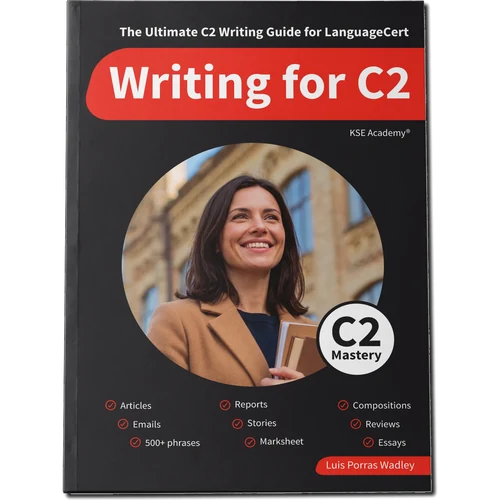
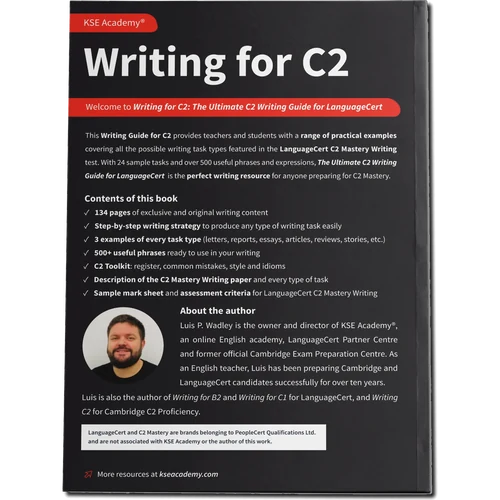
Para el Speaking no hay nada como practicar en voz alta, pero si también te estás preparando la parte escrita del examen, tienes mi guía del Writing del C2 Mastery y el libro de KSE Academy para el Writing C2 de LanguageCert, con todos los tipos de tarea y respuestas modelo. Es un libro de Writing, no de Speaking, pero buena parte del vocabulario y de los recursos para argumentar te servirán también al hablar.
Y con esto ya tienes todo lo que necesitas saber del Speaking del C2 Mastery. Si te queda alguna duda, déjame un comentario y te respondo encantado. 🙂
