
Tabla de contenidos
El Reading del C2 Mastery de LanguageCert es exigente, pero también muy predecible: siempre son cuatro textos con cuatro tipos de tarea, y el formato es el mismo que en el C1. Lo que cambia es la densidad: textos literarios con metáforas, ensayos con argumentos encadenados y matices que se juegan en una sola palabra. Además, comparte tiempo con el Writing, así que gestionar bien el reloj es media nota.
Desde mi experiencia como preparador de exámenes, en el C2 casi nadie falla por no entender el texto: los puntos se pierden por un matiz, un adverbio o una ironía que se lee demasiado deprisa. Por eso, en esta guía te explico cómo es el Reading del C2 Mastery, qué tienes que hacer en cada una de sus cuatro partes, cómo se corrige y, lo más importante, te dejo un ejemplo de cada parte, escrito por mí, con las respuestas explicadas. ¡Vamos allá!
Reading C2 Mastery: qué es el nivel C2
El C2 Mastery certifica un nivel C2 del Marco Común Europeo de Referencia para las Lenguas (MCER), el nivel más alto. En comprensión lectora, eso significa que lees con facilidad prácticamente cualquier texto, incluidos los abstractos, los literarios y los muy idiomáticos, y que captas los matices de significado, el tono y la intención del autor.
Traducido al examen, en el Reading del C2 Mastery tienes que ser capaz de:
- Entender un texto literario o académico, con metáforas, símiles y lenguaje idiomático, y decidir si una afirmación sobre él es verdadera o falsa.
- Ver cómo se construye el discurso: referencias, contrastes, ejemplos y transiciones entre ideas.
- Localizar información concreta en varios textos cortos y distinguir su propósito.
- Responder a preguntas con respuestas cortas y precisas, a menudo reformulando lo que dice el texto.
Cómo es el Reading del C2 Mastery
El Reading forma parte del Written Exam, junto con el Listening y el Writing. Estas son sus características principales:
- Se hace después del Listening, y tienes 2 horas y 40 minutos para el Reading y el Writing juntos, en el orden que prefieras.
- Tiene cuatro partes y 26 preguntas, y cada respuesta correcta vale 1 punto.
- Las respuestas se pasan a una hoja de respuestas (Answer Sheet) dentro de ese tiempo.
- Puedes hacerlo en papel en un centro o online desde casa, con el mismo formato.
| Parte | Texto | Tarea | Preguntas |
|---|---|---|---|
| Part 1 | Un texto con lenguaje idiomático, ideas narrativas o académicas, argumentos y opiniones | Decidir si 5 afirmaciones son verdaderas o falsas | 5 |
| Part 2 | Un texto al que le faltan 6 frases | Elegir la frase de cada hueco entre 8 (sobran dos) | 6 |
| Part 3 | Cuatro textos cortos sobre un mismo tema, con propósitos distintos | Decidir en qué texto (A a D) está cada información | 7 |
| Part 4 | Un texto continuo: narrativo, descriptivo, explicativo, biográfico… | Responder a preguntas abiertas en 5 palabras como máximo | 8 |
Las cuatro partes del Reading C2 Mastery
Part 1
Lees un texto con lenguaje idiomático, ideas narrativas o académicas, argumentos y opiniones, y decides si 5 afirmaciones sobre él son verdaderas (T) o falsas (F). Parece la tarea más sencilla, pero no lo es: las afirmaciones parafrasean el texto, y una sola palabra (always, never, only, altogether) puede convertir una afirmación casi correcta en falsa. Solo hay dos opciones: no existe la de «el texto no lo dice».
Part 2
Tienes un texto al que le han quitado 6 frases, y una lista de 8 frases para completar los huecos. Sobran dos, así que las trampas son más difíciles de descartar. Aquí no basta con entender la frase: tienes que ver cómo encaja con lo que va antes y con lo que va después. Fíjate mucho en los pronombres (it, this, they), en los conectores (however, for example, instead) y en las repeticiones de ideas.
Part 3
Lees cuatro textos cortos (un anuncio, un email, un artículo, un folleto…) que tratan el mismo tema pero tienen propósitos distintos, y respondes a 7 preguntas del tipo «¿En qué texto se menciona…?». Puedes usar cada texto más de una vez. Es una tarea de buscar información rápido, pero con trampa: las preguntas están parafraseadas y varios textos hablan de cosas parecidas.
Part 4
Lees un texto continuo (una historia, una biografía, un texto explicativo…) y respondes a 8 preguntas abiertas (what, why, where…) con cinco palabras como máximo. No hace falta escribir frases completas, pero la respuesta tiene que contestar exactamente a lo que se pregunta.
Ejemplos de Reading C2 Mastery
Estos ejemplos los he escrito yo siguiendo el formato del examen, con textos y preguntas de nivel C2. Intenta hacerlos sin mirar las respuestas y, después, lee la explicación de cada una: es ahí donde se aprende cómo piensa el examen.
Ejemplo de Reading C2 Mastery: Part 1
Un texto narrativo sobre la hija de un farero, con cinco afirmaciones para decidir si son verdaderas o falsas:
Read the text and the statements. Decide whether each statement is true (T) or false (F).
The keeper’s daughter
My father kept the light on Carrick Point for thirty-one years, and in all that time I never once heard him call it a job. It was, he said, a conversation: the lamp spoke to the ships, and the ships, by passing safely, answered. As a child I took this for the kind of thing fathers say, a pleasant varnish over long nights and cold mornings. It was only after he died, when I sat alone in the lamp room with the lens dark for the first time in a century, that I understood he had meant it quite literally, and that the silence was now mine to keep.
The tower itself was never beautiful. Squat, salt-bitten and painted a white that the weather turned the colour of old teeth, it crouched on the headland like something waiting to be forgiven. Visitors expected romance and found instead a kitchen that smelt of paraffin and a staircase that punished the knees. My mother, who had married a lighthouse without quite realising it, spent her first winter there, she later told me, ‘learning to be lonely on purpose’. By the second winter she had stopped counting the days until spring and started counting the birds instead, filling notebook after notebook with a tally so meticulous that ornithologists still cite it.
I left at eighteen, as the young do, convinced that the world was somewhere else. I studied, married, moved cities twice and acquired the habit, common among the children of remote places, of describing my childhood as though it had happened to someone braver. The truth was more prosaic. I had been neither brave nor deprived; I had simply been somewhere that asked very little of me except attention, and I had given it grudgingly.
When the lighthouse was automated, the authorities offered my father a cottage in the village and a small pension. He accepted both with a courtesy that I now recognise as grief. He walked out to the point every evening for the rest of his life, not to check on the light, which no longer needed him, but, I suspect, to be there when it spoke.
- The writer’s father regarded his work as a kind of communication rather than an occupation.
- As a child, the writer believed her father’s description of his work was entirely accurate.
- The writer’s mother adapted to life at the lighthouse more quickly than she had expected.
- The writer suggests that she exaggerated the hardships of her childhood when describing it to others.
- After the lighthouse was automated, the writer’s father continued to check that the light was working properly.
Ver respuestas
- T: «I never once heard him call it a job. It was, he said, a conversation»: la luz «hablaba» con los barcos.
- F: De niña lo tomaba por «the kind of thing fathers say», un barniz agradable; lo entendió de verdad mucho después.
- F: Su primer invierno fue «learning to be lonely on purpose», y solo en el segundo dejó de contar los días: la adaptación no fue rápida, y el texto no dice nada de lo que esperaba.
- T: Hablaba de su infancia «as though it had happened to someone braver», cuando la verdad era más prosaica.
- F: La luz ya no le necesitaba: iba cada tarde a la punta, no para comprobarla, sino «to be there when it spoke».
Ejemplo de Reading C2 Mastery: Part 2
Un ensayo sobre la idea de que la mente infantil es una página en blanco. Lee primero el texto entero, aunque tenga huecos, y después busca las frases:
Read the text. Six sentences have been removed. Choose the correct sentence (A to H) for each gap. There are two extra sentences you do not need.
The myth of the blank slate
For much of the twentieth century, a seductive idea dominated discussions of how children learn: that the infant mind is essentially empty, waiting to be written on by experience. (1) _______________ If every capacity is learnt, then every failure is a failure of teaching, and every success a triumph of method.
The difficulty is that the evidence has steadily refused to cooperate. (2) _______________ Babies only a few days old will look longer at a face than at a scrambled arrangement of the same features, and they appear to register when a quantity of objects has changed, long before they could possibly have been taught to count.
None of this means that experience is unimportant. (3) _______________ A child born with the capacity for language will still learn Finnish rather than Swahili only if Finnish is what she hears, and a predisposition to notice faces is of little use in a world without people.
The more interesting question, then, is not whether nature or nurture matters, but how the two interact. (4) _______________ Children who are naturally drawn to books, for example, tend to be given more of them, so that an initial inclination is amplified by the very environment it helps to create.
This has uncomfortable implications for anyone who would like to measure the effect of a particular school or teaching method. (5) _______________ Disentangling cause from consequence in such circumstances is less a matter of better statistics than of better questions.
(6) _______________ It suggests that the most effective teaching may be less about filling an empty vessel than about recognising what is already there and giving it something worth growing towards.
- A. The appeal of this view was as much moral as scientific.
- B. Here the picture becomes considerably more intricate, since the two rarely operate independently.
- C. On the contrary, innate capacities appear to function less as finished products than as starting points.
- D. Few parents, however, would be willing to accept such a conclusion.
- E. If children partly select their own environments, then differences between groups of pupils may reflect choices as much as instruction.
- F. Research on very young infants suggests that they arrive equipped with surprisingly specific expectations about the world.
- G. None of this should be read as an argument for fatalism.
- H. Teachers have long complained that they are blamed for problems they cannot control.
Ver respuestas
- A: Explica por qué la idea resultaba atractiva: si todo se aprende, todo depende de la enseñanza («moral as much as scientific»).
- F: «The evidence has steadily refused to cooperate» y después vienen los ejemplos con bebés: la frase F los introduce.
- C: «None of this means that experience is unimportant»: las capacidades innatas son puntos de partida, no productos acabados, y lo que sigue lo ilustra.
- B: Después de plantear cómo interactúan, la frase B anuncia que el panorama se complica, y el ejemplo de los libros lo muestra.
- E: Las implicaciones para medir colegios: si los niños eligen en parte su entorno, las diferencias pueden deberse a elecciones.
- G: Cierra el texto: nada de esto es un argumento para el fatalismo, sino para otra forma de enseñar.
Sobran la D (los padres) y la H (las quejas de los profesores): hablan de temas cercanos, pero ninguna encaja con lo que va antes y después de ningún hueco.
Ejemplo de Reading C2 Mastery: Part 3
Cuatro textos cortos sobre un proyecto de renaturalización de un valle, cada uno con un propósito distinto:
Read the four texts (A to D) and the questions. For each question, choose the correct text. You can use each text more than once. Which text:
A
From the Upper Wyre Rewilding Trust: annual report Five years after the last sheep were removed from the valley, the transformation has exceeded our projections. Scrub has colonised over forty per cent of the former grazing land, and surveys recorded eleven breeding pairs of a warbler previously absent from the county. We remain committed to our principle of minimal intervention, though we have, reluctantly, fenced the river corridor to protect young trees from deer.
B
Letter to the Wyre Valley Gazette I have farmed on the edge of the Upper Wyre for thirty years, and I am tired of being told that what my family did for generations was a form of vandalism. The so-called wilderness is a monoculture of bramble. Meanwhile the village school has lost two pupils this year because their parents’ jobs went with the flocks. Nobody asked us.
C
Walking the Wild Wyre: guided days Join our naturalists for a full day exploring one of Britain’s most talked-about landscapes. Expect rough ground and no facilities beyond the visitor hut. Groups are limited to twelve, and dogs cannot be accommodated during the nesting season (March to July). Booking essential; all profits support local conservation.
D
Review: ‘The Unfarmed Valley’ (documentary) The film is at its best when it resists easy conclusions. The director gives the Trust’s ecologists and the remaining farmers equal time, and the most affecting scene shows both sides walking the same hillside in near silence. Where it falters is in its final ten minutes, which abandon nuance for an overwrought soundtrack and a sunset that tells us what to feel.
- acknowledges a departure from an organisation’s stated approach?
- warns that animals will not be permitted at certain times of year?
- criticises a lack of consultation with the local community?
- praises an attempt to present opposing views fairly?
- mentions a species returning to the area?
- suggests that the change has had social consequences?
- objects to a manipulative use of music and imagery?
Ver respuestas
- A: «Minimal intervention, though we have, reluctantly, fenced the river corridor»: reconocen que se han apartado de su principio.
- C: No se admiten perros en época de cría.
- B: «Nobody asked us».
- D: El director da «equal time» a ecólogos y agricultores.
- A: Once parejas de una curruca que no estaba en el condado.
- B: La escuela ha perdido dos alumnos porque los trabajos se fueron con los rebaños.
- D: El final cae en una banda sonora recargada y una puesta de sol que nos dice qué sentir.
Ejemplo de Reading C2 Mastery: Part 4
Un texto sobre cómo Gran Bretaña pasó de la hora local a una hora común, con ocho preguntas abiertas. Recuerda: cinco palabras como máximo por respuesta.
Read the text and answer the questions. Use a maximum of five words for each answer.
When time was local
Until the middle of the nineteenth century, every town in Britain kept its own time. Noon was simply the moment when the sun stood highest over the local church, which meant that Bristol ran roughly ten minutes behind London and Plymouth a further few minutes behind that. For most people this was not a problem. Few journeys were fast enough for the discrepancy to matter, and a traveller arriving by stagecoach would adjust their watch as naturally as they adjusted to the local accent.
The railways changed that almost overnight. A timetable is a promise made in advance, and a promise that means one thing in the town where it is printed and another at the next station is hardly a promise at all. Passengers missed connections, and, more seriously, signalmen working to different clocks on the same line were a recipe for collision. The Great Western Railway responded in 1840 by imposing London time across its entire network, and other companies soon followed.
Towns were slower to fall into line. Some installed clocks with two minute hands, one showing local time and the other ‘railway time’, an arrangement that satisfied tradition and timetables alike while satisfying no one completely. Others refused outright, regarding the change as an imposition by the capital on matters that were properly local. Exeter’s dean famously kept the cathedral clock on local time for several years after the rest of the city had conceded.
The question was only settled in law in 1880, when Parliament made Greenwich Mean Time the legal standard for the whole of Great Britain. By then, however, the law was largely confirming what had already happened in practice. The telegraph, which could transmit a time signal instantly from Greenwich to any station in the country, had made local time not merely inconvenient but faintly absurd.
What is striking, in retrospect, is how quickly a convention that had seemed rooted in nature itself came to seem arbitrary. Time had always been something read from the sky. Within a single generation it became something agreed upon, distributed by wire and enforced by timetable, and very few people noticed the moment at which the sun stopped being the final authority.
- What determined noon in each town before standardisation?
- Why did the time differences rarely matter to people before the railways?
- What safety risk did different clocks create on the railways?
- What did the Great Western Railway do in 1840?
- How did some towns try to respect both systems?
- Why did some towns reject railway time?
- What made it possible to send the exact time across the country instantly?
- According to the writer, what had people previously believed time was based on?
Ver respuestas
- the sun’s highest point
- journeys were too slow
- collisions (between trains)
- imposed London time
- clocks with two minute hands
- it was imposed by London
- the telegraph
- the sky / the sun
Recuerda: cinco palabras como máximo, sin necesidad de frases completas. En la 6, también vale seen as interference from London o similar: lo que se evalúa es la idea (una imposición de la capital en un asunto local).
Cómo se evalúa el Reading del C2 Mastery
El Reading tiene 26 preguntas y cada respuesta correcta vale 1 punto, así que la nota máxima es de 26 puntos. No se resta por los errores, así que no dejes ninguna pregunta en blanco.
Esa nota se convierte después a una puntuación sobre 50, igual que la del Listening y la del Writing. Las tres suman una nota sobre 150 para todo el Written Exam, y para aprobar necesitas 75 sobre 150 (Pass). A partir de 101 sobre 150 obtienes un High Pass. Es decir, el aprobado es del examen escrito completo, no de cada parte por separado: un buen Reading puede compensar un Listening flojo, y al revés.
En la Part 4, la respuesta tiene que contestar exactamente a lo que se pregunta y no pasar de cinco palabras: copiar un trozo largo del texto «por si acaso» no te asegura el punto.
Consejos para el Reading del C2 Mastery
Estos son los consejos que doy a mis alumnos para el Reading del C2 Mastery:
- Decide antes cuánto tiempo le das a cada parte. El Reading y el Writing comparten 2 horas y 40 minutos, y el Writing del C2 es largo. Una buena referencia es dejar al menos una hora y cuarto para el Writing.
- En la Part 1, busca la parte del texto que corresponde a cada afirmación y compárala con calma. Una afirmación es verdadera solo si el texto dice exactamente eso.
- Cuidado con el lenguaje idiomático. Expresiones como throw the baby out with the bathwater o get carried away suelen esconder la clave de una pregunta.
- En la Part 2, comprueba lo que va antes y lo que va después del hueco. Una frase que encaja con lo anterior pero no con lo siguiente no es la buena.
- En la Part 3, subraya la idea clave de cada pregunta y busca su equivalente, no la palabra exacta.
- En la Part 4, cuenta las palabras. Copia del texto si hace falta, pero solo lo justo para responder.
- Pasa las respuestas a la hoja con tiempo. Una respuesta que no está en la hoja no cuenta.
Para ver el examen completo, aquí tienes la guía del LanguageCert C2 Mastery, con los exámenes de muestra oficiales para descargar. Y si dudas entre exámenes, también tienes mi guía del C2 Proficiency de Cambridge.
Y para el Writing del C2 Mastery…
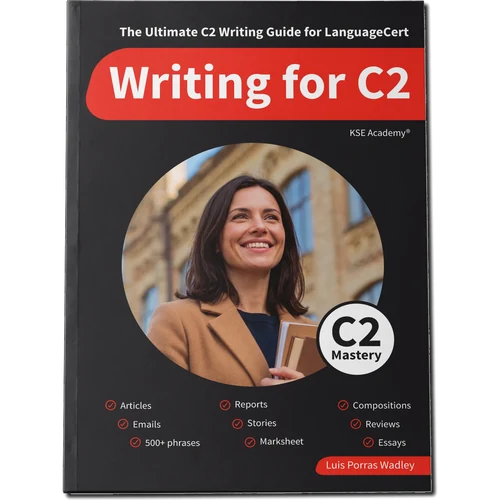
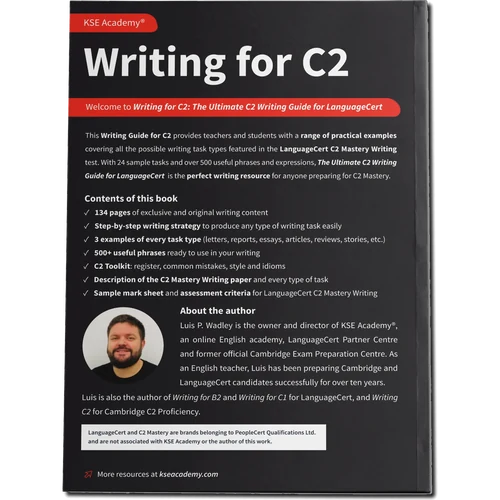
Para el Reading, lo que más ayuda es leer mucho y practicar con exámenes. Pero como el Reading comparte tiempo con el Writing, prepararte bien el Writing te dará minutos de oro. Para eso tienes mi guía del Writing del C2 Mastery y el libro de KSE Academy para el Writing C2 de LanguageCert, con todos los tipos de tarea, respuestas modelo y expresiones útiles. Es un libro de Writing, no de Reading, pero te ayudará a terminar el Writing más rápido y con más seguridad.
Y con esto ya tienes todo lo que necesitas saber del Reading del C2 Mastery. Si te queda alguna duda, déjame un comentario y te respondo encantado. 🙂
