
Tabla de contenidos
El Reading del C1 Expert de LanguageCert es exigente, pero también muy predecible: siempre son cuatro textos con cuatro tipos de tarea, y lo que cambia respecto al B2 no es tanto el formato como el tipo de texto. Aquí te vas a encontrar argumentos, ironía, lenguaje idiomático y textos densos, y tendrás que leer entre líneas. Además, comparte tiempo con el Writing, así que gestionar bien el reloj es media nota.
Desde mi experiencia como preparador de exámenes, en el C1 los puntos se pierden casi siempre por leer demasiado rápido: el texto se entiende, pero se escapa un matiz. Por eso, en esta guía te explico cómo es el Reading del C1 Expert, qué tienes que hacer en cada una de sus cuatro partes, cómo se corrige y, lo más importante, te dejo un ejemplo de cada parte, escrito por mí, con las respuestas explicadas. ¡Vamos allá!
Reading C1 Expert: qué es el nivel C1
El C1 Expert certifica un nivel C1 del Marco Común Europeo de Referencia para las Lenguas (MCER), un nivel avanzado. En comprensión lectora, eso significa que entiendes textos largos y complejos, tanto de temas concretos como abstractos, que aprecias las diferencias de estilo y de propósito, y que captas lo que el autor sugiere sin decirlo abiertamente.
Traducido al examen, en el Reading del C1 Expert tienes que ser capaz de:
- Entender un texto con lenguaje idiomático, argumentos y opiniones, y decidir si una afirmación sobre él es verdadera o falsa.
- Ver cómo se construye el discurso: referencias, contrastes, ejemplos y transiciones entre ideas.
- Localizar información concreta en varios textos cortos y distinguir su propósito.
- Responder a preguntas con respuestas cortas y precisas, a menudo reformulando lo que dice el texto.
Cómo es el Reading del C1 Expert
El Reading forma parte del Written Exam, junto con el Listening y el Writing. Estas son sus características principales:
- Se hace después del Listening, y tienes 2 horas y 40 minutos para el Reading y el Writing juntos, en el orden que prefieras.
- Tiene cuatro partes y 26 preguntas, y cada respuesta correcta vale 1 punto.
- Las respuestas se pasan a una hoja de respuestas (Answer Sheet) dentro de ese tiempo.
- Puedes hacerlo en papel en un centro o online desde casa, con el mismo formato.
| Parte | Texto | Tarea | Preguntas |
|---|---|---|---|
| Part 1 | Un texto con lenguaje idiomático, ideas narrativas o académicas, argumentos y opiniones | Decidir si 5 afirmaciones son verdaderas o falsas | 5 |
| Part 2 | Un texto al que le faltan 6 frases | Elegir la frase de cada hueco entre 8 (sobran dos) | 6 |
| Part 3 | Cuatro textos cortos sobre un mismo tema, con propósitos distintos | Decidir en qué texto (A a D) está cada información | 7 |
| Part 4 | Un texto continuo: narrativo, descriptivo, explicativo, biográfico… | Responder a preguntas abiertas en 5 palabras como máximo | 8 |
Las cuatro partes del Reading C1 Expert
Part 1
Lees un texto con lenguaje idiomático, ideas narrativas o académicas, argumentos y opiniones, y decides si 5 afirmaciones sobre él son verdaderas (T) o falsas (F). Parece la tarea más sencilla, pero no lo es: las afirmaciones parafrasean el texto, y una sola palabra (always, never, only, altogether) puede convertir una afirmación casi correcta en falsa. Solo hay dos opciones: no existe la de «el texto no lo dice».
Part 2
Tienes un texto al que le han quitado 6 frases, y una lista de 8 frases para completar los huecos. Sobran dos, así que las trampas son más difíciles de descartar. Aquí no basta con entender la frase: tienes que ver cómo encaja con lo que va antes y con lo que va después. Fíjate mucho en los pronombres (it, this, they), en los conectores (however, for example, instead) y en las repeticiones de ideas.
Part 3
Lees cuatro textos cortos (un anuncio, un email, un artículo, un folleto…) que tratan el mismo tema pero tienen propósitos distintos, y respondes a 7 preguntas del tipo «¿En qué texto se menciona…?». Puedes usar cada texto más de una vez. Es una tarea de buscar información rápido, pero con trampa: las preguntas están parafraseadas y varios textos hablan de cosas parecidas.
Part 4
Lees un texto continuo (una historia, una biografía, un texto explicativo…) y respondes a 8 preguntas abiertas (what, why, where…) con cinco palabras como máximo. No hace falta escribir frases completas, pero la respuesta tiene que contestar exactamente a lo que se pregunta.
Ejemplos de Reading C1 Expert
Estos ejemplos los he escrito yo siguiendo el formato del examen, con textos y preguntas de nivel C1. Intenta hacerlos sin mirar las respuestas y, después, lee la explicación de cada una: es ahí donde se aprende cómo piensa el examen.
Ejemplo de Reading C1 Expert: Part 1
Un artículo de opinión sobre el aburrimiento, con cinco afirmaciones para decidir si son verdaderas o falsas:
Read the text and the statements. Decide whether each statement is true (T) or false (F).
In defence of boredom
There was a time, not so very long ago, when being bored was an unavoidable part of life. You queued at the post office with nothing to look at but the back of the person in front of you; you sat through long car journeys staring out of the window; you waited for the kettle to boil. These days, boredom has all but disappeared, or at least we have become remarkably skilled at keeping it at arm’s length. The moment there is a gap in our day, however small, out comes the phone.
On the face of it, this is progress. Few people would argue that standing in a queue doing nothing is a better use of time than catching up on the news or replying to a friend. Yet a growing number of psychologists believe that by filling every idle moment, we may be throwing the baby out with the bathwater. Boredom, they argue, is not simply an unpleasant feeling to be got rid of as quickly as possible; it is a signal that our current activity is not meeting our needs, and a nudge to go and find something more meaningful to do.
Some researchers go further, claiming that boredom is good for creativity. In one frequently cited study, participants who had first been given a mind-numbingly dull task, copying numbers out of a telephone directory, came up with more original ideas in a subsequent creativity test than those who had gone straight to it. The explanation usually offered is that when the mind is under-stimulated, it starts to wander, and mind-wandering is where unexpected connections are made.
It would be wrong, however, to get carried away. The evidence is still patchy, and the studies tend to be small. Moreover, there is a world of difference between the occasional dull afternoon and the chronic boredom experienced by people stuck in unrewarding jobs or long periods of unemployment, which is associated with anything but creativity. Romanticising boredom is easy for those who can choose when to be bored.
What does seem clear is that something is lost when we never allow our minds to drift. The writer who gets her best ideas in the shower is not a cliché for nothing: it is one of the few places left where nobody checks their phone. Perhaps, then, the answer is not to banish our devices, which would be neither realistic nor particularly desirable, but to stop treating every pause as an emergency. The next time you find yourself waiting for a bus, try doing nothing at all. You may be surprised by what turns up.
- The writer believes that people today are better at avoiding boredom than they were in the past.
- According to some psychologists, boredom serves no useful purpose.
- In the study mentioned, the participants who did a dull task first produced less original ideas.
- The writer suggests that the evidence linking boredom and creativity is not yet conclusive.
- The writer recommends giving up mobile phones altogether.
Ver respuestas
- T: «Boredom has all but disappeared, or at least we have become remarkably skilled at keeping it at arm’s length». Hoy evitamos el aburrimiento mucho mejor que antes.
- F: Es justo al revés: para estos psicólogos, el aburrimiento es una señal de que lo que hacemos no nos llena y un empujón para buscar algo con más sentido.
- F: Quienes hicieron primero la tarea aburrida tuvieron ideas más originales, no menos.
- T: «The evidence is still patchy, and the studies tend to be small»: las pruebas todavía no son concluyentes.
- F: El autor dice expresamente que desterrar los dispositivos no sería «ni realista ni especialmente deseable». Lo que propone es no tratar cada pausa como una emergencia.
En las preguntas de verdadero o falso del C1, fíjate en las palabras que cambian el sentido: no useful purpose, less original, altogether. Basta con una para que la afirmación sea falsa.
Ejemplo de Reading C1 Expert: Part 2
Un texto sobre cómo pedir perdón bien. Lee primero el texto entero, aunque tenga huecos, y después busca las frases:
Read the text. Six sentences have been removed. Choose the correct sentence (A to H) for each gap. There are two extra sentences you do not need.
The art of the apology
Few skills are as undervalued as the ability to apologise well. We are taught to say sorry as soon as we can talk, usually under the stern gaze of a parent, and many of us never progress much beyond that stage. (1) _______________ Anyone who has received a grudging ‘I’m sorry if you were offended’ knows that some apologies make matters worse rather than better.
So what distinguishes an apology that works from one that does not? (2) _______________ Researchers who have analysed thousands of them tend to agree on a handful of key ingredients. The first, and arguably the most important, is an acknowledgement of responsibility. ‘Mistakes were made’ does not count.
(3) _______________ An apology that dwells at length on the pressures the speaker was under, or on what the other person did to provoke them, quickly turns into a defence. The person receiving it is left feeling that they are being asked to sympathise rather than being offered an apology.
A third ingredient is an offer of repair. (4) _______________ In some cases this is straightforward: if you break a friend’s vase, you can replace it. In others, particularly where trust has been damaged, the repair may consist of little more than a commitment to behave differently in future.
Interestingly, timing matters too, though not always in the way one might expect. (5) _______________ Apologies offered too quickly, before the injured party has had the chance to express how they feel, can come across as an attempt to close the subject. Waiting a little, and listening first, often produces a better result.
Perhaps the hardest part of apologising, though, is not finding the right words but overcoming our own reluctance. (6) _______________ Paradoxically, people tend to think more highly of those who admit their mistakes gracefully, not less. The apology we fear will diminish us usually does the opposite.
- A. Yet an apology is a surprisingly complex act, and it is remarkably easy to get wrong.
- B. It is not, it turns out, simply a matter of saying the words with feeling.
- C. The second is to resist the temptation to explain too much.
- D. This means showing a willingness to put right whatever harm has been done.
- E. It is often assumed that the sooner an apology is made, the better.
- F. Many of us worry that saying sorry will make us look weak or incompetent.
- G. Children, after all, tend to apologise far more readily than adults.
- H. That is why the most effective apologies are always made in writing.
Ver respuestas
- A: «Many of us never progress much beyond that stage» y, después, el ejemplo de una disculpa que empeora las cosas: A introduce la idea de que disculparse es fácil de hacer mal.
- B: Responde a la pregunta anterior («what distinguishes an apology that works…?») y prepara lo que viene: los investigadores han encontrado unos «ingredientes» concretos.
- C: «The first… is an acknowledgement of responsibility» pide un «the second», y la frase siguiente desarrolla justo eso: las disculpas que se explican demasiado se convierten en una defensa.
- D: «An offer of repair» se explica en D, y «In some cases this is straightforward» se refiere a reparar el daño.
- E: «Not always in the way one might expect»: E presenta lo que solemos pensar (cuanto antes, mejor) y el texto lo matiza a continuación.
- F: «Overcoming our own reluctance» y, después, «Paradoxically, people tend to think more highly of those who admit their mistakes»: F explica de dónde viene esa resistencia.
Sobran la G (habla de niños, pero no conecta con la disculpa «a regañadientes» que viene después) y la H (el texto nunca habla de disculparse por escrito).
Ejemplo de Reading C1 Expert: Part 3
Cuatro textos cortos sobre el trabajo desde casa, cada uno con un propósito distinto:
Read the four texts (A to D) and the questions. For each question, choose the correct text. You can use each text more than once.
A
The Workroom, Kingsbridge
Tired of working at the kitchen table? Fed up with cafés where the Wi-Fi drops every time someone orders a latte? The Workroom offers flexible desk space in a converted Victorian warehouse just five minutes from Kingsbridge station. Choose a hot desk by the day, or a dedicated desk with lockable storage on a monthly basis. Members enjoy high-speed broadband, unlimited coffee, bookable meeting rooms and a programme of lunchtime talks that are as good for networking as they are for learning. There is no joining fee and no minimum contract: if it doesn’t suit you, simply walk away. Book a free trial day online.
B
Five years after the great shift to home working, the evidence on its effects remains stubbornly mixed. Some large studies have found that employees working from home are more productive, citing fewer interruptions and the time saved by not commuting. Others have reached the opposite conclusion, particularly for tasks that depend on collaboration. What most researchers do agree on is that the answer depends heavily on the individual. Younger employees, who are more likely to live in shared or cramped accommodation and who have most to gain from watching more experienced colleagues at work, appear to benefit least. For many of them, the office was never simply a place to work; it was a place to learn the unwritten rules of a profession.
C
Subject: Hybrid working from March
Dear all,
Following the staff survey in the autumn, the management team has agreed a new approach to office attendance. From March, all staff will be expected to work from the office on Tuesdays and Thursdays, with the remaining days at your discretion. We recognise that this is a significant change for those of you who have been working mainly from home, so it will be phased in over three months, starting with one office day a week. Line managers will be in touch to discuss individual circumstances, including any caring responsibilities. In the meantime, please don’t hesitate to raise any concerns with me directly.
Best wishes, Hannah Clarke, Head of Operations
D
Sir,
I read with dismay your article celebrating the ‘return to the office’. As someone who spent fifteen years commuting two hours a day, I can assure your writer that there is nothing romantic about a delayed train. Since my employer allowed me to work from home, I have reclaimed ten hours a week, which I now spend with my children rather than on the 7.42. I accept that I miss the occasional chat by the coffee machine, but I would not exchange my current arrangement for any number of them. Employers who insist on bringing staff back simply because they want to see people at their desks should ask themselves what they are really measuring.
Name and address supplied
- Which text mentions a change that will be introduced in stages?
- Which text refers to research that has reached opposite conclusions?
- Which text admits that working from home has a minor drawback?
- Which text describes an arrangement that can be ended without any penalty?
- Which text suggests that some workers miss out on informal learning when they work from home?
- Which text questions the motives of some employers?
- Which text invites the reader to raise personal difficulties?
Ver respuestas
- C: El cambio «will be phased in over three months, starting with one office day a week».
- B: Unos estudios dicen que se rinde más en casa y otros llegan a «the opposite conclusion».
- D: «I accept that I miss the occasional chat by the coffee machine»: un inconveniente pequeño que no le hace cambiar de opinión.
- A: «No joining fee and no minimum contract: if it doesn’t suit you, simply walk away».
- B: Para los más jóvenes, la oficina era el lugar donde aprendían «las reglas no escritas» de su profesión viendo trabajar a otros.
- D: Pide a las empresas que se pregunten qué están midiendo de verdad cuando quieren ver a la gente en su mesa.
- C: Los responsables hablarán de las circunstancias de cada uno y la autora invita a plantearle cualquier preocupación directamente.
Ejemplo de Reading C1 Expert: Part 4
Un texto explicativo sobre cómo entra una palabra en el diccionario, con ocho preguntas abiertas. Recuerda: cinco palabras como máximo por respuesta.
Read the text and answer the questions. Use a maximum of five words for each answer.
How a word gets into the dictionary
Every year, the publication of new dictionary entries is greeted with a mixture of amusement and outrage. Commentators queue up to lament the inclusion of some piece of internet slang and to declare that the language is going to the dogs. What rarely gets reported is the painstaking process behind each decision, and the fact that lexicographers, as the people who write dictionaries are known, see their job not as deciding what words should mean but as recording how people actually use them.
The process begins with evidence. Modern dictionaries rely on vast electronic collections of written and spoken English, known as corpora, which may contain billions of words drawn from newspapers, books, websites, transcribed conversations and even television subtitles. When a new word, or a new meaning of an existing word, starts to appear, it is flagged for further investigation. Members of the public can also suggest words, though editors are quick to point out that a single enthusiastic email is no substitute for evidence of widespread use.
The key question is not whether a word is new, but whether it is likely to last. Lexicographers look for three things in particular. The first is frequency: the word must appear often enough to suggest that a reasonable number of people are using it. The second is spread. A term used only by a small group, such as the players of a particular online game, is unlikely to be included, however frequently it appears. The third, and perhaps the hardest to judge, is staying power. Most editors prefer to wait until a word has been in use for several years before admitting it, which explains why dictionaries are often accused of being behind the times.
Once a word has passed these tests, the real work begins. Writing a definition is a surprisingly difficult craft. It must be accurate, concise and written in words that are simpler than the one being defined, which rules out the tempting shortcut of using a synonym. Lexicographers also have to decide how the word is pronounced, what part of speech it is and whether it needs a label, such as ‘informal’ or ‘offensive’, to guide the reader.
Ironically, the words that cause the greatest public outcry are often the ones that lexicographers find least controversial, since the evidence for their use is overwhelming. The decisions that keep editors awake at night tend to involve words that are changing their meaning, where today’s mistake may well become tomorrow’s standard usage.
- How do lexicographers see the purpose of their work?
- What are corpora?
- What is not considered enough evidence that a word is widely used?
- Why might a word used by players of an online game be left out?
- Why are dictionaries often said to be behind the times?
- What shortcut must a definition avoid?
- Apart from pronunciation and part of speech, what may a word need?
- Which words give editors the most difficulty?
Ver respuestas
- recording how people use words / recording actual usage
- (large) electronic collections of English / collections of written and spoken English
- a single (enthusiastic) email
- it is not widespread / only a small group uses it
- editors wait several years (before including words)
- (using) a synonym
- a label (such as ‘informal’ or ‘offensive’)
- words that are changing (their) meaning
En el C1 hay ocho preguntas en lugar de siete, y las respuestas suelen exigir que reformules o resumas una idea, no solo que copies un dato. Aun así, el límite sigue siendo de cinco palabras.
Cómo se evalúa el Reading del C1 Expert
El Reading tiene 26 preguntas y cada respuesta correcta vale 1 punto, así que la nota máxima es de 26 puntos. No se resta por los errores, así que no dejes ninguna pregunta en blanco.
Esa nota se convierte después a una puntuación sobre 50, igual que la del Listening y la del Writing. Las tres suman una nota sobre 150 para todo el Written Exam, y para aprobar necesitas 75 sobre 150 (Pass). A partir de 101 sobre 150 obtienes un High Pass. Es decir, el aprobado es del examen escrito completo, no de cada parte por separado: un buen Reading puede compensar un Listening flojo, y al revés.
En la Part 4, la respuesta tiene que contestar exactamente a lo que se pregunta y no pasar de cinco palabras: copiar un trozo largo del texto «por si acaso» no te asegura el punto.
Consejos para el Reading del C1 Expert
Estos son los consejos que doy a mis alumnos para el Reading del C1 Expert:
- Decide antes cuánto tiempo le das a cada parte. El Reading y el Writing comparten 2 horas y 40 minutos, y el Writing del C1 es largo. Una buena referencia es dejar al menos una hora y cuarto para el Writing.
- En la Part 1, busca la parte del texto que corresponde a cada afirmación y compárala con calma. Una afirmación es verdadera solo si el texto dice exactamente eso.
- Cuidado con el lenguaje idiomático. Expresiones como throw the baby out with the bathwater o get carried away suelen esconder la clave de una pregunta.
- En la Part 2, comprueba lo que va antes y lo que va después del hueco. Una frase que encaja con lo anterior pero no con lo siguiente no es la buena.
- En la Part 3, subraya la idea clave de cada pregunta y busca su equivalente, no la palabra exacta.
- En la Part 4, cuenta las palabras. Copia del texto si hace falta, pero solo lo justo para responder.
- Pasa las respuestas a la hoja con tiempo. Una respuesta que no está en la hoja no cuenta.
Para ver el examen completo, aquí tienes la guía del LanguageCert C1 Expert, con los exámenes de muestra oficiales para descargar. Y si dudas entre exámenes, también tienes mi guía del C1 Advanced de Cambridge.
Y para el Writing del C1 Expert…
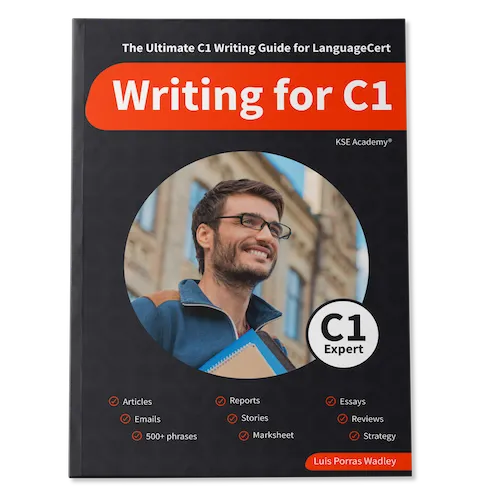
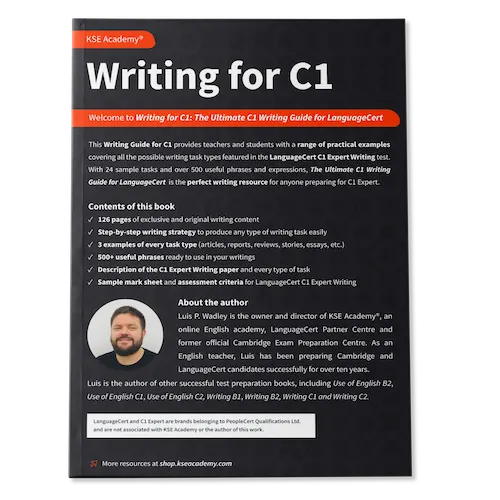
Para el Reading, lo que más ayuda es leer mucho y practicar con exámenes. Pero como el Reading comparte tiempo con el Writing, prepararte bien el Writing te dará minutos de oro. Para eso tienes mi guía del Writing del C1 Expert y el libro de KSE Academy para el Writing C1 de LanguageCert, con todos los tipos de tarea, respuestas modelo y expresiones útiles. Es un libro de Writing, no de Reading, pero te ayudará a terminar el Writing más rápido y con más seguridad.
Y con esto ya tienes todo lo que necesitas saber del Reading del C1 Expert. Si te queda alguna duda, déjame un comentario y te respondo encantado. 🙂
