
Tabla de contenidos
El Speaking del B1 Achiever de LanguageCert dura 12 minutos y lo haces tú solo con un interlocutor, sin compañero. Es el nivel en el que el examen empieza a parecerse a una conversación de verdad: ya no basta con responder, también tienes que dar tu opinión, ponerte de acuerdo con el interlocutor y contar una historia durante minuto y medio.
Desde mi experiencia como preparador de exámenes, el Speaking del B1 se aprueba sobre todo practicando el formato, porque cada parte pide algo distinto. Por eso, en esta guía te explico cómo es el Speaking del B1 Achiever, qué tienes que hacer en cada una de sus cuatro partes, cómo se corrige y, lo más importante, te enseño un ejemplo de cada parte con una respuesta modelo de nivel B1 y un breve análisis. ¡Vamos allá!
Speaking B1 Achiever: qué es el nivel B1
El B1 Achiever certifica un nivel B1 del Marco Común Europeo de Referencia para las Lenguas (MCER), lo que se conoce como un nivel intermedio. En lo que a la conversación se refiere, el MCER dice que un hablante de B1:
Sabe desenvolverse en casi todas las situaciones que se le presentan cuando viaja donde se habla esa lengua. Puede participar espontáneamente en una conversación que trate temas cotidianos de interés personal o que sean pertinentes para la vida diaria (por ejemplo, familia, aficiones, trabajo, viajes y acontecimientos actuales).
Traducido al examen, en el Speaking del B1 Achiever tienes que ser capaz de:
- Hablar de ti y de tus experiencias, y dar tu opinión con un motivo.
- Desenvolverte en situaciones cotidianas: disculparte, pedir información, quejarte con educación…
- Comentar varias opciones con el interlocutor y llegar a un acuerdo.
- Hablar minuto y medio seguido sobre un tema: contar algo que te pasó, describir a alguien, hablar de tus planes…
No se espera un discurso perfecto. Se espera que te comuniques sin demasiada ayuda, que unas las ideas con sentido y que los errores no impidan entenderte.
Cómo es el Speaking del B1 Achiever
El Speaking es el Spoken Exam del B1 Achiever y es un examen independiente del Written Exam (Listening, Reading y Writing), así que puedes hacerlo otro día. Estas son sus características principales:
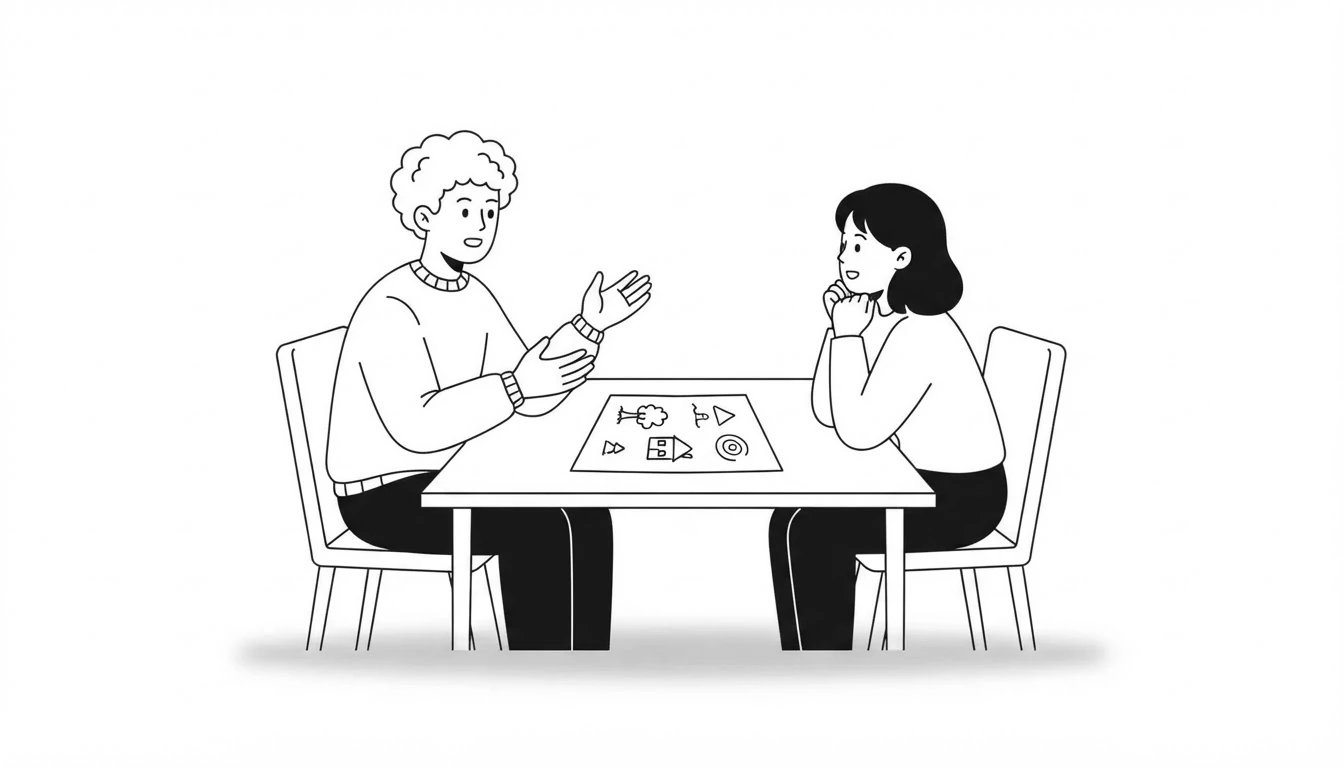
- Es individual: estáis tú y un interlocutor, sin compañero.
- Dura 12 minutos y tiene cuatro partes.
- Puedes hacerlo en un centro, cara a cara, o online desde casa. En los dos casos, el interlocutor está contigo en directo.
- Se graba, y no te evalúa el interlocutor, sino un examinador de LanguageCert que escucha la grabación después.
- En la Part 2 el interlocutor interpreta un papel (un vecino, un recepcionista…), pero tú nunca tienes que hacer de otra persona: siempre hablas como tú mismo.
| Parte | Duración | Qué tienes que hacer |
|---|---|---|
| Part 1 | 3 minutos | Deletrear tu apellido, decir de dónde eres y responder hasta 5 preguntas sobre ti y tus opiniones. |
| Part 2 | 3 minutos | Dos role plays breves: en uno empieza el interlocutor y en el otro empiezas tú. |
| Part 3 | 3 minutos | Hablar con el interlocutor sobre unas imágenes con varias opciones y tomar una decisión juntos. |
| Part 4 | 3 minutos | Tras 30 segundos para tomar notas, hablar minuto y medio sobre un tema y responder preguntas de seguimiento. |
Las cuatro partes del Speaking B1 Achiever
Part 1
Es la parte para romper el hielo. El interlocutor te pide que deletrees tu apellido y te pregunta de dónde eres. Después te hace hasta cinco preguntas, cada una de un tema distinto (los viajes, la música, las compras…). En el B1 ya se espera que des tu opinión y la justifiques con un motivo o un ejemplo.
Part 2
Aquí tienes que desenvolverte en situaciones de la vida real. El interlocutor te plantea al menos dos situaciones:
- En la primera, empieza él («I start.») y tú respondes.
- En la segunda, empiezas tú («You start.»), así que eres tú quien abre la conversación.
Cada situación dura unos dos turnos por persona y, si sobra tiempo, puede haber una tercera. Se evalúa que uses el lenguaje funcional adecuado: disculparte, pedir información, quejarte, ofrecer ayuda…
Part 3
Es una pequeña discusión para tomar una decisión. El interlocutor te da una hoja con imágenes de varias opciones (cosas que comprar, actividades, lugares…) y tenéis que hablar de ellas hasta poneros de acuerdo. Empieza el interlocutor. Importa más cómo das tu opinión, preguntas por la suya y propones que llegar a un acuerdo perfecto en el tiempo que tienes.
Part 4
Es tu turno largo. El interlocutor elige uno de tres temas y te da papel y bolígrafo para que tomes notas durante 30 segundos. Después tienes que hablar minuto y medio sin ayuda y, al terminar, responder a algunas preguntas de seguimiento (follow-up questions) sobre el mismo tema.
Ejemplos de Speaking B1 Achiever
Ahora vamos a lo práctico. Te enseño una tarea de cada parte, escrita por mí siguiendo el formato del examen, con una respuesta modelo de nivel B1 y un análisis de por qué funciona. En el examen real hablarás, así que no se trata de memorizar estas respuestas, sino de fijarte en cómo están construidas.
Ejemplo de Speaking B1 Achiever: Part 1
Estas serían las preguntas de la Part 1:
Part 1. The interlocutor asks you to spell your surname and says Where are you from? Then you’ll be asked up to five questions on different topics, for example:
- Travel: Do you prefer travelling by train or by plane? Why?
- Music: Has your taste in music changed since you were a teenager?
- Shopping: Do you enjoy going shopping, or do you find it stressful?
- Technology: How did you learn to use a computer?
- Your neighbourhood: What would you change about the area where you live?
Y así podría responderlas un candidato de nivel B1:
Interlocutor: Do you prefer travelling by train or by plane? Why?
Candidate: By train, definitely. It’s more comfortable, you can walk around, and you don’t have to be at the station two hours early like at the airport. I also like looking out of the window.
Interlocutor: Has your taste in music changed since you were a teenager?
Candidate: Yes, quite a lot. When I was fifteen I only listened to rock, but now I prefer quieter music, like jazz or acoustic songs, especially when I’m working.
Interlocutor: Do you enjoy going shopping, or do you find it stressful?
Candidate: It depends. I like shopping for food at the market, but I find clothes shopping stressful, especially on Saturdays, because the shops are always full of people.
Interlocutor: How did you learn to use a computer?
Candidate: My older brother taught me when I was about ten. Later we had computer classes at school, but I think I learnt most things just by trying.
Interlocutor: What would you change about the area where you live?
Candidate: I’d like more green spaces. There’s only one small park, so I’d turn the old car park into a garden where children could play.
Por qué funciona:
Por qué funciona:
Por qué funciona:
Por qué funciona:
- Respuestas de dos o tres frases, con la opinión primero y el motivo después.
- Usa tiempos distintos según la pregunta: el pasado (When I was fifteen I only listened to…), el presente y el condicional (I’d like more green spaces).
- Matiza en lugar de responder sí o no: It depends., Yes, quite a lot.
Expresiones útiles: …, definitely., It depends., When I was…, I used to…, I’d like…, especially when…
Ejemplo de Speaking B1 Achiever: Part 2
En la primera situación empieza el interlocutor:
Part 2, first situation. We’re neighbours. I start.
Hi. Sorry to bother you, but your music was really loud last night.
Interlocutor: Hi. Sorry to bother you, but your music was really loud last night.
Candidate: Oh, I’m really sorry. It was my birthday and I had some friends round. I didn’t realise it was so loud.
Interlocutor: I couldn’t sleep until two o’clock.
Candidate: That’s terrible, I apologise. It won’t happen again, and next time I’ll let you know before I have people over.
En la segunda, eres tú quien tiene que empezar:
Part 2, second situation. I work at the reception desk of a gym. You’d like to join. You start.
Candidate: Hello. I’m interested in joining the gym. Could you tell me how much it costs?
Interlocutor: Of course. It’s forty euros a month, or four hundred for the whole year.
Candidate: I see. And is it open at weekends? I work long hours during the week, so I’d mostly come on Saturdays and Sundays.
Interlocutor: Yes, from eight in the morning until eight in the evening.
Candidate: Great. Is it possible to try it for a day before I decide?
- Con el vecino, se disculpa, da una explicación y promete una solución, que es lo que se espera ante una queja.
- En el gimnasio, abre la conversación con una frase clara y hace preguntas educadas con Could you…? e Is it possible to…?
- En las dos situaciones reacciona a lo que dice el interlocutor (That’s terrible, I see), en lugar de soltar frases preparadas.
Expresiones útiles: I’m really sorry., I didn’t realise…, It won’t happen again., I’m interested in…, Could you tell me…?, Is it possible to…?
Ejemplo de Speaking B1 Achiever: Part 3
En la Part 3, el candidato recibe una hoja con imágenes. Aquí te describo lo que aparece en ella:
Part 3. Our English school wants to make the students’ common room a nicer place, and it can buy two things. Here are some pictures of ideas. Let’s talk about them and decide together which two would be best. I’ll start.
Pictures on the task sheet:
- a coffee machine
- a table tennis table
- shelves with books and magazines in English
- a big TV
- plants and comfortable sofas
- two computers
Interlocutor: So, what do you think about the coffee machine?
Candidate: I think it’s a good idea, because a lot of students come straight from work and they’re tired. But the school already has a café downstairs, so maybe it isn’t the most important thing.
Interlocutor: That’s true. What about the table tennis table?
Candidate: It would be fun, but I think it’s quite noisy, and some people use the common room to study. What do you think about the books and magazines?
Interlocutor: I like that idea. Students could practise their reading.
Candidate: Yes, I agree, and it’s cheap. I also like the plants and the comfortable sofas. At the moment the room is a bit cold and boring, and with sofas people would stay and talk to each other in English.
Interlocutor: And the TV or the computers?
Candidate: Everyone has a phone, so I don’t think we need computers. And a TV can stop people talking to each other. So, shall we choose the books and the sofas with plants?
Interlocutor: Yes, I think that’s a good decision.
- Comenta los pros y los contras de cada opción en vez de decir solo si le gusta.
- Pregunta la opinión del interlocutor (What do you think about…?), que es parte de la tarea.
- Termina proponiendo una decisión (So, shall we choose…?), que cierra la tarea con naturalidad.
Expresiones útiles: I think it’s a good idea, because…, It would be…, but…, What do you think about…?, I agree., I don’t think we need…, So, shall we choose…?
Ejemplo de Speaking B1 Achiever: Part 4
Estos serían los tres temas de la Part 4:
Part 4. The interlocutor chooses one of these topics, gives you paper and a pen, and you have thirty seconds to write some notes:
- A A teacher you remember
- B A trip that didn’t go as planned
- C Your plans for the next few years
Talk for one and a half minutes. Then answer the interlocutor’s follow-up questions.
Supongamos que te toca el tema B. Así podrían ser las notas y la charla de un candidato de nivel B1, con las preguntas de seguimiento al final:
Notes (30 seconds): Rome, last summer / with friends / train cancelled / no hotel room / slept at station café / met a family / great evening / lesson: plan B
Candidate: I’d like to talk about a trip to Rome last summer, which didn’t go as we planned at all. I went with two friends from university, and we wanted to spend three days there. The problems started on the first day, because our train from the airport was cancelled, so we arrived in the city centre four hours late.
Candidate: When we finally got to the hotel, the receptionist told us there was a mistake with our booking and there were no rooms left. We were really tired and a bit angry, because it was nearly midnight and all the other hotels near the station were full.
Candidate: In the end, we spent the night in a café at the station. It sounds awful, but actually something nice happened. We started chatting to an Italian family who were waiting for an early train, and they shared their food with us and gave us lots of tips about the city.
Candidate: The next morning we found a small hotel, and the rest of the trip was fantastic. I learnt that it’s always a good idea to have a plan B, but also that sometimes the problems are what you remember most.
Interlocutor: Thank you. Do you usually plan your holidays carefully?
Candidate: Not really. I book the transport and the hotel, but I like deciding what to do when I get there.
Interlocutor: Would you go back to Rome?
Candidate: Yes, definitely. There were lots of places we didn’t have time to see, like the museums.
- Las notas siguen el orden de la historia, de principio a fin, y le sirven de guion.
- La historia tiene una estructura clara: presentación, problemas, cómo lo resolvieron y qué aprendió.
- Usa los tiempos del pasado y los conectores de una narración: The problems started…, When we finally got…, In the end…, The next morning…
Expresiones útiles: I’d like to talk about…, The problems started when…, In the end…, It sounds…, but actually…, I learnt that…
Vídeo de ejemplo del Speaking B1 Achiever
LanguageCert publica la grabación de un examen de Speaking real del B1 Achiever, junto con la nota que le puso el examinador. Merece mucho la pena verlo para hacerte una idea del ritmo del examen.
En el vídeo, Sara obtiene un Pass: 8 de 12 puntos, que equivalen a 34 de 50. Resuelve las tareas casi sin ayuda del interlocutor, la conversación fluye con bastante naturalidad y une bien sus ideas. Su gramática es algo limitada para el nivel y tiene errores que se notan, aunque no impiden entender lo que dice. Su vocabulario es correcto, con algún fallo cuando el tema le resulta menos familiar, y se nota la influencia de su lengua materna, pero todo se entiende bien y solo hay alguna duda de vez en cuando.
Fíjate en que Sara aprueba con un 2 en los cuatro criterios: no hace falta hablar sin errores, sino comunicarse con soltura y sin depender del interlocutor.
Cómo se evalúa el Speaking del B1 Achiever
El examinador escucha la grabación y te puntúa en cuatro criterios, cada uno de 0 a 3 puntos, teniendo en cuenta tu actuación en todo el examen:
| Criterio | Qué se valora |
|---|---|
| Task Fulfilment and Coherence | Si haces lo que pide cada tarea sin depender del interlocutor, si la conversación fluye y si unes bien las ideas. |
| Accuracy and Range of Grammar | Si usas una variedad de estructuras de B1 y si los errores dificultan la comunicación. |
| Accuracy and Range of Vocabulary | Si tu vocabulario es suficiente y adecuado para los temas del examen. |
| Pronunciation, Intonation and Fluency | Si se te entiende con facilidad y si mantienes el ritmo sin demasiadas pausas. |
Así que la nota máxima es de 12 puntos, que luego se convierten a una puntuación sobre 50. Para aprobar necesitas 25 sobre 50 (Pass), y a partir de 38 sobre 50 obtienes un High Pass.
Consejos para el Speaking del B1 Achiever
Estos son los consejos que doy a mis alumnos para el Speaking del B1 Achiever:
- Da siempre un motivo. Después de tu opinión, añade because… o un ejemplo. Es la forma más sencilla de demostrar nivel B1.
- Practica historias en pasado. En la Part 4 salen muchas veces experiencias: un viaje, un día especial, una persona importante. Ten dos o tres historias preparadas y adáptalas.
- Cronométrate minuto y medio. Se hace largo si no lo has practicado. Grábate y comprueba si llegas al tiempo sin repetirte.
- En la Part 3, pregunta también. No te limites a dar tu opinión: pregunta la del interlocutor y propón una decisión al final.
- No te preocupes por el interlocutor. No es quien te evalúa, así que no intentes leer su cara. Habla para la grabación.
- Si no sabes una palabra, explícala. It’s a thing you use to… mantiene la conversación en marcha.
Si quieres comparar con el examen equivalente de Cambridge, tienes también mi guía del Speaking del B1 Preliminary. Y para ver el examen completo, aquí tienes la guía del LanguageCert B1 Achiever.
Siguiente paso: el Writing del B1 y el Speaking del B2
Si también te estás preparando la parte escrita del examen, tienes mi guía del Writing del B1 Achiever, con un ejemplo de cada tipo de tarea. Y cuando quieras dar el salto al siguiente nivel, en la guía del Speaking del B2 Communicator verás qué cambia: más tiempo para pensar en la Part 3, una negociación más compleja y dos minutos de turno largo.
Y con esto ya tienes todo lo que necesitas saber del Speaking del B1 Achiever. Si te queda alguna duda, déjame un comentario y te respondo encantado. 🙂
