
Table of contents
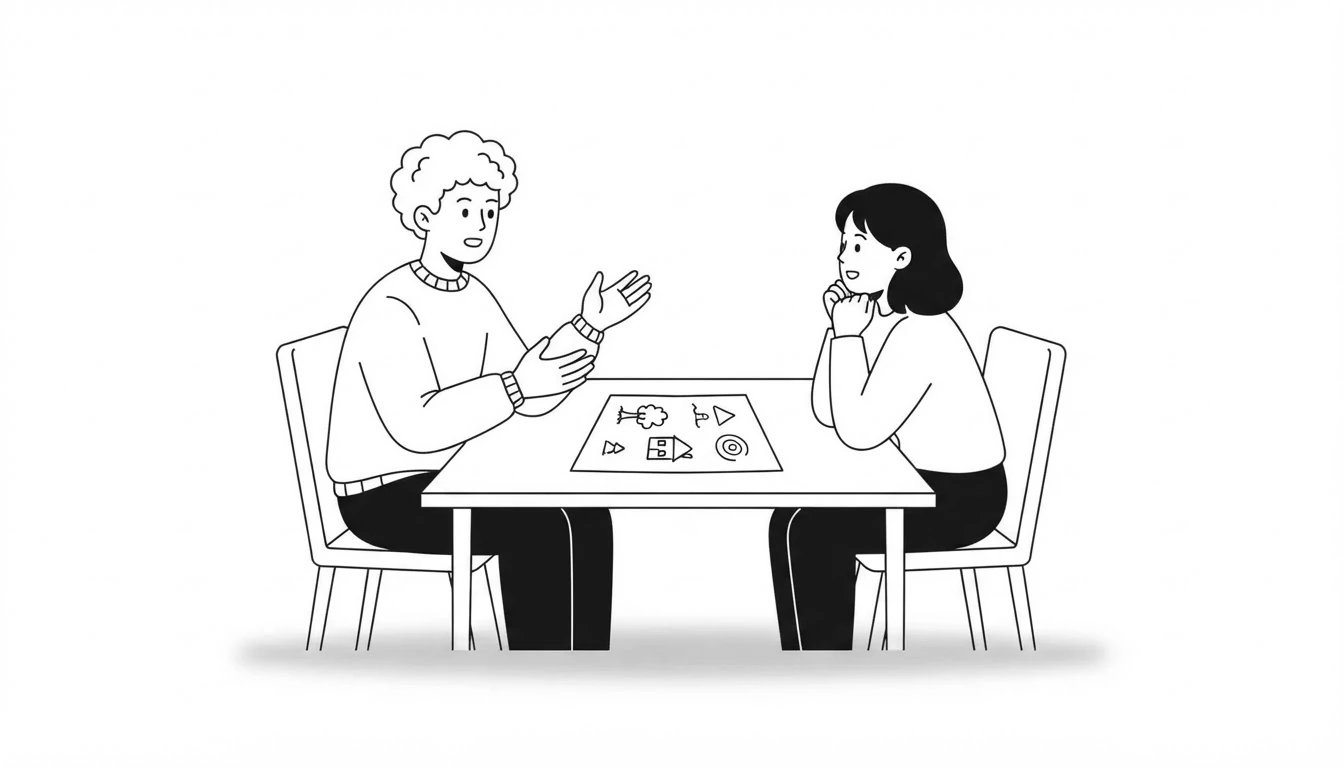
LanguageCert B1 Achiever Speaking lasts 12 minutes and you take it on your own with an interlocutor, with no partner. This is the level where the exam starts to feel like a real conversation: answering isn’t enough any more, you also have to give your opinion, reach an agreement with the interlocutor and tell a story for a minute and a half.
In my experience as an exam trainer, B1 Speaking is passed above all by practising the format, because each part asks for something different. That’s why in this guide I explain what B1 Achiever Speaking is like, what you have to do in each of its four parts, how it’s marked and, most importantly, I show you an example of every part with a B1 model answer and a short analysis. Let’s get started!
B1 Achiever Speaking: what B1 level means
B1 Achiever certifies B1 level on the Common European Framework of Reference for Languages (CEFR), known as intermediate level. When it comes to conversation, the CEFR says a B1 speaker:
Can deal with most situations likely to arise whilst travelling in an area where the language is spoken. Can enter unprepared into conversation on topics that are familiar, of personal interest or pertinent to everyday life (e.g. family, hobbies, work, travel and current events).
In exam terms, in B1 Achiever Speaking you need to be able to:
- Talk about yourself and your experiences, and give your opinion with a reason.
- Cope with everyday situations: apologising, asking for information, complaining politely…
- Discuss several options with the interlocutor and reach an agreement.
- Talk for a minute and a half without stopping about a topic: something that happened to you, a person you know, your plans…
Nobody expects a perfect performance. You’re expected to communicate without too much help, to link your ideas sensibly and to make sure your mistakes don’t stop you being understood.
What B1 Achiever Speaking is like
Speaking is the Spoken Exam of B1 Achiever and it’s separate from the Written Exam (Listening, Reading and Writing), so you can take it on a different day. These are its main features:
- It’s one to one: just you and an interlocutor, with no partner.
- It lasts 12 minutes and has four parts.
- You can take it at a centre, face to face, or online from home. Either way, the interlocutor is with you live.
- It’s recorded, and you aren’t marked by the interlocutor but by a LanguageCert examiner who listens to the recording later.
- In Part 2 the interlocutor plays a role (a neighbour, a receptionist…), but you never have to play anyone else: you always speak as yourself.
| Part | Time | What you have to do |
|---|---|---|
| Part 1 | 3 minutes | Spell your surname, say where you’re from and answer up to 5 questions about yourself and your opinions. |
| Part 2 | 3 minutes | Two short role plays: in one the interlocutor starts and in the other you start. |
| Part 3 | 3 minutes | Talk with the interlocutor about some pictures showing different options and make a decision together. |
| Part 4 | 3 minutes | After 30 seconds to make notes, talk for a minute and a half about a topic and answer follow-up questions. |
The four parts of B1 Achiever Speaking
Part 1
This is the ice-breaker. The interlocutor asks you to spell your surname and asks where you’re from. Then you’re asked up to five questions, each on a different topic (travel, music, shopping…). At B1 you’re expected to give your opinion and back it up with a reason or an example.
Part 2
Here you have to cope with real-life situations. The interlocutor sets up at least two situations:
- In the first, the interlocutor starts («I start.») and you respond.
- In the second, you start («You start.»), so you’re the one who opens the conversation.
Each situation lasts about two turns each and, if there’s time, there may be a third. What’s assessed is whether you use the right functional language: apologising, asking for information, complaining, offering help…
Part 3
This is a short discussion to make a decision. The interlocutor gives you a sheet with pictures of several options (things to buy, activities, places…) and you talk about them until you reach an agreement. The interlocutor starts. How you give your opinion, ask for theirs and make suggestions matters more than reaching a perfect agreement in the time you have.
Part 4
This is your long turn. The interlocutor chooses one of three topics and gives you paper and a pen so you can make notes for 30 seconds. Then you talk for a minute and a half without help and, when you finish, answer a few follow-up questions on the same topic.
B1 Achiever Speaking examples
Now for the practical part. Here’s a task for every part, written by me following the exam format, with a B1 model answer and an analysis of why it works. In the real exam you’ll be speaking, so the idea isn’t to memorise these answers but to notice how they’re built.
B1 Achiever Speaking example: Part 1
These could be the Part 1 questions:
Part 1. The interlocutor asks you to spell your surname and says Where are you from? Then you’ll be asked up to five questions on different topics, for example:
- Travel: Do you prefer travelling by train or by plane? Why?
- Music: Has your taste in music changed since you were a teenager?
- Shopping: Do you enjoy going shopping, or do you find it stressful?
- Technology: How did you learn to use a computer?
- Your neighbourhood: What would you change about the area where you live?
And this is how a B1 candidate might answer them:
Interlocutor: Do you prefer travelling by train or by plane? Why?
Candidate: By train, definitely. It’s more comfortable, you can walk around, and you don’t have to be at the station two hours early like at the airport. I also like looking out of the window.
Interlocutor: Has your taste in music changed since you were a teenager?
Candidate: Yes, quite a lot. When I was fifteen I only listened to rock, but now I prefer quieter music, like jazz or acoustic songs, especially when I’m working.
Interlocutor: Do you enjoy going shopping, or do you find it stressful?
Candidate: It depends. I like shopping for food at the market, but I find clothes shopping stressful, especially on Saturdays, because the shops are always full of people.
Interlocutor: How did you learn to use a computer?
Candidate: My older brother taught me when I was about ten. Later we had computer classes at school, but I think I learnt most things just by trying.
Interlocutor: What would you change about the area where you live?
Candidate: I’d like more green spaces. There’s only one small park, so I’d turn the old car park into a garden where children could play.
Why it works:
Why it works:
Why it works:
Why it works:
- Answers of two or three sentences, with the opinion first and the reason after.
- It uses different tenses depending on the question: the past (When I was fifteen I only listened to…), the present and the conditional (I’d like more green spaces).
- It adds nuance instead of just saying yes or no: It depends., Yes, quite a lot.
Useful expressions: …, definitely., It depends., When I was…, I used to…, I’d like…, especially when…
B1 Achiever Speaking example: Part 2
In the first situation, the interlocutor starts:
Part 2, first situation. We’re neighbours. I start.
Hi. Sorry to bother you, but your music was really loud last night.
Interlocutor: Hi. Sorry to bother you, but your music was really loud last night.
Candidate: Oh, I’m really sorry. It was my birthday and I had some friends round. I didn’t realise it was so loud.
Interlocutor: I couldn’t sleep until two o’clock.
Candidate: That’s terrible, I apologise. It won’t happen again, and next time I’ll let you know before I have people over.
In the second, you’re the one who has to start:
Part 2, second situation. I work at the reception desk of a gym. You’d like to join. You start.
Candidate: Hello. I’m interested in joining the gym. Could you tell me how much it costs?
Interlocutor: Of course. It’s forty euros a month, or four hundred for the whole year.
Candidate: I see. And is it open at weekends? I work long hours during the week, so I’d mostly come on Saturdays and Sundays.
Interlocutor: Yes, from eight in the morning until eight in the evening.
Candidate: Great. Is it possible to try it for a day before I decide?
- With the neighbour, the candidate apologises, explains and promises a solution, which is what’s expected when someone complains.
- At the gym, the candidate opens with a clear sentence and asks polite questions with Could you…? and Is it possible to…?
- In both situations the candidate reacts to what the interlocutor says (That’s terrible, I see) instead of reeling off prepared sentences.
Useful expressions: I’m really sorry., I didn’t realise…, It won’t happen again., I’m interested in…, Could you tell me…?, Is it possible to…?
B1 Achiever Speaking example: Part 3
In Part 3, the candidate gets a sheet with pictures. Here’s a description of what’s on it:
Part 3. Our English school wants to make the students’ common room a nicer place, and it can buy two things. Here are some pictures of ideas. Let’s talk about them and decide together which two would be best. I’ll start.
Pictures on the task sheet:
- a coffee machine
- a table tennis table
- shelves with books and magazines in English
- a big TV
- plants and comfortable sofas
- two computers
Interlocutor: So, what do you think about the coffee machine?
Candidate: I think it’s a good idea, because a lot of students come straight from work and they’re tired. But the school already has a café downstairs, so maybe it isn’t the most important thing.
Interlocutor: That’s true. What about the table tennis table?
Candidate: It would be fun, but I think it’s quite noisy, and some people use the common room to study. What do you think about the books and magazines?
Interlocutor: I like that idea. Students could practise their reading.
Candidate: Yes, I agree, and it’s cheap. I also like the plants and the comfortable sofas. At the moment the room is a bit cold and boring, and with sofas people would stay and talk to each other in English.
Interlocutor: And the TV or the computers?
Candidate: Everyone has a phone, so I don’t think we need computers. And a TV can stop people talking to each other. So, shall we choose the books and the sofas with plants?
Interlocutor: Yes, I think that’s a good decision.
- The candidate talks about the pros and cons of each option instead of just saying whether they like it.
- The candidate asks for the interlocutor’s opinion (What do you think about…?), which is part of the task.
- The candidate ends by suggesting a decision (So, shall we choose…?), which closes the task naturally.
Useful expressions: I think it’s a good idea, because…, It would be…, but…, What do you think about…?, I agree., I don’t think we need…, So, shall we choose…?
B1 Achiever Speaking example: Part 4
These could be the three Part 4 topics:
Part 4. The interlocutor chooses one of these topics, gives you paper and a pen, and you have thirty seconds to write some notes:
- A A teacher you remember
- B A trip that didn’t go as planned
- C Your plans for the next few years
Talk for one and a half minutes. Then answer the interlocutor’s follow-up questions.
Let’s say you get topic B. This is what a B1 candidate’s notes and talk might look like, with the follow-up questions at the end:
Notes (30 seconds): Rome, last summer / with friends / train cancelled / no hotel room / slept at station café / met a family / great evening / lesson: plan B
Candidate: I’d like to talk about a trip to Rome last summer, which didn’t go as we planned at all. I went with two friends from university, and we wanted to spend three days there. The problems started on the first day, because our train from the airport was cancelled, so we arrived in the city centre four hours late.
Candidate: When we finally got to the hotel, the receptionist told us there was a mistake with our booking and there were no rooms left. We were really tired and a bit angry, because it was nearly midnight and all the other hotels near the station were full.
Candidate: In the end, we spent the night in a café at the station. It sounds awful, but actually something nice happened. We started chatting to an Italian family who were waiting for an early train, and they shared their food with us and gave us lots of tips about the city.
Candidate: The next morning we found a small hotel, and the rest of the trip was fantastic. I learnt that it’s always a good idea to have a plan B, but also that sometimes the problems are what you remember most.
Interlocutor: Thank you. Do you usually plan your holidays carefully?
Candidate: Not really. I book the transport and the hotel, but I like deciding what to do when I get there.
Interlocutor: Would you go back to Rome?
Candidate: Yes, definitely. There were lots of places we didn’t have time to see, like the museums.
- The notes follow the order of the story, from start to finish, and work as a script.
- The story has a clear structure: introduction, problems, how they were solved and what was learnt.
- It uses past tenses and the linking words of a narrative: The problems started…, When we finally got…, In the end…, The next morning…
Useful expressions: I’d like to talk about…, The problems started when…, In the end…, It sounds…, but actually…, I learnt that…
B1 Achiever Speaking sample video
LanguageCert publishes the recording of a real B1 Achiever Speaking exam, together with the mark the examiner gave it. It’s well worth watching to get a feel for the pace of the exam.
In the video, Sara gets a Pass: 8 out of 12, which converts to 34 out of 50. The tasks are completed with hardly any help from the interlocutor, the conversation flows fairly naturally and the ideas are well linked. The grammar is a little limited for the level and there are noticeable mistakes, although they don’t get in the way of understanding. The vocabulary is good, with the odd slip when the topic is less familiar, and the influence of the candidate’s first language can be heard, but everything is easy to follow and there’s only the occasional hesitation.
Notice that this is a pass with a 2 in all four criteria: you don’t need to speak without mistakes, you need to communicate with ease and without relying on the interlocutor.
How B1 Achiever Speaking is marked
The examiner listens to the recording and gives you a mark for four criteria, each from 0 to 3, based on your performance across the whole exam:
| Criterion | What is assessed |
|---|---|
| Task Fulfilment and Coherence | Whether you do what each task asks without relying on the interlocutor, whether the conversation flows and whether you link your ideas well. |
| Accuracy and Range of Grammar | Whether you use a range of B1 structures and whether your mistakes get in the way of communication. |
| Accuracy and Range of Vocabulary | Whether your vocabulary is wide enough and right for the topics in the exam. |
| Pronunciation, Intonation and Fluency | Whether you’re easy to understand and whether you keep going without too many pauses. |
So the top mark is 12, which is then converted to a score out of 50. To pass you need 25 out of 50 (Pass), and from 38 out of 50 you get a High Pass.
Tips for B1 Achiever Speaking
These are the tips I give my students for B1 Achiever Speaking:
- Always give a reason. After your opinion, add because… or an example. It’s the simplest way to show B1 level.
- Practise stories in the past. Part 4 often asks for an experience: a trip, a special day, an important person. Have two or three stories ready and adapt them.
- Time yourself for a minute and a half. It feels long if you haven’t practised. Record yourself and check you can fill the time without repeating yourself.
- In Part 3, ask questions too. Don’t just give your opinion: ask for the interlocutor’s and suggest a decision at the end.
- Don’t worry about the interlocutor. They aren’t marking you, so don’t try to read their face. Speak for the recording.
- If you don’t know a word, explain it. It’s a thing you use to… keeps the conversation going.
If you’d like to compare it with the equivalent Cambridge exam, there’s also my guide to B1 Preliminary Speaking. And to see the whole exam, here’s my guide to LanguageCert B1 Achiever.
Next step: B1 Writing and B2 Speaking
If you’re also preparing the written part of the exam, there’s my guide to B1 Achiever Writing, with an example of every task type. And when you’re ready for the next level, my guide to B2 Communicator Speaking shows you what changes: time to think before Part 3, a more complex negotiation and a two-minute long turn.
And that’s everything you need to know about B1 Achiever Speaking. If you still have any questions, leave me a comment and I’ll be happy to help. 🙂
