
Table of contents
LanguageCert C1 Expert Reading is demanding, but also very predictable: there are always four texts with four types of task, and what changes from B2 isn’t so much the format as the kind of text. Expect arguments, irony, idiomatic language and dense texts, and be ready to read between the lines. It also shares its time with Writing, so managing the clock well is half the battle.
In my experience as an exam trainer, at C1 marks are nearly always lost by reading too fast: you understand the text, but you miss a nuance. So in this guide I explain what C1 Expert Reading is like, what you have to do in each of its four parts, how it’s marked and, most importantly, I give you an example of every part, written by me, with every answer explained. Let’s get started!
C1 Expert Reading: what C1 level means
C1 Expert certifies C1 on the Common European Framework of Reference for Languages (CEFR), an advanced level. In reading, that means you understand long, complex texts on both concrete and abstract topics, you appreciate differences in style and purpose, and you pick up what the writer implies without saying it openly.
In exam terms, in C1 Expert Reading you need to be able to:
- Understand a text full of idiomatic language, arguments and opinions, and decide whether a statement about it is true or false.
- See how discourse is built: references, contrasts, examples and transitions between ideas.
- Find specific information across several short texts and tell their purposes apart.
- Answer questions with short, precise answers, often rephrasing what the text says.
What C1 Expert Reading is like
Reading is part of the Written Exam, together with Listening and Writing. These are its main features:
- It comes after Listening, and you have 2 hours 40 minutes for Reading and Writing together, in whichever order you like.
- It has four parts and 26 questions, and each correct answer is worth 1 mark.
- You transfer your answers to an Answer Sheet within that time.
- You can take it on paper at a centre or online from home, in the same format.
| Part | Text | Task | Questions |
|---|---|---|---|
| Part 1 | One text with idiomatic language, narrative or academic ideas, arguments and opinions | Decide whether 5 statements are true or false | 5 |
| Part 2 | A text with 6 sentences removed | Choose the sentence for each gap from 8 (two are extra) | 6 |
| Part 3 | Four short texts on the same theme, with different purposes | Decide which text (A to D) contains each piece of information | 7 |
| Part 4 | One continuous text: narrative, descriptive, explanatory, biographical… | Answer open questions in five words or fewer | 8 |
The four parts of C1 Expert Reading
Part 1
You read a text with idiomatic language, narrative or academic ideas, arguments and opinions, and decide whether 5 statements about it are true (T) or false (F). It looks like the easiest task, but it isn’t: the statements paraphrase the text, and a single word (always, never, only, altogether) can turn an almost correct statement into a false one. There are only two options: there’s no ‘not given’.
Part 2
You get a text with 6 sentences removed and a list of 8 sentences to fill the gaps. Two are extra, so the distractors are harder to rule out. Understanding the sentence isn’t enough: you have to see how it fits with what comes before and after. Pay close attention to pronouns (it, this, they), linkers (however, for example, instead) and ideas that are repeated.
Part 3
You read four short texts (an advert, an email, an article, a leaflet…) on the same theme but with different purposes, and answer 7 questions like «Which text mentions…?». You can use each text more than once. It’s a task about finding information quickly, with a catch: the questions are paraphrased and several texts talk about similar things.
Part 4
You read one continuous text (a story, a biography, an explanatory text…) and answer 8 open questions (what, why, where…) in five words or fewer. You don’t need full sentences, but your answer must respond exactly to the question.
C1 Expert Reading examples
I’ve written these examples following the exam format, with C1-level texts and questions. Try them without looking at the answers, then read the explanation for each one: that’s where you learn how the exam thinks.
C1 Expert Reading example: Part 1
An opinion piece about boredom, with five statements to mark true or false:
Read the text and the statements. Decide whether each statement is true (T) or false (F).
In defence of boredom
There was a time, not so very long ago, when being bored was an unavoidable part of life. You queued at the post office with nothing to look at but the back of the person in front of you; you sat through long car journeys staring out of the window; you waited for the kettle to boil. These days, boredom has all but disappeared, or at least we have become remarkably skilled at keeping it at arm’s length. The moment there is a gap in our day, however small, out comes the phone.
On the face of it, this is progress. Few people would argue that standing in a queue doing nothing is a better use of time than catching up on the news or replying to a friend. Yet a growing number of psychologists believe that by filling every idle moment, we may be throwing the baby out with the bathwater. Boredom, they argue, is not simply an unpleasant feeling to be got rid of as quickly as possible; it is a signal that our current activity is not meeting our needs, and a nudge to go and find something more meaningful to do.
Some researchers go further, claiming that boredom is good for creativity. In one frequently cited study, participants who had first been given a mind-numbingly dull task, copying numbers out of a telephone directory, came up with more original ideas in a subsequent creativity test than those who had gone straight to it. The explanation usually offered is that when the mind is under-stimulated, it starts to wander, and mind-wandering is where unexpected connections are made.
It would be wrong, however, to get carried away. The evidence is still patchy, and the studies tend to be small. Moreover, there is a world of difference between the occasional dull afternoon and the chronic boredom experienced by people stuck in unrewarding jobs or long periods of unemployment, which is associated with anything but creativity. Romanticising boredom is easy for those who can choose when to be bored.
What does seem clear is that something is lost when we never allow our minds to drift. The writer who gets her best ideas in the shower is not a cliché for nothing: it is one of the few places left where nobody checks their phone. Perhaps, then, the answer is not to banish our devices, which would be neither realistic nor particularly desirable, but to stop treating every pause as an emergency. The next time you find yourself waiting for a bus, try doing nothing at all. You may be surprised by what turns up.
- The writer believes that people today are better at avoiding boredom than they were in the past.
- According to some psychologists, boredom serves no useful purpose.
- In the study mentioned, the participants who did a dull task first produced less original ideas.
- The writer suggests that the evidence linking boredom and creativity is not yet conclusive.
- The writer recommends giving up mobile phones altogether.
Show answers
- T: ‘Boredom has all but disappeared, or at least we have become remarkably skilled at keeping it at arm’s length.’ We avoid boredom far better than we used to.
- F: It’s the opposite: for these psychologists, boredom is a signal that our current activity isn’t meeting our needs and a nudge to find something more meaningful.
- F: The people who did the dull task first came up with more original ideas, not less original ones.
- T: ‘The evidence is still patchy, and the studies tend to be small’: it isn’t conclusive yet.
- F: The writer says explicitly that banishing our devices would be ‘neither realistic nor particularly desirable’. The suggestion is to stop treating every pause as an emergency.
In C1 true/false questions, watch for the words that change the meaning: no useful purpose, less original, altogether. One is enough to make a statement false.
C1 Expert Reading example: Part 2
A text about how to apologise well. Read the whole text first, gaps and all, and then look for the sentences:
Read the text. Six sentences have been removed. Choose the correct sentence (A to H) for each gap. There are two extra sentences you do not need.
The art of the apology
Few skills are as undervalued as the ability to apologise well. We are taught to say sorry as soon as we can talk, usually under the stern gaze of a parent, and many of us never progress much beyond that stage. (1) _______________ Anyone who has received a grudging ‘I’m sorry if you were offended’ knows that some apologies make matters worse rather than better.
So what distinguishes an apology that works from one that does not? (2) _______________ Researchers who have analysed thousands of them tend to agree on a handful of key ingredients. The first, and arguably the most important, is an acknowledgement of responsibility. ‘Mistakes were made’ does not count.
(3) _______________ An apology that dwells at length on the pressures the speaker was under, or on what the other person did to provoke them, quickly turns into a defence. The person receiving it is left feeling that they are being asked to sympathise rather than being offered an apology.
A third ingredient is an offer of repair. (4) _______________ In some cases this is straightforward: if you break a friend’s vase, you can replace it. In others, particularly where trust has been damaged, the repair may consist of little more than a commitment to behave differently in future.
Interestingly, timing matters too, though not always in the way one might expect. (5) _______________ Apologies offered too quickly, before the injured party has had the chance to express how they feel, can come across as an attempt to close the subject. Waiting a little, and listening first, often produces a better result.
Perhaps the hardest part of apologising, though, is not finding the right words but overcoming our own reluctance. (6) _______________ Paradoxically, people tend to think more highly of those who admit their mistakes gracefully, not less. The apology we fear will diminish us usually does the opposite.
- A. Yet an apology is a surprisingly complex act, and it is remarkably easy to get wrong.
- B. It is not, it turns out, simply a matter of saying the words with feeling.
- C. The second is to resist the temptation to explain too much.
- D. This means showing a willingness to put right whatever harm has been done.
- E. It is often assumed that the sooner an apology is made, the better.
- F. Many of us worry that saying sorry will make us look weak or incompetent.
- G. Children, after all, tend to apologise far more readily than adults.
- H. That is why the most effective apologies are always made in writing.
Show answers
- A: ‘Many of us never progress much beyond that stage’, then an example of an apology that makes things worse: A introduces the idea that apologising is easy to get wrong.
- B: It answers the question before it (‘what distinguishes an apology that works…?’) and sets up what follows: researchers have found specific ‘ingredients’.
- C: ‘The first… is an acknowledgement of responsibility’ calls for ‘the second’, and the next sentence develops exactly that: apologies that explain too much turn into a defence.
- D: ‘An offer of repair’ is explained in D, and ‘In some cases this is straightforward’ refers to putting the harm right.
- E: ‘Not always in the way one might expect’: E states the usual assumption (the sooner, the better), which the text then qualifies.
- F: ‘Overcoming our own reluctance’, then ‘Paradoxically, people tend to think more highly of those who admit their mistakes’: F explains where that reluctance comes from.
The extra sentences are G (it mentions children, but doesn’t connect with the grudging apology that follows) and H (the text never talks about written apologies).
C1 Expert Reading example: Part 3
Four short texts about working from home, each with a different purpose:
Read the four texts (A to D) and the questions. For each question, choose the correct text. You can use each text more than once.
A
The Workroom, Kingsbridge
Tired of working at the kitchen table? Fed up with cafés where the Wi-Fi drops every time someone orders a latte? The Workroom offers flexible desk space in a converted Victorian warehouse just five minutes from Kingsbridge station. Choose a hot desk by the day, or a dedicated desk with lockable storage on a monthly basis. Members enjoy high-speed broadband, unlimited coffee, bookable meeting rooms and a programme of lunchtime talks that are as good for networking as they are for learning. There is no joining fee and no minimum contract: if it doesn’t suit you, simply walk away. Book a free trial day online.
B
Five years after the great shift to home working, the evidence on its effects remains stubbornly mixed. Some large studies have found that employees working from home are more productive, citing fewer interruptions and the time saved by not commuting. Others have reached the opposite conclusion, particularly for tasks that depend on collaboration. What most researchers do agree on is that the answer depends heavily on the individual. Younger employees, who are more likely to live in shared or cramped accommodation and who have most to gain from watching more experienced colleagues at work, appear to benefit least. For many of them, the office was never simply a place to work; it was a place to learn the unwritten rules of a profession.
C
Subject: Hybrid working from March
Dear all,
Following the staff survey in the autumn, the management team has agreed a new approach to office attendance. From March, all staff will be expected to work from the office on Tuesdays and Thursdays, with the remaining days at your discretion. We recognise that this is a significant change for those of you who have been working mainly from home, so it will be phased in over three months, starting with one office day a week. Line managers will be in touch to discuss individual circumstances, including any caring responsibilities. In the meantime, please don’t hesitate to raise any concerns with me directly.
Best wishes, Hannah Clarke, Head of Operations
D
Sir,
I read with dismay your article celebrating the ‘return to the office’. As someone who spent fifteen years commuting two hours a day, I can assure your writer that there is nothing romantic about a delayed train. Since my employer allowed me to work from home, I have reclaimed ten hours a week, which I now spend with my children rather than on the 7.42. I accept that I miss the occasional chat by the coffee machine, but I would not exchange my current arrangement for any number of them. Employers who insist on bringing staff back simply because they want to see people at their desks should ask themselves what they are really measuring.
Name and address supplied
- Which text mentions a change that will be introduced in stages?
- Which text refers to research that has reached opposite conclusions?
- Which text admits that working from home has a minor drawback?
- Which text describes an arrangement that can be ended without any penalty?
- Which text suggests that some workers miss out on informal learning when they work from home?
- Which text questions the motives of some employers?
- Which text invites the reader to raise personal difficulties?
Show answers
- C: The change ‘will be phased in over three months, starting with one office day a week’.
- B: Some studies find people are more productive at home; others reach ‘the opposite conclusion’.
- D: ‘I accept that I miss the occasional chat by the coffee machine’: a minor drawback that doesn’t change the writer’s mind.
- A: ‘No joining fee and no minimum contract: if it doesn’t suit you, simply walk away.’
- B: For younger employees, the office was where they learnt ‘the unwritten rules’ of their profession by watching others.
- D: The writer asks employers to consider what they’re really measuring when they want to see people at their desks.
- C: Line managers will discuss individual circumstances, and the writer invites staff to raise concerns with her directly.
C1 Expert Reading example: Part 4
An explanatory text about how a word gets into the dictionary, with eight open questions. Remember: five words or fewer per answer.
Read the text and answer the questions. Use a maximum of five words for each answer.
How a word gets into the dictionary
Every year, the publication of new dictionary entries is greeted with a mixture of amusement and outrage. Commentators queue up to lament the inclusion of some piece of internet slang and to declare that the language is going to the dogs. What rarely gets reported is the painstaking process behind each decision, and the fact that lexicographers, as the people who write dictionaries are known, see their job not as deciding what words should mean but as recording how people actually use them.
The process begins with evidence. Modern dictionaries rely on vast electronic collections of written and spoken English, known as corpora, which may contain billions of words drawn from newspapers, books, websites, transcribed conversations and even television subtitles. When a new word, or a new meaning of an existing word, starts to appear, it is flagged for further investigation. Members of the public can also suggest words, though editors are quick to point out that a single enthusiastic email is no substitute for evidence of widespread use.
The key question is not whether a word is new, but whether it is likely to last. Lexicographers look for three things in particular. The first is frequency: the word must appear often enough to suggest that a reasonable number of people are using it. The second is spread. A term used only by a small group, such as the players of a particular online game, is unlikely to be included, however frequently it appears. The third, and perhaps the hardest to judge, is staying power. Most editors prefer to wait until a word has been in use for several years before admitting it, which explains why dictionaries are often accused of being behind the times.
Once a word has passed these tests, the real work begins. Writing a definition is a surprisingly difficult craft. It must be accurate, concise and written in words that are simpler than the one being defined, which rules out the tempting shortcut of using a synonym. Lexicographers also have to decide how the word is pronounced, what part of speech it is and whether it needs a label, such as ‘informal’ or ‘offensive’, to guide the reader.
Ironically, the words that cause the greatest public outcry are often the ones that lexicographers find least controversial, since the evidence for their use is overwhelming. The decisions that keep editors awake at night tend to involve words that are changing their meaning, where today’s mistake may well become tomorrow’s standard usage.
- How do lexicographers see the purpose of their work?
- What are corpora?
- What is not considered enough evidence that a word is widely used?
- Why might a word used by players of an online game be left out?
- Why are dictionaries often said to be behind the times?
- What shortcut must a definition avoid?
- Apart from pronunciation and part of speech, what may a word need?
- Which words give editors the most difficulty?
Show answers
- recording how people use words / recording actual usage
- (large) electronic collections of English / collections of written and spoken English
- a single (enthusiastic) email
- it is not widespread / only a small group uses it
- editors wait several years (before including words)
- (using) a synonym
- a label (such as ‘informal’ or ‘offensive’)
- words that are changing (their) meaning
At C1 there are eight questions instead of seven, and the answers often require you to rephrase or summarise an idea rather than just copy a fact. Even so, the limit is still five words.
How C1 Expert Reading is marked
Reading has 26 questions and each correct answer is worth 1 mark, so the maximum is 26 marks. There’s no penalty for wrong answers, so never leave a question blank.
That mark is then converted to a score out of 50, just like Listening and Writing. The three add up to a score out of 150 for the whole Written Exam, and you need 75/150 to pass (Pass). From 101/150 you get a High Pass. In other words, you pass the Written Exam as a whole, not each part separately: a good Reading score can make up for a weaker Listening, and vice versa.
In Part 4, your answer has to respond exactly to the question and stay within five words: copying a long chunk of the text «just in case» won’t guarantee the mark.
Tips for C1 Expert Reading
These are the tips I give my students for C1 Expert Reading:
- Decide in advance how long you’ll spend on each part. Reading and Writing share 2 hours 40 minutes, and C1 Writing is long. A good rule of thumb is to leave at least an hour and a quarter for Writing.
- In Part 1, find the part of the text that matches each statement and compare them carefully. A statement is true only if the text says exactly that.
- Watch out for idiomatic language. Expressions like throw the baby out with the bathwater or get carried away often hide the key to a question.
- In Part 2, check what comes before and after the gap. A sentence that fits what comes before but not what comes after isn’t the right one.
- In Part 3, underline the key idea in each question and look for its equivalent, not the exact word.
- In Part 4, count your words. Copy from the text if you need to, but only what you need to answer.
- Leave time to transfer your answers. An answer that isn’t on the Answer Sheet doesn’t count.
For the full exam, here’s my guide to LanguageCert C1 Expert, with the official sample papers to download. And if you’re choosing between exams, you also have my guide to Cambridge C1 Advanced.
And for C1 Expert Writing…
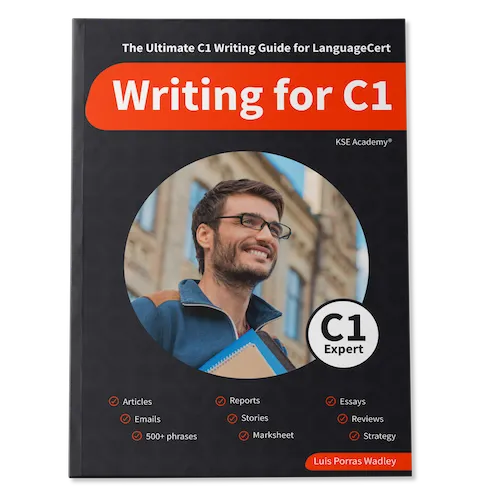
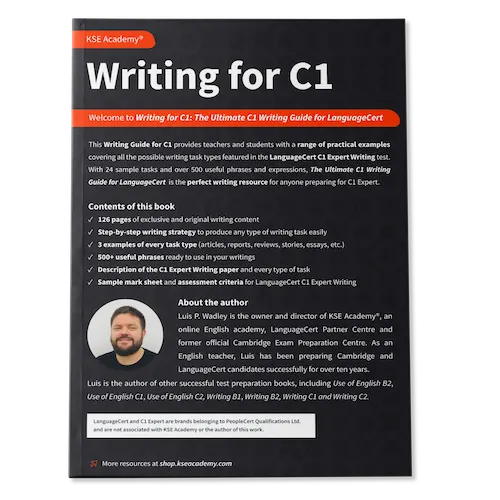
For Reading, what helps most is reading a lot and practising with past papers. But because Reading shares its time with Writing, being well prepared for Writing will save you precious minutes. For that, you have my guide to C1 Expert Writing and the KSE Academy book for LanguageCert C1 Writing, with every task type, model answers and useful language. It’s a Writing book, not a Reading one, but it’ll help you finish the Writing faster and with more confidence.
And that’s everything you need to know about C1 Expert Reading. If you have any questions, leave me a comment and I’ll be happy to answer. 🙂
