
Table of contents
LanguageCert C2 Mastery is the highest level in the International ESOL series, and its Writing paper is where it shows most clearly whether your English is genuinely at C2 level. You have to write two texts, one formal and one more personal, with the precision and naturalness of an expert user of the language.
But don’t worry, because in my experience as an exam trainer, Writing is also the section where good preparation pays off soonest. In this guide I’ll explain what the C2 Mastery Writing paper is like, what you have to do in Part 1 and Part 2, how it’s marked and, most importantly, I’ll show you a sample answer for every type of task, with a short analysis of what makes it a C2 text. Let’s get started!
Writing C2 Mastery: what C2 level means
C2 Mastery certifies a C2 level according to the Common European Framework of Reference for Languages (CEFR). It’s the highest level of the framework, and when it comes to writing, the CEFR self-assessment grid describes it like this:
I can write clear, smoothly flowing text in an appropriate style. I can write complex letters, reports or articles which present a case with an effective logical structure which helps the recipient to notice and remember significant points. I can write summaries and reviews of professional or literary works.
LanguageCert spells out what it expects from you in Writing at this level. In short, you need to be able to:
- Produce well-organised writing on complex or abstract topics.
- Produce clear, fluent formal letters, reports and articles whose style suits the purpose and the reader.
- Narrate and describe naturally, keeping the right style throughout.
- Develop convincing arguments.
- Keep consistent control of complex structures and use a very wide range of vocabulary, including finer shades of meaning and idiomatic expressions.
- Handle sensitive situations, such as complaints or disagreements, with tact.
- Organise your text with a good range of cohesive devices and punctuate accurately.
As you can see, the types of text are very similar to those at C1. The difference lies in their quality: more precision, more naturalness and even finer control of register. Now let’s look at the exam itself.
What the C2 Mastery Writing paper is like
Writing is part of the C2 Mastery Written Exam, together with Listening and Reading. Listening always comes first, and after that you have 2 hours and 40 minutes for Reading and Writing, in whichever order you prefer. There’s no fixed time for Writing, so managing your time well is part of the challenge (you’ll find my tips further down).
In the Writing section you have to write two texts:
| Part 1 | Part 2 | |
|---|---|---|
| Words | 200-250 | 250-300 |
| Register | formal | informal or semi-formal |
| Reader | a general audience (a newspaper, a company, the readers of a magazine…) | a particular reader (a friend, a magazine’s readership, the judges of a competition…) |
| What you do | respond to a text, some figures or a set of notes, expressing and justifying your position | write a more personal or creative text in which you persuade, argue, hypothesise, evaluate… |
| Text types | formal letter or email, report, argumentative essay or article (a review is also possible) | personal letter or email, story or descriptive composition (an article is also possible) |
| Marks | 12 | 12 |
There’s only one task in each part, so there’s no choice. As at C1, the points you have to cover don’t usually appear as bullet points: they’re built into the instructions or the input itself. That’s why it’s essential to read the task very carefully.
Types of Writing in C2 Mastery
Let’s see what you might be asked to write in each part. I’ve written all the tasks in this guide myself, following the exam format, so they aren’t official, but they’re exactly the same style. The figures in the inputs are invented too.
C2 Mastery Writing: Part 1
In Part 1 you respond formally to some input, which can be written, graphic or a set of notes: an opinion column, survey results, a table… As well as using the information, you have to take a position: give your opinion, justify it, make recommendations or argue a point. One difference from C1: here the argumentative essay is part of Part 1.
Formal letter / formal email
A very common task is a letter to the editor of a newspaper responding to an opinion piece. It can also be a formal email to a company or an organisation:
The extract below appeared in a column in your local newspaper. Write a letter to the paper in which you react to the columnist’s argument and say whether you think the town should follow his advice.
Time to close the book on libraries
by Daniel Price
Our town spends almost half a million pounds a year keeping three public libraries open, yet most of us now read on screens, and anything a library holds can be found online. These buildings are quiet because they are no longer needed. The council should sell them and give every resident a free e-book subscription instead.
Write between 200 and 250 words.
Report
The report is the most typical text type when the input is a survey or a table. You have to summarise the most relevant data and make recommendations, in an objective tone:
The company you work for, Northway Logistics, has seen a rise in the number of staff leaving. The Human Resources Director would like a report that sums up what the exit interviews held over the past two years revealed and proposes ways of keeping more employees.
Exit interviews 2025-2026: main reason for leaving (160 employees)
| Workload and long hours | 38% |
| No clear career progression | 29% |
| Salary | 21% |
| Moving to another area | 12% |
62% of leavers had worked for the company for less than three years.
Write between 200 and 250 words.
Argumentative essay
A text in which you argue for a clear, reasoned point of view on a matter of public concern, often based on a quotation or two opposing views:
A current affairs journal is publishing readers’ essays on whether young people should be required to complete a year of civic service. Write an essay for the journal in which you consider both opinions below and give your own view.
«A compulsory year of service, in hospitals, schools or conservation projects, would give young people skills, purpose and a real sense of belonging to their community.»
«Forcing young adults to work for a year, often for little or no pay, would delay their studies and careers and treat them as cheap labour.»
Write between 200 and 250 words.
Article
In an article for a newspaper, a magazine or a website, you comment on the input and give your opinion while keeping the reader engaged:
A health and wellbeing magazine is running a series on modern lifestyles. Using the survey results below, write an article for the magazine in which you comment on what they reveal and say whether you think people are likely to change their habits.
How well do we sleep?
Survey of 1,800 adults by the Restwell Foundation
- Average sleep on weeknights: 6 hours 20 minutes (recommended: 7 to 9 hours).
- 48% look at their phone in the last ten minutes before going to sleep.
- 1 in 3 are kept awake by worries about work at least once a week.
- 71% believe they would be more productive if they slept more.
- Only 15% have changed their routine in the past year to sleep better.
Write between 200 and 250 words.
Review
The review isn’t on the official list of Part 1 tasks, but it has appeared in LanguageCert practice papers, so it’s worth being ready for it. In a review you evaluate something you’ve watched, read or visited:
A website for television and streaming fans has asked readers to review a recent documentary. You have just watched the series in your notes below. Write a review for the website, describing the series, giving your opinion of it and saying who you would recommend it to.
The Deep Unknown: 5 episodes, streaming on OceanView
- Deep-sea creatures never filmed before: astonishing
- Presenter Dr Amara Osei: warm, clear, never patronising
- Ep. 3 on deep-sea mining: important but one-sided
- Music sometimes over the top
- Ep. 5 ending: hopeful, moving
- Families with older children
Write between 200 and 250 words.
C2 Mastery Writing: Part 2
In Part 2 you write a longer text (between 250 and 300 words) that is more personal or creative, for a specific reader. There’s no input here, just the instructions. Letters to a friend are informal, while stories and compositions are semi-formal. The instructions ask you to perform C2 functions: persuading, arguing, hypothesising, expressing mood or evaluating.
Personal letter / informal email
Writing to a friend or relative to advise them, persuade them of something or tell them about an experience and how it made you feel:
Last month you decided to live without your smartphone for four weeks as an experiment. Write an email to a friend describing how you felt during the experience, imagining how your friend would cope without their own phone, and persuading them to try it.
Write between 250 and 300 words.
Story
A narrative, usually for a competition or a magazine, that must clearly answer the task (a title, a situation, a proverb…):
A literary magazine is inviting entries for its annual short story prize. Every story must illustrate the proverb «Be careful what you wish for». Send in your entry.
Write between 250 and 300 words.
Descriptive composition
Describing a person, a place or an experience and explaining what it has meant to you:
A magazine has launched a series called «The View from My Window», in which readers describe a view they have known for many years. Write a composition describing the view and the way it changes, and explain what living with it every day has meant to you.
Write between 250 and 300 words.
An article can also appear in Part 2, with a more personal tone than in Part 1. The structure is the same as in the article example below.
C2 Mastery Writing examples
In this section you’ll find a model answer for each task. They’re all original and written to simulate a C2 level, so that you get a realistic idea of what’s expected. Under each one I briefly explain what makes it work.
C2 Mastery Writing example: formal letter
An answer to the libraries column task. It’s a letter that disagrees firmly but with tact:
Dear Editor,
I read Daniel Price’s column on the future of our public libraries with growing disbelief. His proposal may sound modern, but it rests on a view of libraries that is at least twenty years out of date.
Mr Price assumes that a library is simply a warehouse for books, and that once the books can be downloaded, the building serves no purpose. Anyone who has visited the Central Library on a weekday afternoon will know otherwise. It is where pensioners learn to bank online, where job seekers without a printer apply for work and where teenagers from crowded homes find somewhere quiet to revise. None of this can be delivered through an e-book subscription.
His point about cost is equally unconvincing. Half a million pounds is a modest sum when set against everything the libraries provide, and the money raised by selling three buildings could only be spent once, whereas the loss would be permanent. A free subscription, moreover, is of little use to residents who own no device or lack the confidence to use one.
I do accept that our libraries must change if they are to survive. Longer opening hours, up-to-date computers and closer ties with local schools would draw in the very people Mr Price believes have stopped coming. The question the council should be asking, therefore, is not whether we can afford our libraries, but whether we can afford to lose them.
Yours faithfully,
Laura Bennett
- An answer to each of the columnist’s arguments (what libraries are for and what they cost), with concrete examples of who uses them.
- A concession before the ending (I do accept that our libraries must change), which makes the letter more convincing.
- Flawless formal register and a well-rounded final sentence: not whether we can afford our libraries, but whether we can afford to lose them.
C2 Mastery Writing example: report
An answer to the exit interviews task. Notice that the data isn’t copied: it’s interpreted.
Staff Turnover at Northway Logistics
Introduction
This report outlines what departing employees told us in exit interviews over the past two years and proposes measures that could reduce staff turnover.Findings
Workload emerged as the principal cause of resignations, mentioned by 38% of the 160 leavers, many of whom described regular overtime as unsustainable. Close behind came the absence of a clear career path (29%), while pay was the deciding factor for roughly one in five. Only 12% left for reasons beyond our control, namely moving away. Perhaps most telling is that almost two thirds had been with us for under three years, which indicates that we are losing staff just as their training begins to pay off.Recommendations
With this in mind, I would propose that the company:
• review staffing levels in the busiest departments, so that overtime becomes the exception rather than the rule;
• give every new employee a development plan, reviewed after their first twelve months;
• compare its salaries with those of competitors and close any significant gaps.Conclusion
Keeping experienced staff costs considerably less than recruiting and training their replacements. Should these measures be adopted, there is every reason to expect turnover to fall and the company to benefit from a more settled, motivated workforce.
- Rephrased and compared data: Close behind came…, roughly one in five, almost two thirds.
- A conclusion of the writer’s own drawn from the data: we are losing staff just as their training begins to pay off.
- Recommendations linked to each finding and a conditional inversion in the conclusion (Should these measures be adopted).
C2 Mastery Writing example: argumentative essay
An answer to the civic service task. At C2 it isn’t enough to give arguments for and against: the essay has to lead to a conclusion of your own.
A Year for the Common Good?
Few proposals divide opinion as sharply as the idea that every young adult should spend a year serving the community. Supporters regard it as an investment in citizenship; critics, as an unfair demand on a generation already under considerable pressure.
The case in favour is not hard to make. A year spent caring for the elderly or restoring woodland would expose young people to lives very different from their own, and many would discover abilities that no classroom had ever drawn out. Society would gain too, since chronically understaffed services could count on a steady supply of willing hands.
However, the word «compulsory» changes everything. Service that is imposed rather than chosen risks breeding resentment, and those who stand to gain most are seldom the ones eager to take part. Unless participants were properly paid, the scheme would also penalise students from poorer families, for whom twelve months without earnings could mean giving up on university altogether.
In my view, the principle deserves support, but compulsion does not. A well-funded voluntary programme, valued by employers and universities and offering a fair allowance, would capture most of the benefits without the drawbacks. Were governments to make such a year genuinely attractive, they might well discover that obliging anyone to serve had never been necessary.
- Both views from the task, dealt with in a paragraph each, with developed arguments.
- A nuanced opinion that accepts the idea but rejects the obligation: the principle deserves support, but compulsion does not.
- C2 structures such as Few proposals divide opinion as sharply as… and Were governments to make such a year genuinely attractive.
C2 Mastery Writing example: article
An answer to the sleep survey task. A C2 article combines data, opinion and a style that holds the reader’s interest:
Wide Awake: Why We Know Better but Sleep Worse
Most of us would never skip a meal to answer an email, yet we routinely sacrifice sleep for exactly that reason. According to a new survey by the Restwell Foundation, the average adult now manages just six hours and twenty minutes on a weeknight, well short of what experts recommend.
The causes will surprise nobody. Almost half of the 1,800 people questioned admit to scrolling through their phones in the final minutes before turning off the light, and one in three is regularly kept awake by worries about work. Our bedrooms, it seems, have quietly become extensions of the office.
What is striking is not that we sleep badly, but that we know it. A remarkable 71% believe more rest would make them more productive, and yet a mere 15% have done anything about it in the past year. Knowing what is good for us, evidently, is not the same as acting on it.
Will this change? Not of its own accord. Habits formed over years rarely give way to statistics, however alarming. Change is more likely to come from employers who discourage late-night messages, and from small routines such as leaving the phone in another room. Until then, many of us will go on lying awake, perfectly aware of what we ought to be doing.
- An engaging opening with an unexpected comparison: skipping a meal versus losing sleep.
- Critical use of the data: the article focuses on the contradiction between what we know and what we do.
- A final paragraph that answers the second part of the task (whether we’ll change our habits).
C2 Mastery Writing example: review
An answer to the documentary task. A good C2 review evaluates with nuance and doesn’t just say whether you liked something:
Into the Dark: The Deep Unknown
Television has taken us to the ocean floor before, but seldom with such a sense of genuine discovery. The Deep Unknown, a five-part series now streaming on OceanView, brings back footage of creatures no camera had ever recorded, and the results are frequently astonishing.
Much of the credit belongs to its presenter, the marine biologist Dr Amara Osei. Her enthusiasm is infectious, and she has a rare gift for explaining complex science without ever talking down to her audience.
The series is not flawless. The third episode, on the impact of deep-sea mining, raises questions that urgently need asking, but it gives the industry’s side so little time that it feels more like a campaign than an investigation. The soundtrack, too, occasionally swells to a pitch better suited to a disaster film, as if the images were not dramatic enough on their own.
These reservations aside, this is documentary making of a very high order. The final episode, which follows scientists working to protect a newly discovered reef, ends on a note of cautious hope that is all the more moving for being understated. Families with older children will find it both thrilling and thought-provoking, and I would recommend it to anyone who has ever wondered what lies beneath the waves.
- Every point in the notes, turned into prose with precise evaluative vocabulary: infectious, talking down to, understated.
- Balance: a very positive verdict that acknowledges two flaws.
- A clear recommendation for the audience mentioned in the notes.
C2 Mastery Writing example: personal letter
An answer to the month without a phone task. Here you need to express mood, hypothesise and persuade, without losing the natural tone of an email to a friend:
Hi Sam,
You’ll never guess what I’ve been up to. Remember how I kept moaning that I spent half my life staring at a screen? Well, I finally did something about it: I locked my phone in a drawer for a whole month and made do with an ancient model that only makes calls.
I won’t pretend the first week was easy. I kept reaching for my pocket every few minutes, and I felt strangely on edge, as if the world were carrying on without me. Getting around was a nightmare too, with nothing but a paper map and the kindness of strangers.
By the second week, though, something had shifted. I read on the bus instead of scrolling, I slept far better and I actually remembered conversations, because I’d been listening rather than half-checking messages. Had anyone told me a month ago that I’d enjoy it, I’d have laughed in their face. What surprised me most was how little I’d missed: the news still happened, my friends still found me, and nobody minded waiting a day for a reply.
Now, I know exactly what you’re thinking: «That’s fine for you, but I’d go mad.» And you probably would, for about three days! You’d miss the football scores and the group chat, and you’d be convinced something dreadful was happening without you. But knowing you, once the withdrawal wore off, you’d love having your evenings back.
So here’s my challenge: try it for a fortnight. If nothing changes, you can tell me I’m turning into my grandmother and I won’t argue. If it does, you owe me dinner.
Write back soon (by email, obviously)!
Love,
Alex
- Informal but rich register: contractions and expressions such as moaning, made do with, on edge and laughed in their face.
- How the writer’s feelings developed, from the anxiety of the first week to the surprise that followed.
- Hypotheses about the friend (you’d miss the football scores…) and a humorous challenge at the end.
C2 Mastery Writing example: story
An answer to the short story competition task. The story illustrates the proverb without spelling it out until the very end:
Be Careful What You Wish For
For three years, Martin had wished, every single night, that the man upstairs would move out. Mr Kowalski practised the trumpet at seven each morning, dropped what sounded like bowling balls onto his floor at midnight and sang, badly, in the shower. Martin had complained, slipped polite notes under his door and, eventually, stopped speaking to him altogether.
So when he came home one wet Tuesday to find a removal van outside the building, he could hardly contain his delight. That evening, for the first time in years, the flat above was silent. Martin opened a bottle of wine and toasted his good fortune.
The silence lasted precisely four days. On the fifth, the new tenants arrived: a young couple, a toddler, a drum kit and, judging by the barking, at least two large dogs. Within a week, Martin was lying awake at three in the morning, listening to a nursery rhyme being hammered out on the drums and wondering how he had ever found the trumpet annoying.
Then, one Sunday, a postcard dropped through his letterbox. It was from Mr Kowalski, who now lived by the sea. «Sorry for all the noise,» it read. «I was learning to play for my granddaughter’s wedding. She says I’m almost good enough now. Thank you for your patience.»
Martin read it twice and sat down heavily. Not once in three years, it dawned on him, had he asked his neighbour why he played. He stuck the postcard on the fridge, where it stayed for many years: a reminder that the thing we most long to be rid of is sometimes the thing we end up missing.
- A clear character and conflict from the first sentence.
- Humour and concrete detail instead of general adjectives: a nursery rhyme being hammered out on the drums.
- A final twist that gives the title its meaning, with an inversion (Not once in three years… had he asked).
C2 Mastery Writing example: descriptive composition
An answer to the view from my window task. The key is to combine description with reflection on what it has meant to you:
The Wall Opposite
My bedroom window never offered anything that might appear on a postcard. For the eighteen years I lived in my parents’ flat, it looked out onto the back of an old textile factory: a vast brick wall, blackened in places, with a single row of windows near the top and a drainpipe that ran crookedly from the roof to the yard below.
As a child, I resented it. My friends had views of parks or of the river; I had bricks. Yet over the years I came to know that wall more intimately than any landscape. In winter, frost gathered in the gaps between the bricks, so that on clear mornings the whole surface seemed to glitter. In spring, a stubborn buddleia forced its way out of the gutter, and by July it was covered in purple flowers and visited by butterflies that had no business being in the middle of a city. And on summer evenings the setting sun turned the brickwork the colour of copper, so that for ten minutes my dull view became something close to beautiful.
It was that wall, I suspect, that taught me to look closely. When there is little to see, you begin to notice everything: the pigeon that returned to the same broken pane each spring, the way rain darkened the bricks from the top down.
These days I live on the top floor of a building with a view of the mountains that guests never fail to photograph. It is, by any standard, a finer view. And yet, on grey mornings, I sometimes find myself missing that wall, which asked nothing of me and taught me more than I ever realised.
- An unattractive view that becomes interesting through the details of each season.
- Precise descriptive vocabulary: blackened, crookedly, glitter, the colour of copper.
- The reflection the task asks for and an ending that contrasts the old view with the new one.
How the C2 Mastery Writing paper is marked
Each task is marked separately against four criteria, and you can get 0 to 3 marks for each one. So each task is worth 12 marks, and the whole Writing section 24.
| Criterion | What it looks at |
|---|---|
| Task Fulfilment | Whether you fully satisfy the task: the reader is well informed, the genre and tone are appropriate and you respect the word count. |
| Accuracy and Range of Grammar | Whether you use a full range of complex structures with assurance. |
| Accuracy and Range of Vocabulary | Whether you use a wide, precise range of vocabulary, including less common words and expressions. Spelling counts here too. |
| Organisation | Whether the text is coherent and logically organised, using varied cohesive devices and a structure that suits the type of text. Punctuation counts here too. |
To get top marks on each criterion, any errors should be no more than slips, and advanced vocabulary and complex structures should appear naturally, not forced.
Your two Writing marks are then turned into a mark out of 50 and combined with your Listening and Reading results. To pass the Written Exam you need 75 out of 150 overall (Pass), and from 101 you get a High Pass. I explain it with an example in my complete guide to C2 Mastery.
Will I lose marks if I write too much or too little?
According to LanguageCert’s criteria:
- If you don’t reach the minimum, examiners reflect this in your Task Fulfilment mark, so it can cost you marks.
- If you go over the maximum, there’s no direct penalty, but writing too much usually means more mistakes and a weaker text.
- If your text is off topic, it gets no marks at all.
My advice: don’t stay close to the minimum, and try to get near the top of the word limit in both tasks. Both British and American spelling are accepted, as long as you’re consistent.
Tips for the C2 Mastery Writing paper
These are the tips I give my C2 Mastery students:
- Leave plenty of time for Writing. Between the two tasks you have to write up to 550 words, and that takes time. As you have 2 hours and 40 minutes for Reading and Writing together, spend at least an hour and a quarter on Writing.
- Read the task very carefully. Make sure everything the instructions and the input ask for has its place in your text.
- Don’t copy the input. Use the information, but in your own words.
- Pay attention to register. Part 1 is formal and Part 2 more personal, but at C2 you’re expected to show very fine control of tone.
- Show your level naturally. A text full of forced structures and words reads worse than a simple, well-written one.
- Plan and check. Make a quick outline before you start and save a few minutes at the end to check your work.
If you’re still deciding which exam to take, have a look at my guide to Cambridge C2 Proficiency Writing to compare the two formats. And if you’re preparing for the level below, here’s my guide to C1 Expert Writing. If you’d like a teacher to mark your writing, have a look at my C2 Mastery Writing correction service.
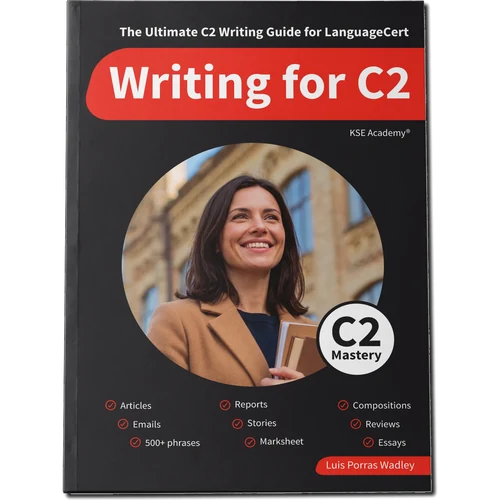
C2 Mastery Writing guide with examples
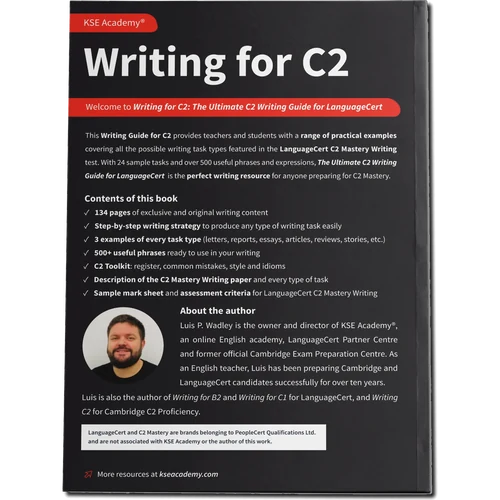
If you’d like to practise with many more examples, have a look at the KSE Academy guide to LanguageCert C2 Writing. In it you’ll find:
- Every Part 1 and Part 2 task type, explained in detail.
- 3 sample tasks with model answers for each type of text.
- Over 500 useful expressions for your writing.
- A step-by-step writing strategy for any type of task.
- The marking criteria and a sample assessment sheet.
And that’s everything you need to know about the C2 Mastery Writing paper. If you still have any questions, leave me a comment and I’ll be happy to help. 🙂
