
Table of contents
B2 First (FCE) Reading is the part of the Cambridge exam that tests your reading comprehension: extracts from novels, articles, interviews… and questions that go well beyond understanding what the text is about. Cambridge wants to know whether you pick up opinions, attitudes, nuances and how a text is put together.
Before we start, two things that surprise a lot of people. First, Reading isn’t a separate paper: it goes together with Use of English in a single paper lasting 1 hour 15 minutes. Second, Part 1, which looks like Use of English, officially counts as Reading. In this guide I’ll explain what B2 Reading looks like part by part, how much it counts towards your result, how to manage your time and which strategies work, with real examples from an official Cambridge sample test. 🙂
What B2 First Reading looks like
Reading is part of the Reading and Use of English paper: seven parts, 52 questions and 1 hour 15 minutes in total. According to Cambridge, the Reading section is made up of Parts 1, 5, 6 and 7, and the Use of English section of Parts 2, 3 and 4:
| Part | Task | Questions | Marks | Section |
|---|---|---|---|---|
| 1 | Multiple-choice cloze: text with 8 gaps and 4 options | 8 | 8 | Reading |
| 2 | Open cloze: text with 8 gaps, no options | 8 | 8 | Use of English |
| 3 | Word formation: form words from a given word | 8 | 8 | Use of English |
| 4 | Key word transformation: rewrite sentences with a key word | 6 | 12 | Use of English |
| 5 | Multiple choice: long text with 6 four-option questions | 6 | 12 | Reading |
| 6 | Gapped text: put 6 sentences back into a text | 6 | 12 | Reading |
| 7 | Multiple matching: match 10 statements to sections of a text | 10 | 10 | Reading |
If you add it up, Reading accounts for 42 of the paper’s 70 marks, and Use of English for the remaining 28. Parts 5 and 6 carry the most weight per question: each one is worth two marks.
How much does Reading count towards your final result?
Your B2 First result is the average of five equally weighted scores: Reading, Use of English, Writing, Listening and Speaking. So although Reading and Use of English are done together, they’re scored separately, and Reading makes up a fifth of your final result.
What each part of Reading tests
| Part | What Cambridge assesses |
|---|---|
| 1 | Vocabulary in context: collocations, fixed expressions, phrasal verbs and shades of meaning |
| 5 | Detail, opinion, attitude, tone, purpose, main idea, meaning from context, implication and reference |
| 6 | Cohesion, coherence and text structure |
| 7 | Detail, opinion, specific information and implication |
Part 1: Multiple-choice cloze
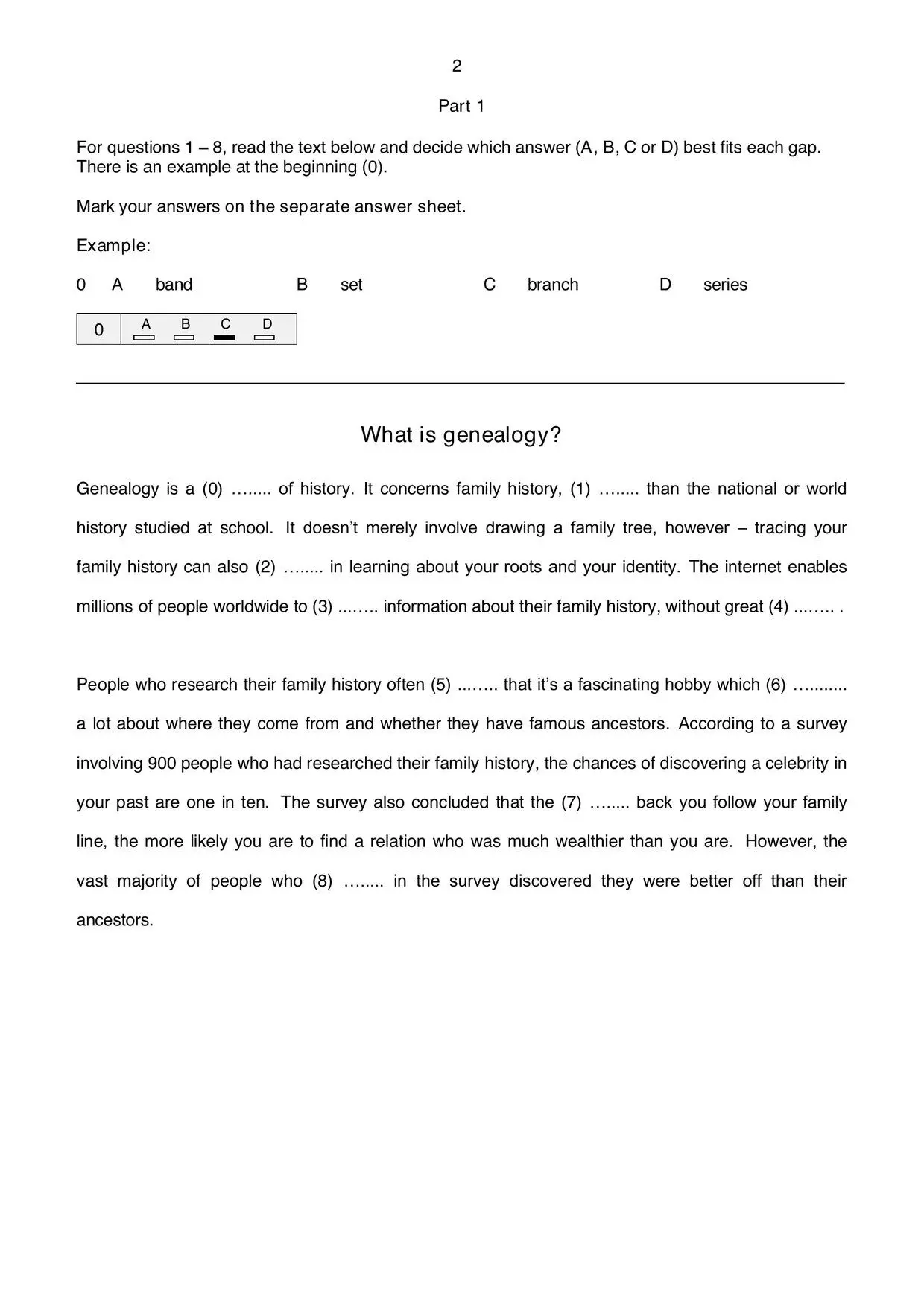
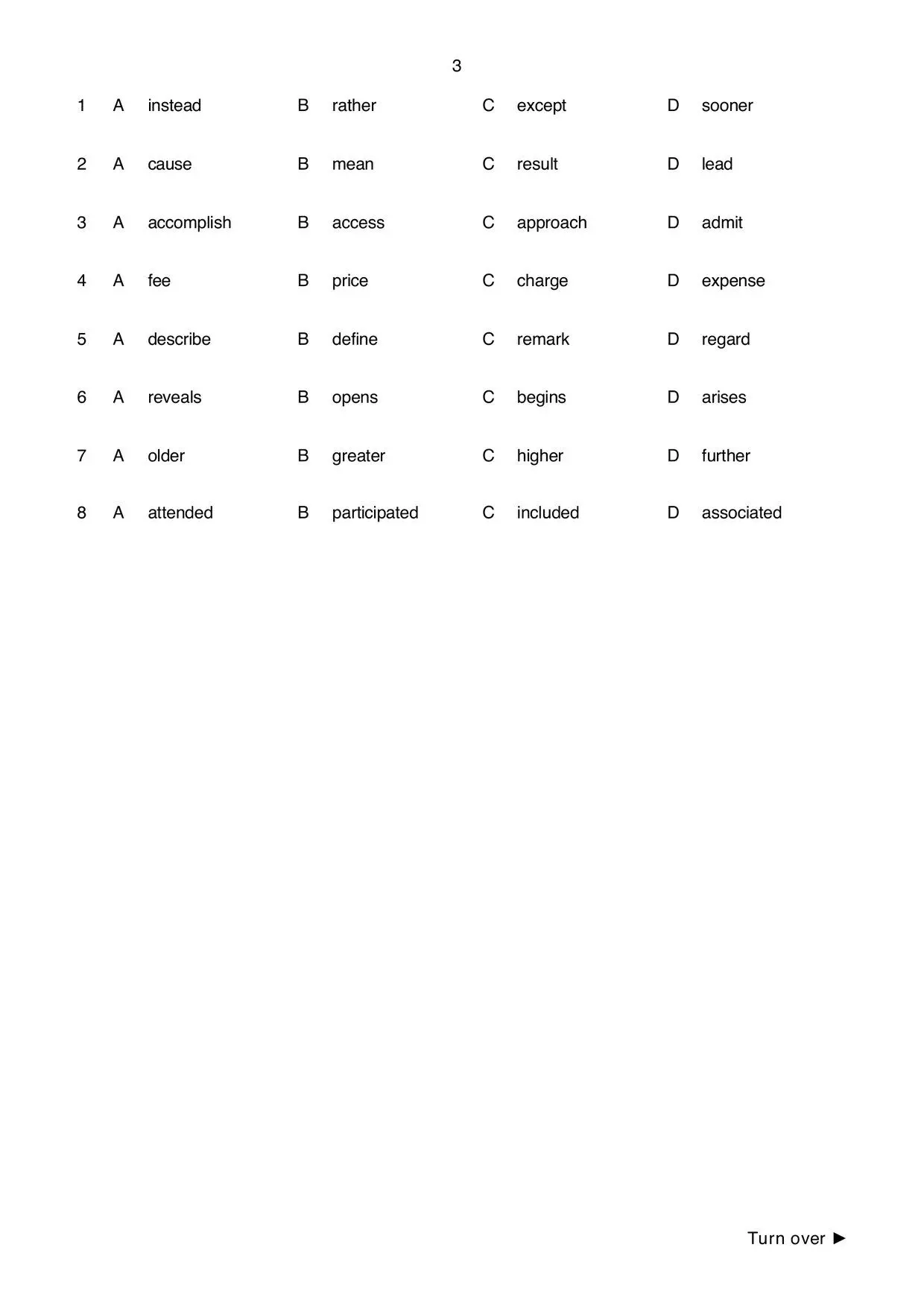
A short text with eight gaps and four options for each. To be clear: officially, Reading and Use of English Part 1 is part of Reading and is scored as Reading. Even so, on this site you’ll find it under Use of English, because that’s how most people see it: because of its format, and because what it mainly tests is vocabulary (which word goes with which). In the sample test, the key to half the questions was the word right after the gap. You’ll find the full explanation, with the test solved, in the guide to Use of English Part 1.
This is what the whole of Part 1 looks like in the Cambridge sample test: the text on one page and the options for each gap on the next.
Part 5: Multiple choice
A long text, usually an extract from a novel or an article, and six four-option questions that follow the order of the text. Here Cambridge asks about feelings, opinions, the writer’s purpose or what a word refers to, and the star distractor is the option that repeats words from the text without saying the same thing.
In the sample test, the text is an extract from a novel in which Caitlin describes the day her brother came back from university. This is the whole of Part 5, with the text on the left and the questions on the right:
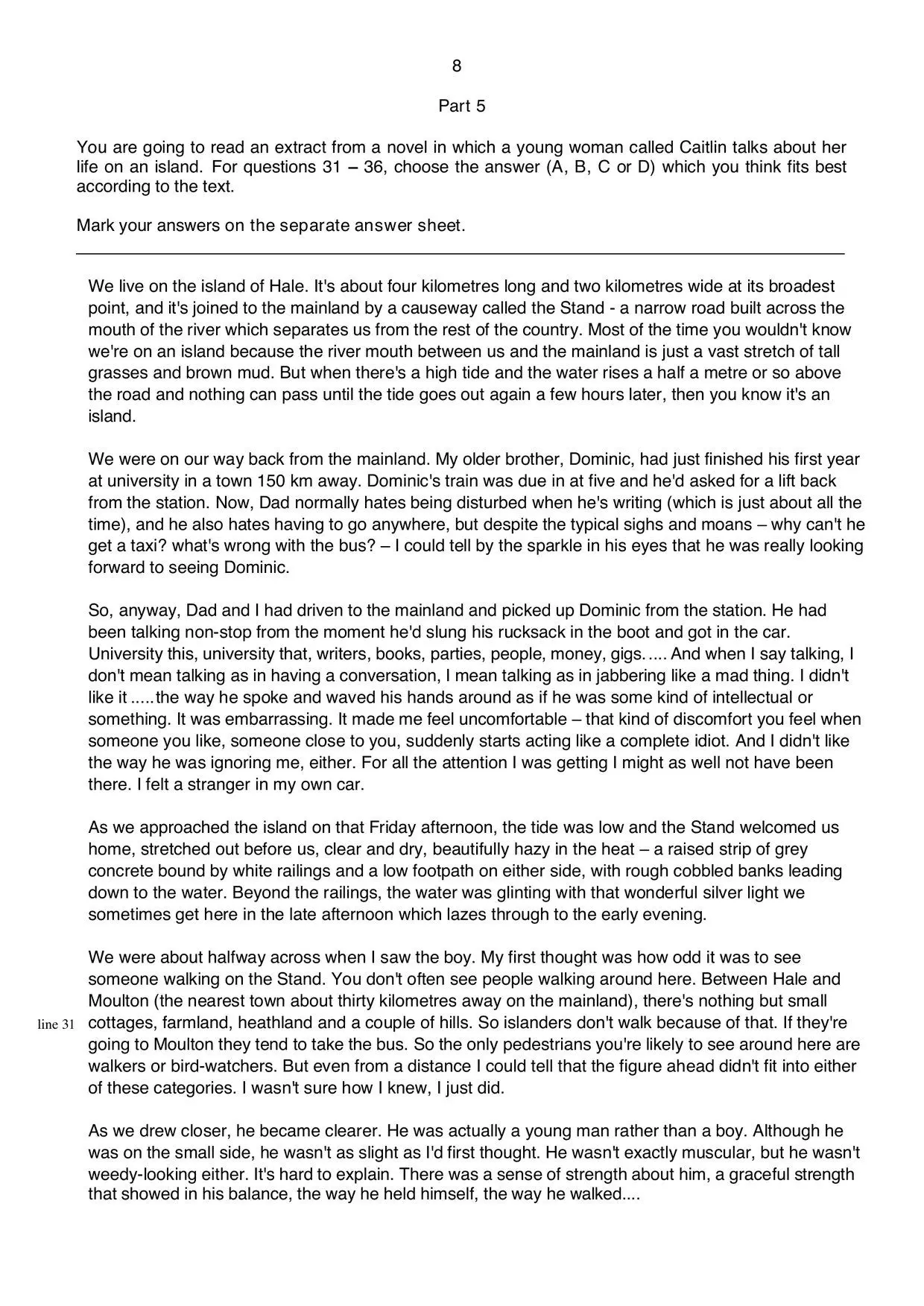
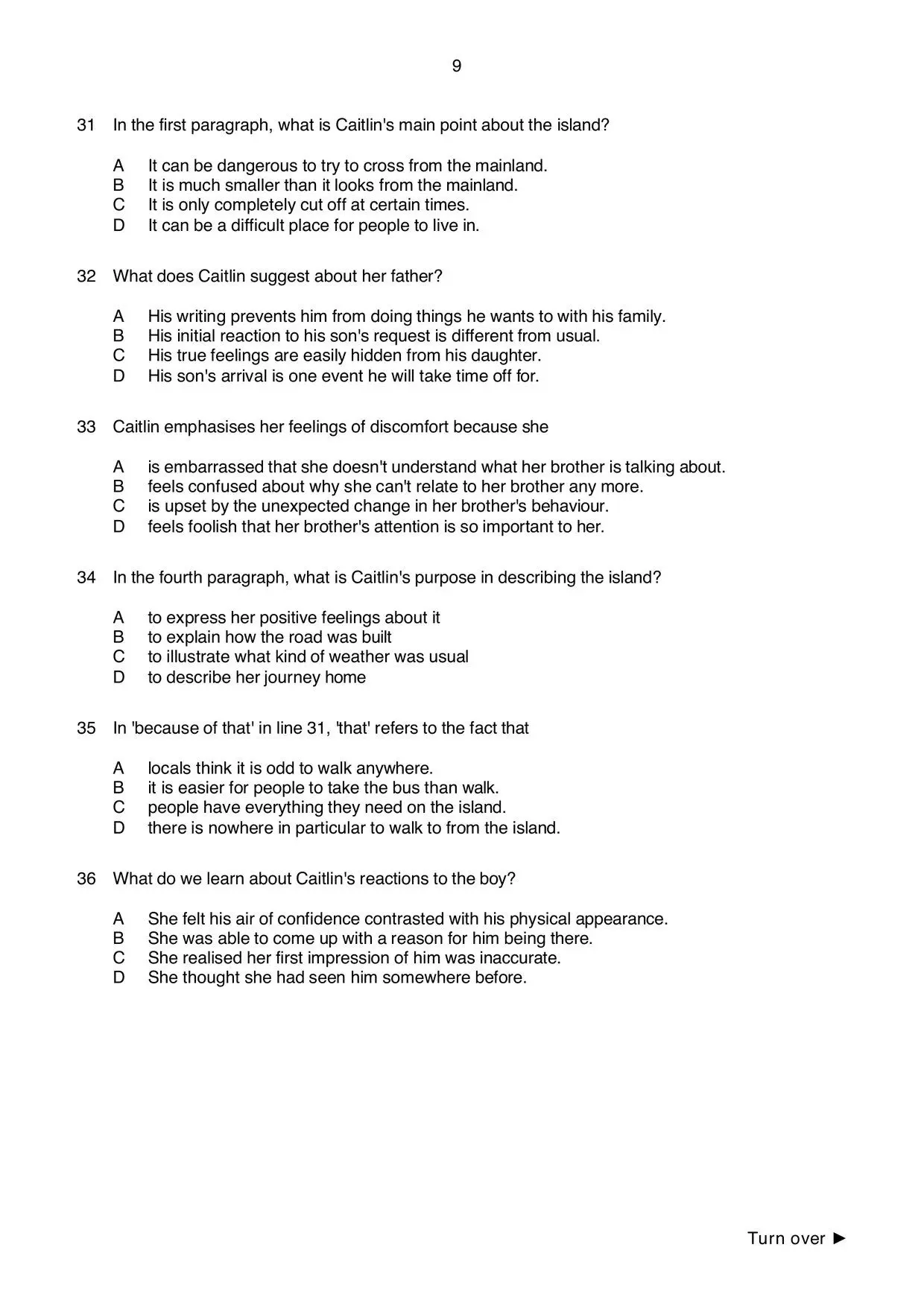
Look at question 31. The first paragraph explains that the island is joined to the mainland by a road and that most of the time you wouldn’t know we’re on an island; only at high tide can nothing pass. The answer is C: it’s only completely cut off at certain times. The other three options add ideas the text doesn’t state (danger, size, how hard it is to live there).
You’ll find all six questions solved, the question types and the strategy in the guide to B2 Reading Part 5.
Part 6: Gapped text
An article from which six sentences have been removed; they appear jumbled after the text, together with a seventh that isn’t needed. You have to put each one back. This part tests whether you understand how a text is built: pronouns, linkers and how ideas connect.
In the sample test, a former Royal Ballet dancer explains what training really involves. This is the whole of Part 6, with the article on the left and the sentences on the right:
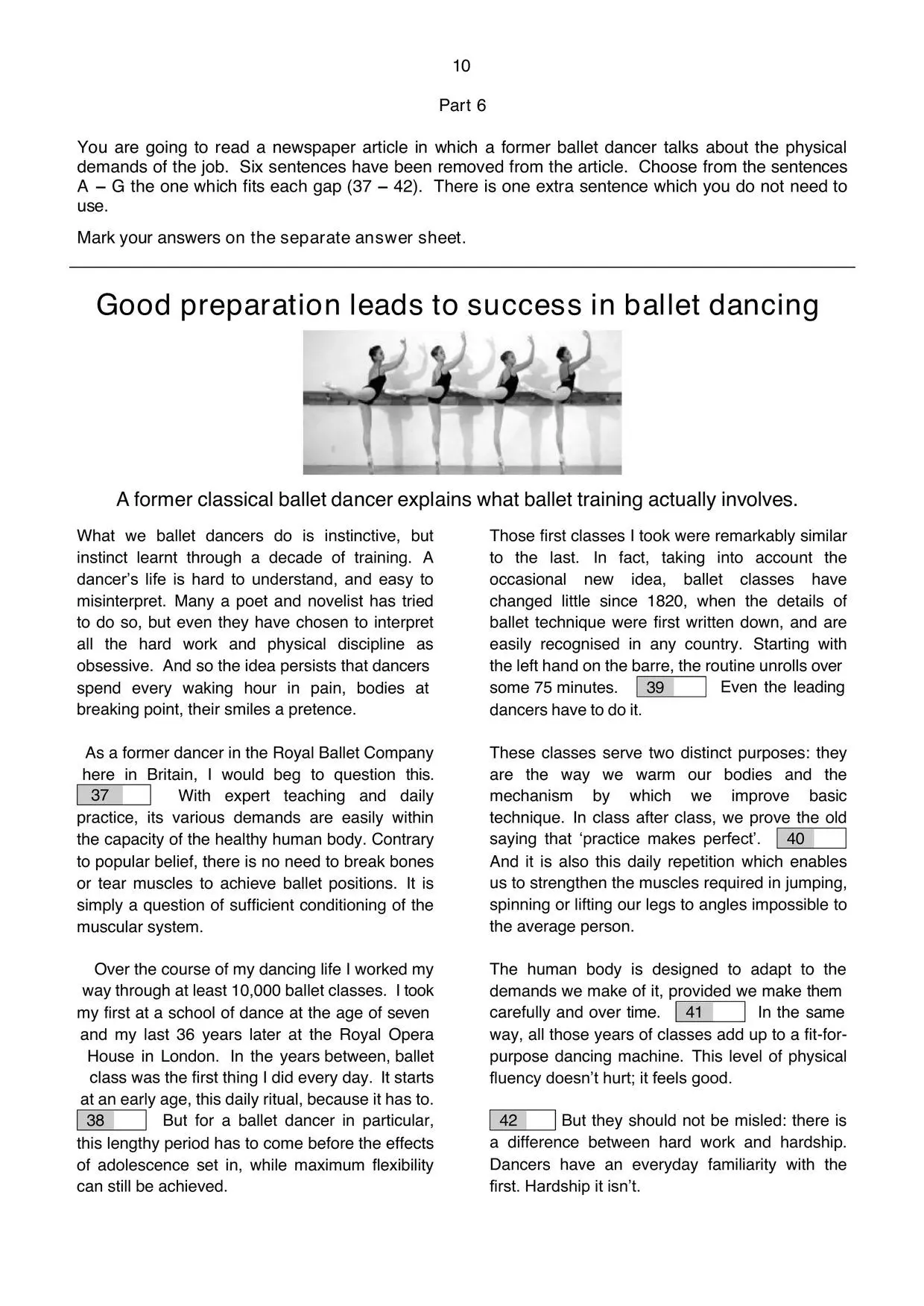
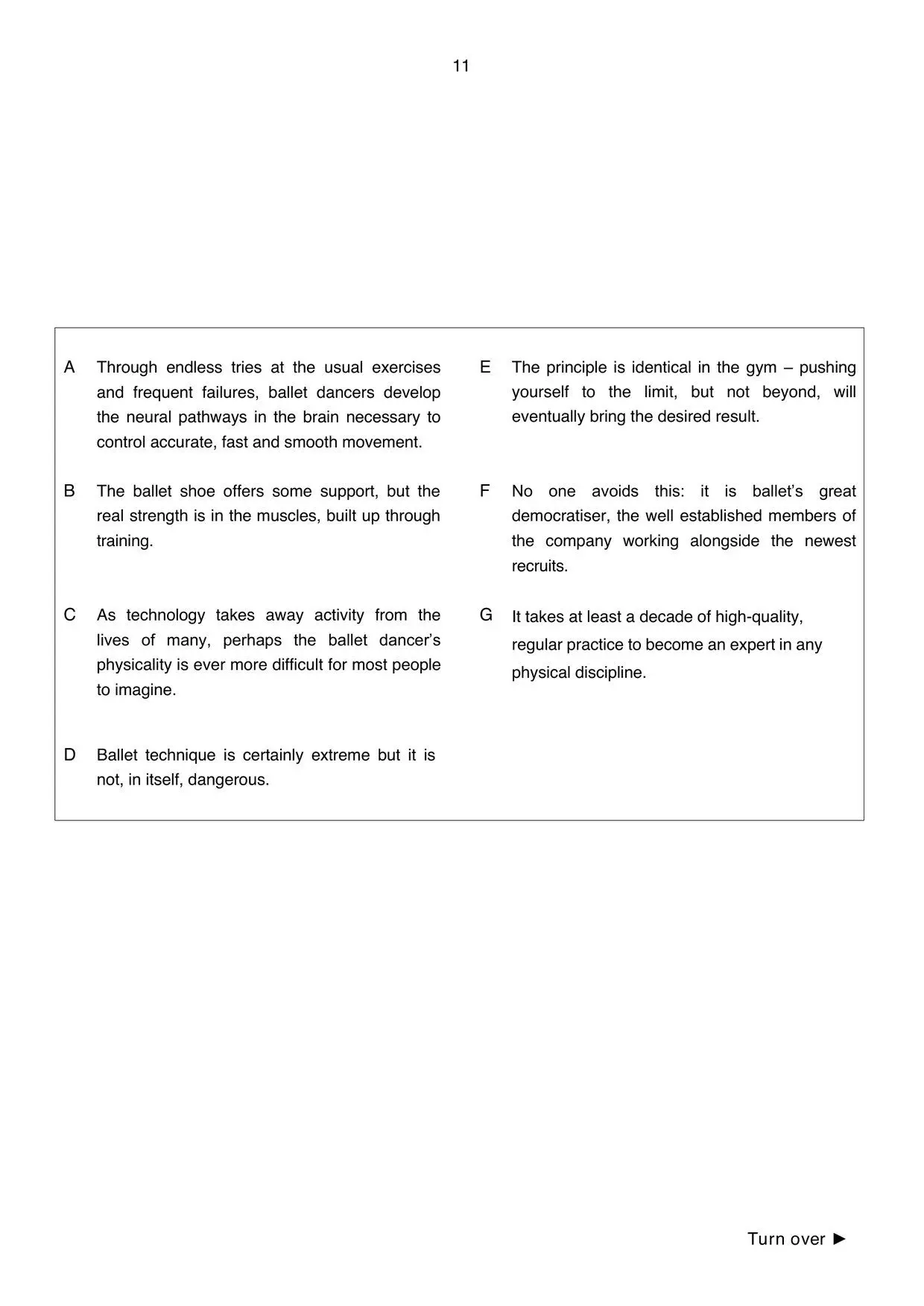
Look at gap 37. Right after it, its various demands needs something to refer to. The correct sentence is D: Ballet technique is certainly extreme but it is not, in itself, dangerous. That its refers to ballet technique. In all six gaps of the test, the decisive clue came after the gap, not before.
You’ll find all six gaps solved and the clues that link each sentence to its place in the guide to B2 Reading Part 6.
Part 7: Multiple matching
A long text divided into sections, or several short texts, and ten statements you have to match to the section where they appear. Sections can be used more than once and the questions don’t follow the order of the text. It’s the part with the most questions, but each one is worth one mark.
In the sample test, a journalist interviews a young Chelsea footballer and his father. The first question says states how surprised the writer was at Duncan’s early difficulties, and the answer is in section A. This is the whole of Part 7, with the questions on the left and the text on the right:
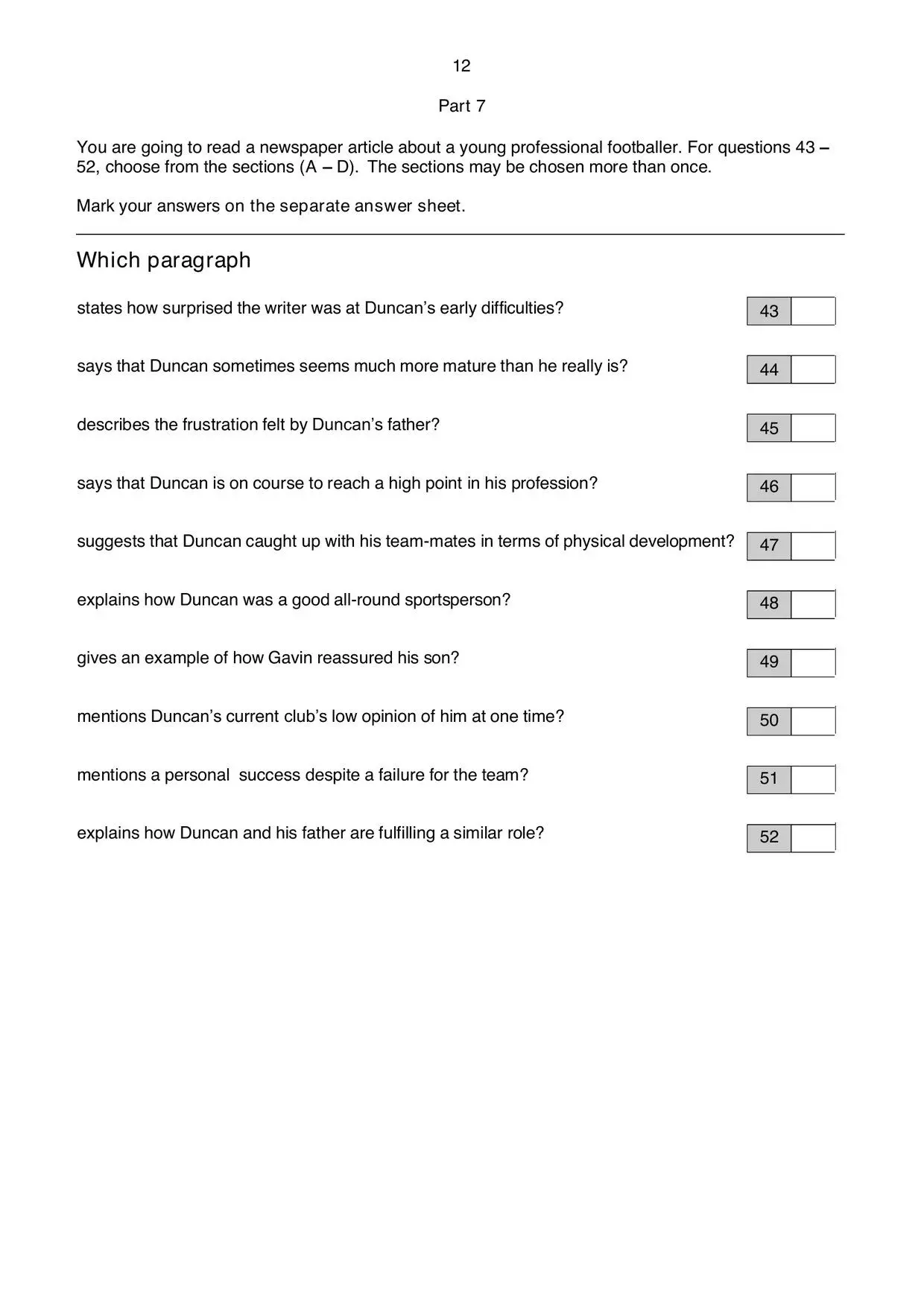
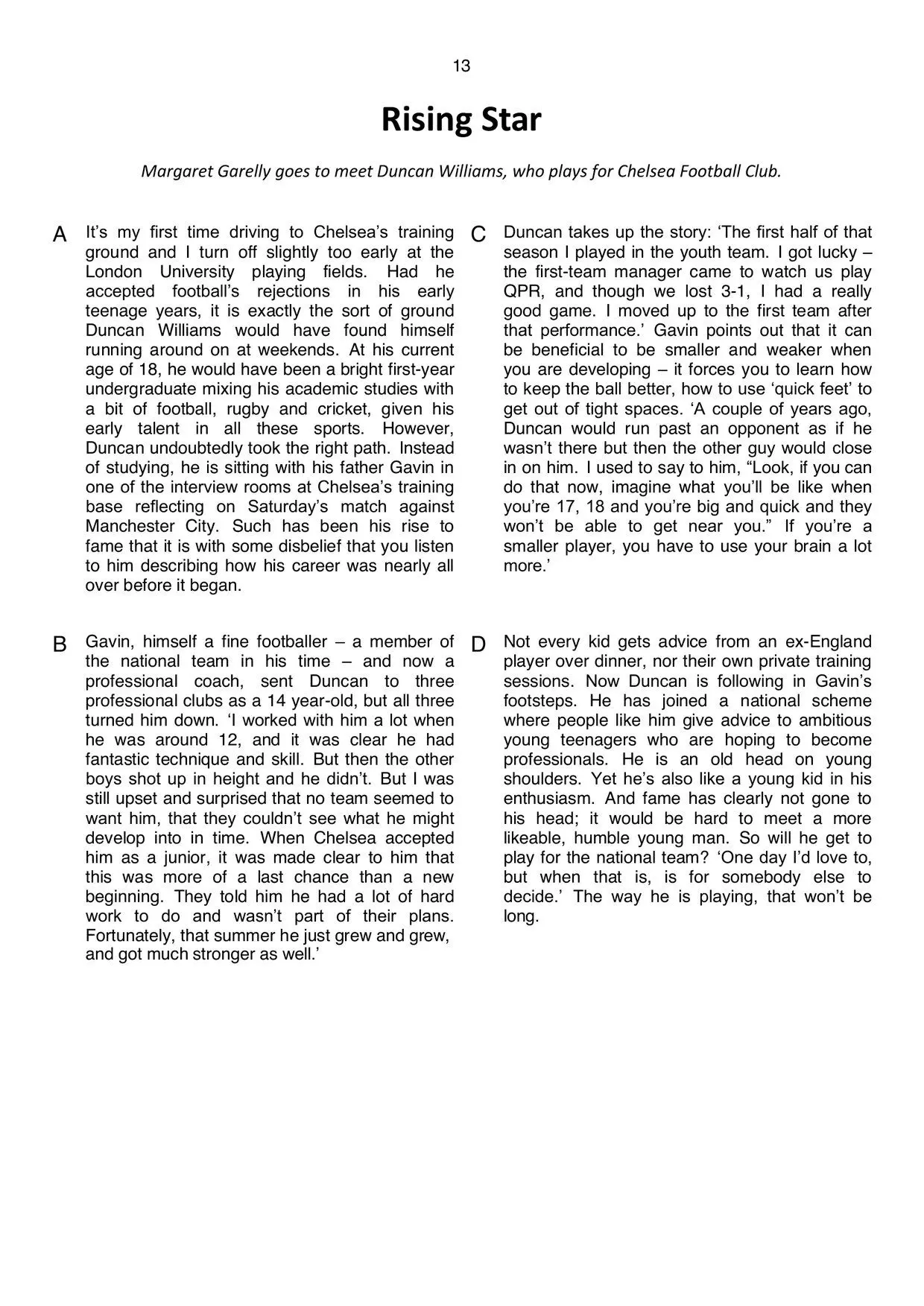
The journalist writes it is with some disbelief that you listen to him describing how his career was nearly all over before it began. Disbelief is the surprise in the question: the answer is A. The trap is in section B, where surprised appears literally, but the person saying it is the father, not the journalist.
You’ll find all ten questions solved and the section-by-section method in the guide to B2 Reading Part 7.
How to split the hour and a quarter
Cambridge doesn’t set a time per part, so this is my own recommendation, based on what tends to work for my students. What matters is having a plan and sticking to it:
| Block | Suggested time |
|---|---|
| Parts 1 to 4 (Use of English and Part 1) | About 30 minutes |
| Part 5 | About 15 minutes |
| Part 6 | About 12 minutes |
| Part 7 | About 13 minutes |
| Final check | About 5 minutes |
Two details from the Cambridge handbook worth bearing in mind. In the paper-based exam no additional time is allowed for completing the answer sheet, so you have to do it within the hour and a quarter. And you can do the parts in any order, although Cambridge recommends following the order of the question paper so you don’t put answers in the wrong section of the sheet.
Strategies that work across the whole Reading paper
- Read the text before the options. In Parts 5 and 6, Cambridge recommends reading the text first: that way you understand its structure and don’t get led astray by false options.
- Beware of word spotting. It’s the warning Cambridge repeats most across all three parts: an option sharing words with the text doesn’t mean it says the same thing.
- Look for the same idea in different words. Correct answers almost always paraphrase the text (surprised = disbelief; mature = an old head on young shoulders).
- Always read what comes next. In Part 6, the decisive clues came after the gap; in Part 5, many answers depend on a later but or despite.
- Notice who says what. In texts with several voices, the same idea may come from two different people.
- Don’t leave anything blank. There’s no penalty for wrong answers.
How to prepare for B2 First Reading
Beyond doing practice tests, what really improves your Reading is reading a lot, and a bit of everything. Cambridge recommends practising with the same types of text that come up in the exam: extracts from character-driven novels, interviews in which people explain their ideas, and reviews or articles in which several people give their opinions.
If you want a starting point, my guide to learning English with short stories explains how to get the most out of them, and my book Short Stories in English for Intermediate Learners (B1 and B2) has stories at your level with audio. And for Part 6, go over the B2 connectors in English: they’re half the clues.
Frequently asked questions about B2 First Reading
How many parts are there in B2 First Reading?
Four: Parts 1, 5, 6 and 7 of the Reading and Use of English paper. In total, 30 questions and 42 marks.
How long is B2 First Reading?
It doesn’t have its own time: Reading and Use of English are done together in a single paper lasting 1 hour 15 minutes, and you decide how to split it.
How much does Reading count in B2 First?
A fifth. Your result is the average of five equally weighted scores: Reading, Use of English, Writing, Listening and Speaking.
Is there extra time to transfer answers to the answer sheet?
No. In the paper-based exam you have to mark your answers on the sheet within the hour and a quarter. In the digital exam you answer directly on screen.
Can I do the parts in any order?
Yes. Even so, in the paper-based exam Cambridge recommends following the order of the question paper, so you don’t mark answers in the wrong section.
Do wrong answers lose marks?
There’s no penalty in B2 First, so answer every question even if you’re not sure.
Keep preparing for B2 First
You’ll find each part of Reading explained in depth, with the sample test solved, in the guides to B2 Reading Part 5, B2 Reading Part 6 and B2 Reading Part 7. For the rest of the exam, check out the guides to Use of English, Writing and Speaking, or go back to the main B2 First page.
Did you find this guide useful? Share it with other students and teachers preparing for the FCE. And if you’re left with any doubts, leave them in the comments. I read every one.
See you in the next guide. Until then, don’t forget to keep smiling! 🙂
