
Table of contents
B2 First Reading Part 7 is the multiple matching task: a long text divided into sections (or several short texts) and ten questions where you have to decide which section each idea appears in. It’s the part of Reading with the most questions, but here each answer is worth one mark, not two.
Above all, it tests your ability to find information quickly and accurately: knowing where something is said, and not confusing it with another section that says something similar. In this guide I’ll explain what B2 Reading Part 7 looks like, how to read the questions so you can find the answers without rereading everything five times, and we’ll go through the ten questions of an official Cambridge sample test together. 🙂
What B2 Reading Part 7 looks like
Part 7 is the last part of the Reading and Use of English paper: seven parts, 52 questions and 1 hour 15 minutes. You’ll find the overview in the guide to B2 First Reading; this is the part we’re looking at here:
| Detail | B2 Reading Part 7 |
|---|---|
| What you do | Match 10 statements to the section of the text (or the text) where they appear |
| Number of questions | 10 (numbered 43 to 52) |
| Type of text | One long text divided into sections, or up to six short texts |
| Options | Each section can be chosen more than once |
| Marks | 1 mark per correct answer, 10 in total |
| What it tests | Detail, opinion, specific information and implication |
How the questions work
The questions come before the text and almost always start with Which paragraph… or Which person…, followed by a verb that tells you what to look for: states, describes, explains, mentions, suggests. Two things are worth being clear about:
- The questions don’t follow the order of the text. Unlike Part 5, the answer to the first question may be in the last section.
- One section can answer several questions. In the sample test, each of the four sections answers two or three questions. Having used a section already doesn’t mean it won’t come up again.
The four-step method
- Read the ten questions and underline the key idea in each. Not the word, the idea: frustration felt by Duncan’s father, personal success despite a failure for the team.
- Read the first section and compare it with all the questions. Note which questions could be there. Do the same with each section. That way you read the text carefully once, instead of searching for each question separately.
- Check the whole question, not just part of it. Cambridge warns that other sections may say something similar without reflecting all of the question. Pay particular attention to who says what.
- Be suspicious of repeated vocabulary. A word from the question appearing in a section doesn’t make it the answer; the answer often uses different words.
The sample test, solved question by question
This is the official Cambridge sample test: an article about Duncan Williams, a young Chelsea footballer, written by a journalist who interviews him with his father, Gavin. First the questions, then the text:
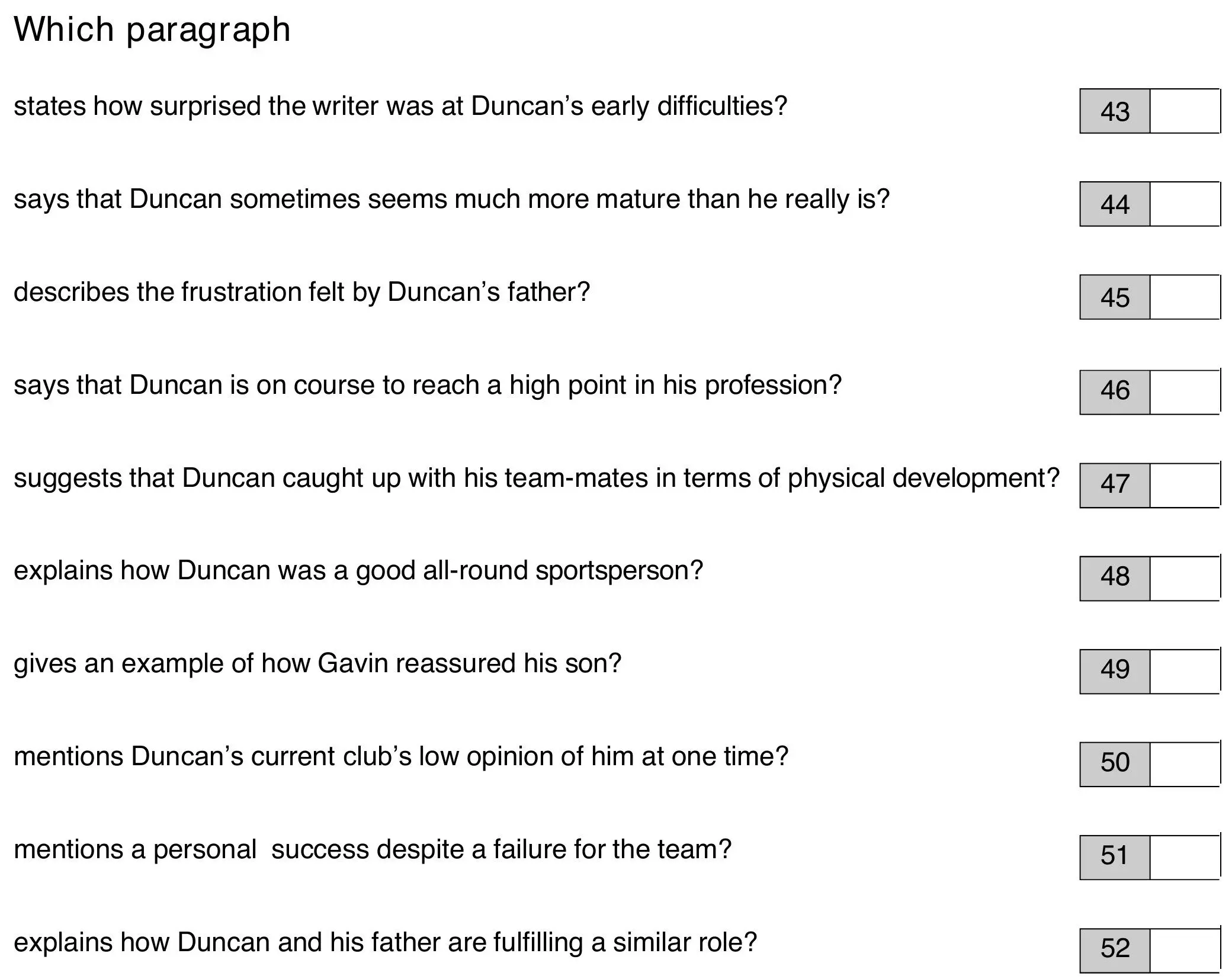
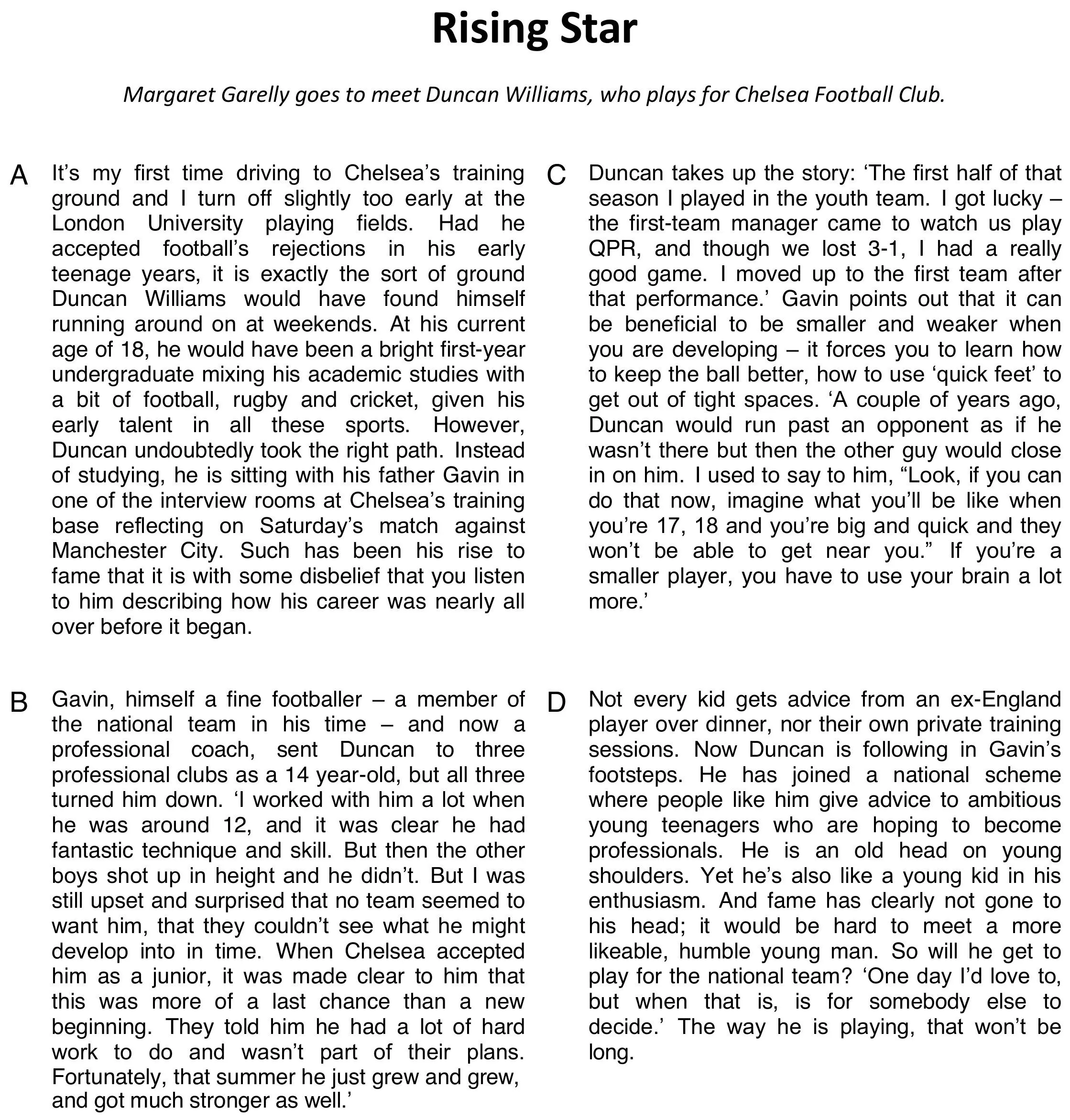
Try it before reading the explanations. I’ve grouped them by section, which is how you actually work through this part:
Section A: questions 43 and 48
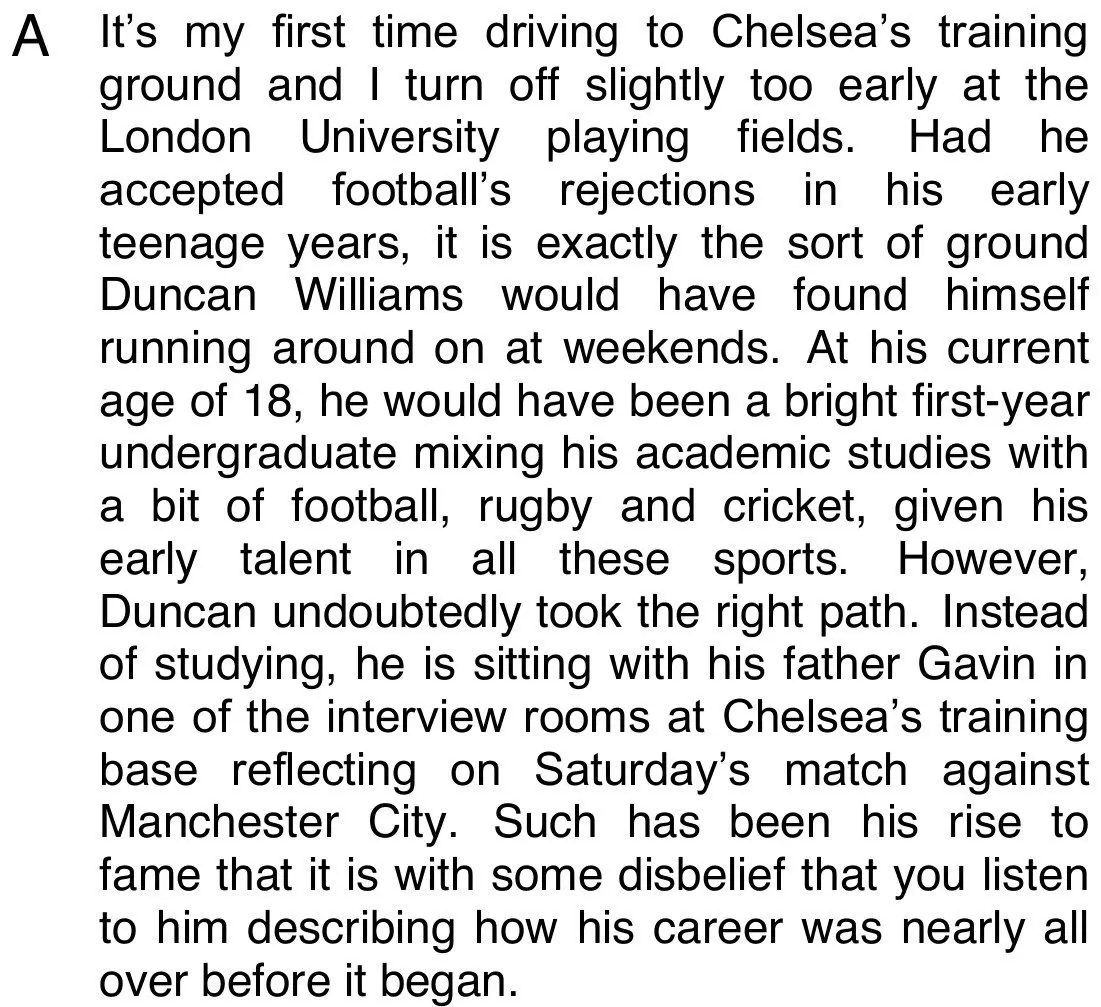
43. A. States how surprised the writer was at Duncan’s early difficulties. The journalist writes that «it is with some disbelief that you listen to him describing how his career was nearly all over before it began». Disbelief is the surprise in the question. It’s the clearest trap in the test: section B literally contains surprised (I was still upset and surprised), but the person saying it is the father, not the journalist.
48. A. Explains how Duncan was a good all-round sportsperson. Had he gone to university, he would be mixing his studies with «a bit of football, rugby and cricket, given his early talent in all these sports». Several sports at once is the idea of all-round.
Section B: questions 45, 47 and 50
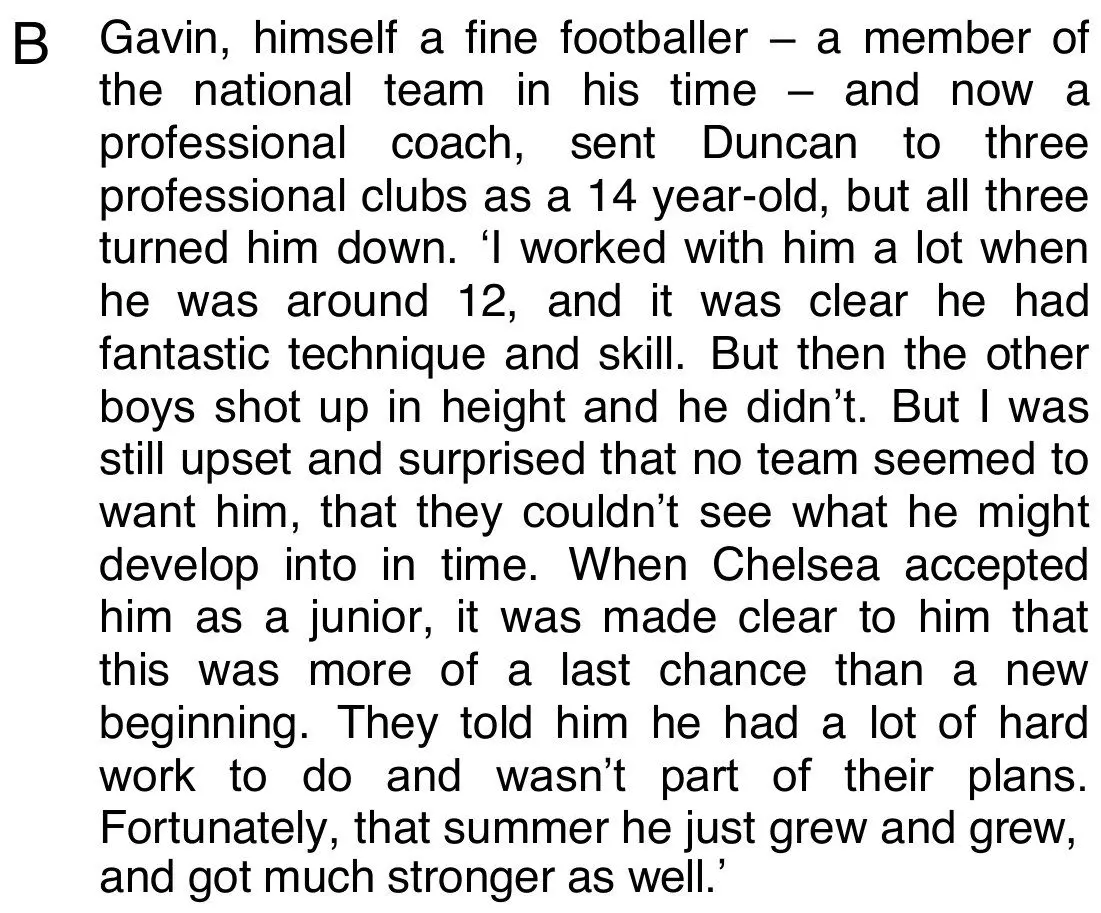
45. B. Describes the frustration felt by Duncan’s father. Gavin says «I was still upset and surprised that no team seemed to want him, that they couldn't see what he might develop into in time». Nobody seeing his son’s potential is the frustration in the question.
47. B. Suggests that Duncan caught up with his team-mates in terms of physical development. First, «the other boys shot up in height and he didn't»; later, «that summer he just grew and grew, and got much stronger as well». The question says caught up: you need to put the two sentences together to see it.
50. B. Mentions Duncan’s current club’s low opinion of him at one time. When Chelsea took him on, they made it clear it was «more of a last chance than a new beginning» and that he «wasn't part of their plans». The current club is Chelsea, and at one time means back then.
Section C: questions 49 and 51
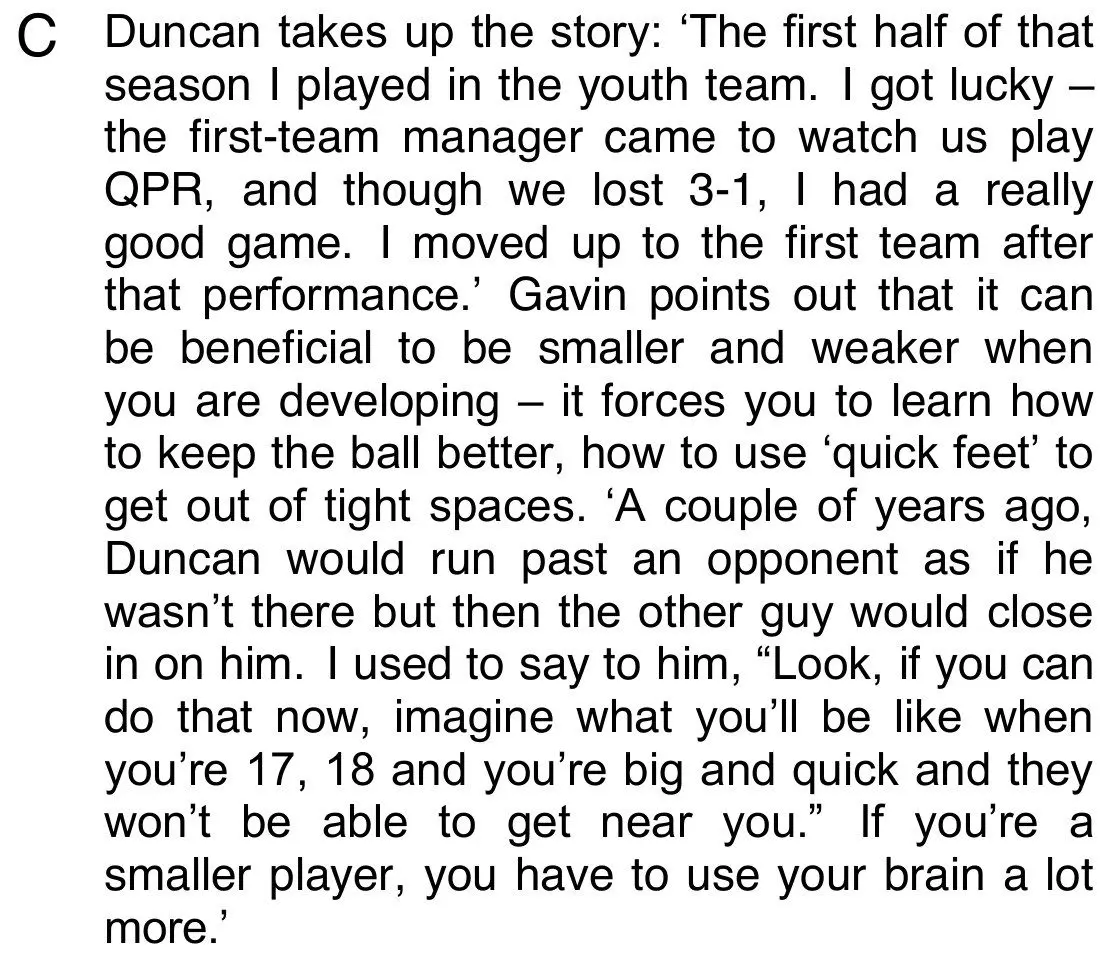
49. C. Gives an example of how Gavin reassured his son. Gavin used to tell him: «Look, if you can do that now, imagine what you'll be like when you're 17, 18 and you're big and quick». Gives an example asks for a specific situation, and here it is, quoted word for word.
51. C. Mentions a personal success despite a failure for the team. «Though we lost 3-1, I had a really good game». Though is the question’s despite; the defeat is the team’s failure; and the good game is the personal success.
Section D: questions 44, 46 and 52
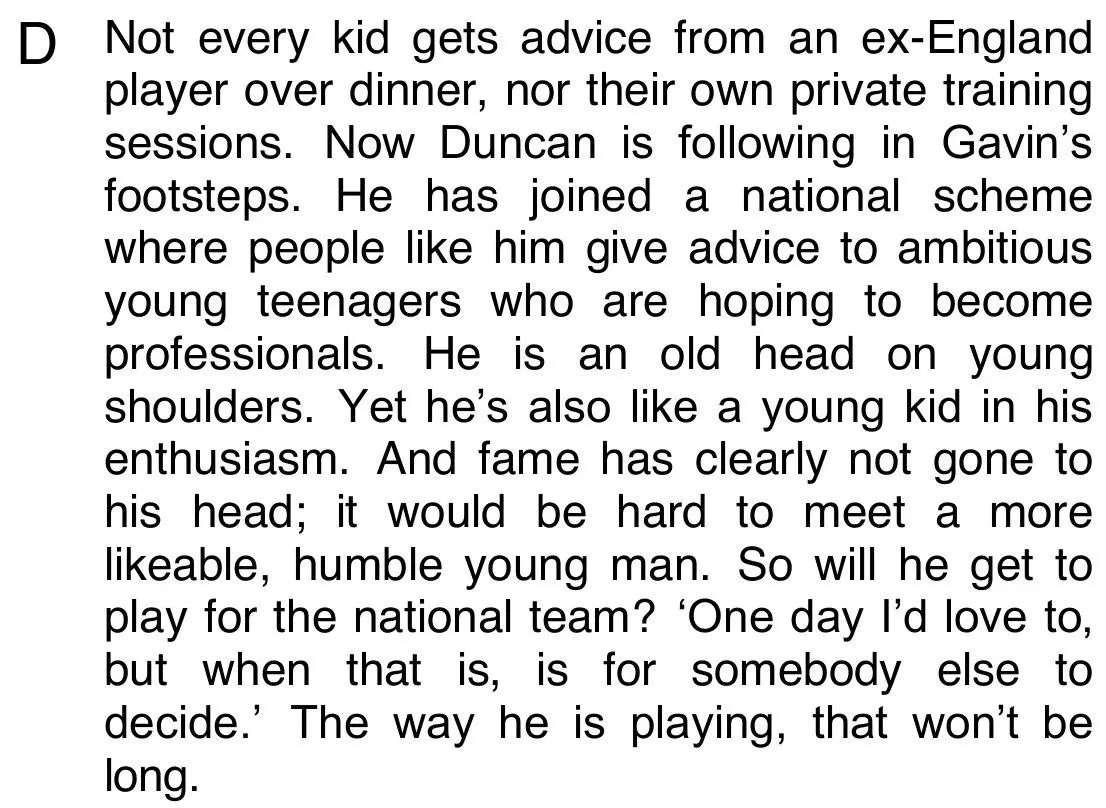
44. D. Says that Duncan sometimes seems much more mature than he really is. «He is an old head on young shoulders»: an idiom that means exactly that, being mature for your age. It’s a good example of a question that doesn’t share a single word with the text.
46. D. Says that Duncan is on course to reach a high point in his profession. Will he play for the national team? «The way he is playing, that won't be long». Playing for his country is the high point of the profession, and on course means he’s heading there.
52. D. Explains how Duncan and his father are fulfilling a similar role. «Now Duncan is following in Gavin's footsteps. He has joined a national scheme where people like him give advice to ambitious young teenagers». His father advised him, and now he advises other young players.
Answers, in case you’ve been keeping track: 43A, 44D, 45B, 46D, 47B, 48A, 49C, 50B, 51C, 52D.
How the ideas were expressed in the text
This table sums up the most important thing about Part 7: the question and the text hardly ever use the same words.
| Question | Section | The question says… | The text says… |
|---|---|---|---|
| 43 | A | how surprised the writer was | with some disbelief |
| 44 | D | more mature than he really is | an old head on young shoulders |
| 45 | B | frustration felt by Duncan’s father | upset… that no team seemed to want him |
| 46 | D | on course to reach a high point | that won’t be long |
| 47 | B | caught up… physical development | he just grew and grew |
| 48 | A | a good all-round sportsperson | early talent in all these sports |
| 49 | C | how Gavin reassured his son | imagine what you’ll be like… |
| 50 | B | current club’s low opinion | wasn’t part of their plans |
| 51 | C | personal success despite a failure | though we lost 3-1, I had a really good game |
| 52 | D | fulfilling a similar role | following in Gavin’s footsteps |
Typical distractors in B2 First Reading Part 7
- The question’s word in the wrong section. Surprised appears in B, but question 43 is about the journalist’s surprise, which is in A.
- The wrong person. In texts with several voices (here, the journalist, Duncan and Gavin), pay attention to who says or feels what.
- Half the idea. Cambridge warns that other sections may cover part of the question. Section C also talks about being smaller than the others, but only B says Duncan caught up with them (question 47).
Strategy for B2 Reading Part 7
- Work section by section, not question by question. Reading each section once and comparing it with all the questions is much faster than searching the whole text ten times.
- Paraphrase the question before you search. Think how it might be put in other words: surprised could be disbelief; mature, old head.
- Don’t rule out a section because you’ve used it. Sections repeat; in this test, B and D answer three questions each.
- If you’re torn between two sections, reread the whole question. There’s usually a detail (who, when, despite) that fits only one.
- Save time for it. Cambridge doesn’t set a time per part, but as it comes last, it’s the one that suffers most if you’re short of time. Around 12 to 15 minutes is reasonable.
Most common mistakes in B2 Reading Part 7
- Choosing by repeated words. It’s the number one mistake in this part, and Cambridge repeats it in the handbook.
- Ignoring who is speaking. The same idea may come from two different people.
- Searching the whole text for each question. It takes a huge amount of time and increases confusion.
- Leaving questions blank at the end. If you run out of time, choose the most likely section: there’s no penalty.
Frequently asked questions about B2 First Reading Part 7
How many questions are there in B2 First Reading Part 7?
Ten questions (numbered 43 to 52). It’s the part of Reading with the most questions.
How much is each question worth?
One mark. That’s why, even with ten questions, Part 7 is worth 10 marks, less than Parts 5 and 6, which are worth 12 each.
Can I use a section more than once?
Yes. Sections can be chosen more than once, and it’s normal for several of them to answer two or three questions.
Do the questions follow the order of the text?
No. Unlike Part 5, the questions in Part 7 don’t follow the order of the text, so don’t assume the answer to question 43 is in section A.
Do wrong answers lose marks?
There’s no penalty in B2 First, so answer all ten even if you’re not sure.
Keep preparing B2 Reading
This guide completes the series on B2 First Reading. If you’ve missed any, check out the guides to B2 Reading Part 5 and B2 Reading Part 6. And remember that Part 1, which also counts towards Reading, is explained in Use of English Part 1.
Did you find this guide useful? Share it with other students and teachers preparing for the FCE. And if you’re left with any doubts about a question, leave them in the comments. I read every one.
See you in the next guide. Until then, don’t forget to keep smiling! 🙂
