
Table of contents
B2 First Reading Part 5 is the first pure reading comprehension part of the exam: a long text, usually an extract from a novel or an article, and six multiple-choice questions with four options each. And it’s one of the parts that carries the most weight: each question is worth two marks.
Here Cambridge doesn’t just ask what happens in the text, but what the narrator feels, what they mean by a phrase or what a word refers to. And the favourite trap is always the same: the option that repeats words from the text without saying what the text says. In this guide I’ll explain what B2 Reading Part 5 looks like, which types of question come up, and we’ll go through the six questions of an official Cambridge sample test together. 🙂
What B2 Reading Part 5 looks like
Part 5 is part of the Reading and Use of English paper: seven parts, 52 questions and 1 hour 15 minutes. According to Cambridge, the Reading section is made up of Parts 1, 5, 6 and 7. You’ll find the overview in the guide to B2 First Reading; this is the part we’re looking at here:
| Detail | B2 Reading Part 5 |
|---|---|
| What you do | Read a long text and answer 6 questions, choosing the correct option out of 4 (A, B, C or D) |
| Number of questions | 6 (numbered 31 to 36) |
| Type of text | An extract from a novel, an article or similar, in which ideas, feelings and opinions are expressed |
| Marks | 2 marks per correct answer, 12 in total |
| Order | The questions follow the order of the text; the last one may refer to the text as a whole |
| What it tests | Detail, opinion, attitude, tone, purpose, main idea, meaning from context, implication and reference |
What types of question come up
According to the Cambridge handbook, you can be asked about many different things in this part, but almost all of them fit one of these types. Recognising them tells you what to look for in the text:
| Question type | How it’s usually worded | In the sample test |
|---|---|---|
| Main idea of a paragraph | What is the writer’s main point…? | Question 31 |
| Someone’s attitude or feelings | What does X suggest about…?, How does X feel…? | Questions 32, 33 and 36 |
| Writer’s purpose | What is the writer’s purpose in…? | Question 34 |
| Reference | ‘that’ in line 31 refers to… | Question 35 |
| Meaning of a word or phrase | What does ‘X’ mean in line…? | Not in this sample |
| The text as a whole | What is the writer doing in the text as a whole? | Not in this sample |
The four-step method
- Read the whole text before looking at the options. It’s Cambridge’s first piece of advice: three out of four options are wrong, so reading them all before the text just fills your head with false ideas.
- Read each question, but not the options. The question tells you what to look for and often where (in the first paragraph, in line 31). As the questions follow the order of the text, each answer comes after the previous one.
- Find the passage and understand it in your own words. Before looking at A, B, C and D, try to answer yourself: how does Caitlin feel? What does that refer to?
- Now compare with the options. Keep the one that says the same as the text, even in different words, and rule out those that only share vocabulary with it.
The sample test, solved question by question
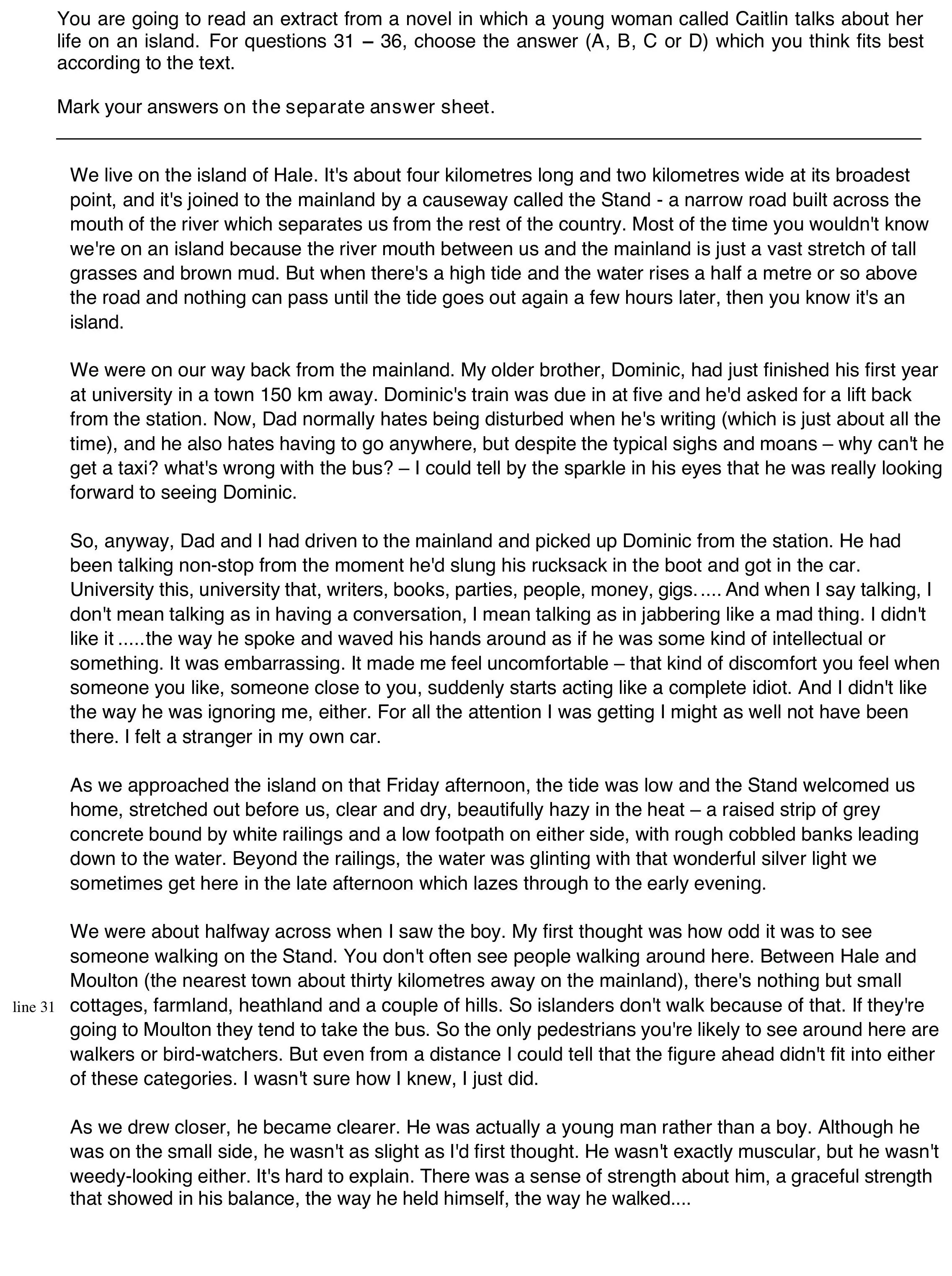
This is the text from the official Cambridge sample test: an extract from a novel in which Caitlin, a young woman who lives on an island, describes the day her brother came back from university. Read it all and try the questions before reading my explanations:
Question 31: the island

Caitlin explains that the island is joined to the mainland by a road, the Stand, and that «most of the time you wouldn't know we're on an island». Only at high tide, when the water covers the road, «nothing can pass until the tide goes out again».
Correct answer: C. The island is only completely cut off at certain times, at high tide. A mentions danger, which the text doesn’t; B compares its size with how it looks from the mainland, and the text gives measurements but makes no such comparison; D talks about how hard it is to live there, which this paragraph doesn’t say.
Question 32: the father

Her father «normally hates being disturbed when he's writing» and also hates having to go anywhere, but despite «the typical sighs and moans», Caitlin sees «the sparkle in his eyes»: he was really looking forward to seeing Dominic.
Correct answer: D. Although he normally stops writing for nothing, his son’s arrival is an exception. B is the subtlest trap: his first reaction is the typical sighs and moans, in other words the usual, not something different. C says the opposite of the text, because his daughter does notice how he feels; and A doesn’t hold up, because his writing doesn’t stop him from collecting his son.
Question 33: Caitlin’s discomfort

Dominic won’t stop talking about university, and Caitlin describes «that kind of discomfort you feel when someone you like, someone close to you, suddenly starts acting like a complete idiot».
Correct answer: C. The key word is suddenly: what makes her uncomfortable is the unexpected change in her brother’s behaviour. A is a classic case of word spotting: embarrassing appears in the text, but Caitlin doesn’t say she can’t understand what her brother is talking about. B and D add ideas the text doesn’t contain (confusion, feeling foolish).
Question 34: describing the island

In the fourth paragraph, the Stand «welcomed us home», it’s «beautifully hazy in the heat» and the water glints with «that wonderful silver light».
Correct answer: A. In purpose questions, look at the type of words: welcomed, beautifully and wonderful express positive feelings, not information. B doesn’t work because how the road was built is explained in the first paragraph, not here; C turns a light that sometimes appears into usual weather; and D is partly true (they are on their way home), but it isn’t the purpose of the description.
Question 35: what that refers to

The full sentence is: «Between Hale and Moulton… there's nothing but small cottages, farmland, heathland and a couple of hills. So islanders don't walk because of that.»
Correct answer: D. In reference questions, the answer is nearly always just before the word: that refers to the fact that there’s nothing between the island and the nearest town, so there’s nowhere in particular to walk to. B is the sequence trap: the bus is mentioned in the next sentence, not the previous one. A and C don’t appear in the text.
Question 36: the boy

As they get closer, Caitlin realises that «he was actually a young man rather than a boy» and that «he wasn't as slight as I'd first thought».
Correct answer: C. Actually and as I’d first thought are the signals: her first impression was wrong. A is the most dangerous option, because the text does talk about strength and the way he moves, but it doesn’t say this contrasts with his appearance. B contradicts the text (I wasn’t sure how I knew), and D isn’t mentioned.
Answers, in case you’ve been keeping track: 31C, 32D, 33C, 34A, 35D, 36C.
What decided each answer
| Question | Answer | Type | The clue |
|---|---|---|---|
| 31 | C | Main idea | most of the time you wouldn’t know + high tide |
| 32 | D | Attitude | despite + the sparkle in his eyes |
| 33 | C | Feelings | suddenly starts acting like… |
| 34 | A | Purpose | welcomed, beautifully, wonderful |
| 35 | D | Reference | The sentence right before that |
| 36 | C | Reaction | actually, as I’d first thought |
Typical distractors in B2 First Reading Part 5
- The option that repeats words from the text. Cambridge calls it word spotting: an option sharing a word with the text doesn’t mean it says the same thing. Question 33 (embarrassing).
- The option that says the exact opposite. His true feelings are easily hidden, when Caitlin sees them in his eyes. Question 32.
- The option that’s true but doesn’t answer the question. They are on their way home, but that isn’t the purpose of the description. Question 34.
- The option that’s in the text, but somewhere else. The bus is there, but after that, not before. Question 35.
- The option that exaggerates or adds. Dangerous, difficult place to live in, confused: reasonable ideas the text doesn’t state. Questions 31 and 33.
Strategy for B2 Reading Part 5
- Don’t read the options before the text. Three out of four are false and they bias you.
- Use the location clues. In the first paragraph, in line 31, in the fourth paragraph: go straight to that passage.
- Read the whole sentence in unfinished-sentence questions. When the question is half a sentence, check that the complete sentence matches the text, not just the option.
- Look for the words that change the meaning. Despite, actually, suddenly, rather than: they’re usually right where the answer is.
- Give it the time it deserves. Cambridge doesn’t set a time per part, but it’s the densest text in Reading and each question is worth double. Around 15 minutes is reasonable.
Most common mistakes in B2 Reading Part 5
- Choosing the option that sounds like something you’ve read. If you can’t point to the sentence in the text that says the same, be suspicious.
- Answering with what you think, not what the text says. It’s reasonable that island life might be hard, but the question is what Caitlin says.
- Stopping at the first sentence of the passage. Many answers depend on a but or a despite that comes afterwards.
- Ignoring tone. In attitude and purpose questions, evaluative adjectives and adverbs are the best clue.
Frequently asked questions about B2 First Reading Part 5
How many questions are there in B2 First Reading Part 5?
Six questions (numbered 31 to 36), each with four options (A, B, C or D).
How much is each question worth?
Two marks. In total, Part 5 is worth 12 marks, the same as Part 6, even though Part 7 has more questions.
Do the questions follow the order of the text?
Yes. Cambridge presents the questions in the same order as the information in the text, so you can follow the development of the ideas. The last one may refer to the text as a whole.
Do wrong answers lose marks?
There’s no penalty in B2 First, so answer all six even if you’re not sure.
What kind of texts come up?
They’re usually extracts from novels or articles in which someone expresses ideas, opinions and feelings. That’s why Cambridge recommends practising with interviews and character-driven novels.
Keep preparing B2 Reading
This guide is part of the series on B2 First Reading. Once you’ve got the hang of this part, move on to B2 Reading Part 6 and B2 Reading Part 7. And if you want to practise reading with texts at your level, have a look at my guide to learning English with short stories.
Did you find this guide useful? Share it with other students and teachers preparing for the FCE. And if you’re left with any doubts about a question, leave them in the comments. I read every one.
See you in Part 6. Until then, don’t forget to keep smiling! 🙂
