
Table of contents
If you’ve ever tried to learn English with a textbook and found yourself losing focus after ten minutes, you’re not alone. Stories are different. Stories pull you in, make you curious about what happens next, and — almost without you noticing — teach you vocabulary, grammar and natural expressions along the way. That’s why learning English with short stories has become one of the most popular and effective approaches for learners at every level.
In this guide, you’ll discover a practical, step-by-step method for using short stories to improve your English, plus level-by-level guidance, study routines that fit into a busy life, and recommendations to help you find the right material. Whether you’re a complete beginner or already at an advanced level, reading short stories in English is something you can start doing today.
📚 What you’ll need to get started
- ✅ A short story at your level
- ✅ A notebook or vocabulary app
- ✅ Audio (if available)
- ✅ 10–30 minutes a day
That’s it. No expensive courses, no complicated materials. Just a good story and a little consistency.
Why short stories are so effective for learning English
There are dozens of ways to learn English, so why choose short stories? The answer comes down to four things: motivation, memory, real language and practicality.
- Motivation and enjoyment. Language learning is a long game, and the single biggest predictor of success is consistency. You’re far more likely to sit down and study every day if you’re genuinely enjoying what you’re doing. Stories create curiosity. You want to know what happens to the characters. That emotional engagement keeps you reading — and the more you read, the more English you absorb.
- Cognitive benefits: context makes everything stick. Research in language acquisition consistently shows that we remember vocabulary and grammar much better when we encounter them in context, rather than on a list. When you learn a new word in the middle of a gripping scene, your brain creates a rich memory — you remember not just the word, but the situation, the emotion and the sentence around it. That’s the kind of learning that actually lasts.
- Real language in action. Textbooks often present English in a rather artificial way. Short stories, on the other hand, give you dialogues that sound like real conversations, natural expressions that native speakers actually use, and cultural references that help you understand the world behind the language. You’ll encounter phrasal verbs, idioms, colloquial speech and formal register — all in context, all doing a job within the narrative.
- Short texts are ideal for busy learners. A novel is a commitment. A short story is manageable. You can read one in a single sitting, revisit it several times across a week, and work with it deeply without feeling overwhelmed. For learners who have jobs, families and a hundred other things competing for their attention, that accessibility is everything. A short story gives you a complete, satisfying reading experience in 10 to 30 minutes — which means there’s no excuse not to fit it into your day.
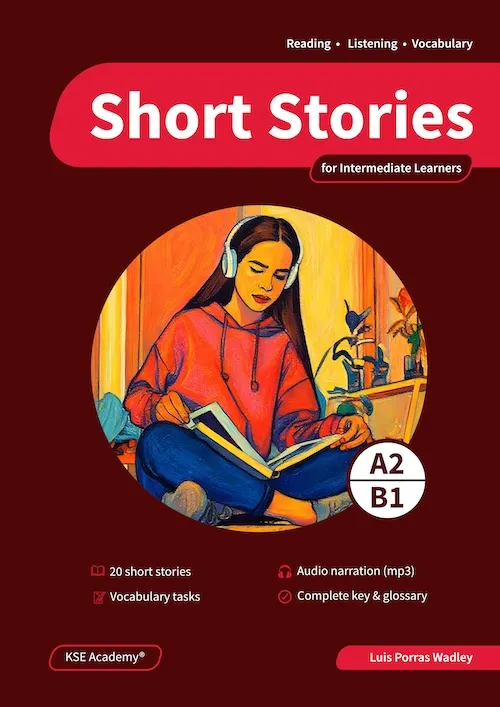
Short Stories in English for Intermediate Learners (A2 and B1) with Audio
Improve your English through 20 original modern stories written specifically for A2 and B1 learners. Each story comes with professionally narrated audio, a comprehensive glossary, reading comprehension questions and vocabulary exercises — everything you need to build your skills naturally and enjoyably.
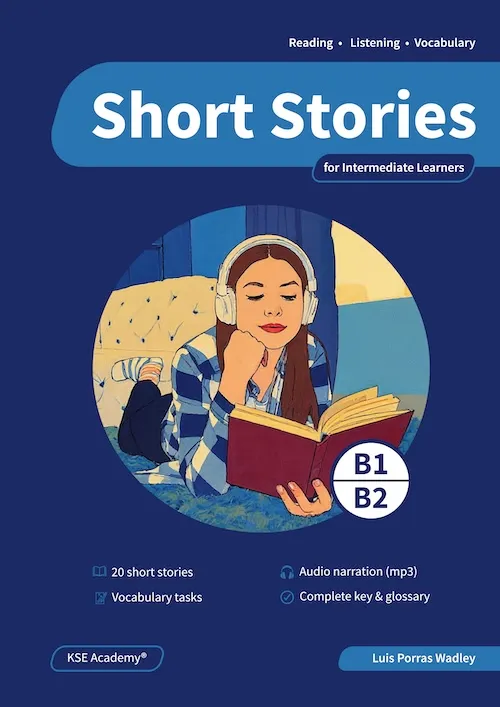
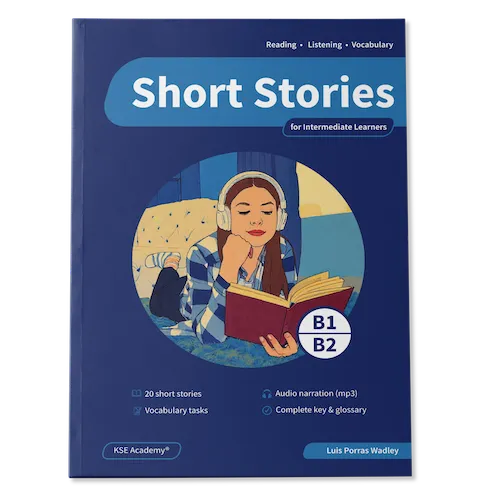
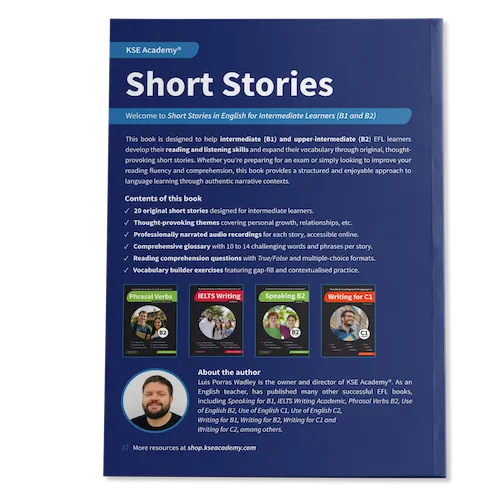
Short Stories in English for Intermediate Learners (B1 and B2) with Audio
Ready to push your English further? These 20 original modern stories are written for B1 and B2 learners, with richer vocabulary, longer texts and more demanding language tasks. Includes professionally narrated audio, glossaries, comprehension questions and vocabulary exercises — perfect for learners working towards Cambridge B2 First or simply aiming higher.
How learning with stories works: the core method
You can use this five-step workflow with any short story, at any level. It doesn’t require special tools or a lot of time — just a consistent approach. Once you’ve done it two or three times, it becomes second nature.
Step 1: Choose an appropriate story
The most important factor in successful story-based learning is choosing a text that’s at the right level — challenging enough to stretch you, but not so difficult that you feel lost. A good rule of thumb is the 5% rule: if more than roughly one word in twenty is completely unknown to you, the text is probably too difficult. If you can glide through the whole thing without learning anything new, it’s too easy.
Beyond vocabulary, think about topic familiarity. A story set in a world you know something about — cooking, sport, travel, family life — will be easier to follow even when the language is slightly above your level. Length matters too: start short. A 400–600 word story is the perfect training ground, especially in the early stages.
Step 2: First reading for meaning
On your first read-through, your only job is to understand the big picture. Don’t stop every time you hit an unknown word. Don’t reach for the dictionary. Just read. Ask yourself: Who are the main characters? What happens? How does it end? How does the story make you feel?
This first reading trains your brain to tolerate ambiguity — a skill that’s absolutely essential for real-world communication. Native speakers don’t know every word they encounter either; they use context to infer meaning, and you should practise doing the same. Once you’ve got the gist, you’re ready to go deeper.
Step 3: Second reading for vocabulary and grammar
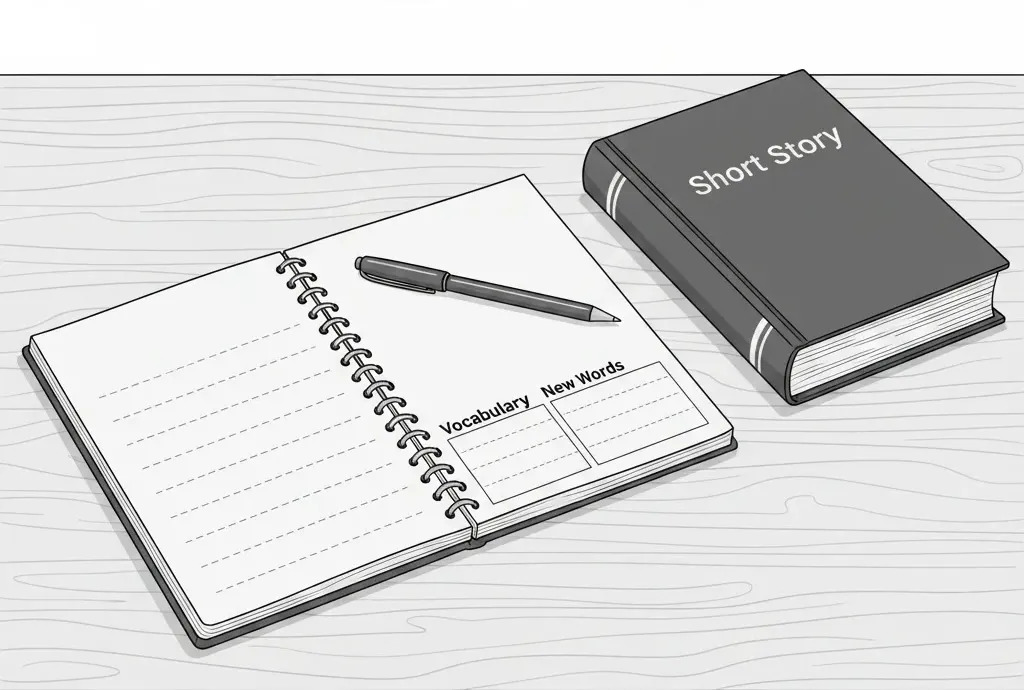
Now go back through the story with a pencil (or a highlighting tool if you’re reading digitally). This time, underline or highlight words, phrases and expressions that are new to you or that you’d like to use yourself. Look up the ones that seem most useful and add them to a vocabulary notebook or app — but don’t just copy the definition. Write the word in a sentence of your own, ideally inspired by the story. This simple habit makes a huge difference to how well new vocabulary sticks.
At the same time, pay attention to grammar. Notice how verb tenses are used to shift between past events and background description. Spot how reported speech works, or how the author uses conditional structures to build tension. You don’t need to analyse every sentence — just notice patterns. This is where your English vocabulary and English grammar grow in the most natural, enjoyable way possible.
Step 4: Listen, shadow and read aloud
If your story comes with audio — and many graded readers and story collections do — this step is where things get really interesting. Start by reading along with the recording: follow the text with your eyes as you listen to the narrator. This connects the written word with the spoken sound, and it’s particularly helpful for words you’ve been mispronouncing silently in your head.
Next, try shadowing: play the audio and repeat just a second or two behind the speaker, mimicking their rhythm, stress and intonation as closely as you can. It might feel strange at first, but shadowing is one of the most powerful techniques for developing natural, fluent speech. Finally, read the story aloud on your own — no audio, just your voice. Focus on sounding natural, not just accurate.
Step 5: Use the story to speak and write
The final step is where passive input becomes active output — and where the real language learning happens. Start by retelling the story in your own words, either aloud or in writing. You’ll quickly notice which vocabulary and structures you’ve actually absorbed and which ones you only half understood.
If the story has dialogue, try role-playing the conversation with a study partner, or simply act out both parts yourself. This might feel silly, but it’s excellent spoken practice. You can also use the story as a creative writing prompt: change the ending, write a sequel, tell the same events from a different character’s point of view, or write a diary entry as one of the characters. These tasks push you to use the language you’ve been studying in genuinely communicative ways.
How to choose the right story for your level
One of the most common mistakes learners make is choosing a text that’s either far too easy or far too challenging. The first leaves you bored; the second leaves you overwhelmed. Here’s how to find the sweet spot.
Signs a story is too easy or too difficult
A story is probably too easy if you understand almost every single word on the first read, you never feel the need to pause, and you finish it without having learnt anything new. That’s fine for pleasure reading — but if your goal is progress, you need a little more challenge.
A story is probably too difficult if you find yourself reaching for the dictionary every few lines, if you finish a paragraph and have no idea what it was about, or if you feel more frustrated than engaged. Struggling is normal and healthy — but constant struggle without comprehension is demotivating and counterproductive.
The ideal reading experience sits somewhere in between: you understand the general flow, you encounter new language regularly, and you feel a satisfying sense of effort and reward. Trust your emotional response to the text — it’s usually a reliable guide.
Quick guide: from beginner to advanced
| Level | Story length | Vocabulary | Grammar | Themes |
|---|---|---|---|---|
| Beginner (A1) | Very short (100–200 words) | Basic, high-frequency words | Simple present and past | Everyday, familiar situations |
| Lower-intermediate (A2–B1) | Short (300–500 words) | Everyday vocabulary + some new words | Simple past narratives, basic tenses | Relatable, real-life situations |
| Upper-intermediate (B1–B2) | Short–medium (400–700 words) | Richer vocabulary, some idioms and phrasal verbs | Wider range of tenses and structures | More varied, emotionally engaging themes |
| Advanced (C1+) | Medium (600–1,000+ words) | Dense, figurative, nuanced language | Complex structures, implicit grammar | Abstract, literary, culturally layered |
Matching stories to your goals
Your level is only part of the picture — your goals matter too. If you’re preparing for a Cambridge exam, look for stories that expose you to the kind of vocabulary and text types that appear in the exam: narratives, descriptive passages and character-driven scenes. You might also find it useful to browse dedicated resource pages, such as my guides to the best books for B1 and the best books for B2, to complement your story reading with targeted exam preparation materials.
If your goal is general communication, prioritise stories with natural dialogue and everyday vocabulary. If you’re focused on listening and pronunciation, make audio your priority and choose stories that come with professional narration. Knowing why you’re learning shapes what you should be reading.
Study routines: how to learn with short stories at any level
The biggest mistake language learners make isn’t choosing the wrong material — it’s being inconsistent. Twenty minutes every day will always outperform a three-hour session once a fortnight. The good news is that short stories are perfectly suited to small, regular study slots. Here are three routines depending on how much time you have.
Busy learners: 10–15 minutes per day
Even the busiest learners can find ten minutes — on the commute, during a lunch break, or before bed. The micro-routine works like this: read one page or one scene of your story, pause to review one or two new words or phrases you noticed, and spend the last minute or two retelling (aloud or in your head) what you just read. That’s it. It sounds almost too simple, but done daily, this routine produces real results over time. The key is not to skip days — a short session is infinitely better than no session.
Standard routine: 30 minutes per day
If you have half an hour, you can follow the full core method in a single session. Spend the first ten minutes on your first read-through for meaning. Use the next ten minutes for your second read, underlining vocabulary and noting grammar patterns. In the final ten minutes, do a quick vocabulary review — write new words in context, test yourself on what you’ve noted — and finish with a short oral or written retell of the story. If your story comes with comprehension questions or exercises, those fit naturally into the middle section of this routine.
Intensive weekend sessions
Once or twice a week, try dedicating 45–60 minutes to a single story. Work through all five steps of the core method properly, including the shadowing and speaking tasks. Use this longer session to go deeper: analyse a grammar structure you noticed, research the cultural background of the story, or write a more extended response — a full alternative ending, a character analysis, or a personal reflection on the themes. These deeper sessions are where you consolidate everything you’ve been absorbing during your shorter daily sessions.
Using short stories to improve specific skills
One of the great advantages of story-based learning is that it works on multiple skills at the same time. But you can also use stories deliberately to target a specific area you want to improve. Here’s how.
Vocabulary: learning words in context
Context is the single most powerful memory aid available to a language learner. When you encounter a new word in the middle of a story — where it has a character, a setting and an emotion attached to it — you’re far more likely to remember it than if you’d seen it on a flashcard. As you read, pay particular attention to collocations (words that go together naturally, such as «make a decision» or «heavy rain») and fixed phrases, not just individual words. These chunks of language are what make your English sound natural rather than merely correct.
To consolidate new vocabulary, use spaced repetition: review new words after one day, then three days, then a week. Apps like Anki make this easy, but a simple handwritten notebook works just as well if you use it consistently. The goal is to move words from your passive vocabulary (words you recognise) into your active vocabulary (words you actually use).
Grammar: seeing structures in action
Grammar is often taught as a set of abstract rules, but short stories show you grammar doing something — carrying meaning, creating tension, showing the relationship between events. As you read, train yourself to notice structures you’ve studied. Spot how the past perfect is used to refer to something that happened before the main story events. Notice how modal verbs like «might» or «could» create uncertainty or possibility. Once you’ve identified a structure in context, try rewriting the sentence using a different tense or structure — this small exercise forces you to think actively about how grammar works.
Reading fluency and comprehension
Regular story reading builds fluency almost automatically — the more you read, the more your brain learns to process English in chunks rather than word by word. But you can accelerate this by practising specific reading strategies. Use your first read-through to practise skimming (reading quickly for the general idea) and predicting (guessing what might happen next). On your second read, practise inferencing: what does the author imply but never say directly? These are exactly the skills tested in Cambridge reading exams, and stories are a brilliantly enjoyable way to develop them.
Listening and pronunciation with story audio
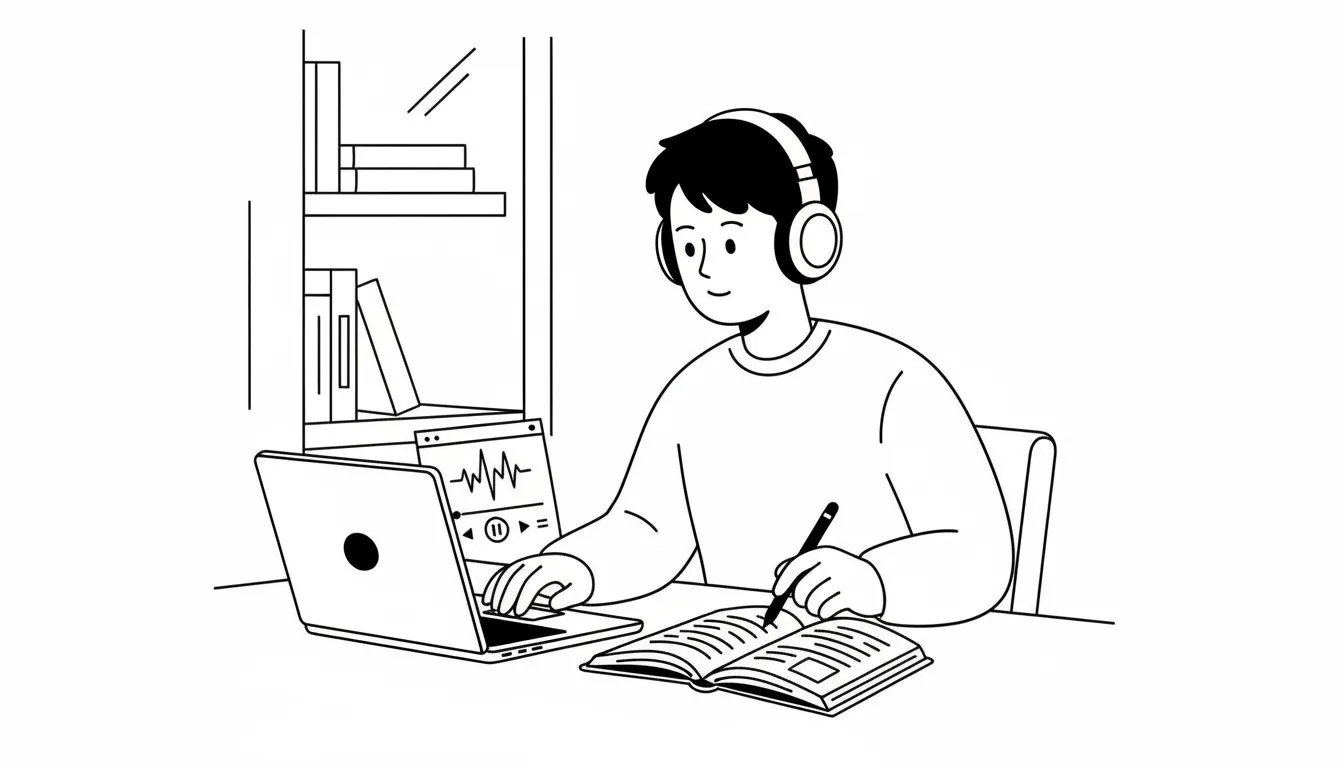
If you have access to an audio version of your story, use it in two phases. First, listen and read simultaneously — this helps you connect written forms with spoken sounds and is particularly useful for words you’ve been misreading. Then, try listening only, without the text, and see how much you can follow. This builds genuine listening comprehension, not just reading comprehension. Finally, use shadowing (as described in Step 4 of the core method) to work on your own pronunciation, rhythm and intonation. Over time, you’ll find that your spoken English begins to sound more natural and confident.
Speaking and writing: from reading to active use
Stories are not just for reading — they’re a springboard for speaking and writing practice. For speaking, try oral retells (summarise the story aloud in two minutes), role-plays (act out a key dialogue), or mini-presentations (explain what the story is about and what you thought of it, as if recommending it to a friend). For writing, the creative possibilities are endless: write an alternative ending, compose a diary entry from a character’s perspective, or write a short review of the story. These active tasks are where you transform input into output — and output is what builds real communicative competence.
How short stories support exam preparation
Reading stamina and text awareness
Cambridge exams require you to read efficiently under time pressure — and that’s a skill that needs to be trained. Short stories are an excellent bridge between the short, controlled texts you might find in a coursebook and the longer, more demanding passages in an exam paper. Reading a story a day builds the stamina and the text awareness you need to approach exam reading with confidence. You learn to navigate narrative structure, identify the author’s purpose and follow an argument — all skills that transfer directly to the exam room.
Vocabulary and language range for exams
Examiners — both in written papers and in speaking tests — are looking for range and flexibility: the ability to use a variety of vocabulary and structures, not just the safe, basic options. Regular story reading is one of the most effective ways to build this range, because it exposes you to words and phrases in authentic, meaningful contexts. The vocabulary you pick up through stories tends to be the kind of natural, idiomatic language that impresses examiners far more than a memorised list of advanced words used out of context.
Strategies you can transfer to exam papers
Every reading strategy you practise with short stories — predicting content from the title, inferring meaning from context, skimming for gist, managing your reading speed — is directly applicable to exam tasks. The same goes for vocabulary strategies: using context to guess the meaning of unknown words is not just a good reading habit; it’s an essential exam skill. Students who read widely before their exam consistently outperform those who only do past papers, precisely because they’ve developed these transferable habits without even realising it.

Recommended types of short stories and resources
Not all short stories are created equal when it comes to language learning. The best choice depends on your level, your goals and — crucially — what you actually enjoy reading. Here’s a breakdown of the main types and what each one offers.
Classic tales and fables
Classic tales — Aesop’s fables, folk stories, fairy tales and traditional legends — have a lot going for them as language learning material. Their structure is clear and predictable, which makes them easier to follow. Their moral messages are universal, so you always have something to discuss or write about. And they’re packed with cultural references that give you an insight into the history and values behind the English-speaking world. The vocabulary can sometimes feel a little formal or old-fashioned, but that’s actually useful exposure — many of these words and expressions still appear in modern English.
Modern short stories for everyday English
If you want to learn the English that people actually speak and write today, modern short stories are the way to go. Contemporary stories are set in familiar, everyday situations — work, relationships, travel, family life — and they use the vocabulary, expressions and structures that you’ll actually need in real-world communication. The dialogue sounds natural, the cultural references are current, and the themes are immediately relatable.
Short Stories in English for Intermediate Learners (A2 and B1) with Audio
Improve your English through 20 original modern stories written specifically for A2 and B1 learners. Each story comes with professionally narrated audio, a comprehensive glossary, reading comprehension questions and vocabulary exercises — everything you need to build your skills naturally and enjoyably.
Short Stories in English for Intermediate Learners (B1 and B2) with Audio
Ready to push your English further? These 20 original modern stories are written for B1 and B2 learners, with richer vocabulary, longer texts and more demanding language tasks. Includes professionally narrated audio, glossaries, comprehension questions and vocabulary exercises — perfect for learners working towards Cambridge B2 First or simply aiming higher.
This is exactly the philosophy behind the two story collections I’ve developed at KSE Academy. Short Stories in English for A2 and B1 offers 20 original stories written specifically for lower-intermediate learners, exploring universal themes like personal growth, relationships and everyday challenges — all in accessible, natural English. Each story comes with professionally narrated audio, a comprehensive glossary, comprehension questions and vocabulary exercises, so every reading session is also a structured learning experience. For those at a higher level, Short Stories in English for B1 and B2 follows the same format with richer vocabulary, longer stories and more demanding language tasks, making it ideal for learners working towards Cambridge B2 First or simply wanting to push their English further.
Graded readers and levelled story collections
Graded readers are books written or adapted specifically for language learners, with the vocabulary and grammar carefully controlled to match a particular level. Publishers like Oxford, Cambridge and Penguin produce extensive graded reader series, ranging from complete beginner to advanced. They’re a reliable and widely available resource, and many come with audio. The main difference from purpose-written story collections is that graded readers often adapt existing literary works rather than creating original content — which can sometimes make the language feel slightly less natural, though the best series manage this very well.
Story-based courses and apps
A number of language learning apps have built their entire method around stories — Lingopie, Beelinguapp and StoryLearning’s Storylearner, among others. These platforms typically combine audio, text and built-in vocabulary tools (such as tap-to-translate) in a single interface, which makes them very convenient for learners on the go. They work particularly well as a complement to physical or digital books: use an app for your daily micro-sessions and a book for your deeper weekly work. The key, as always, is consistency — whichever format you use.
Frequently asked questions about learning English with short stories
What if I don’t understand everything in the story?
That’s completely normal — and it’s actually part of the process. You don’t need to understand every single word to benefit from reading a story. As long as you understand the general flow and can follow the main events, you’re learning. Tolerance of ambiguity is one of the most important skills in real-world language use, and stories are a safe place to practise it. On your second read, you can fill in the gaps — but never let unknown words stop you on the first read-through.
Can I really learn English just by reading short stories?
Stories alone won’t get you to fluency — but they’re one of the most powerful tools in your learning toolkit. Used alongside speaking practice, grammar study and listening work, regular story reading can dramatically accelerate your progress. The key word is regularly: a story a day or a few per week, consistently applied over months, produces remarkable results. Think of stories as the foundation that makes all your other learning stick.
How do I know if a story is right for my level?
Use the 5% rule: if roughly one word in twenty (or fewer) is unknown, the level is probably right. More than that, and it may be too difficult; significantly fewer, and it may be too easy. Also pay attention to how you feel while reading — mild challenge and curiosity are good signs. Frustration and confusion after every sentence are a sign to find something slightly easier. The level comparison table earlier in this article is a useful reference point too.
How many stories should I read per week?
There’s no magic number, but a realistic and effective target for most learners is two to four short stories per week. This gives you enough exposure to build momentum without burning out. If you’re following the core method properly — two readings, vocabulary work, audio and an output task — even one story per week is extremely valuable. Quality of engagement always matters more than quantity.
Should I read the same story several times?
Absolutely — and it’s highly recommended. The first reading gives you meaning; the second gives you language; the third (if you do one, perhaps a few days later) gives you fluency and consolidation. Re-reading a story you already understand allows your brain to focus entirely on the language rather than the plot, which is exactly the state in which vocabulary and grammar are best absorbed. Think of re-reading as revision, not repetition.
Are short stories useful for exam preparation?
Very much so. As we explored in the exam preparation section above, regular story reading builds reading stamina, grows your vocabulary range, and develops the text strategies — predicting, inferencing, skimming — that are directly tested in exams like Cambridge B1 Preliminary and B2 First. Stories won’t replace targeted exam practice, but they’re a highly enjoyable and effective complement to it. Many of my students who read consistently in the months before their exam report feeling far more confident in the reading and use of English papers.
Do I need to use a dictionary while I read?
On your first read-through: no. Resist the urge. On your second read: yes, selectively. Look up words that seem important to the story’s meaning, that appear more than once, or that you’d genuinely like to use yourself. Avoid looking up every unknown word — it breaks your focus and creates a dependency that makes reading feel like hard work. A good story at the right level should require only occasional dictionary use on the second read.
Start learning English with short stories today
Let’s bring it all together. The method is straightforward: choose a story at the right level → read for meaning → read for language → listen and shadow → speak and write. Repeat consistently, and the results will follow.
Your next steps are simple. Pick a story today — something short, something at your level, something that looks genuinely interesting to you. Follow the first two steps of the method. Don’t overthink it. The most important thing is to start, and to come back tomorrow.
If you’d like a ready-made starting point with everything built in — original stories, professional audio, glossaries and exercises — my two collections are designed to make the whole process as smooth as possible. Short Stories in English for A2 and B1 is ideal if you’re at a lower-intermediate level and want to build your confidence with accessible, engaging stories. If you’re already at B1 and looking to push towards B2, Short Stories in English for B1 and B2 offers the same structured approach with richer language and more demanding tasks. Both are available now and come with downloadable audio you can use anywhere.
Now you have the method, the routines and the resources. All that’s left is to open a story and begin.
And until the next article, don’t forget to keep smiling!
