
Table of contents
B2 First Reading Part 6 is the gapped text: an article from which six sentences have been removed, and you have to decide where each one came from, choosing from seven options. One is left over. As in Part 5, each answer is worth two marks.
This part doesn’t so much test whether you understand each sentence as whether you understand how a text is built: how one idea links to the next, what a this or a they refers to, why a paragraph starts with But. Once you learn to see those seams, the task becomes almost mechanical. In this guide I’ll explain what B2 Reading Part 6 looks like, which clues to look for, and we’ll go through the six gaps of an official Cambridge sample test together. 🙂
What B2 Reading Part 6 looks like
Part 6 is part of the Reading and Use of English paper: seven parts, 52 questions and 1 hour 15 minutes. You’ll find the overview in the guide to B2 First Reading; this is the part we’re looking at here:
| Detail | B2 Reading Part 6 |
|---|---|
| What you do | Put back 6 sentences that have been removed from a text, choosing from 7 options (A to G) |
| Number of questions | 6 (numbered 37 to 42) |
| The extra sentence | One option doesn’t fit any gap; each sentence can only be used once |
| Type of text | A magazine or newspaper article, or similar |
| Marks | 2 marks per correct answer, 12 in total |
| What it tests | Cohesion, coherence and text structure |
The clues that link a sentence to its gap
Cambridge stresses that understanding each sentence on its own isn’t enough: you have to follow how the ideas develop. In practice, that means looking for these clues in the sentence and on both sides of the gap:
| Type of clue | What to look for | Example from the sample test |
|---|---|---|
| Pronouns and determiners | this, it, they, these: what do they refer to? | its various demands (gap 37), No one avoids this (gap 39) |
| Summarising words | this lengthy period, the principle: they pick up an earlier idea | Gaps 38 and 41 |
| Linkers | But, In the same way, also, Even | Gaps 38, 40, 41 and 42 |
| General / particular | A general idea followed by a specific case | any physical discipline / a ballet dancer in particular (gap 38) |
| Coherence of ideas | The sentence must fit what comes before and what comes after | All of them |
If you want to go over the linkers that come up most in this part, check out my guide to B2 connectors in English.
The four-step method
- Read the gapped text before the sentences. That’s Cambridge’s advice: first get an idea of the structure and how the writer’s ideas develop.
- Read the seven sentences and notice their clues. Underline pronouns, linkers and words that point back to something (this, the principle, no one avoids this).
- For each gap, check before and after. This is the mistake Cambridge highlights most: choosing a sentence that fits what comes before without checking that what follows makes sense.
- Reread the whole paragraph with the sentence in it. It should read as if it had been written that way from the start. Leave the extra sentence for last: it’ll be the one that fits nowhere.
The sample test, solved gap by gap
This is the text from the official Cambridge sample test: an article in which a former Royal Ballet dancer explains what ballet training really involves. Read it all along with the sentences and try it before reading my explanations:
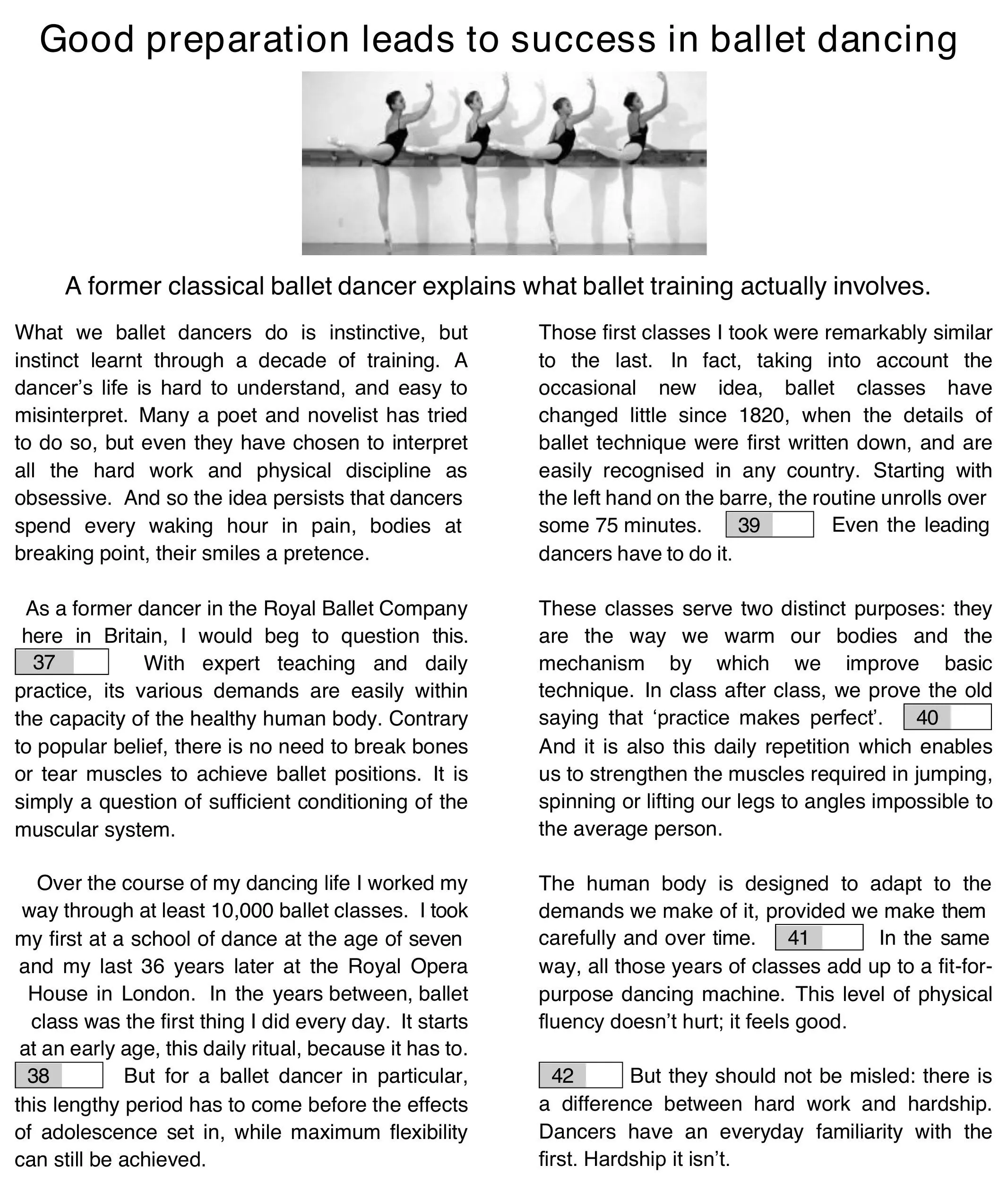
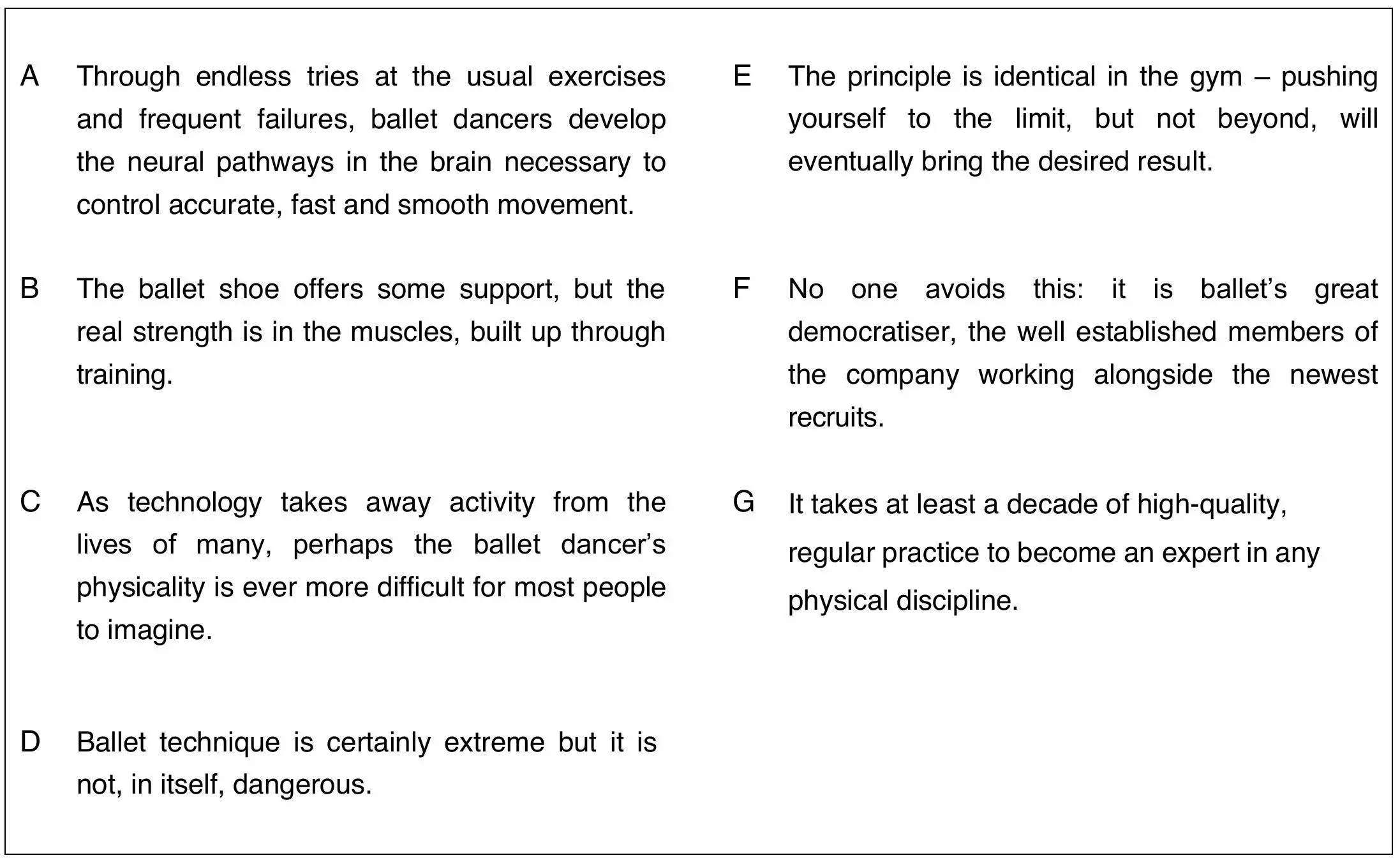
Gap 37
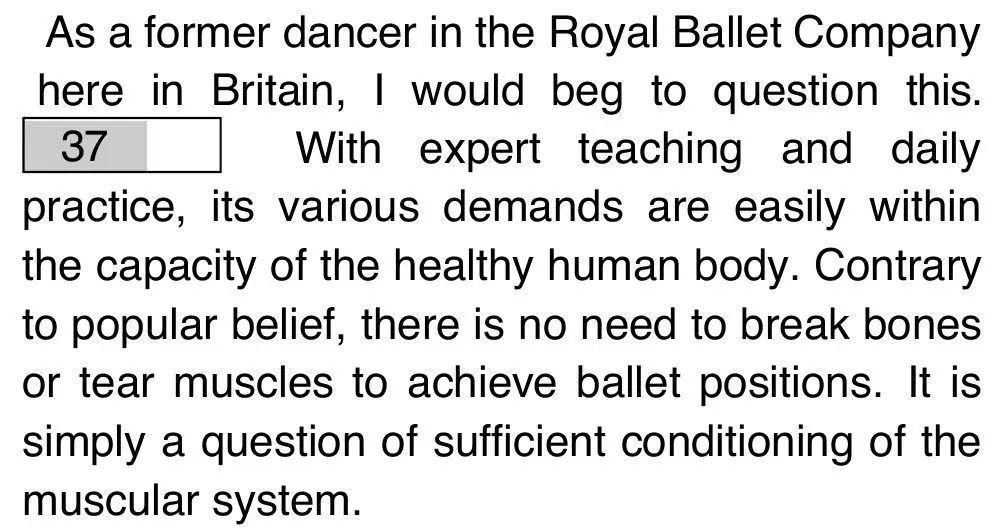
Answer: D, Ballet technique is certainly extreme but it is not, in itself, dangerous.
Before the gap, the writer says she wants to question the idea that dancers live in pain (I would beg to question this). After it, its various demands are easily within the capacity of the healthy human body. That its needs something to refer to, and D provides it: ballet technique. What’s more, D introduces exactly the idea developed afterwards: nobody needs to break anything.
Gap 38
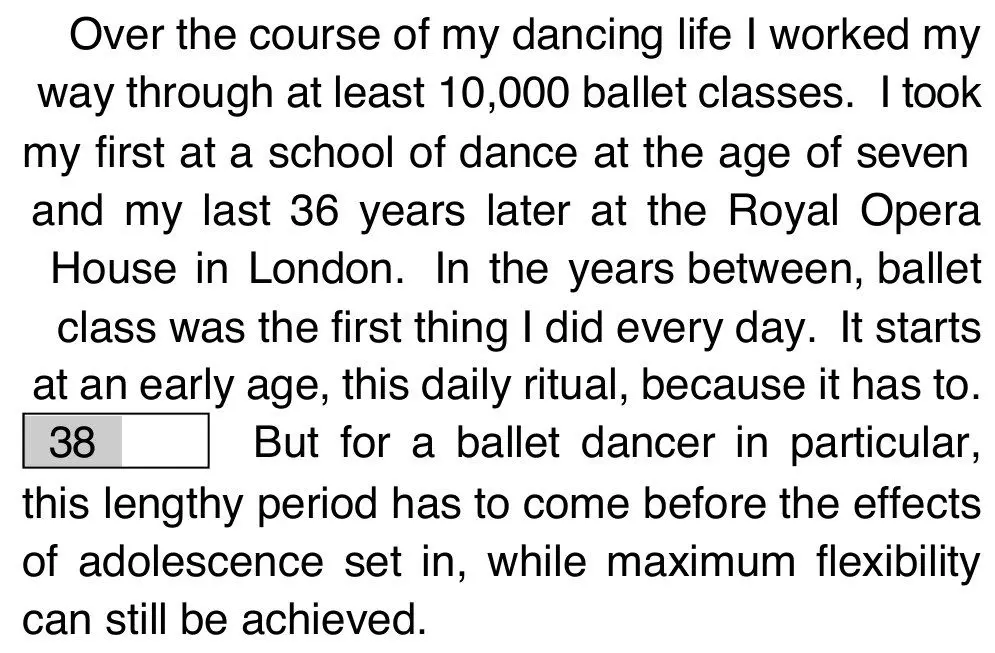
Answer: G, It takes at least a decade of high-quality, regular practice to become an expert in any physical discipline.
The clearest clue comes after the gap: But for a ballet dancer in particular, this lengthy period…. You need a sentence that mentions a long period (a decade) and something general (any physical discipline) for in particular to make sense. It’s the general / particular pattern.
Gap 39
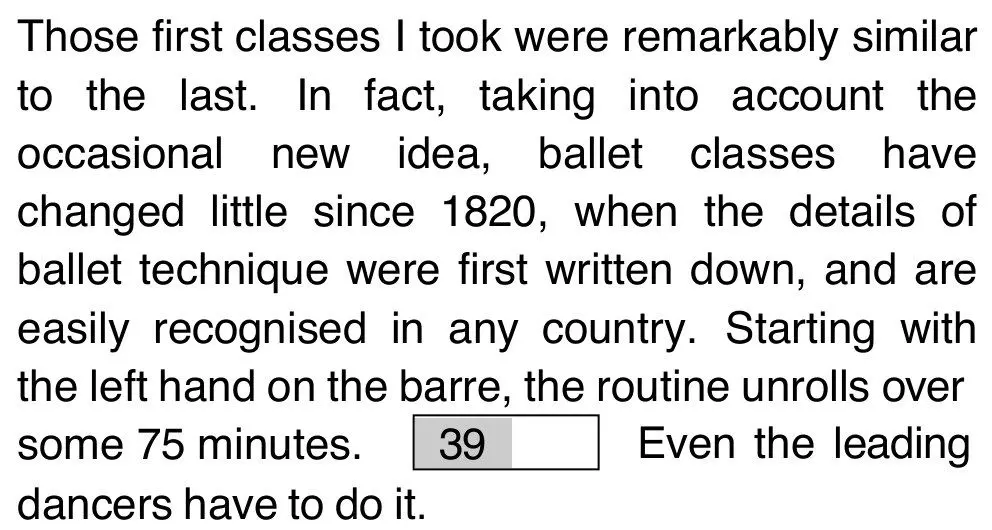
Answer: F, No one avoids this: it is ballet’s great democratiser, the well established members of the company working alongside the newest recruits.
Before, the class routine is described (the routine unrolls over some 75 minutes); after, Even the leading dancers have to do it. F fits on both sides: this refers back to the class, and the idea that nobody gets out of it prepares the Even that follows: even the stars.
Gap 40
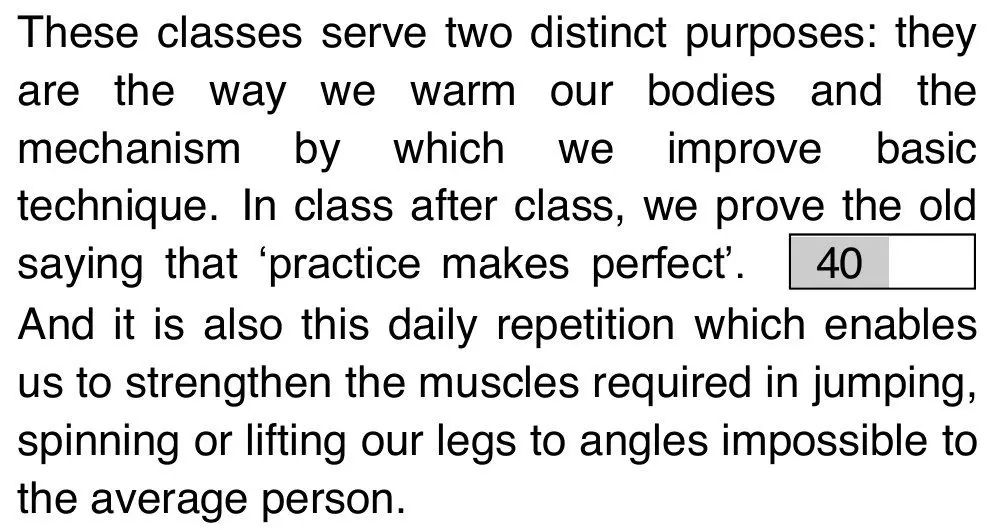
Answer: A, Through endless tries at the usual exercises and frequent failures, ballet dancers develop the neural pathways in the brain necessary to control accurate, fast and smooth movement.
Before the gap comes practice makes perfect, and A develops it: repeating and failing builds connections in the brain. After it comes And it is also this daily repetition which enables us to strengthen the muscles: that also tells you the previous sentence already described another benefit of repetition. This is where the distractor sits, sentence B, which talks about muscles and is very tempting, but leaves nothing for the also to add to.
Gap 41
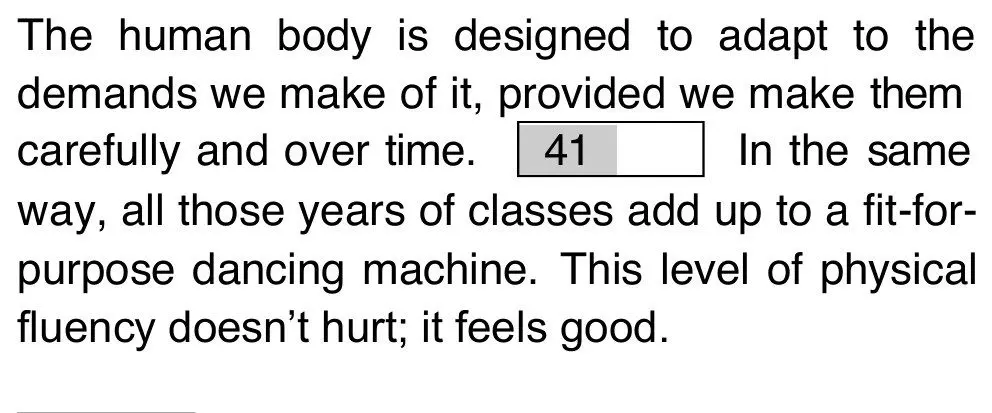
Answer: E, The principle is identical in the gym – pushing yourself to the limit, but not beyond, will eventually bring the desired result.
Before: the body adapts if you make demands on it carefully and over time. The principle picks up exactly that idea. After: In the same way, all those years of classes…. To say in the same way you need an earlier comparison, and E provides it: the gym.
Gap 42
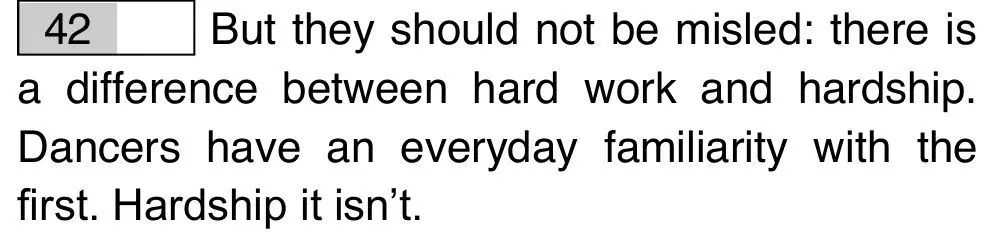
Answer: C, As technology takes away activity from the lives of many, perhaps the ballet dancer’s physicality is ever more difficult for most people to imagine.
The gap opens the last paragraph, and the clue comes right after it: But they should not be misled. Who? Only C mentions a group to refer to: most people. And the But makes sense: people find it hard to imagine, but they shouldn’t confuse hard work with hardship.
Answers, in case you’ve been keeping track: 37D, 38G, 39F, 40A, 41E, 42C. The extra sentence is B.
Which clue decided each gap
| Gap | Sentence | The clue |
|---|---|---|
| 37 | D | its (after) needs ballet technique |
| 38 | G | this lengthy period and in particular (after) |
| 39 | F | this = the class; Even the leading dancers (after) |
| 40 | A | also (after) needs an earlier benefit |
| 41 | E | the principle and In the same way (after) |
| 42 | C | they (after) = most people |
Look at the right-hand column: in all six gaps, the decisive clue came after the gap. That’s why Cambridge insists on not stopping at the sentence before.
Typical distractors in B2 First Reading Part 6
- The sentence that shares vocabulary. B talks about muscles and training, just like the paragraph with gap 40, but it links neither to what comes before nor to the also. Cambridge specifically warns against this word spotting.
- The sentence that fits what comes before, but not what comes after. It’s the mistake the handbook highlights most: it seems to work until you read the next sentence.
- The sentence you’d use in another gap. As each sentence only works in one place, one mistake leads to another. If two gaps seem to need the same sentence, one of them is wrong.
Strategy for B2 Reading Part 6
- Start with the clearest gaps. The ones with a strong pronoun or linker (they, In the same way) come out first and cut down the options for the rest.
- Cross out the sentences you’ve used. Each sentence works only once; fewer options make the last gaps much easier.
- Don’t force the extra sentence. There’s always one left over. If a sentence fits nowhere, it’s probably that one.
- Reread the whole text at the end. With all the sentences in place, the text should flow. If a paragraph jars, check that gap again.
- Watch the time. Cambridge doesn’t set a time per part, but around 12 to 13 minutes is usually enough if you read methodically.
Most common mistakes in B2 Reading Part 6
- Reading only the sentence before the gap. In this test, the clue came after the gap in all six.
- Choosing by repeated words. A sentence using muscles or practice isn’t automatically the right one.
- Not working out what pronouns refer to. This, it and they are the most reliable clue in the whole part.
- Starting with the sentences instead of the text. Without the structure of the text in your head, every sentence looks possible.
Frequently asked questions about B2 First Reading Part 6
How many questions are there in B2 First Reading Part 6?
Six gaps (numbered 37 to 42) and seven sentences to choose from (A to G).
How much is each question worth?
Two marks. In total, Part 6 is worth 12 marks.
Can I use a sentence more than once?
No. Each sentence can only be used once, and there’s always one you don’t need.
Do wrong answers lose marks?
There’s no penalty in B2 First, so put a sentence in every gap even if you’re not sure.
How do I know which sentence is the extra one?
It’s usually the one that shares the topic of the text but doesn’t match the clues of any gap. In the sample test, it’s B: it talks about muscles, like the text, but connects to nothing.
Keep preparing B2 Reading
This guide is part of the series on B2 First Reading. If you haven’t already, check out the guide to B2 Reading Part 5, and once you’ve got the hang of this part, move on to B2 Reading Part 7.
Did you find this guide useful? Share it with other students and teachers preparing for the FCE. And if you’re left with any doubts about a gap, leave them in the comments. I read every one.
See you in Part 7. Until then, don’t forget to keep smiling! 🙂
