
Table of contents
As we have seen on other occasions, B2 Use of English tests your ability to use English vocabulary and grammar accurately. In this guide we focus on B2 First Use of English Part 1, the multiple-choice cloze: a text with eight gaps and four options for each one.
At first sight it looks like the easiest part, because all you have to do is choose. But the four options usually mean almost the same thing, and what decides the answer is hardly ever the meaning on its own: it’s the word that comes right after the gap, the collocation or the fixed expression. In this guide I’ll explain what B2 Use of English Part 1 looks like, what exactly it tests, and we’ll go through the eight questions of an official Cambridge sample test together. 🙂
What B2 Use of English Part 1 looks like
| Detail | B2 Use of English Part 1 |
|---|---|
| What you do | Read a text with 8 gaps and choose the correct option out of 4 (A, B, C or D) for each one |
| Number of questions | 8 (numbered 1 to 8), plus a worked example (0) |
| Options | 4 words or phrases per gap |
| Marks | 1 mark per correct answer |
| How you answer | On paper, by marking the box on the answer sheet; in the digital exam, by clicking |
| What it tests | Vocabulary: collocations, fixed expressions, phrasal verbs, dependent prepositions and shades of meaning |
Is it Reading or Use of English?
There’s a detail here worth knowing. Since 2015, Reading and Use of English have been a single paper, Reading and Use of English, with seven parts, 52 questions and 1 hour 15 minutes. According to Cambridge, the Reading section is made up of Parts 1, 5, 6 and 7, and the Use of English section of Parts 2, 3 and 4. In other words, this Part 1 officially counts towards Reading, even though it keeps the format of a classic Use of English exercise.
Even so, on this site I include it as part of Use of English, because that’s how most candidates and teachers see it, and because, given the nature of the task, it has much more to do with how the language is used (which word goes with which) than with reading comprehension as such. That’s how I recommend you prepare for it. But to avoid any confusion: for scoring purposes, Part 1 counts as Reading. You’ll find the full picture in the guide to B2 First Reading.
What exactly B2 First Use of English Part 1 tests
According to the Cambridge handbook, four types of question come up in this part. Learning to recognise them saves you a lot of time:
- Words with similar meanings. The four options are near-synonyms, and only one fits the exact nuance of the sentence: look, see, watch or notice, for example.
- The word that goes with what follows. Several options mean the same, but only one works with the preposition or structure after the gap: interested in, but keen on; succeed in, but manage to.
- Collocations, fixed expressions and linkers. Combinations that simply are that way in English: pay attention to, make a decision, take part in, even if.
- Phrasal verbs. You may be tested on the whole phrasal verb, just the verb or just the particle: carry out, carry or out.
The practical takeaway is clear: in the multiple-choice cloze it isn’t enough to know what a word means. You need to know which other words it combines with.
The three-step method
- Read the whole text before looking at the options. That way you understand the topic and the tone, and some gaps (like number 7 in the test we’ll look at) depend on a structure that spans the whole sentence.
- For each gap, read what comes before and after it. A preposition, a that or a than right after the gap rules out options instantly. It’s the step that earns the most marks.
- Try all four options in the sentence. First rule out on grammar (they don’t fit with what follows), then on collocation and, only at the end, on shades of meaning.
The sample test, solved question by question
This is the text from the official Cambridge sample test. Try to answer it before reading the explanations:
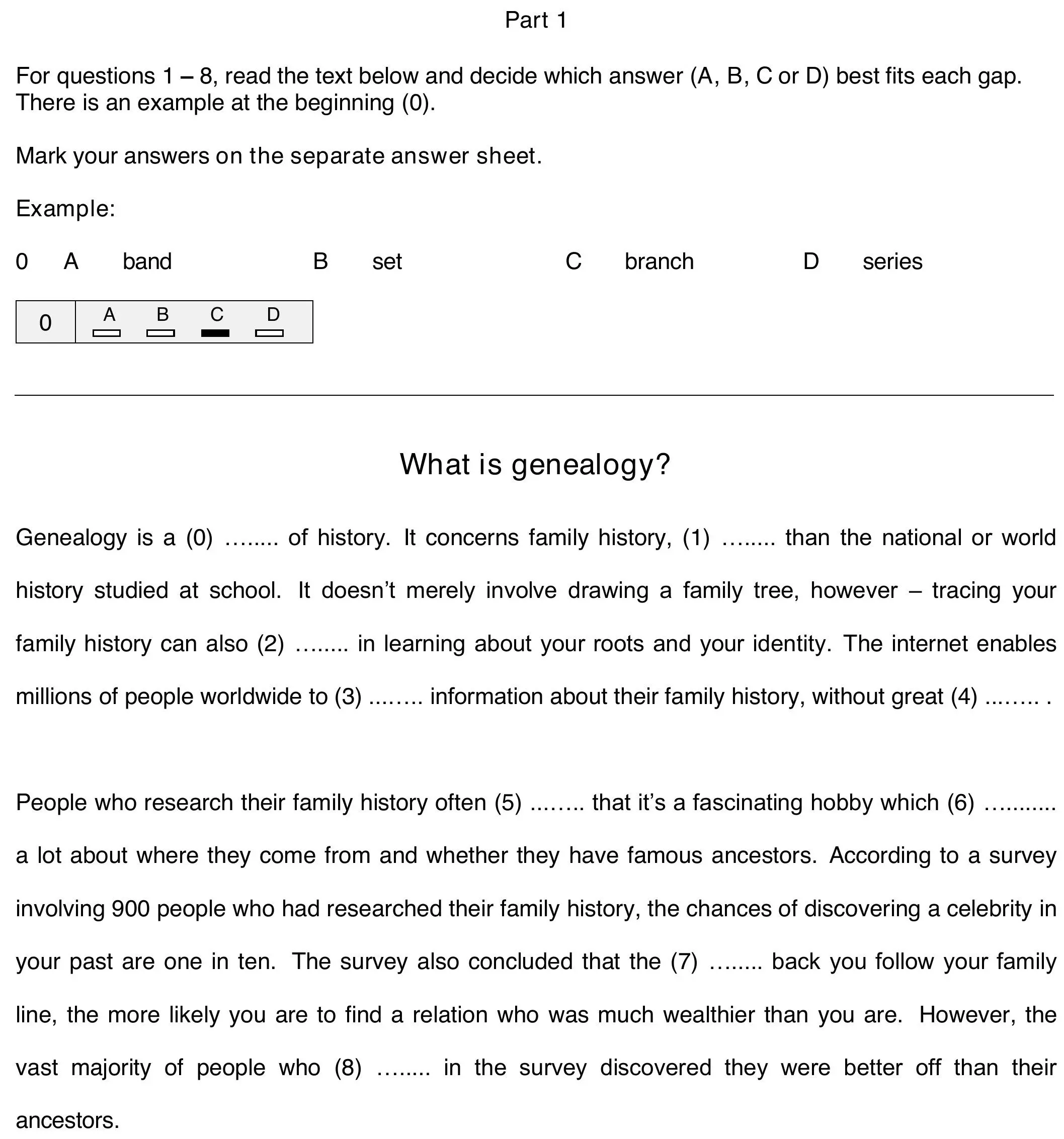
The example already shows the logic of this part: Genealogy is a (0) ___ of history, with the options band, set, branch and series. All four are groups or divisions of something, but the collocation is a branch of history. The answer is C.
First paragraph: questions 1 to 4


1. Answer: B, rather. It concerns family history, ___ than the national or world history. The clue is than, right after the gap: rather than. Instead means the same, but it needs of (instead of). Sooner than exists, but it expresses preference (I’d sooner walk than wait), and except makes no sense here.

2. Answer: C, result. Tracing your family history can also ___ in learning about your roots. Again, the preposition decides: result in. Lead has the right meaning, but it goes with to (lead to learning), and cause and mean take a direct object, with no preposition.

3. Answer: B, access. The internet enables millions of people worldwide to ___ information. Here meaning decides: access information. Accomplish is to achieve a goal, approach is to move towards something or deal with a problem, and admit is to confess or let in.

4. Answer: D, expense. Without great ___. All four options are about money, and this is the classic collocation gap: we say without great expense, just like at great expense. A fee is what you pay for a service or to join something, a price is what something costs to buy and a charge is what you’re charged; none of them combines with great to talk about cost in general.
Second paragraph: questions 5 to 8
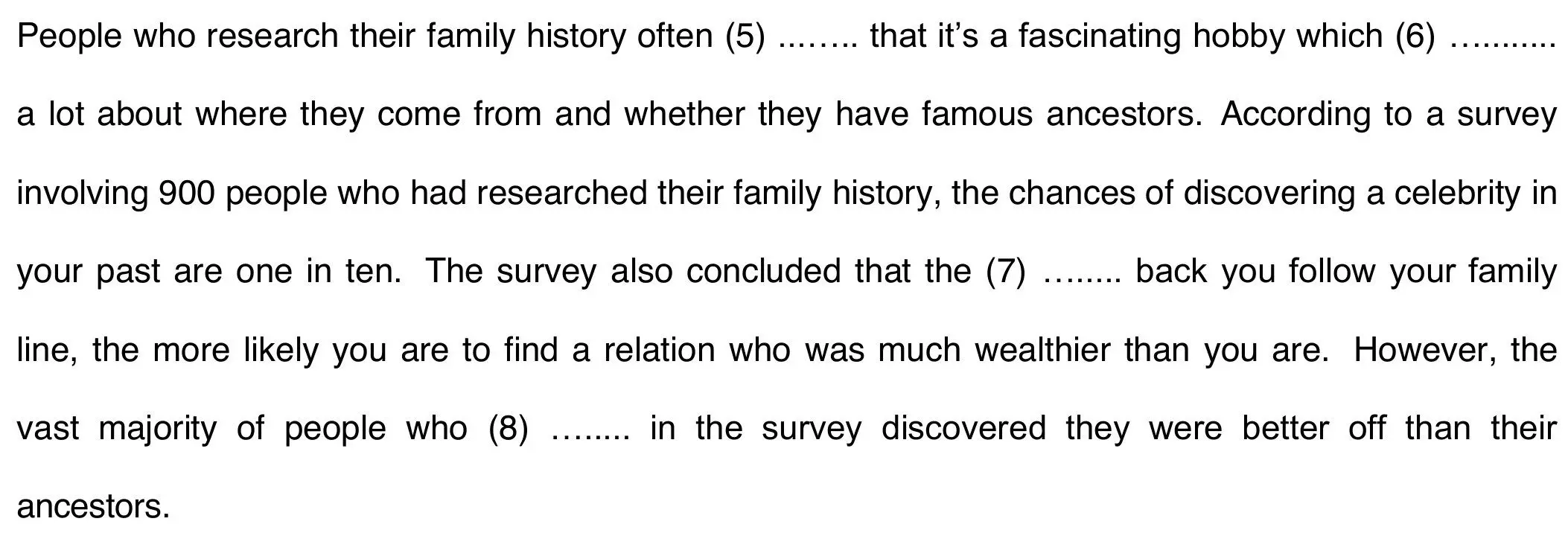

5. Answer: C, remark. People who research their family history often ___ that it’s a fascinating hobby. Look at what follows: that plus a clause. Remark that works this way. The other three need an object and as: describe it as, define it as, regard it as. It’s a very typical distractor: three options with the right meaning and the wrong structure.

6. Answer: A, reveals. A fascinating hobby which ___ a lot about where they come from. You need a verb that takes an object (a lot) and means to show or uncover: reveal a lot about. Arise can’t take an object, and opens and begins make no sense with a lot about.

7. Answer: D, further. The ___ back you follow your family line, the more likely you are… Here the clue is spread across the whole sentence: the the… the more structure calls for a comparative, and the word back calls for an idea of distance in time. Further back is the natural combination. Older, greater and higher are comparatives, but they don’t go with back.

8. Answer: B, participated. The vast majority of people who ___ in the survey. The preposition again: participate in. Attend is close in meaning, but it takes no preposition (attend a meeting) and is used with events, not surveys. Include needs an object or the passive (were included in), and associate goes with with.
Answers, in case you’ve been keeping track: 1B, 2C, 3B, 4D, 5C, 6A, 7D, 8B.
What decided each answer
If we put the eight questions side by side, you can clearly see where to look in this part:
| Question | Answer | The clue | Question type |
|---|---|---|---|
| 1 | rather | than after the gap | Fixed expression |
| 2 | result | in after the gap | Dependent preposition |
| 3 | access | the object, information | Meaning |
| 4 | expense | great before the gap | Collocation |
| 5 | remark | that after the gap | Structure |
| 6 | reveals | the object, a lot about | Meaning and structure |
| 7 | further | back and the… the more | Collocation and comparative |
| 8 | participated | in after the gap | Dependent preposition |
In four of the eight questions, the answer was decided by the word right after the gap. If you only read up to the gap, you’re guessing.
Typical distractors in B2 First Use of English Part 1
- The synonym with the wrong preposition. Lead means the same as result, but it goes with to, not in. Questions 2 and 8.
- The synonym with the wrong structure. Describe, define and regard need as; only remark takes that. Question 5.
- The word from the same field that doesn’t form the collocation. Fee, price and charge are all money, but the collocation is great expense. Question 4.
- The word that needs another word that isn’t there. Instead would work with of, but the text says than. Question 1.
Strategy for B2 Use of English Part 1
- Always read beyond the gap. Finish the sentence before choosing. A preposition or a that after the gap removes options without you even having to think about meaning.
- Rule out before you choose. Cross out the options that don’t fit grammatically with what follows; you’ll usually be left with one or two.
- If you’re torn between two, think collocation. Ask yourself which combination you’ve seen more often in English: great expense or great charge.
- Learn vocabulary in chunks. Don’t memorise result; memorise result in. Don’t memorise access; memorise access information. It’s the way of studying that works best for this part.
- Don’t spend too long on it. Cambridge doesn’t set a time per part, but you have 1 hour 15 minutes for all seven. As it’s one of the quickest, around 8 to 10 minutes is usually enough.
Most common mistakes in B2 First Use of English Part 1
- Choosing by translation. If the four options translate similarly into your language, translation won’t help you. What decides is the combination in English.
- Reading only up to the gap. It’s the mistake that costs the most marks: the clue comes after the gap in half the questions.
- Trusting the option that sounds most sophisticated. Accomplish or regard may sound more B2, but that doesn’t make them fit.
- Studying lists of single words. Knowing what participate means isn’t enough if you don’t know it goes with in.
B2 Use of English Part 1 exercises online
What follows is a compilation of Use of English Part 1 activities for B2 First (FCE). I have compiled and adapted these exercises from the internet over the years, but I don’t know who the original writer or publisher is. So please, if you know who created these texts or know the original source, don’t hesitate to contact me. I’ll be happy to either reference them appropriately or remove them to avoid any copyright infringement.
Exercise 1: Fabric Designer
Exercise 2: The Art of Forgetting
Exercise 3: From Fiction to Reality
Exercise 4: Where to Go Whale Watching
Exercise 5: What Is a Coincidence?
Exercise 6: Messages from the Stone Age
Exercise 7: Drumming Up Business
Exercise 8: Multitasking Children
Exercise 9: Working for Navy
Download B2 Use of English exercises in PDF for free
The following are Use of English Part 1 handouts in PDF that I created for my students. They’re a few years old, so the format may not be perfect, but they’re still great practice resources.
- Use of English Part 1: Georgia Floods
- Use of English Part 1: Introduction to Sociology
- Use of English Part 1: Only When I Laugh
- Use of English Part 1: Star Wars Plane
Frequently asked questions about B2 Use of English Part 1
How many questions are there in B2 First Use of English Part 1?
Eight questions (numbered 1 to 8), plus a worked example at the start. Each one has four options and is worth one mark.
Can there be more than one correct answer?
No, there’s always only one possible answer in Part 1. Sometimes you’ll find similar options and even options that aren’t grammatically wrong, but there’s always one that fits the gap better, more naturally, than the others. That’s sometimes where the difficulty of this part lies.
Do wrong answers lose marks?
No. Wrong answers simply don’t add to your score, but they don’t take anything away either. So it’s always best not to leave any question unanswered.
How long are the texts?
These texts are usually 140-180 words long, and are normally divided into two or three short paragraphs. The one in the sample test we’ve just solved, for example, is about 170 words long.
Does this part count towards Reading or Use of English?
Officially, towards Reading: the Reading section is made up of Parts 1, 5, 6 and 7 of the paper, and the Use of English section of Parts 2, 3 and 4. Even so, you prepare for it the same way as the rest of Use of English, because what it tests is vocabulary in context.
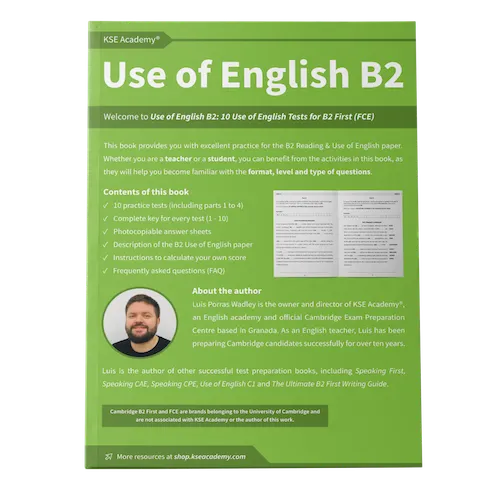
Use of English B2: 10 Use of English Tests for B2 First (FCE)
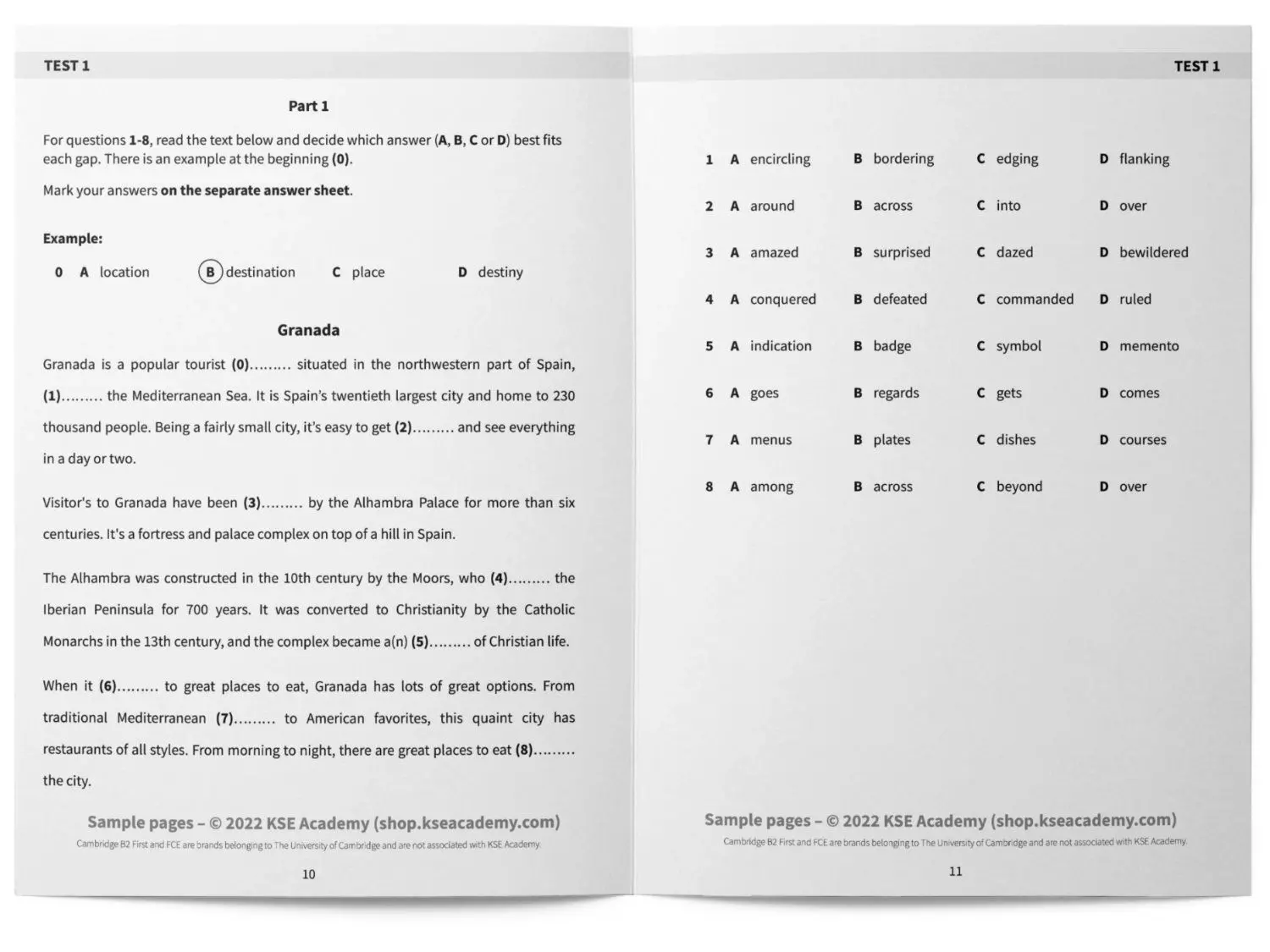
If you need more resources to prepare for Use of English, have a look at my book Use of English B2: 10 Use of English Tests for B2 First (FCE). In it you will find:
- A description of the Use of English paper in the FCE test by Cambridge English.
- Frequently asked questions (FAQ).
- 10 practice tests (including parts 1 to 4 of Reading and Use of English).
- A photocopiable answer sheet per test.
- Instructions to calculate your own score.
- The key for each B2 Use of English test.
Keep preparing B2 Use of English
This guide is part of the series on B2 First Use of English. Once you’ve got the hang of this part, move on to Use of English Part 2 and the word formation task in Part 3, or go back to the main B2 First page to see the whole exam.
Did you find this guide useful? Share it with other students and teachers preparing for the FCE. And if you’re left with any doubts about a question, leave them in the comments. I read every one.
See you in Part 2. Until then, don’t forget to keep smiling! 🙂
