

Table of contents
B2 First Use of English Part 3 is the well-known word formation task: a text with eight gaps and, next to each one, a word in capital letters that you have to transform so that it fits. You aren’t given options and you can’t write whatever you like: the starting word is fixed, and your job is to find the right form of it.
The good news is that it can almost always be solved with the same two-step method: first you decide what type of word is missing, and then what exact form it needs (plural, negative, with an internal change). In this guide I’ll explain what B2 Use of English Part 3 looks like, which suffixes and prefixes come up again and again, and we’ll go through the eight gaps of an official Cambridge sample test together. 🙂
What B2 Use of English Part 3 looks like
B2 First Use of English is part of the Reading and Use of English paper: seven parts, 52 questions and 1 hour 15 minutes. The Use of English section is made up of Parts 2, 3 and 4 (Part 1 looks like Use of English, but Cambridge scores it as part of Reading), and its score counts the same as each of the four skills. This is the third part of the paper:
| Detail | B2 Use of English Part 3 |
|---|---|
| What you do | Read a text with 8 gaps and, using the word in capitals on each line, form the missing word |
| Number of questions | 8 (numbered 17 to 24), plus a worked example (0) |
| What you write | A single word, always derived from the one you’re given |
| Marks | 1 mark per correct answer |
| Spelling | It must be correct; in the paper-based exam, answers in CAPITAL LETTERS |
| What it tests | Vocabulary: suffixes, prefixes, internal changes and compounds |
The four ways to transform a word
Cambridge only uses four types of change in this part, and it’s worth keeping them in mind when you look at the word in capitals:
- Adding a suffix, which usually changes the word class: effect (noun) → effective (adjective), add (verb) → addition (noun).
- Adding a prefix, which changes the meaning, nearly always to make it negative: advantage → disadvantage, able → unable.
- Making an internal change to the root: long → length, strong → strength, choose → choice.
- Forming a compound: hand → handwriting, break → outbreak. It’s the least common, but it does come up.
And they’re often combined: success → unsuccessfully takes a negative prefix, an adjective suffix and an adverb suffix all at once. That’s why the Cambridge handbook stresses knowing the whole family of each word: compete, competition, competitor, competitive, competitively, uncompetitive. If you want to go over the theory calmly, check out my guide to word formation processes in English.
The two-step method
Step 1: what type of word is missing?
Before thinking about suffixes, look at what surrounds the gap. The grammar of the sentence nearly always tells you what you need:
| If the gap comes… | You need… | Example |
|---|---|---|
| After an article, a possessive or an adjective | A noun | the largest ___ of garlic |
| Before a noun | An adjective | the rather ___ smell |
| Between as and as, or after be, seem, become | An adjective | as ___ as penicillin |
| Next to a verb, a participle or an adjective it modifies | An adverb | ___ used in cooking |
| After a modal or to | A verb | to ___ the problem |
Step 2: what exact form does it need?
Once you know the word class, fine-tune it. Ask yourself three questions: is it singular or plural (look at the verb)? Does the meaning of the text call for a negative word? Is it a person, a thing or an abstract idea? Most mistakes in word formation don’t come from not knowing the word, but from skipping this second step.
The sample test, solved gap by gap
This is the text from the official Cambridge sample test. Try to complete it yourself before reading the explanations:
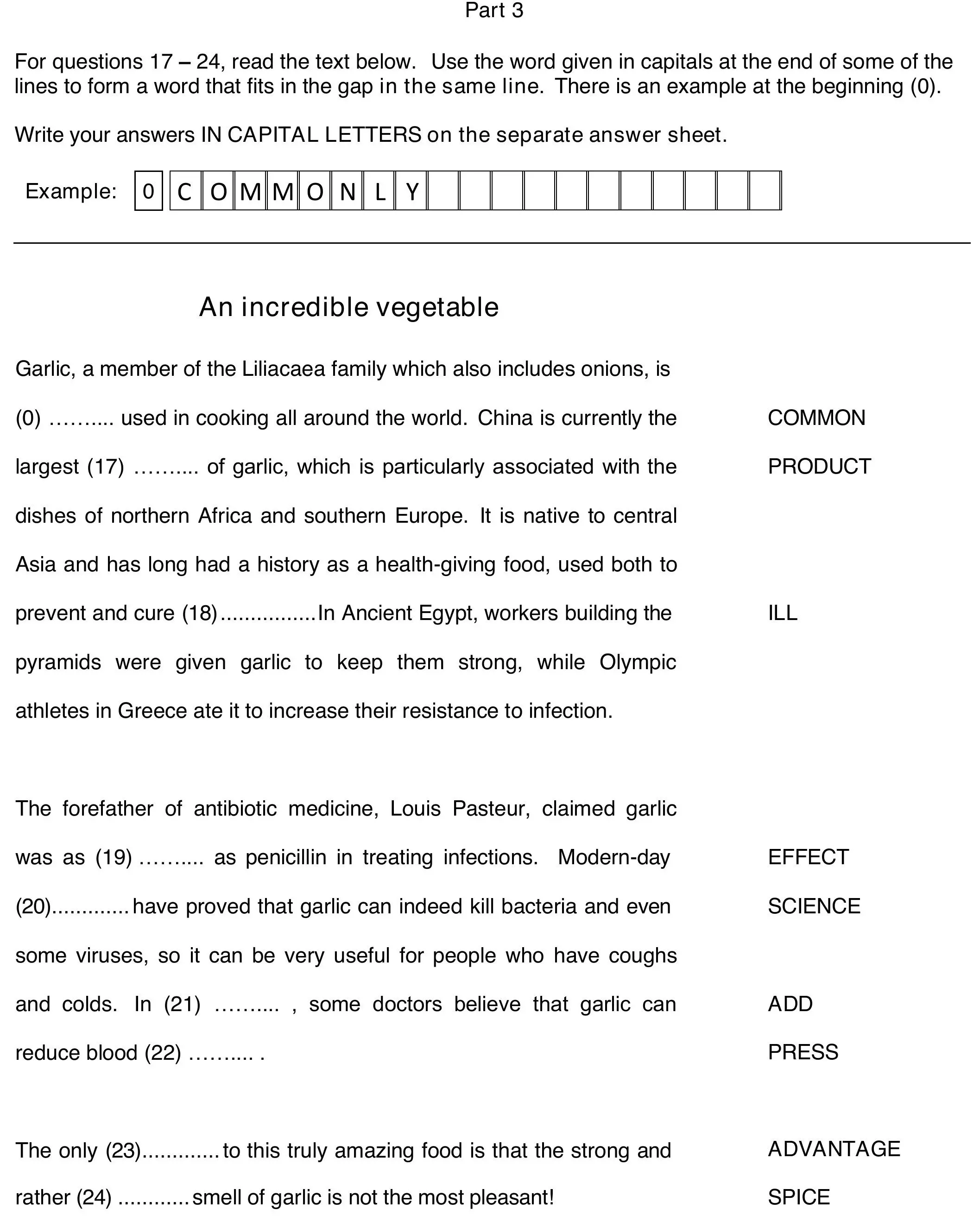
The example already gives you a clue to the method: (0) ___ used in cooking comes before a participle, so it needs an adverb. COMMON → commonly.
First paragraph: gaps 17 and 18
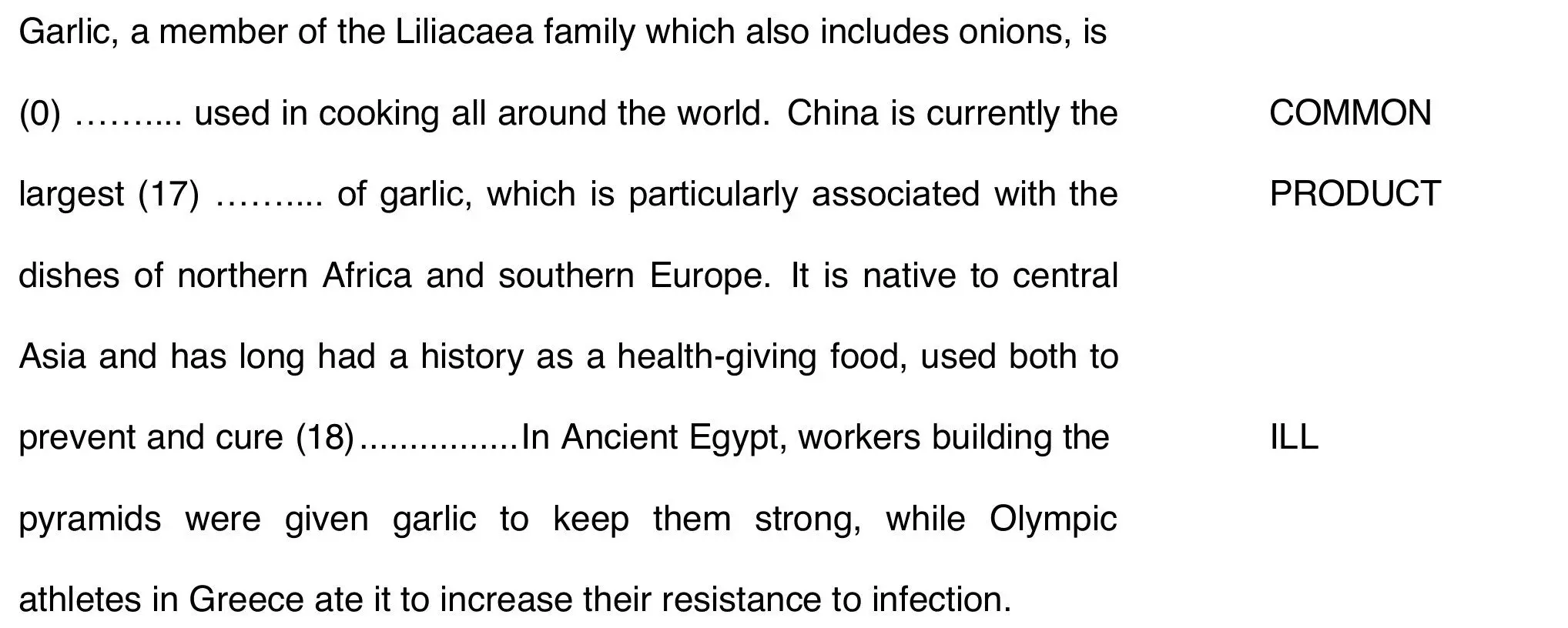
17. PRODUCT → producer. The largest ___ of garlic: after a superlative you need a noun. But the product family has several: production, productivity, producer. The subject is China, a country that produces garlic, so you need whoever produces: producer. The largest production of garlic sounds possible, but it isn’t what the sentence says, and product as it stands never works, because the word always has to change.
18. ILL → illness or illnesses. Prevent and cure ___: after two linked verbs you need their object, a noun. Ill is an adjective; its noun is illness. Here Cambridge accepts both singular and plural, because both make sense. Illnesses has a double s in both places: watch your spelling.
Second paragraph: gaps 19 to 22
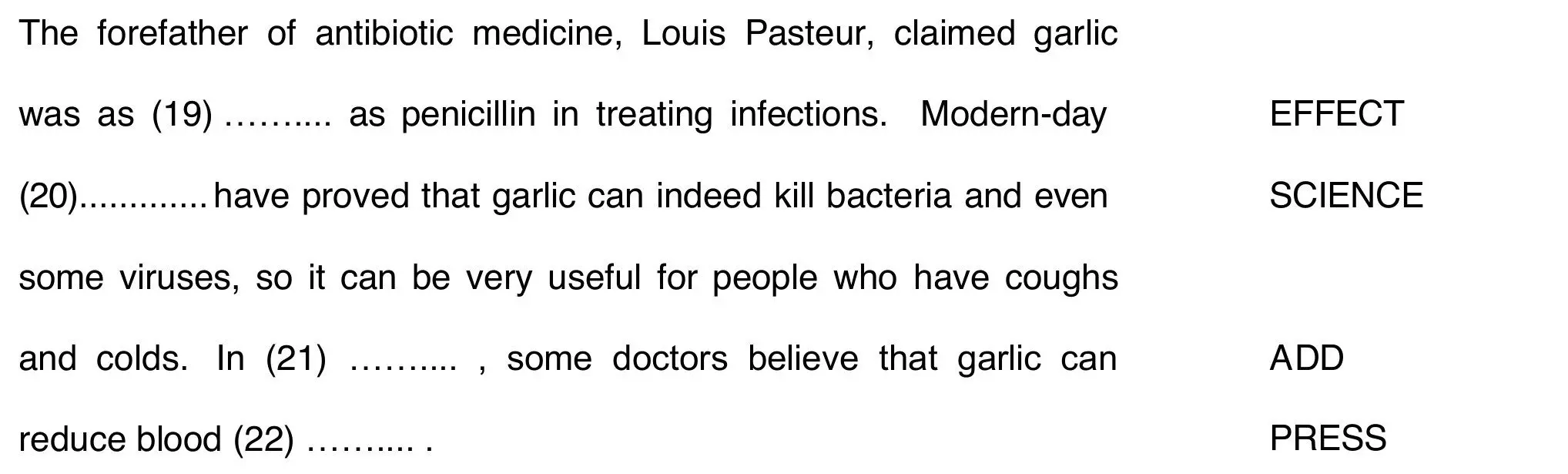
19. EFFECT → effective. As ___ as penicillin: the as… as structure with the verb be (garlic was as ___ as) calls for an adjective. The trap is effectively, which is an adverb and can’t describe the subject after be.
20. SCIENCE → scientists. Modern-day ___ have proved: it’s the subject of the sentence, so it’s a noun, and since only people prove things, you need the people who do science: scientist. Now step two: the verb is have, not has, so it’s plural. Singular scientist is a very typical mistake.
21. ADD → addition. In ___, some doctors believe: you can’t work this out from grammar alone; you have to recognise the fixed expression in addition. Fixed expressions and collocations come up often in word formation, and if you know them, the gap solves itself.
22. PRESS → pressure. Reduce blood ___: another collocation, blood pressure. The noun from press is pressure; careful, because press is also a noun (the media), but it can’t be the answer, since the word always has to change.
Third paragraph: gaps 23 and 24

23. ADVANTAGE → disadvantage. This is the type of gap that comes up again and again from one exam to the next: the one that needs a negative prefix. The only ___ to this truly amazing food is that the smell… is not the most pleasant: what follows is something bad, so the meaning calls for the opposite of an advantage. Grammatically, advantage would fit; only the meaning of the text tells you it has to be negative.
24. SPICE → spicy. The strong and rather ___ smell: before the noun smell and linked to the adjective strong, you need another adjective. Spice + -y drops the final e: spicy, not spicey.
Answers, in case you’ve been keeping track: 17 producer, 18 illness(es), 19 effective, 20 scientists, 21 addition, 22 pressure, 23 disadvantage, 24 spicy.
What type of change each gap needed
If we put the eight gaps side by side, you can clearly see the mix of changes Cambridge tends to ask for in a single text:
| Gap | Word | Answer | Word class | Change |
|---|---|---|---|---|
| 17 | PRODUCT | producer | Noun (person or entity) | Suffix -er |
| 18 | ILL | illness(es) | Abstract noun | Suffix -ness |
| 19 | EFFECT | effective | Adjective | Suffix -ive |
| 20 | SCIENCE | scientists | Noun (person), plural | Suffix -ist + plural |
| 21 | ADD | addition | Noun (fixed expression) | Suffix -ition |
| 22 | PRESS | pressure | Noun (collocation) | Suffix -ure |
| 23 | ADVANTAGE | disadvantage | Negative noun | Prefix dis- |
| 24 | SPICE | spicy | Adjective | Suffix -y (drops the e) |
Five nouns, two adjectives, one negative and one plural: that’s a very typical spread. Nouns are usually the majority in B2 word formation.
The suffixes and prefixes that come up most at B2
You don’t need to memorise endless lists, but you do need to recognise these endings, because they instantly tell you which word class you’re forming:
| To form… | Common endings | Examples |
|---|---|---|
| Abstract nouns | -tion/-sion, -ment, -ness, -ity, -ance/-ence, -ship | decision, improvement, happiness, ability, performance, friendship |
| Nouns for people | -er/-or, -ist, -ian, -ant/-ent | producer, visitor, scientist, musician, assistant |
| Adjectives | -ful, -less, -ous, -ive, -able/-ible, -al, -ic, -y | useful, careless, famous, effective, reliable, national, scientific, spicy |
| Adverbs | -ly | commonly, easily, unexpectedly |
| Verbs | -en, -ise/-ize, -ify | widen, realise, simplify |
| Negative words | un-, in-/im-/il-/ir-, dis-, mis- | unusual, impossible, illegal, irregular, disappear, misunderstand |
Internal changes deserve a special mention, as they cause the most mistakes: you can’t work them out by just adding a suffix. Long → length, strong → strength, wide → width, deep → depth, high → height, die → death, choose → choice, lose → loss. Many of them end in -th, and you’ll find them all in my guide to nouns ending in TH for Use of English Part 3. And if adjectives are your weak spot, have a look at how to form adjectives in English.
What you can and can’t write
- One word only. Never two, even if you think the answer needs an article or a preposition: that’s already in the text.
- The word always changes. Cambridge is clear about it: the word in capitals is never the answer as it stands. If you think press or advantage fits without changing it, read the sentence again.
- Each word belongs to its own line. The word in capitals only works for the gap on that same line; don’t try to use it anywhere else.
- Spelling has to be perfect. There’s no leeway in Part 3: spicey, ilness or sientists are wrong answers even if you got the word right. Watch the typical changes when adding suffixes: the e that disappears (spice → spicy), the y that becomes i (happy → happiness) and the doubled consonant (begin → beginner).
- On paper, in CAPITAL LETTERS. The answer sheet asks for capitals in Parts 2, 3 and 4. In the digital exam you simply type the word.
Strategy for B2 First Use of English Part 3
- Read the whole text before you start. The title and the overall meaning help you spot gaps like 23, where only the meaning tells you the word has to be negative.
- Apply step 1 to every gap. Before thinking about endings, decide the word class by looking at what comes before and after: an article, a noun, a verb, as… as.
- Apply step 2 without exception. Singular or plural? Positive or negative? Person or thing? This check is what turns an almost into a mark.
- If you’re torn between two words from the same family, try both in the sentence. The largest production of garlic versus the largest producer of garlic: read them in full and keep the one that says what the text means.
- Leave a couple of minutes to check your spelling. It’s what gives away the most marks in this part, and it’s the easiest thing to fix.
Most common mistakes in B2 First Use of English Part 3
- Writing the word from the family you know best. You see PRODUCT and write production because it’s familiar. Cambridge warns about exactly this: read the sentence, don’t just react to the word.
- Forgetting the plural. Scientist have proved doesn’t agree. Always check the verb or the determiner.
- Missing the negative. The negative-prefix gap is grammatically perfect without the prefix; only the meaning of the text gives it away.
- Mixing up adjectives and adverbs. Effective versus effectively: after be, and in as… as with be, it’s the adjective.
- Misspelling a word you knew. It’s the most frustrating mistake, and in this part it costs you the whole mark.
Frequently asked questions about B2 Use of English Part 3
How many questions are there in B2 First Use of English Part 3?
Eight questions (numbered 17 to 24), plus a worked example at the start. Each correct answer is worth one mark.
Do you always have to change the word in capitals?
Yes. According to Cambridge, in every case the given word has to change. If you write it as it is, the answer is wrong.
Can the answer be plural or negative?
Yes, and it’s very common. Cambridge warns that the word sometimes needs to be plural and sometimes negative, and a single text often has at least one of each. The context tells you.
Do spelling mistakes count?
Yes. In Use of English Parts 2, 3 and 4, spelling has to be correct, so one letter too many or too few costs you the mark.
How much time should I spend on it?
Cambridge doesn’t set a time per part: you have 1 hour 15 minutes for all seven parts of Reading and Use of English. Since the Reading parts have longer texts, it’s best not to spend more than about 10 minutes on this one.
Do wrong answers lose marks?
There’s no penalty in B2 First, so write something in all eight gaps even if you’re not sure.
Practise B2 First Use of English Part 3 with my book
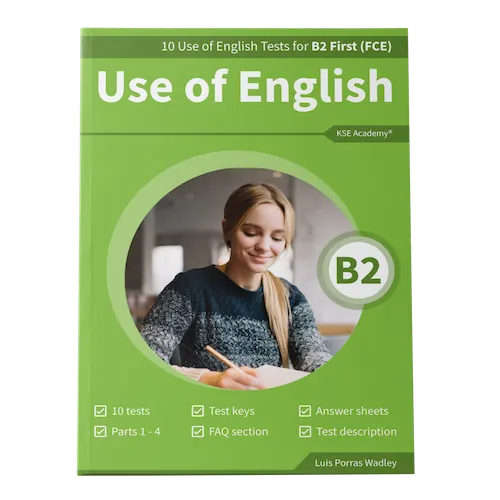
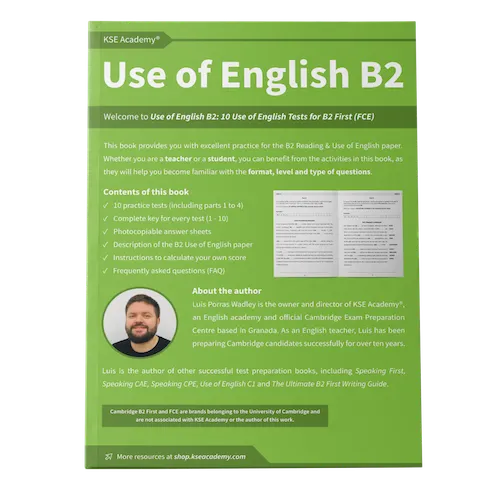
If you want to train word formation with texts at the same level and in the same format as the exam, my book Use of English B2: 10 Use of English Tests for B2 First (FCE) has ten complete tests covering all four parts of Use of English, with the answers explained.
Keep preparing B2 Use of English
This guide is part of the series on B2 First Use of English. If you haven’t already, check out the guides to Use of English Part 1 and Use of English Part 2, and once you’ve mastered word formation, move on to the key word transformation task in Part 4. You can also go back to the main B2 First page to see the whole exam.
Did you find this guide useful? Share it with other students and teachers preparing for the FCE. And if you’re left with any doubts about a word, leave them in the comments. I read every one.
See you in Part 4. Until then, don’t forget to keep smiling! 🙂
