
Table of contents
B2 First Use of English Part 4 is the well-known key word transformation: six sentences you have to rewrite in other words, using a key word you can’t change and without going over five words. For many candidates it’s the hardest part of Use of English, and it’s also the one that carries the most weight: each question is worth two marks.
The good news is that those two marks are awarded separately, one for each half of the answer, so even if you don’t get it all right you can still score. And the structures that come up are repeated a lot from one exam to the next. In this guide I’ll explain what B2 Use of English Part 4 looks like, exactly how it’s marked, which transformations come up again and again, and we’ll go through the six questions of an official Cambridge sample test together. 🙂
What B2 Use of English Part 4 looks like
Part 4 is part of the Reading and Use of English paper: seven parts, 52 questions and 1 hour 15 minutes. According to Cambridge, the Use of English section is made up of Parts 2, 3 and 4, and this is the last one:
| Detail | B2 Use of English Part 4 |
|---|---|
| What you do | Complete a second sentence so that it means the same as the first, using the key word |
| Number of questions | 6 (numbered 25 to 30), plus a worked example (0) |
| How many words you write | Between 2 and 5, including the key word; contractions count as two (except can’t) |
| The key word | You must use it and you can’t change it in any way |
| Marks | 2 marks per question (1 for each half of the answer), 12 in total |
| Spelling | It must be correct; in the paper-based exam, answers in CAPITAL LETTERS |
| What it tests | Grammar and vocabulary at once: structures, fixed expressions, phrasal verbs |
The four rules you can’t break
- Between two and five words. If you write six, you lose both marks, even if the sentence is perfect. And remember that didn’t counts as two words (did not); only can’t counts as one.
- The key word, exactly as it is. You must use it and you can’t change it: if the word is SAID, says or saying won’t do. If you don’t use it or you alter it, you lose the marks.
- The same meaning. The second sentence has to say, as far as possible, the same as the first. The tense only changes when the structure requires it, as with the reported speech in question 27 (know → knew).
- Only the missing words. On the answer sheet you don’t copy the whole sentence: you write only what goes in the gap, including the key word.
How it’s marked: the two halves
This is the most useful thing to understand about Part 4, and something hardly anyone explains. Cambridge splits each answer into two parts, and each one is worth a mark. Usually, one half is the structure that comes with the key word and the other is what links it to the rest of the sentence.
For example, in question 25 of the test we’re about to solve, the answer is a good idea to go, and the official key splits it like this: a good idea | to go. If you write a good idea going, the second half is wrong, but you get the mark for the first. The practical consequence is very clear: never leave a question blank. Half an answer is worth more than none.
The transformations that come up most at B2
The key word almost always forces you to use a specific structure. These are the ones that come up most in B2 First; master them and you’re halfway there:
| Structure | Example transformation |
|---|---|
| Passive | Someone stole my bike. → My bike was stolen. |
| Impersonal passive | People say he is rich. → He is said to be rich. |
| Reported speech and indirect questions | «Are you tired?» → She asked me if I was tired. |
| Conditionals and unless | If you don’t hurry, you’ll be late. → Unless you hurry, you’ll be late. |
| Wish and if only | I’m sorry I didn’t call her. → I wish I had called her. |
| Would rather and prefer | I’d prefer to stay in. → I’d rather stay in. |
| So, such, too and enough | The film was so boring that… → It was such a boring film that… |
| Comparatives | Tom is taller than Ann. → Ann is not as tall as Tom. |
| Modals of deduction | I’m sure he forgot. → He must have forgotten. |
| Phrasal verbs | They cancelled the match. → They called off the match. |
| Fixed expressions | It’s pointless to complain. → It’s not worth complaining. |
The four-step method
- Compare the two sentences and cross out what’s repeated. What’s left in the first sentence is exactly what you have to express in the gap.
- Think about which structure the key word brings. SAID usually calls for an impersonal passive, IF for an indirect question, LONG for a time expression. The key word is hardly ever there by chance.
- Look at what comes right after the gap. It’s a clue many people ignore: if knocking follows, you need something that goes with -ing; if to the museum follows, you need a verb that goes with to. The handbook stresses the verb at the end in particular, which tells you whether you need a singular or plural.
- Count the words and reread the whole sentence. Between two and five, with the key word untouched, and with the same meaning and tense as the original.
The sample test, solved question by question
These are the instructions and the example from the official Cambridge sample test:
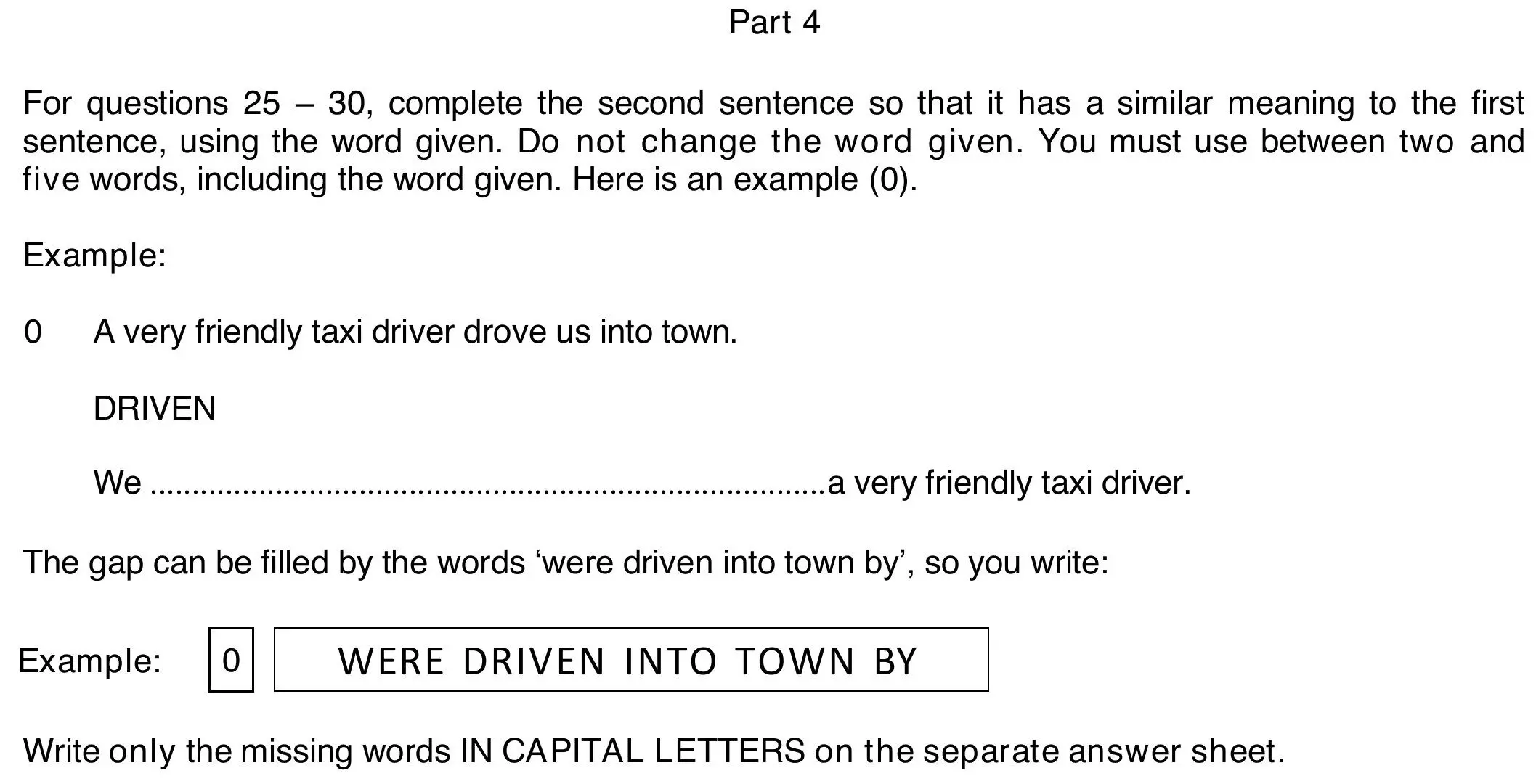
The example already shows the most typical structure: A very friendly taxi driver drove us into town → We were driven into town by a very friendly taxi driver. The key word DRIVEN forces you into the passive, and notice that the answer has five words, the maximum allowed. Try the six questions before reading the explanations.
Question 25: IDEA

Joan was in favour of visiting the museum → Joan thought it would be ___ to the museum.
Answer: a good idea to go (halves: a good idea | to go). Being in favour of something means thinking it would be a good idea to do it. The trap is at the end: after the gap comes to the museum, and visit doesn’t take to (visit the museum), so the verb has to be go. If you write a good idea to visit, you get one mark out of two.
Question 26: THAT

Arthur has the talent to become a concert pianist → Arthur is so ___ could become a concert pianist.
Answer: talented that he (halves: talented | that he). It’s the same structure you saw in Part 2: so + adjective + that + result. The noun talent becomes the adjective talented (a bit of word formation inside Part 4), and after that the subject of could is missing: he. Forgetting that subject is the most common mistake here.
Question 27: IF

‘Do you know when the match starts, Sally?’ asked Mary → Mary asked Sally ___ time the match started.
Answer: if she knew what (halves: if she knew | what). It’s an indirect question: the yes/no question (Do you know…?) is introduced with if, the pronoun changes (you → she) and the verb moves back a tense (know → knew). The second half depends on the end: since time follows, when becomes what time. Cambridge also accepts the (if she knew the time the match started).
Question 28: LONG

I knocked for ages at Ruth’s door but I got no reply → I ___ knocking at Ruth’s door but I got no reply.
Answer: spent a long time (halves: spent / took / was | a long time). For ages is an informal way of saying a long time, and the clue is again after the gap: knocking. Which verb goes with time + -ing? Spend time doing something. The key also accepts took and was, but spent is the most natural and safest option.
Question 29: SAID

Everyone says that the band is planning to go on a world tour next year → The band ___ planning to go on a world tour next year.
Answer: is said to be (halves: is / are said | to be). It’s the impersonal passive, one of Cambridge’s favourites: Everyone says that X is doing… → X is said to be doing…. Since planning follows, you need to be to keep the continuous form. With band, both is and are are accepted, because in British English collective nouns can take a plural verb.
Question 30: CALL

I’d prefer not to cancel the meeting → I’d rather ___ the meeting.
Answer: not call off (halves: not | call off). There are two changes at once here, which is very typical of this part: I’d prefer not to becomes I’d rather not + bare infinitive, and cancel becomes the phrasal verb call off. Cambridge also accepts you didn’t call off (I’d rather you didn’t call off the meeting), although it changes the subject; the version with not is the most direct.
Answers, in case you’ve been keeping track: 25 a good idea to go, 26 talented that he, 27 if she knew what, 28 spent a long time, 29 is said to be, 30 not call off.
Which structure each question needed
If we put the six questions side by side, you can see the kind of grammar Cambridge is looking for at B2:
| Question | Key word | Answer | Structure | The two halves |
|---|---|---|---|---|
| 0 | DRIVEN | were driven into town by | Passive | Example |
| 25 | IDEA | a good idea to go | Fixed expression | a good idea | to go |
| 26 | THAT | talented that he | so + adjective + that | talented | that he |
| 27 | IF | if she knew what | Indirect question | if she knew | what |
| 28 | LONG | spent a long time | spend time + -ing | spent | a long time |
| 29 | SAID | is said to be | Impersonal passive | is said | to be |
| 30 | CALL | not call off | would rather + phrasal verb | not | call off |
Notice that in four of the six, what came right after the gap decided one of the two halves: to the museum, time, knocking and planning.
What you can and can’t write
- Between two and five words, counting the key word. Six words means zero marks.
- Contractions, in their full form. Didn’t is two words, I’d is two words; only can’t counts as one.
- The key word unchanged. No other verb form, no plural, no singular.
- Only what’s missing. Don’t copy the beginning or end of the sentence onto the answer sheet.
- Correct spelling and, on paper, CAPITAL LETTERS. Just like in Parts 2 and 3.
Strategy for B2 Use of English Part 4
- Secure the half you can see first. If you know SAID calls for is said, write it even if you’re unsure about the rest: that mark is already yours.
- Watch the tense. If the first sentence is in the past, so is the second. It’s one of the most frequent slips and it costs you half a question.
- Look for two changes, not one. Many questions combine a grammar structure with a vocabulary change, like question 30 (would rather + call off).
- Study by structure, not by single sentences. Transformations repeat themselves: if you master the list above, you’ll recognise almost every question.
- Give it enough time. Cambridge doesn’t set a time per part, but this is the part of Use of English that needs the most thinking, and each question is worth double. Around 10 to 12 minutes is reasonable.
Most common mistakes in B2 First Use of English Part 4
- Going over five words. It usually happens when you miscount contractions or copy part of the sentence.
- Changing the key word. Said turned into says, long turned into longer: zero marks.
- Changing the meaning. A grammatically perfect sentence that doesn’t say the same as the original doesn’t score.
- Ignoring the end of the sentence. To visit before to the museum, or when before time: the end was warning you.
- Leaving it blank. With half-marks available, a partial answer almost always adds something.
Practise key word transformation with my book
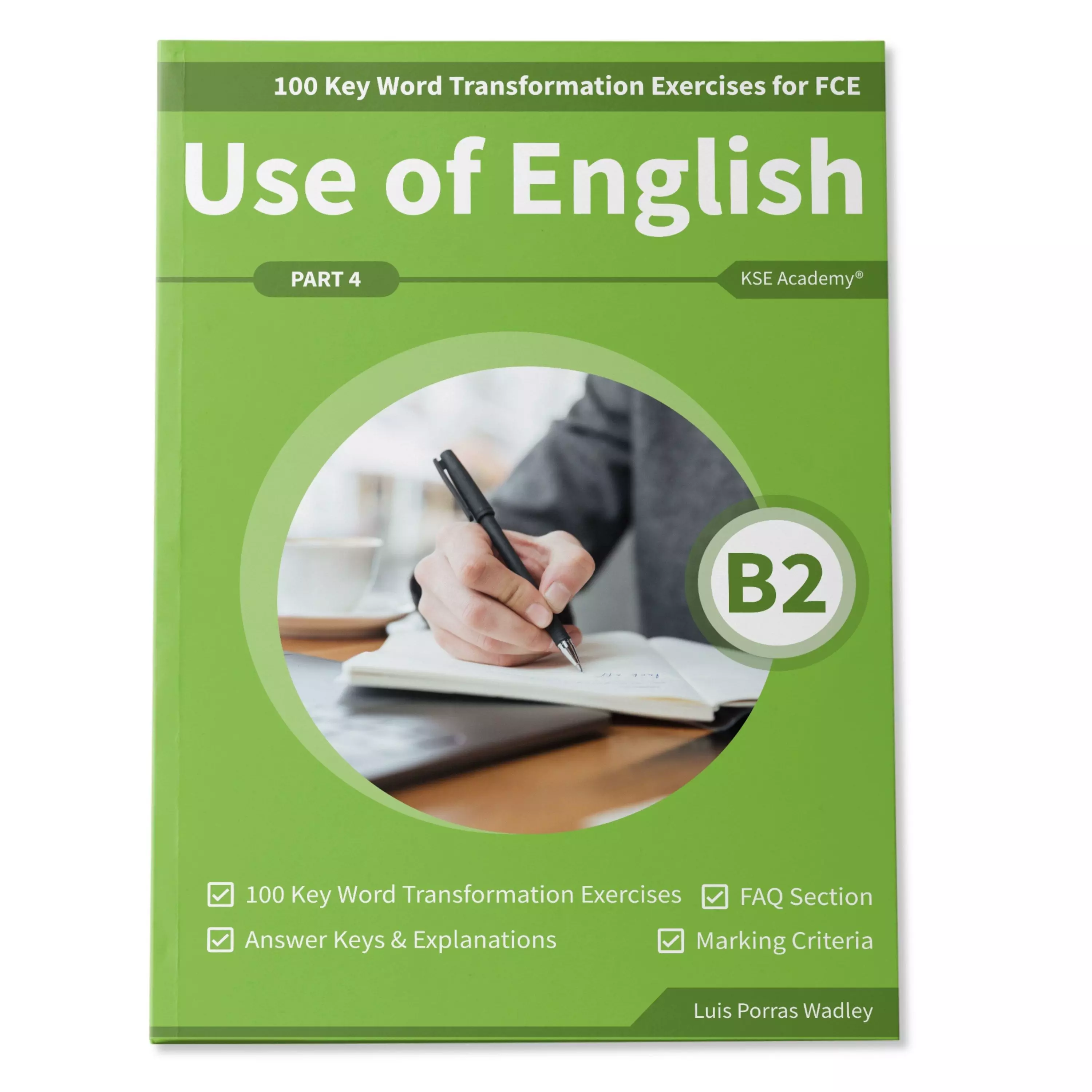
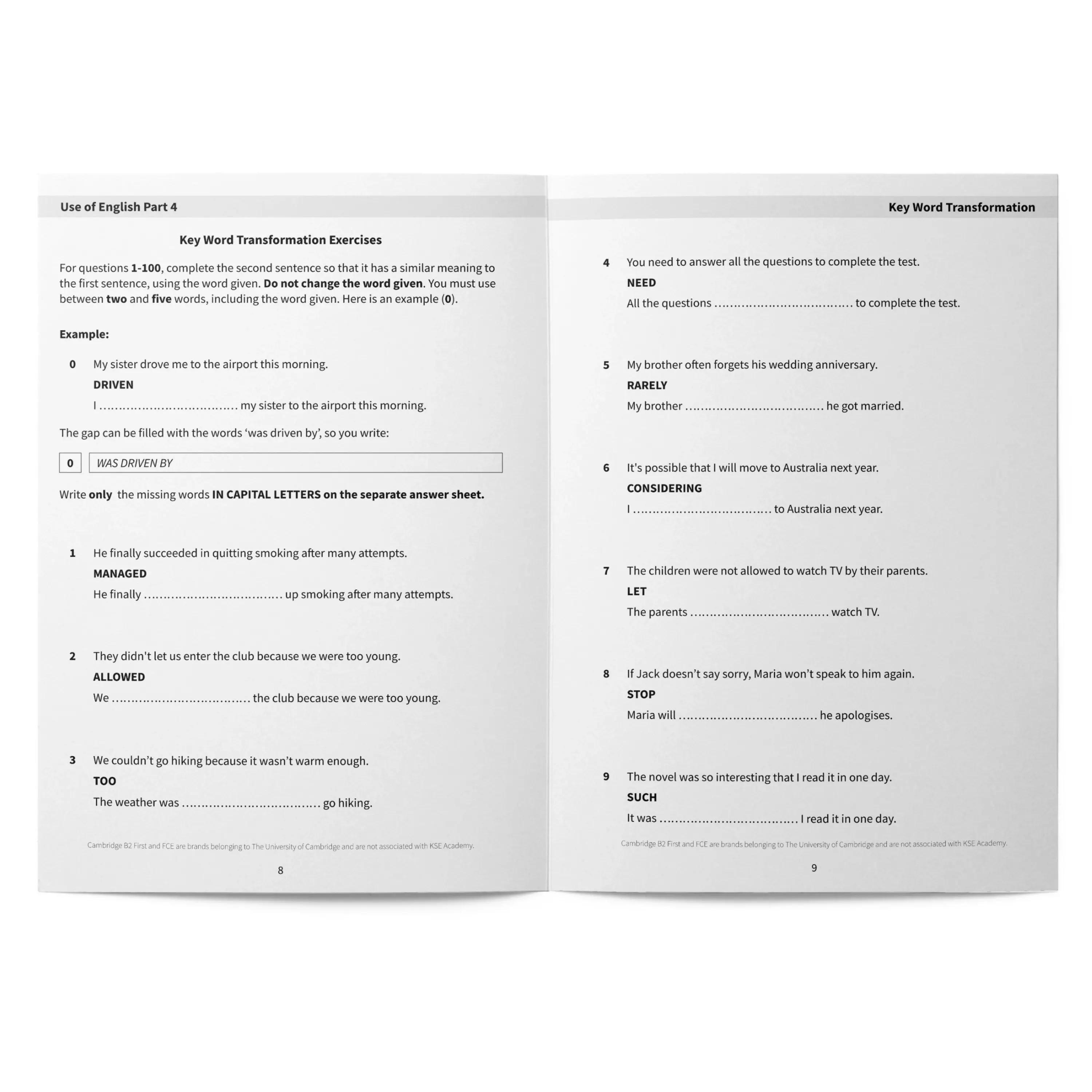
If you want to train this part in depth, I have a book devoted entirely to it: Use of English B2 Part 4: 100 Key Word Transformation Sentences. It has 100 exercises in the same format as the exam, with the key and an explanation for every answer, a section on how this part is marked (including the two halves) and frequently asked questions about key word transformation.
Frequently asked questions about B2 Use of English Part 4
How many questions are there in B2 First Use of English Part 4?
Six questions (numbered 25 to 30), plus a worked example at the start.
How much is each question worth?
Two marks: Cambridge splits each answer into two parts and gives one mark for each part that’s correct. In total, Part 4 is worth 12 marks.
Do contractions count as one word or two?
Two. Doesn’t counts as does not and I’d as I would. The only exception is can’t, which is the contraction of cannot and counts as one word.
Can I change the form of the key word?
No. You have to use it exactly as it appears: if you change it or don’t use it, the answer doesn’t score.
Can there be more than one correct answer?
Yes. The official key often allows variants, as in question 28 of the test we’ve solved (spent, took or was a long time). But write only one.
Do wrong answers lose marks?
There’s no penalty in B2 First, and here you can even get a mark for half an answer. Never leave it blank.
Keep preparing B2 Use of English
This guide completes the series on B2 First Use of English. If you’ve missed any, check out the guides to Use of English Part 1, Use of English Part 2 and the word formation task in Part 3. You can also go back to the main B2 First page to see the whole exam.
Did you find this guide useful? Share it with other students and teachers preparing for the FCE. And if you’re left with any doubts about a transformation, leave them in the comments. I read every one.
See you in the next guide. Until then, don’t forget to keep smiling! 🙂
