
Table of contents
B2 Use of English is one of the five scores that make up your B2 First (FCE) result, together with Reading, Writing, Listening and Speaking, and it tests your ability to apply your lexical and grammatical knowledge of the language. Honestly, I love this part of the exam, because it combines vocabulary and grammar in a very practical way. In this guide we focus on B2 First Use of English Part 2, the open cloze.
It’s the only part of Use of English where you’re given nothing: no options, as in Part 1, and no starting word, as in Part 3. Just a text with eight gaps and the instruction to write one word in each. The good news is that the word is almost always a short grammar word: a relative pronoun, a preposition, an auxiliary, an article. If you learn to see which piece the sentence is missing, the gap solves itself. In this guide I’ll explain what B2 Use of English Part 2 looks like, which kinds of words it asks for, and we’ll go through the eight gaps of an official Cambridge sample test together. 🙂
What B2 Use of English Part 2 looks like
Part 2 is part of the Reading and Use of English paper: seven parts, 52 questions and 1 hour 15 minutes. According to Cambridge, the Use of English section is made up of Parts 2, 3 and 4 (Part 1 looks like Use of English, but it counts towards Reading). This is what you’ll find:
| Detail | B2 Use of English Part 2 |
|---|---|
| What you do | Read a text with 8 gaps and write the missing word in each one, with no options |
| Number of questions | 8 (numbered 9 to 16), plus a worked example (0) |
| What you write | One word per gap; contractions count as two (except can’t) |
| Marks | 1 mark per correct answer |
| Spelling | It must be correct; in the paper-based exam, answers in CAPITAL LETTERS |
| What it tests | Grammar (articles, auxiliaries, prepositions, pronouns, verb tenses) and lexico-grammar (phrasal verbs, linkers, fixed expressions) |
What kind of words are missing in the open cloze
The answer is hardly ever a noun, an adjective or a verb with a meaning of its own: the text gives you those. What’s missing is the «glue» of the sentence. These are the categories that come up most:
| Word type | Typical examples |
|---|---|
| Relative pronouns and adverbs | which, that, who, whose, where, when |
| Prepositions (on their own or dependent) | in, on, at, of, from, for |
| Auxiliaries and modals | do, did, have, been, will, would, could |
| Pronouns, reflexives and determiners | it, there, myself, their, each, every |
| Articles and quantifiers | a, the, any, some, few, much, enough |
| Comparatives and intensifiers | more, than, as, so, such, too |
| One-word linkers | although, unless, despite, while, however |
| Parts of phrasal verbs and fixed expressions | out, up, off; apart (from), as well (as), in spite (of) |
The three-step method
- Read the whole text before writing anything. Cambridge stresses keeping the sense of the whole text in mind: some gaps, like linkers, depend on the relationship between two sentences.
- For each gap, ask yourself which piece the sentence is missing. Look at what comes before and after. Is a verb missing its subject? Is a noun missing its preposition? Is something needed to join two clauses? If the missing word is a verb, check that it agrees with its subject.
- Write the word and reread the whole sentence. It has to sound natural and be grammatically perfect. If you’re torn between two, go for the one that doesn’t need any other word.
The sample test, solved gap by gap
This is the text from the official Cambridge sample test. Try to complete it before reading the explanations:
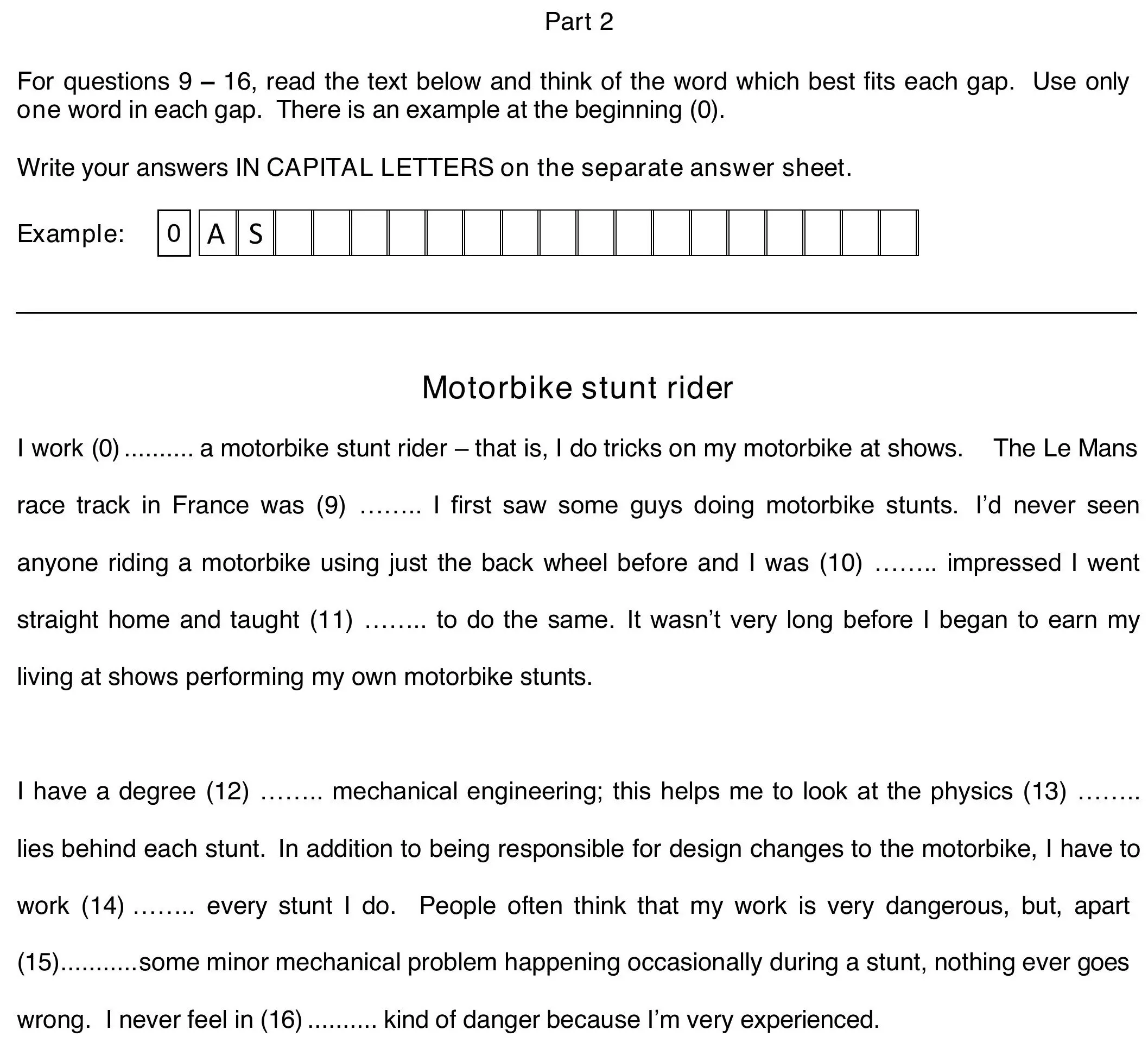
The example already shows you the kind of word you’re looking for: I work (0) ___ a motorbike stunt rider. To talk about your job you use work as. A short grammar word that you can’t work out from the meaning of the sentence, only from how it’s built.
First paragraph: gaps 9 to 11
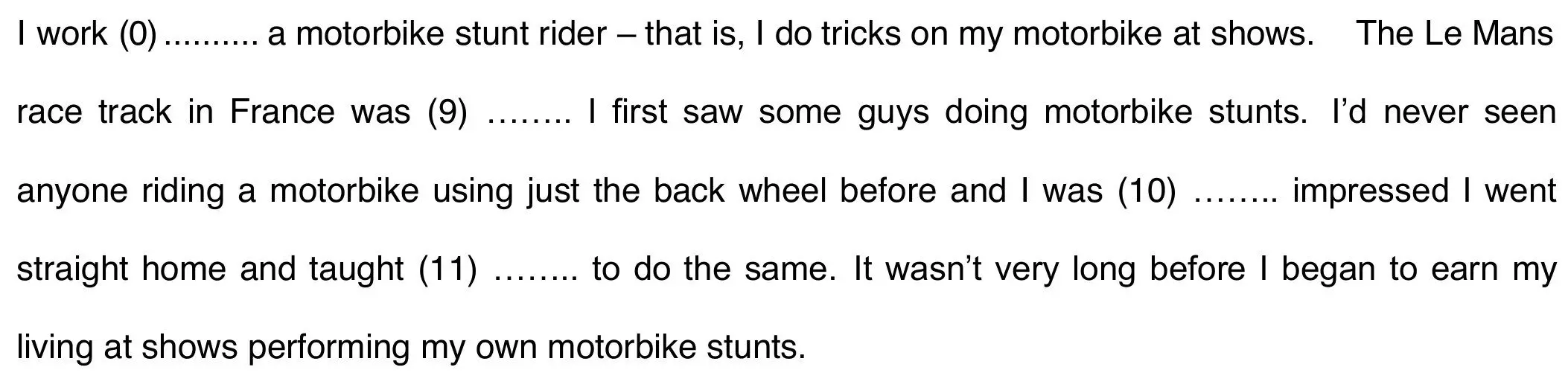
9. where. The Le Mans race track in France was ___ I first saw some guys doing motorbike stunts. After was comes a full clause (I first saw…), so you need something to introduce it, and since it refers to a place (the race track), it’s where. When would be about time, and the official key only accepts where.
10. so. I was ___ impressed I went straight home. After the adjective comes a result (I went straight home), with that left out. That structure is so + adjective + (that) + result. Very or really fit before impressed, but they can’t introduce the result, and such would need a noun (such a shock).
11. myself. I went straight home and taught ___ to do the same. The person teaching and the person learning are the same, so you need a reflexive: taught myself. Me would be a very common mistake.
Second paragraph: gaps 12 to 16
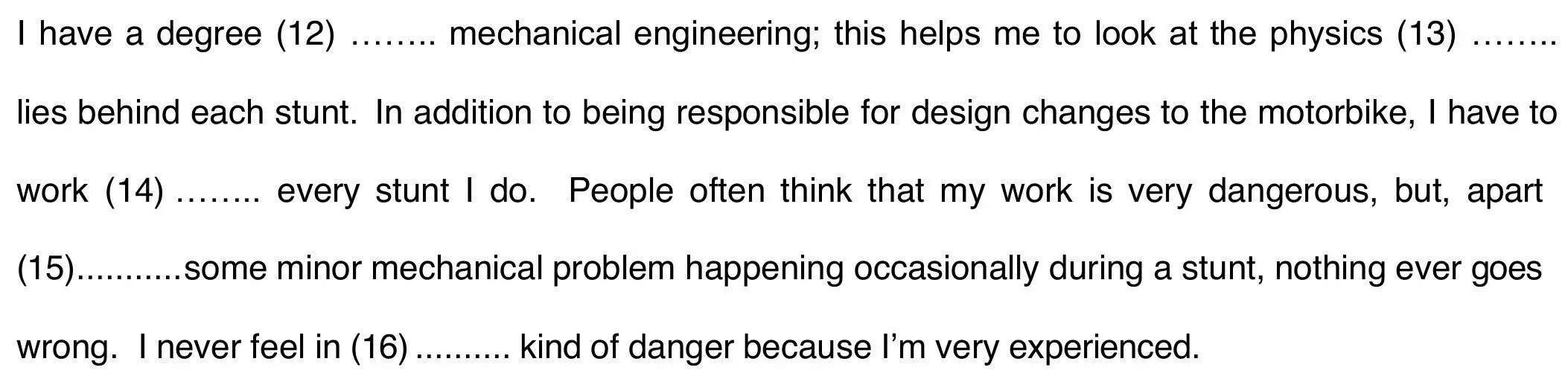
12. in. I have a degree ___ mechanical engineering. It’s a dependent preposition: a degree in a subject. Learners often write a degree of, which is wrong here.
13. which or that. This helps me to look at the physics ___ lies behind each stunt. The verb lies has no subject, and that subject has to refer back to the physics: a relative pronoun. Cambridge accepts both which and that. What doesn’t work, because there’s already an antecedent (the physics).
14. out, on or at. I have to work ___ every stunt I do. It’s the particle of a phrasal verb, and here Cambridge accepts three: work out (calculate, plan), work on and work at (put effort into improving something). It’s a good example of a gap with several correct answers; just write one.
15. from. People often think that my work is very dangerous, but, apart ___ some minor mechanical problem… Fixed expression: apart from. If you see apart, as well or in spite right before a gap, the missing word is almost certainly the preposition that completes the expression.
16. any. I never feel in ___ kind of danger. The sentence is already negative because of never, and English doesn’t stack two negatives, so no doesn’t work. With a negative verb, the quantifier is any; some would be for affirmative sentences.
Answers, in case you’ve been keeping track: 9 where, 10 so, 11 myself, 12 in, 13 which/that, 14 out/on/at, 15 from, 16 any.
Which piece was missing in each gap
If we put the eight gaps side by side, you can see exactly what the open cloze tests:
| Gap | Answer | Word type | The clue |
|---|---|---|---|
| 9 | where | Relative adverb | Full clause after + place |
| 10 | so | Intensifier | Adjective + result |
| 11 | myself | Reflexive pronoun | Subject and object are the same person |
| 12 | in | Dependent preposition | a degree ___ |
| 13 | which/that | Relative pronoun | The verb lies has no subject |
| 14 | out/on/at | Phrasal verb particle | work ___ + object |
| 15 | from | Fixed expression | apart right before |
| 16 | any | Quantifier | Negative sentence because of never |
Eight short words, none with a meaning of its own. That’s almost always what Part 2 is like: Cambridge isn’t testing your vocabulary, it’s testing how an English sentence is built.
What you can and can’t write
- One word only. Never two, and no abbreviations (such as sthg for something).
- No contractions. Didn’t or he’ll count as two words, so they can’t be the answer. The only exception is can’t, which stands for cannot.
- One answer per gap. Even when several are correct, as in gap 14, write only one.
- Spelling has to be correct. A short word spelled wrong (wich, untill) costs you the mark. Punctuation, on the other hand, is ignored.
- On paper, in CAPITAL LETTERS. That’s what the answer sheet asks for in Parts 2, 3 and 4. In the computer-based exam it doesn’t matter whether you use capitals or lower case.
Strategy for B2 Use of English Part 2
- Always read beyond the gap. As in Part 1, what comes after usually decides the answer: a full clause (gap 9), a result (gap 10), a verb with no subject (gap 13).
- Look for incomplete expressions. Apart, as well, in spite, as long, so as… If a fixed expression is only half there, the gap is the missing piece.
- Notice whether the sentence is negative. Never, hardly, without or not change the quantifier (any, not some).
- Check agreement. If the gap is an auxiliary or a verb, it has to agree with its subject and with the tense of the rest of the text.
- Don’t leave it blank. If you can’t see it, write the grammar word that fits best: wrong answers don’t lose marks.
Most common mistakes in B2 First Use of English Part 2
- Translating from your own language. Degree of, taught me or in no kind of danger are literal translations that Cambridge knows very well.
- Writing a word with a meaning of its own. If you’re putting in an adjective or a noun, that’s almost certainly not what’s missing.
- Using contractions. Don’t in a gap is a wrong answer, even if the meaning is perfect.
- Looking only at the word before. Reading up to the gap and filling it by instinct is the quickest way to lose marks in this part.
- Being careless with the spelling of very short words. Precisely because they look easy, they get written quickly and wrongly.
B2 Use of English Part 2 exercises online
In the following sections, you will find a series of Use of English Part 2 activities for B2 First (FCE). I have compiled and adapted these exercises from the internet over the years, but I don’t know who the original author is. So please, if you know who wrote these texts or created the exercises, don’t hesitate to get in touch with me. I’ll be happy to either reference them appropriately or remove them to avoid any copyright infringement.
Exercise 1: London Marathon
Exercise 2: Learning an Instrument
Exercise 3: Dinosaurs Eating
Exercise 4: High-jumper
Exercise 5: Swimming with Seals
Exercise 6: Multimedia Education
Exercise 7: Spot the Gorilla
Exercise 8: The Mini-Monet
Exercise 9: Diet during Pregnancy
Exercise 10: Postman
Download B2 Use of English Part 2 exercises in PDF for free
The following are Use of English Part 2 handouts in PDF that I created for my students. They’re a few years old, so the format may not be perfect regarding the number of gaps, but they’re still great practice resources.
- Use of English Part 2: Fining the Homeless
- Use of English Part 2: Food Allergies from Blood Transfusions
- Use of English Part 2: Helping A Parent Who Smokes
- Use of English Part 2: Heroic Passenger
- Use of English Part 2: Irish Girl Meets Doppelganger
- Use of English Part 2: ISIS Threat Spreads to Star Wars Sets
- Use of English Part 2: The Axeman of New Orleans
- Use of English Part 2: Why Are There Clouds?
Frequently asked questions about B2 Use of English Part 2
How many questions are there in B2 First Use of English Part 2?
Eight questions (numbered 9 to 16), plus a worked example at the start. Each correct answer is worth one mark.
Are contractions counted as one or two words?
Each contraction counts as two words. So doesn’t is counted as does not, hadn’t as had not, etc. Please note that can’t is the contraction of cannot, so it is counted as one word only.
How long are the texts in Use of English B2 Part 2?
These texts are usually 140-180 words long, and are normally divided into two or three short paragraphs. The one in the sample test we’ve just solved, for example, is about 170 words long.
Will incorrect answers penalise me?
No, they won’t. Incorrect answers simply don’t add points to your score, but they won’t make you lose any marks. So it’s always best not to leave any questions unanswered.
Is American English spelling incorrect?
No, not at all. Any standard spelling variety will be considered correct, whether it be British English or American English. So you can write realise or realize, for instance. However, you should be consistent with your spelling and stick to one variety as far as possible.
Should I write my answers in CAPITAL LETTERS?
If you’re doing the paper-based exam, you must write your answers in capital letters, as per the instructions for each exercise. However, if you’re doing the computer-based exam, it doesn’t matter if your answers are in capital or lower-case letters.
Can there be more than one correct answer?
Yes, the gaps in Part 2 sometimes admit more than one correct answer, like gap 14 in the test we’ve solved (out, on or at). However, remember that you can only write one word in each gap.
Use of English B2: 10 Use of English Tests for B2 First (FCE)
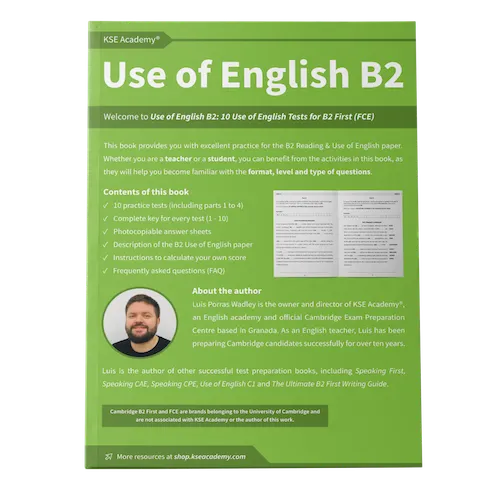
If you need more resources to prepare for Use of English, have a look at my book Use of English B2: 10 Use of English Tests for B2 First (FCE). In it you will find:
- A description of the Use of English paper in the FCE test by Cambridge English.
- Frequently asked questions (FAQ).
- 10 practice tests (including parts 1 to 4 of Reading and Use of English).
- A photocopiable answer sheet per test.
- Instructions to calculate your own score.
- The key for each B2 Use of English test.
Keep preparing B2 Use of English
This guide is part of the series on B2 First Use of English. If you haven’t already, check out the guide to Use of English Part 1, and once you’ve got the hang of this part, move on to the word formation task in Use of English Part 3. You can also go back to the main B2 First page to see the whole exam.
Did you find this guide useful? Share it with other students and teachers preparing for the FCE. And if you’re left with any doubts about a gap, leave them in the comments. I read every one.
See you in Part 3. Until then, don’t forget to keep smiling! 🙂
