
Tabla de contenidos
La Parte 4 del Use of English del B2 First es el famoso key word transformation: seis frases que tienes que reescribir con otras palabras, usando una palabra clave que no puedes cambiar y sin pasarte de cinco palabras. Para muchos candidatos es la parte más difícil del Use of English, y también la que más pesa: cada pregunta vale dos puntos.
La buena noticia es que esos dos puntos se dan por separado, uno por cada mitad de la respuesta, así que aunque no la claves entera puedes sumar. Y que las estructuras que aparecen se repiten mucho de un examen a otro. En esta guía te explico cómo es el Use of English B2 Part 4, cómo se puntúa exactamente, qué transformaciones salen una y otra vez, y resolvemos juntos las seis preguntas de un examen de muestra oficial de Cambridge. 🙂
Cómo es la Parte 4 del B2 Use of English
La Parte 4 forma parte del examen de Reading and Use of English: siete partes, 52 preguntas y 1 hora y 15 minutos. Según Cambridge, la sección de Use of English la forman las Partes 2, 3 y 4, y esta es la última:
| Dato | B2 Use of English Part 4 |
|---|---|
| Qué tienes que hacer | Completar una segunda frase para que signifique lo mismo que la primera, usando la palabra clave |
| Número de preguntas | 6 (numeradas del 25 al 30), más un ejemplo resuelto (0) |
| Cuántas palabras escribes | Entre 2 y 5, incluida la palabra clave; las contracciones cuentan como dos (salvo can’t) |
| La palabra clave | Tienes que usarla y no puedes cambiarla de ninguna forma |
| Puntuación | 2 puntos por pregunta (1 por cada mitad de la respuesta), 12 en total |
| Ortografía | Tiene que ser correcta; en el examen en papel, respuestas en MAYÚSCULAS |
| Qué mide | Gramática y vocabulario a la vez: estructuras, expresiones fijas, phrasal verbs |
Las cuatro reglas que no puedes romper
- Entre dos y cinco palabras. Si escribes seis, pierdes los dos puntos, aunque la frase sea perfecta. Y recuerda que didn’t cuenta como dos palabras (did not); solo can’t cuenta como una.
- La palabra clave, tal cual. Tienes que usarla y no puedes cambiarla: si la palabra es SAID, no vale says ni saying. Si no la usas o la modificas, pierdes los puntos.
- El mismo significado. La segunda frase tiene que decir, en la medida de lo posible, lo mismo que la primera. El tiempo verbal solo cambia cuando lo exige la estructura, como en el estilo indirecto de la pregunta 27 (know → knew).
- Solo las palabras que faltan. En la hoja de respuestas no copias la frase entera: escribes únicamente lo que va en el hueco, incluida la palabra clave.
Cómo se puntúa: las dos mitades
Esto es lo que más conviene entender de la Parte 4, y lo que casi nadie explica. Cambridge divide cada respuesta en dos partes, y cada una vale un punto. Normalmente, una mitad es la estructura que trae la palabra clave y la otra es lo que la conecta con el resto de la frase.
Por ejemplo, en la pregunta 25 del examen que vamos a resolver, la respuesta es a good idea to go, y la clave oficial la divide así: a good idea | to go. Si escribes a good idea going, la segunda mitad está mal, pero te llevas el punto de la primera. La consecuencia práctica es muy clara: nunca dejes una pregunta en blanco. Una respuesta a medias vale más que ninguna.
Las transformaciones que más se repiten en el B2
La palabra clave casi siempre te obliga a usar una estructura concreta. Estas son las que más salen en el B2 First; si las dominas, tienes media Parte 4 ganada:
| Estructura | Ejemplo de transformación |
|---|---|
| Pasiva | Someone stole my bike. → My bike was stolen. |
| Pasiva impersonal | People say he is rich. → He is said to be rich. |
| Estilo indirecto y preguntas indirectas | «Are you tired?» → She asked me if I was tired. |
| Condicionales y unless | If you don’t hurry, you’ll be late. → Unless you hurry, you’ll be late. |
| Wish e if only | I’m sorry I didn’t call her. → I wish I had called her. |
| Would rather y prefer | I’d prefer to stay in. → I’d rather stay in. |
| So, such, too y enough | The film was so boring that… → It was such a boring film that… |
| Comparativos | Tom is taller than Ann. → Ann is not as tall as Tom. |
| Modales de deducción | I’m sure he forgot. → He must have forgotten. |
| Phrasal verbs | They cancelled the match. → They called off the match. |
| Expresiones fijas | It’s pointless to complain. → It’s not worth complaining. |
Un apunte si estás en 2.º de Bachillerato: las transformaciones del bloque B de la PAU de inglés de Andalucía se parecen muchísimo a esta Part 4 (aunque allí reescribes la frase entera). Te lo explico en mi guía del examen de inglés de la PAU de Andalucía.
El método en cuatro pasos
- Compara las dos frases y tacha lo que se repite. Lo que queda en la primera frase es exactamente lo que tienes que expresar en el hueco.
- Piensa qué estructura trae la palabra clave. SAID suele pedir una pasiva impersonal, IF una pregunta indirecta, LONG una expresión de tiempo. La palabra clave casi nunca está ahí por casualidad.
- Mira lo que va justo después del hueco. Es una pista que mucha gente ignora: si detrás viene knocking, necesitas algo que vaya con -ing; si viene to the museum, necesitas un verbo que vaya con to. El handbook insiste especialmente en el verbo del final, que te dice si hace falta singular o plural.
- Cuenta las palabras y relee la frase entera. Entre dos y cinco, con la palabra clave sin tocar, y con el mismo significado y el mismo tiempo verbal que la frase original.
El examen de muestra, resuelto pregunta por pregunta
Estas son las instrucciones y el ejemplo del examen de muestra oficial de Cambridge:
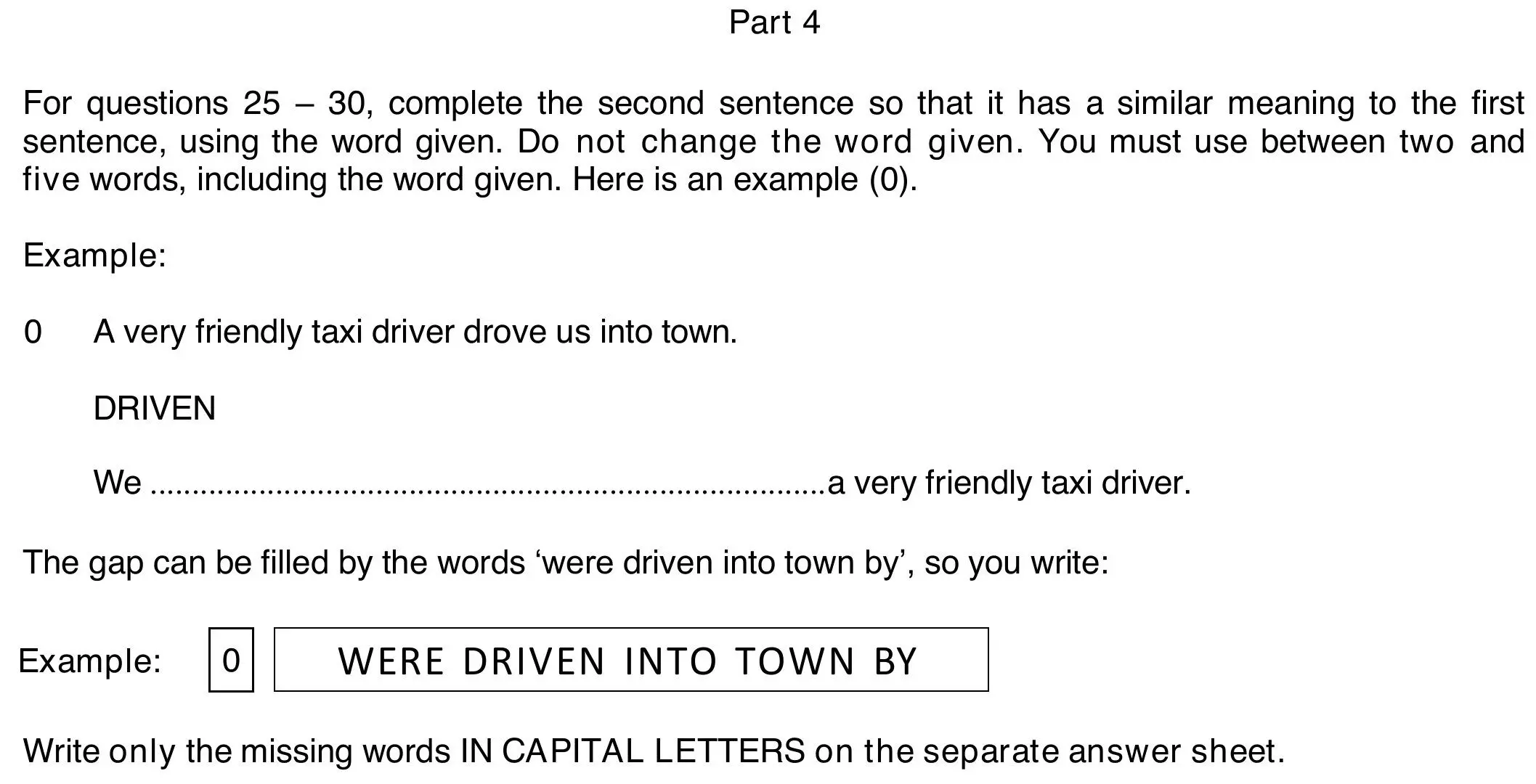
El ejemplo ya muestra la estructura más típica: A very friendly taxi driver drove us into town → We were driven into town by a very friendly taxi driver. La palabra clave DRIVEN te obliga a pasar la frase a pasiva, y fíjate en que la respuesta tiene cinco palabras, el máximo permitido. Intenta resolver las seis preguntas antes de leer las explicaciones.
Pregunta 25: IDEA

Joan was in favour of visiting the museum → Joan thought it would be ___ to the museum.
Respuesta: a good idea to go (mitades: a good idea | to go). Estar a favor de algo es pensar que it would be a good idea to hacerlo. La trampa está al final: detrás del hueco viene to the museum, y visit no lleva to (visit the museum), así que el verbo tiene que ser go. Si escribes a good idea to visit, te llevas un punto de dos.
Pregunta 26: THAT

Arthur has the talent to become a concert pianist → Arthur is so ___ could become a concert pianist.
Respuesta: talented that he (mitades: talented | that he). La estructura es la misma que viste en la Parte 2: so + adjetivo + that + consecuencia. El sustantivo talent se convierte en el adjetivo talented (un word formation dentro de la Parte 4), y después de that falta el sujeto de could: he. Olvidar ese sujeto es el error más común aquí.
Pregunta 27: IF

‘Do you know when the match starts, Sally?’ asked Mary → Mary asked Sally ___ time the match started.
Respuesta: if she knew what (mitades: if she knew | what). Es una pregunta indirecta: la pregunta de sí o no (Do you know…?) se introduce con if, el pronombre cambia (you → she) y el verbo retrocede un tiempo (know → knew). La segunda mitad depende del final: como detrás viene time, when se convierte en what time. Cambridge también acepta the (if she knew the time the match started).
Pregunta 28: LONG

I knocked for ages at Ruth’s door but I got no reply → I ___ knocking at Ruth’s door but I got no reply.
Respuesta: spent a long time (mitades: spent / took / was | a long time). For ages es una forma informal de decir a long time, y la pista está otra vez detrás del hueco: knocking. ¿Qué verbo va con tiempo + -ing? Spend time doing something. La clave acepta también took y was, pero spent es la opción más natural y segura.
Pregunta 29: SAID

Everyone says that the band is planning to go on a world tour next year → The band ___ planning to go on a world tour next year.
Respuesta: is said to be (mitades: is / are said | to be). Es la pasiva impersonal, una de las favoritas de Cambridge: Everyone says that X is doing… → X is said to be doing…. Como detrás viene planning, necesitas to be para mantener el continuo. Con band se aceptan tanto is como are, porque en inglés británico los sustantivos colectivos pueden ir en plural.
Pregunta 30: CALL

I’d prefer not to cancel the meeting → I’d rather ___ the meeting.
Respuesta: not call off (mitades: not | call off). Aquí hay dos cambios a la vez, algo muy típico de esta parte: I’d prefer not to se convierte en I’d rather not + infinitivo sin to, y cancel se convierte en el phrasal verb call off. Cambridge acepta también you didn’t call off (I’d rather you didn’t call off the meeting), aunque cambia el sujeto; la versión con not es la más directa.
Respuestas, por si has ido apuntando: 25 a good idea to go, 26 talented that he, 27 if she knew what, 28 spent a long time, 29 is said to be, 30 not call off.
Qué estructura pedía cada pregunta
Si ponemos las seis preguntas juntas, se ve el tipo de gramática que Cambridge busca en el B2:
| Pregunta | Palabra clave | Respuesta | Estructura | Las dos mitades |
|---|---|---|---|---|
| 0 | DRIVEN | were driven into town by | Pasiva | Ejemplo |
| 25 | IDEA | a good idea to go | Expresión fija | a good idea | to go |
| 26 | THAT | talented that he | so + adjetivo + that | talented | that he |
| 27 | IF | if she knew what | Pregunta indirecta | if she knew | what |
| 28 | LONG | spent a long time | spend time + -ing | spent | a long time |
| 29 | SAID | is said to be | Pasiva impersonal | is said | to be |
| 30 | CALL | not call off | would rather + phrasal verb | not | call off |
Fíjate en que en cuatro de las seis, lo que va justo después del hueco decidía una de las dos mitades: to the museum, time, knocking y planning.
Qué puedes escribir y qué no
- Entre dos y cinco palabras, contando la palabra clave. Seis palabras son cero puntos.
- Contracciones, en su forma completa. Didn’t son dos palabras, I’d son dos palabras; solo can’t cuenta como una.
- La palabra clave sin cambios. Ni otra forma del verbo, ni plural, ni singular.
- Solo lo que falta. No copies el principio ni el final de la frase en la hoja de respuestas.
- Ortografía correcta y, en papel, en MAYÚSCULAS. Como en las Partes 2 y 3.
Estrategia para el Use of English B2 Part 4
- Asegura primero la mitad que ves clara. Si sabes que SAID pide is said, escríbelo aunque dudes del resto: ese punto ya es tuyo.
- Vigila el tiempo verbal. Si la primera frase está en pasado, la segunda también. Es uno de los fallos más frecuentes y te cuesta media pregunta.
- Busca dos cambios, no uno. Muchas preguntas combinan una estructura gramatical con un cambio de vocabulario, como la 30 (would rather + call off).
- Estudia por estructuras, no por frases sueltas. Las transformaciones se repiten: si dominas la lista de arriba, reconocerás casi todas las preguntas.
- Déjale tiempo suficiente. Cambridge no fija tiempos por parte, pero es la parte del Use of English que más piensa uno, y vale el doble por pregunta. Unos 10 o 12 minutos es razonable.
Errores más comunes en la Parte 4 del Use of English del B2 First
- Pasarse de cinco palabras. Suele pasar al contar mal las contracciones o al copiar parte de la frase.
- Cambiar la palabra clave. Said convertido en says, long convertido en longer: cero puntos.
- Cambiar el significado. Una frase gramaticalmente perfecta que no dice lo mismo que la original no puntúa.
- Ignorar el final de la frase. To visit delante de to the museum, o when delante de time: el final te avisaba.
- Dejarla en blanco. Con la puntuación por mitades, una respuesta a medias casi siempre suma algo.
Ejercicios del Use of English B2 Part 4
Aquí tienes cuatro ejercicios originales de la Parte 4, con el mismo formato que el examen: un ejemplo (0) y seis frases para transformar con la palabra clave. Hazlos primero sin mirar las respuestas y, cuando termines, compruébalas: cada una lleva su explicación.
Puedes hacerlos aquí mismo, en la versión interactiva, que se corrige sola:
Y si prefieres hacerlos en papel o ver las explicaciones de cada respuesta, aquí abajo tienes la versión en texto 👇
Ejercicio 1
For questions 1–6, complete the second sentence so that it has a similar meaning to the first sentence, using the word given. Do not change the word given. You must use between two and five words, including the word given. Here is an example (0).
0 The book was so exciting that I read it in one evening.
SUCH
It was SUCH an exciting book that I read it in one evening.
1 ‘I didn’t intend to break your vase,’ Polly told her aunt.
MEANT
Polly told her aunt that she ………… her vase.
2 The concert tickets cost £60, while the theatre tickets were only £30.
TWICE
The concert tickets ………… the theatre tickets.
3 Ethan started playing golf two years ago, and now he plays every weekend.
TOOK
It is two years ………… golf, and now he plays every weekend.
4 It wasn’t easy for us to find a parking space near the stadium.
DIFFICULTY
We ………… a parking space near the stadium.
5 The train should have left at 8.15, but it didn’t leave until 8.45.
SUPPOSED
The train ………… at 8.15, but it didn’t leave until 8.45.
6 I spoke to a man. Two teenagers had stolen his car the night before.
WHOSE
I spoke to a man ………… by two teenagers the night before.
Ver respuestas
- 1. had not MEANT to break (también: had never MEANT to break; never MEANT to break): En estilo indirecto, el past simple ‘didn’t intend’ retrocede al past perfect, y ‘intend to’ se convierte en ‘mean to’, con participio ‘meant’: she hadn’t meant to break. El error más habitual es *Hadn’t meant breaking*.
- 2. cost TWICE as much as (también: were TWICE as much as; were TWICE as expensive/dear/costly/pricey as; were TWICE the price of; cost TWICE the price of; were TWICE the cost of): £60 es el doble de £30, así que la comparación es ‘twice as much as’ o ‘twice as expensive as’, con ‘twice’ delante de ‘as … as’. El verbo sigue en pasado: ‘cost’ (nunca *costed*) o ‘were’. El error más habitual es *Twice more expensive than*.
- 3. since Ethan TOOK up (también: since Ethan first TOOK up; since Ethan TOOK up playing): ‘Started … two years ago’ pasa a ‘it is two years since’ + past simple, y ‘start (a hobby)’ es el phrasal verb ‘take up’. El error más habitual es olvidar ‘up’ (*since Ethan took golf*).
- 4. had (some) DIFFICULTY (in) finding/getting/locating: ‘It wasn’t easy to’ se convierte en la colocación ‘have difficulty’, seguida de (in) + -ing: we had difficulty finding. El error más habitual es *Had difficulty to find*.
- 5. was SUPPOSED to leave/depart/go (también: was SUPPOSED to set off; was SUPPOSED to have left): ‘Should have left’ (lo que estaba previsto pero no ocurrió) pasa a ‘was supposed to’ + infinitivo: the train was supposed to leave at 8.15. ‘Was supposed to have left’ también es correcto. *Is supposed to leave* pierde el pasado.
- 6. WHOSE car had been stolen (también: WHOSE car was stolen): Las oraciones se unen con ‘whose’, que sustituye a ‘his’ y va justo delante del sustantivo (whose car), y ‘by two teenagers’ indica que la activa debe pasar a pasiva: had been stolen. Los errores más habituales son *Who his car* y *whose car had stolen*.
Ejercicio 2
For questions 1–6, complete the second sentence so that it has a similar meaning to the first sentence, using the word given. Do not change the word given. You must use between two and five words, including the word given. Here is an example (0).
0 When they were children, Nia and her brother always played in the woods after school.
WOULD
When they were children, Nia and her brother WOULD play in the woods after school.
1 ‘Who owns this umbrella?’ the receptionist asked me.
BELONGED
The receptionist asked me ………….
2 I can’t give you a lift because I don’t have a car.
COULD
If I ………… give you a lift.
3 My sister persuaded me to go to the gym with her.
TALKED
My sister ………… to the gym with her.
4 It would be a waste of time to repair the old printer.
WORTH
It ………… the old printer.
5 Omar and Leila were both absent from the meeting.
NEITHER
………… to the meeting.
6 It’s been months since my cousin Tobi last contacted me.
TOUCH
My cousin Tobi ………… with me for months.
Ver respuestas
- 1. who/whom the/that/this umbrella BELONGED to (también: to whom the/that/this umbrella BELONGED): Una pregunta indirecta lleva el orden de una afirmación (sin ‘did’), y ‘own’ pasa a ‘belong to’: who the umbrella belonged to (o, más formal, to whom the umbrella belonged). *Who did the umbrella belong to* mantiene el orden de pregunta.
- 2. had/owned a car, I COULD (también: had/owned a car I COULD): Una situación presente que no es real se expresa con el segundo condicional: if + past simple (had a car) y después ‘could’ + infinitivo. *If I would have a car* es incorrecto.
- 3. TALKED me into going/coming: ‘Persuade someone to do’ pasa al phrasal verb ‘talk someone into’, seguido de -ing: talked me into going. El error más habitual es *Talked me to go*.
- 4. is not WORTH repairing/fixing/mending (también: would not be WORTH repairing/fixing/mending): ‘A waste of time’ se convierte en la negativa ‘not worth’, y ‘worth’ va seguido de -ing, no de ‘to’: it isn’t worth repairing. El error más habitual es *It isn’t worth to repair*.
- 5. NEITHER Omar nor Leila came/went (también: NEITHER Leila nor Omar came/went): ‘Both absent’ pasa a ‘neither … nor’, y ‘be absent from’ se convierte en un verbo afirmativo que encaje con ‘to the meeting’: neither Omar nor Leila came. *Neither … or* y un verbo negativo (*didn’t come*) son incorrectos.
- 6. has not been/got/gotten/kept in TOUCH (también: has been out of TOUCH): ‘It’s been months since … last’ pasa al present perfect negativo con ‘for’, y ‘contact’ se convierte en la expresión fija ‘be/get in touch with’: Tobi hasn’t been in touch with me for months.
Ejercicio 3
For questions 1–6, complete the second sentence so that it has a similar meaning to the first sentence, using the word given. Do not change the word given. You must use between two and five words, including the word given. Here is an example (0).
0 I left home early because I wanted to catch the first bus.
ORDER
I left home early in ORDER to catch the first bus.
1 The museum didn’t let visitors take photos of the paintings.
ALLOWED
Visitors ………… photos of the paintings in the museum.
2 Samir is more confident than his younger brother.
LESS
Samir’s younger brother has ………… Samir.
3 Deepa began to admire her aunt when she was a little girl, and she still does.
LOOKED
Deepa ………… her aunt ever since she was a little girl.
4 Cecily is sorry that she didn’t learn to swim when she was younger.
REGRETS
Cecily ………… to swim when she was younger.
5 In spite of the restaurant being nearly empty, we had to wait ages for our food.
EVEN
We had to wait ages for our food ………… nearly empty.
6 I’m sure Zac has forgotten his keys again.
BOUND
Zac ………… his keys again.
Ver respuestas
- 1. were not ALLOWED to take: ‘Let’ no tiene pasiva normal, así que ‘didn’t let visitors take’ pasa a la pasiva ‘weren’t allowed’, y ‘allowed’ necesita ‘to’ + infinitivo: weren’t allowed to take. *Weren’t allowed take* y *didn’t allow to take* son incorrectos.
- 2. LESS confidence/self-confidence than: La comparación se invierte (more → less) y, por ‘has’, el adjetivo ‘confident’ pasa al sustantivo ‘confidence’: has less confidence than. El error más habitual es *Has less confident than*.
- 3. has LOOKED up to (también: has always LOOKED up to): Algo que empezó en el pasado y sigue ahora necesita el present perfect con ‘ever since’, y ‘admire’ es el phrasal verb ‘look up to’: has looked up to. *Looked up to* (past simple) y *has looked up her aunt* (sin ‘to’) son incorrectos.
- 4. REGRETS not learning (también: REGRETS not having learnt/learned; REGRETS never learning; REGRETS never having learnt/learned; REGRETS having never learnt/learned; REGRETS she did not learn; REGRETS she had not learnt/learned; REGRETS she had never learnt/learned; REGRETS (that) she never learnt/learned; REGRETS not learning how; REGRETS not having learnt/learned how; REGRETS never learning how; REGRETS she never learnt/learned how): ‘Be sorry that’ pasa a ‘regret’, seguido de (not) + -ing o de una oración con that: regrets not learning. *Regrets not to learn* es incorrecto, porque ‘regret to’ se usa para dar malas noticias.
- 5. EVEN though the restaurant was (también: EVEN with the restaurant being; EVEN though the place was): ‘In spite of’ + -ing pasa al conector ‘even though’, que necesita una oración completa con verbo conjugado: even though the restaurant was. *Even though the restaurant being* y *even the restaurant was* son incorrectos.
- 6. is BOUND to have forgotten: ‘I’m sure’ pasa a ‘be bound to’ y, como el olvido ya ha ocurrido, lleva infinitivo perfecto: is bound to have forgotten. *Is bound to forget* habla del futuro, así que cambia el significado.
Ejercicio 4
For questions 1–6, complete the second sentence so that it has a similar meaning to the first sentence, using the word given. Do not change the word given. You must use between two and five words, including the word given. Here is an example (0).
0 It would be a good idea for you to take an umbrella.
BETTER
You had BETTER take an umbrella.
1 ‘Why don’t we have a picnic by the lake?’ said Dina.
IDEA
Dina ………… a picnic by the lake.
2 No other café in town serves coffee that is anywhere near as good as Matilde’s.
FAR
Matilde’s café serves ………… in town.
3 The council is going to demolish the old cinema next spring.
DOWN
The old cinema is going ………… by the council next spring.
4 I’m sure Yuki didn’t see us, because she didn’t wave.
CAN'T
Yuki ………… us, because she didn’t wave.
5 It’s a pity we didn’t use the sunny weekend to paint the garden fence.
ADVANTAGE
I wish we ………… the sunny weekend to paint the garden fence.
6 Living in such a noisy city still feels strange to Tomos.
USED
Tomos is still ………… in such a noisy city.
Ver respuestas
- 1. had the IDEA of having/holding: ‘Why don’t we …?’ es una sugerencia, así que Dina had the idea of having a picnic: ‘idea’ lleva ‘of’ + -ing. Los errores más habituales son *Had the idea to have* y *had the idea of have*.
- 2. by FAR the best/finest coffee (también: the best/finest coffee by FAR): ‘No other … anywhere near as good’ pasa a un superlativo (the best coffee), reforzado con ‘by far’. *The far best coffee* es incorrecto: ‘by far’ va delante de ‘the’ o al final.
- 3. to be knocked/pulled/torn DOWN: La activa ‘is going to demolish’ pasa al infinitivo pasivo ‘is going to be’ + participio, y ‘demolish’ es el phrasal verb ‘knock/pull/tear down’. *Is going to knock down* sigue siendo activa.
- 4. CAN'T have seen/noticed/spotted: La certeza de que algo no ocurrió en el pasado se expresa con ‘can’t have’ + participio: she can’t have seen us. El error más habitual es *Mustn’t have seen*.
- 5. had taken (full) ADVANTAGE of: Un lamento sobre el pasado es ‘wish’ + past perfect (I wish we had …), y ‘use an opportunity’ es la colocación ‘take advantage of’: had taken advantage of. *Wish we took advantage* y *had taken advantage from* son incorrectos.
- 6. not USED to living/life (también: getting USED to living/life): ‘Still feels strange’ pasa a ‘is still not used to’ (o ‘is still getting used to’), y aquí ‘to’ es preposición, así que lleva -ing o un sustantivo: isn’t used to living. El error más habitual es *Isn’t used to live*.
Practica el key word transformation con mi libro
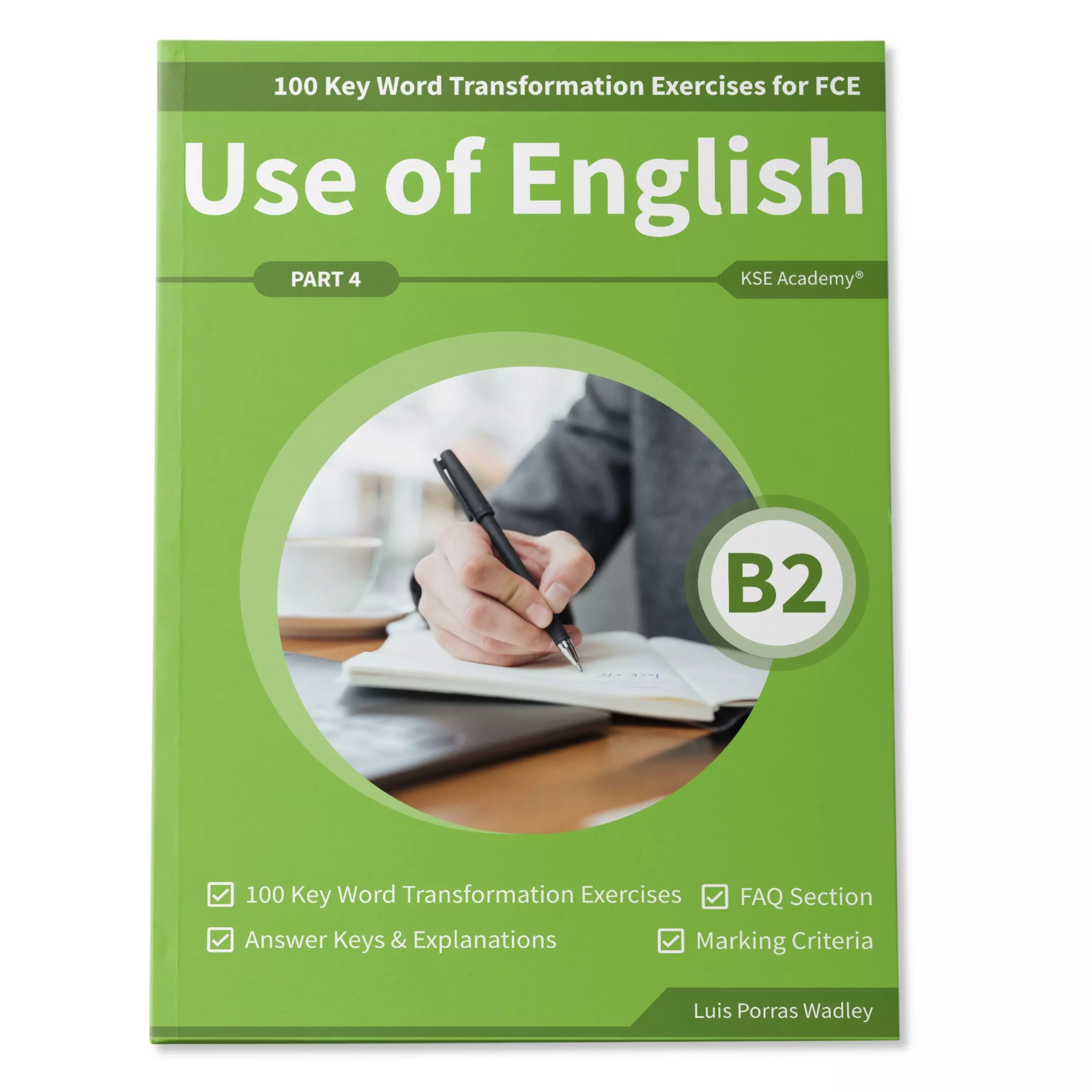
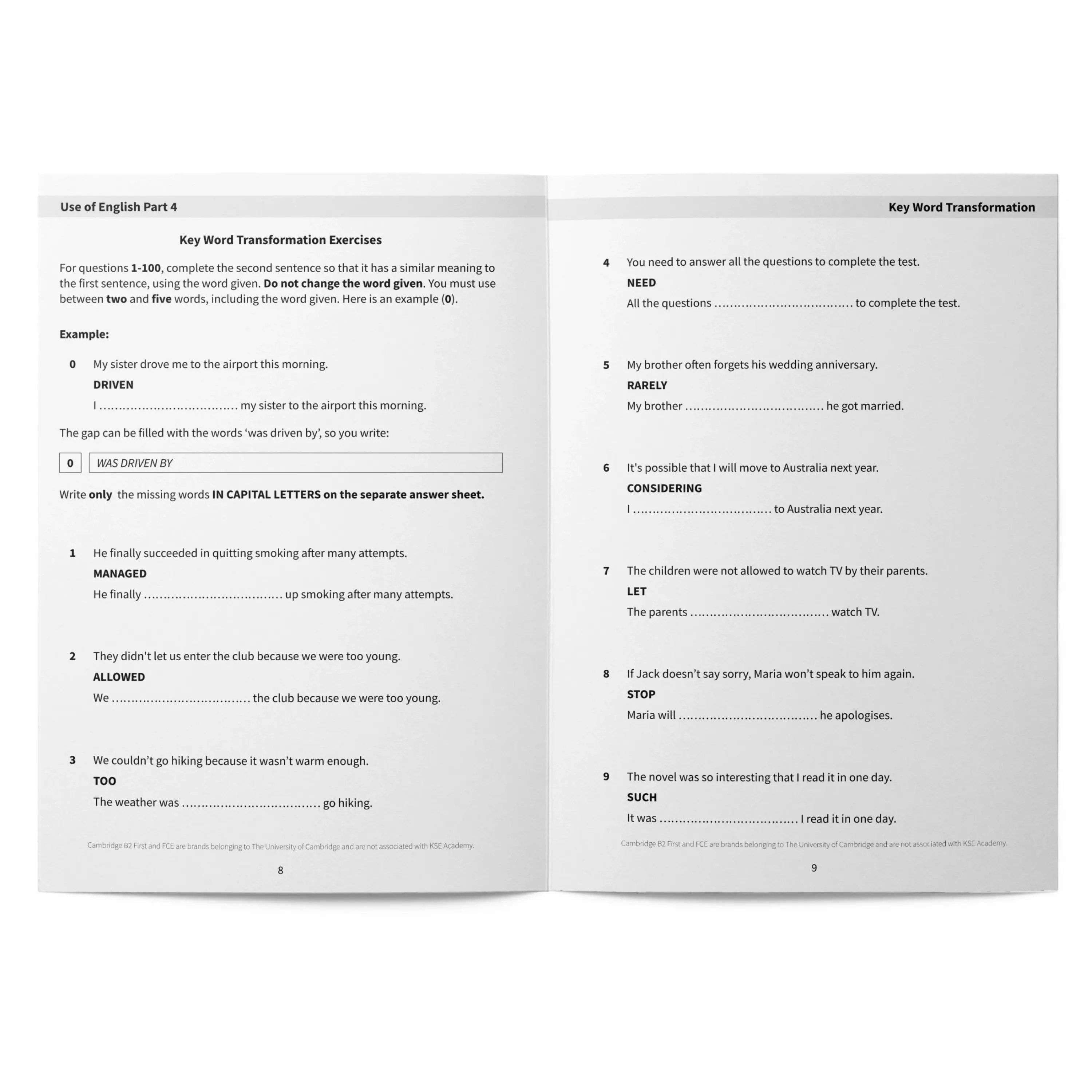
Si quieres entrenar esta parte a fondo, tengo un libro dedicado exclusivamente a ella: Use of English B2 Part 4: 100 Key Word Transformation Sentences. Son 100 ejercicios con el mismo formato que el examen, con la clave y una explicación de cada respuesta, un apartado sobre cómo se corrige esta parte (con las dos mitades) y las preguntas frecuentes sobre el key word transformation.
Preguntas frecuentes sobre la Parte 4 del B2 Use of English
¿Cuántas preguntas tiene la Parte 4 del Use of English del B2 First?
Seis preguntas (numeradas del 25 al 30), más un ejemplo resuelto al principio.
¿Cuánto vale cada pregunta?
Dos puntos: Cambridge divide cada respuesta en dos partes y da un punto por cada una que esté bien. En total, la Parte 4 suma 12 puntos.
¿Las contracciones cuentan como una o dos palabras?
Como dos. Doesn’t cuenta como does not y I’d como I would. La única excepción es can’t, que es la contracción de cannot y cuenta como una sola palabra.
¿Puedo cambiar la forma de la palabra clave?
No. Tienes que usarla exactamente como aparece: si la cambias o no la usas, la respuesta no puntúa.
¿Puede haber más de una respuesta correcta?
Sí. La clave oficial suele admitir variantes, como en la pregunta 28 del examen que hemos resuelto (spent, took o was a long time). Pero escribe solo una.
¿Restan puntos las respuestas incorrectas?
No hay penalización en el B2 First, y además aquí puedes conseguir un punto con media respuesta. Nunca la dejes en blanco.
Sigue preparando el Use of English del B2
Con esta guía cerramos la serie sobre el Use of English del B2 First. Si te falta alguna, tienes las guías del Use of English Part 1, del Use of English Part 2 y del word formation de la Parte 3. También puedes volver a la página principal del B2 First para ver el examen completo.
¿Te ha resultado útil esta guía? Compártela con otros estudiantes y profesores que estén preparando el FCE. Y si te queda alguna duda con alguna transformación, déjamela en los comentarios, que las leo todas.
Nos vemos en la próxima guía. Hasta entonces, don’t forget to keep smiling! 🙂
