
Tabla de contenidos
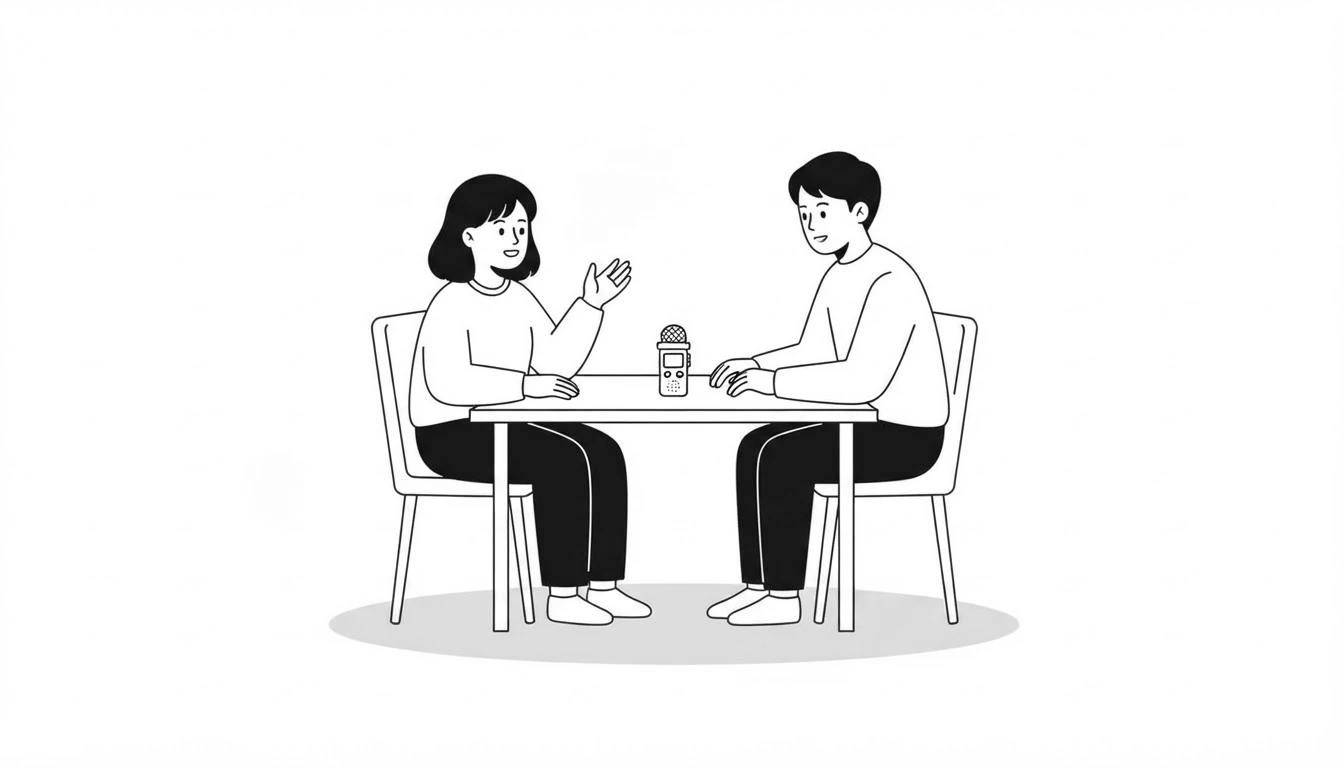
El Speaking del B2 Communicator de LanguageCert tiene algo que lo hace muy distinto del de Cambridge: lo haces tú solo con un interlocutor, sin compañero, y a quien de verdad tienes que convencer no está en la sala, porque el examen se graba y lo corrige otra persona después. Eso tiene sus ventajas (nadie te quita el turno) y también algún que otro inconveniente (no puedes esconderte detrás de nadie).
Desde mi experiencia como preparador de exámenes, el Speaking es la parte en la que más se nota haber practicado el formato. Por eso, en esta guía te explico cómo es el Speaking del B2 Communicator, qué tienes que hacer en cada una de sus cuatro partes, cómo se corrige y, lo más importante, te enseño un ejemplo de cada parte con una respuesta modelo de nivel B2 y un breve análisis. ¡Vamos allá!
Speaking B2 Communicator: qué es el nivel B2
El B2 Communicator certifica un nivel B2 del Marco Común Europeo de Referencia para las Lenguas (MCER), lo que se conoce como un nivel intermedio alto. En lo que a expresión oral se refiere, el MCER dice que un hablante de B2:
Participa en una conversación con un grado de fluidez y espontaneidad que hace posible la comunicación normal con hablantes nativos, y presenta descripciones claras y detalladas sobre una amplia serie de temas relacionados con su especialidad, explicando su punto de vista y las ventajas y desventajas de varias opciones.
Traducido al examen, en el Speaking del B2 Communicator tienes que ser capaz de:
- Hablar de ti y de tus experiencias, y dar tu opinión con motivos y ejemplos.
- Desenvolverte en situaciones cotidianas: pedir, ofrecer, disculparte, aconsejar, quejarte con educación…
- Negociar con otra persona hasta llegar a un acuerdo o a una decisión.
- Hablar durante dos minutos seguidos sobre un tema, narrando, describiendo y opinando de forma organizada.
No se espera que hables como un nativo ni que no cometas errores, sino que te comuniques con fluidez, con un vocabulario variado y sin que los errores impidan entender lo que dices.
Cómo es el Speaking del B2 Communicator
El Speaking es el Spoken Exam del B2 Communicator y es un examen independiente del Written Exam (Listening, Reading y Writing), así que puedes hacerlo otro día. Estas son sus características principales:
- Es individual: estáis tú y un interlocutor, sin compañero.
- Dura 13 minutos y tiene cuatro partes.
- Puedes hacerlo en un centro, cara a cara, o online desde casa. En los dos casos, el interlocutor está contigo en directo.
- Se graba, y no te evalúa el interlocutor, sino un examinador de LanguageCert que escucha la grabación después.
- En algunas partes el interlocutor interpreta un papel (tu amigo, tu compañero de trabajo…), pero tú nunca tienes que hacer de otra persona: siempre hablas como tú mismo.
| Parte | Duración | Qué tienes que hacer |
|---|---|---|
| Part 1 | 3 minutos | Deletrear tu apellido, decir de dónde eres y responder hasta 5 preguntas sobre ti y tus opiniones. |
| Part 2 | 3 minutos | Dos role plays breves: en uno empieza el interlocutor y en el otro empiezas tú. |
| Part 3 | 3 minutos | Tras 20 segundos para pensar, hablar con el interlocutor para hacer un plan y tomar decisiones juntos. |
| Part 4 | 4 minutos | Tras 30 segundos para tomar notas, hablar 2 minutos sobre un tema y responder preguntas de seguimiento. |
Las cuatro partes del Speaking B2 Communicator
Part 1
Es la parte para romper el hielo. El interlocutor te pide que deletrees tu apellido y te pregunta de dónde eres. Después te hace hasta cinco preguntas, cada una de un tema distinto (la comida, el lugar donde vives, la tecnología…). No son preguntas de sí o no: en B2 se espera que des tu opinión y la justifiques en dos o tres frases.
Part 2
Aquí se trata de demostrar que te desenvuelves en situaciones de la vida real. El interlocutor te plantea al menos dos situaciones:
- En la primera, empieza él («We’re friends. I start.») y tú respondes.
- En la segunda, empiezas tú («You start.»), así que eres tú quien tiene que abrir la conversación.
Cada situación dura unos dos turnos por persona y, si sobra tiempo, puede haber una tercera. Lo que se evalúa es que uses el lenguaje funcional adecuado: disculparte, aconsejar, sugerir, pedir un favor…
Part 3
Es una pequeña negociación. El interlocutor te da una hoja con unas ideas para organizar algo (una fiesta, una excursión, un evento…), y él tiene otras ideas distintas. Tienes 20 segundos para pensar y después tenéis que hablar hasta poneros de acuerdo y tomar decisiones. Importa más cómo negocias (proponer, rebatir, ceder, resumir) que llegar a un acuerdo sobre todo en el tiempo que tienes.
Part 4
Es tu turno largo. El interlocutor elige uno de tres temas y te da papel y bolígrafo para que tomes notas durante 30 segundos. Después tienes que hablar dos minutos sin ayuda y, al terminar, responder a algunas preguntas de seguimiento (follow-up questions) sobre el mismo tema.
Ejemplos de Speaking B2 Communicator
Ahora vamos a lo práctico. Te enseño una tarea de cada parte, escrita por mí siguiendo el formato del examen, con una respuesta modelo de nivel B2 y un análisis de por qué funciona. Ten en cuenta que en el examen real hablarás, así que no se trata de memorizar estas respuestas, sino de fijarte en cómo están construidas.
Ejemplo de Speaking B2 Communicator: Part 1
Estas serían las preguntas de la Part 1:
Part 1. The interlocutor asks you to spell your surname and says Where are you from? Then you’ll be asked up to five questions on different topics, for example:
- Food and cooking: Do you enjoy cooking? Why? / Why not?
- Your neighbourhood: What do you like most about the area where you live?
- The weather: How does the weather affect your mood?
- Shopping: Do you prefer shopping online or in shops? Why?
- Technology: Which piece of technology couldn’t you live without?
Y así podría responderlas un candidato de nivel B2:
Interlocutor: Do you enjoy cooking? Why? Why not?
Candidate: Yes, I do, although I don’t have much time for it during the week. At the weekend I like trying new recipes, especially Asian dishes, because they’re completely different from the food I grew up with.
Interlocutor: What do you like most about the area where you live?
Candidate: Probably the fact that everything is within walking distance. There’s a market, a couple of cafés and a big park just round the corner, so I hardly ever need to take the car.
Interlocutor: How does the weather affect your mood?
Candidate: Quite a lot, to be honest. When it’s sunny I feel full of energy, but after a few grey, rainy days I tend to get a bit lazy and I just want to stay at home watching series.
Interlocutor: Do you prefer shopping online or in shops? Why?
Candidate: It depends on what I’m buying. For books or electronics I usually order online because it’s quicker and often cheaper. But when it comes to clothes, I’d rather go to a shop and try things on first.
Interlocutor: Which piece of technology couldn’t you live without?
Candidate: My phone, definitely. I use it for almost everything: work, music, maps, paying for things… I know I should use it less, but I honestly can’t imagine my day without it.
Por qué funciona:
Por qué funciona:
Por qué funciona:
Por qué funciona:
- Respuestas de dos o tres frases: ni un «yes» seco ni un monólogo de un minuto.
- Siempre hay un motivo o un ejemplo: because they’re completely different…, so I hardly ever need to take the car.
- Vocabulario de B2 sin forzar: within walking distance, tend to, I’d rather, when it comes to.
Expresiones útiles: It depends on…, To be honest…, When it comes to…, I’d rather…, Probably the fact that…
Ejemplo de Speaking B2 Communicator: Part 2
En la primera situación empieza el interlocutor:
Part 2, first situation. We’re friends. I start.
I’m thinking of buying a second-hand car. Do you think it’s a good idea?
Interlocutor: I’m thinking of buying a second-hand car. Do you think it’s a good idea?
Candidate: It could be, yes. Second-hand cars are much cheaper, and a new one loses a lot of value in the first couple of years. But have you thought about where you’re going to buy it?
Interlocutor: Well, I’ve seen one on a website and the price is really good.
Candidate: Then I’d be careful. If it’s a private seller, I’d ask a mechanic to have a look at it before you pay anything. And make sure you see all the documents, just in case it’s had any serious problems.
En la segunda, eres tú quien tiene que empezar:
Part 2, second situation. We’re friends. You borrowed my laptop last weekend and now it won’t switch on. You start.
Candidate: Hi, Laura. Listen, I’m really sorry, but I’ve got some bad news about your laptop. I was using it last night and suddenly it switched off, and now it won’t switch on again.
Interlocutor: Oh no! Did you drop it or spill something on it?
Candidate: No, I promise I didn’t. I was just writing an email. Anyway, it’s my responsibility, so I’ll take it to the repair shop near my house tomorrow morning and I’ll pay for whatever needs fixing.
Interlocutor: But I need it for work on Monday.
Candidate: Don’t worry. If it isn’t ready by then, you can use mine until yours is fixed. I really hope it’s nothing serious.
- En la primera situación, da su opinión y un consejo concreto, y además hace una pregunta para que la conversación siga.
- En la segunda, abre la conversación con naturalidad (Listen, I’m really sorry, but…), se disculpa, propone una solución y la amplía cuando el interlocutor pone un problema.
- El tono es el de dos amigos: cercano, pero educado.
Expresiones útiles: Have you thought about…?, If I were you, I’d…, Just in case…, I’m really sorry, but…, Don’t worry, I’ll…
Ejemplo de Speaking B2 Communicator: Part 3
En la Part 3, el candidato recibe una hoja con sus ideas, y el interlocutor tiene las suyas. Aquí te pongo las dos juntas para que veas la diferencia:
Part 3. We’re organising an end-of-course party for our English class. This sheet has your suggestions, and mine are different, so we need to agree on what to do. You have twenty seconds to prepare before we begin.
| End-of-course party | Your ideas | The interlocutor’s ideas |
|---|---|---|
| Day | Last Friday of the course | The Saturday after the course |
| Place | The school garden | A restaurant in town |
| Food | Everyone brings something | A set menu |
| Music | A playlist | Karaoke |
| Present for the teacher | A book | Flowers |
| Budget | €5 each | €25 each |
Candidate: OK, so let’s start with the day. I think the last Friday of the course would be best, because everyone will still be in town. What do you think?
Interlocutor: Hmm, I’d prefer the Saturday after the course. On a Friday some people finish work late.
Candidate: That’s a good point. But some of our classmates are going on holiday as soon as the course ends. Maybe Friday evening, after eight? That way people have time to get there after work.
Interlocutor: OK, Friday at eight sounds fine. And where shall we have it? I thought a restaurant in town would be nice.
Candidate: It would be nice, but I’m worried about the price. Twenty-five euros each is quite a lot for some students. Why don’t we have it in the school garden? It’s free, and if everyone brings something to eat, it’ll only cost about five euros each.
Interlocutor: But what if it rains?
Candidate: Fair enough. We could ask the school if we can use the big classroom on the ground floor in case of bad weather. So, the school, with food that everyone brings. What about music?
Interlocutor: I suggested karaoke. It’s always fun at parties.
Candidate: Actually, that’s a great idea, and we could combine it with my playlist for the rest of the evening. And for the teacher’s present, I think a book is more personal than flowers, because it lasts longer.
Interlocutor: All right, a book, then. So we’ve decided almost everything.
Candidate: Yes: Friday at eight, at school, food from home, karaoke and a playlist, and a book for the teacher, all for about five euros each. Perfect.
- Empieza el candidato y propone, en lugar de esperar a que el interlocutor tire de la conversación.
- Rebate con educación (That’s a good point. But…) y cede cuando tiene sentido, como con el karaoke.
- Justifica cada propuesta con un motivo: el precio, el tiempo, que dure más…
- Termina resumiendo lo que han decidido, que es una forma muy natural de cerrar la tarea.
Expresiones útiles: What do you think?, That’s a good point, but…, Why don’t we…?, Fair enough., We could…, So, we’ve decided…
Ejemplo de Speaking B2 Communicator: Part 4
Estos serían los tres temas de la Part 4:
Part 4. Now it’s your long turn. The interlocutor picks one of these topics and hands you paper and a pen, and you get thirty seconds to jot down some notes:
- A Working from home
- B A skill you would like to learn
- C Sport at school
Talk for two minutes. Then answer the interlocutor’s follow-up questions.
Supongamos que te toca el tema B. Así podrían ser las notas y la charla de un candidato de nivel B2, con las preguntas de seguimiento al final:
Notes (30 seconds): guitar / why: music, friends, relax / how: online lessons + teacher / problem: time, patience / goal: play at a party
Candidate: The skill I’d really like to learn is how to play the guitar. I’ve always loved music, and whenever I’m with friends and someone starts playing, I wish I could join in.
Candidate: There are a few reasons why I’d like to learn it. First of all, I think it would be a great way to relax after work. Most of my day I’m sitting in front of a screen, so doing something creative with my hands would be a nice change. Secondly, it’s something you can share with other people. A guitar is easy to carry, so you can take it to the beach, to a party or on holiday.
Candidate: As for how I’d learn, I think I’d combine two things. There are lots of free video lessons online, which are great for the basics, but I’d also like to have a teacher, at least at the beginning, so that someone can correct my mistakes before they become bad habits.
Candidate: The main problem, to be honest, is time. Between work and everything else, I’m not sure how many hours a week I could spend practising, and I know that you need a lot of patience at the start, when your fingers hurt and nothing sounds right. Even so, I think twenty minutes a day would be enough to make progress.
Candidate: My goal would be quite simple: to be able to play a few songs well enough to play them at a party with my friends. If I managed that within a year, I’d be really happy.
Interlocutor: Thank you. Do you think it’s easier to learn a skill like this as a child or as an adult?
Candidate: In some ways it’s easier as a child, because children learn quickly and they aren’t afraid of making mistakes. But adults are usually more motivated, because they’ve chosen to do it, so I think it’s never too late.
Interlocutor: Should schools spend more time teaching practical skills?
Candidate: I think so, yes. Things like cooking, managing money or playing an instrument are really useful in life, and they could make school more interesting for a lot of students.
- Las notas son palabras sueltas, no frases: en 30 segundos no da tiempo a más, y sirven de guion.
- La charla tiene una estructura clara: qué habilidad, por qué, cómo la aprendería, qué problemas hay y cuál sería el objetivo.
- Usa conectores de B2 para ordenar las ideas: First of all, Secondly, As for, Even so.
- En las preguntas de seguimiento, responde con una opinión matizada en dos o tres frases.
Expresiones útiles: The … I’d really like to… is…, There are a few reasons why…, As for…, The main problem, to be honest, is…, In some ways…, but…
Vídeos de ejemplo del Speaking B2 Communicator
LanguageCert publica algunos exámenes de Speaking reales, grabados con candidatos, junto con la nota que les puso el examinador. Merece mucho la pena verlos para hacerte una idea del ritmo del examen.
En el primero, Gogo obtiene un Pass: 7 de 12 puntos, que equivalen a 30 de 50. Cumple las tareas sin demasiada dificultad y se le entiende bien, pero su gramática se queda corta para el nivel, con errores frecuentes. El vocabulario, la pronunciación y la fluidez son suficientes, aunque duda bastante.
En el segundo, Hanna obtiene un High Pass: 10 de 12 puntos, que equivalen a 42 de 50. Resuelve las tareas con soltura y seguridad, organiza muy bien lo que dice, tiene una pronunciación clara y natural y habla con fluidez. Sus pocos errores de gramática y vocabulario no dificultan la comunicación.
Comparar los dos vídeos es muy útil: la diferencia entre un Pass y un High Pass no está en no cometer ningún error, sino en la soltura, la variedad y la organización.
Cómo se evalúa el Speaking del B2 Communicator
El examinador escucha la grabación y te puntúa en cuatro criterios, cada uno de 0 a 3 puntos, teniendo en cuenta tu actuación en todo el examen:
| Criterio | Qué se valora |
|---|---|
| Task Fulfilment and Coherence | Si haces lo que pide cada tarea, si tus intervenciones son relevantes y si tu discurso está bien organizado. |
| Accuracy and Range of Grammar | Si usas una buena variedad de estructuras de B2 con suficiente corrección. |
| Accuracy and Range of Vocabulary | Si tu vocabulario es variado y adecuado, y si los errores dificultan la comunicación. |
| Pronunciation, Intonation and Fluency | Si se te entiende con facilidad y si mantienes el ritmo sin demasiadas pausas. |
Así que la nota máxima es de 12 puntos, que luego se convierten a una puntuación sobre 50. Para aprobar necesitas 25 sobre 50 (Pass), y a partir de 38 sobre 50 obtienes un High Pass. Como ves en los vídeos, con un 2 en todos los criterios ya estás aprobando con cierto margen.
Consejos para el Speaking del B2 Communicator
Estos son los consejos que doy a mis alumnos para el Speaking del B2 Communicator:
- Amplía siempre tus respuestas. Responde y añade un motivo o un ejemplo. Una respuesta de una palabra no le da al examinador nada que evaluar.
- Practica el formato con el reloj. Dos minutos hablando solo se hacen largos si no lo has practicado. Grábate y escúchate.
- Usa bien los 30 segundos de la Part 4. Apunta cuatro o cinco palabras clave, una por idea, y síguelas en orden.
- En la Part 3, negocia de verdad. No te limites a leer tu hoja: propón, pregunta, rebate y cede cuando tenga sentido.
- No te preocupes por el interlocutor. No es quien te evalúa, así que no intentes leer su cara. Habla para la grabación.
- Si no sabes una palabra, explícala. Parafrasear (the thing you use to…) demuestra recursos y mantiene la fluidez.
- Si haces el examen online, prepara el equipo. Comprueba la conexión, el micrófono y la cámara antes de empezar, y busca un sitio sin ruido.
Si dudas entre exámenes, también tienes mi guía del Speaking del B2 First de Cambridge, para que compares los dos formatos. Y para ver el examen completo, aquí tienes la guía del LanguageCert B2 Communicator.
Y para el Writing del B2 Communicator…
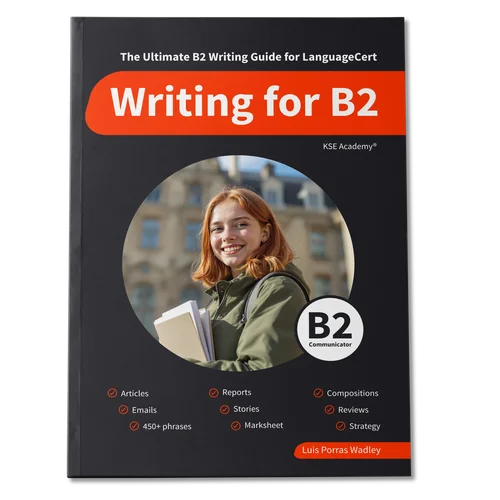
Para el Speaking no hay nada como practicar en voz alta, pero si también te estás preparando la parte escrita del examen, tienes mi guía del Writing del B2 Communicator y el libro de KSE Academy para el Writing B2 de LanguageCert, con todos los tipos de tarea, respuestas modelo y expresiones útiles. Te servirá también para el Speaking, porque gran parte del vocabulario y de los conectores de B2 son los mismos.
Y con esto ya tienes todo lo que necesitas saber del Speaking del B2 Communicator. Si te queda alguna duda, déjame un comentario y te respondo encantado. 🙂
