
Table of contents
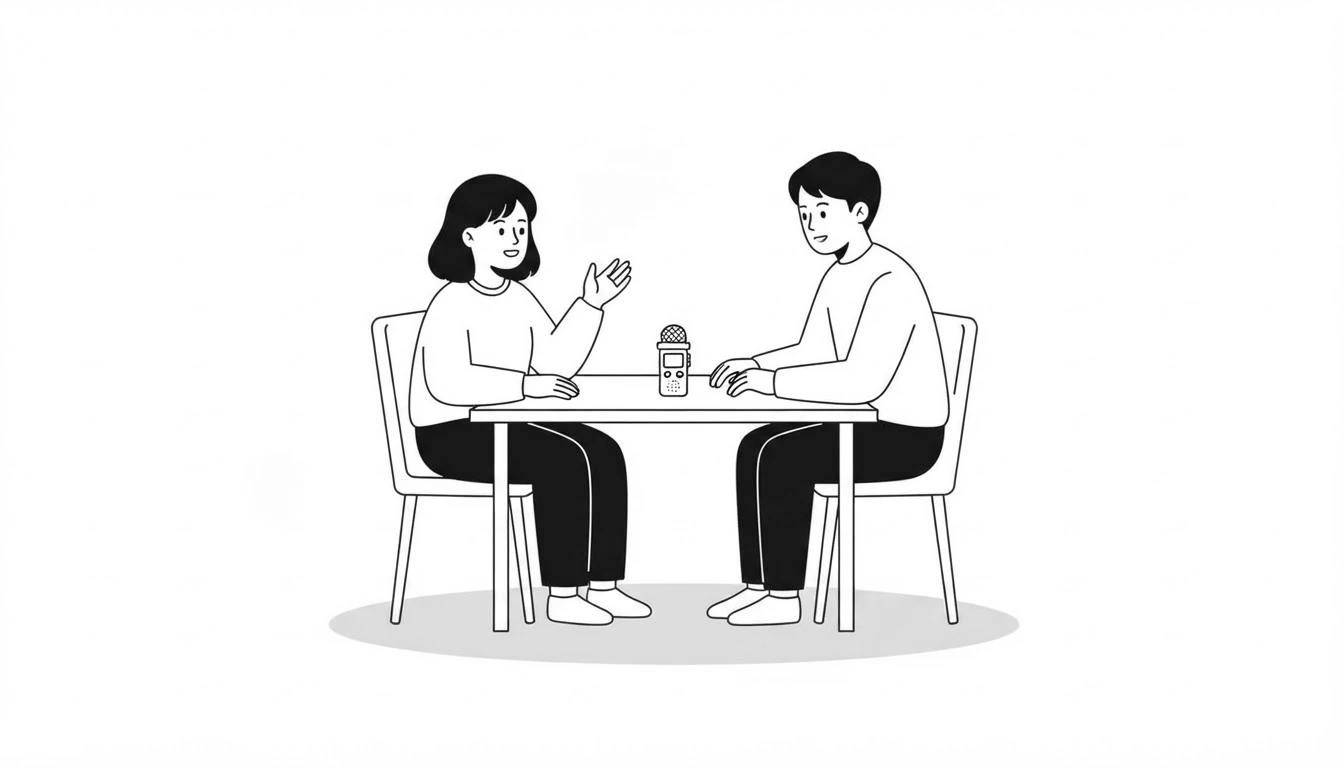
The LanguageCert B2 Communicator Speaking exam has one thing that makes it very different from Cambridge: you take it on your own with an interlocutor, with no partner, and the person you really need to impress isn’t even in the room, because the exam is recorded and marked by someone else afterwards. That has its advantages (nobody steals your turn) and a few drawbacks (there’s no one to hide behind).
In my experience as an exam trainer, Speaking is the part where practising the format makes the biggest difference. So in this guide I’ll explain how B2 Communicator Speaking works, what you have to do in each of its four parts, how it’s marked and, most importantly, I’ll show you an example of every part with a B2 model answer and a short analysis. Let’s get started!
B2 Communicator Speaking: what B2 level means
The B2 Communicator certifies a B2 level on the Common European Framework of Reference for Languages (CEFR), known as upper intermediate. As far as speaking is concerned, the CEFR says a B2 speaker:
Can interact with a degree of fluency and spontaneity that makes regular interaction with native speakers quite possible, and can present clear, detailed descriptions on a wide range of subjects, explaining a viewpoint and giving the advantages and disadvantages of various options.
In exam terms, in B2 Communicator Speaking you need to be able to:
- Talk about yourself and your experiences, and give your opinion with reasons and examples.
- Deal with everyday situations: asking, offering, apologising, giving advice, complaining politely…
- Negotiate with someone until you reach an agreement or a decision.
- Talk for two minutes on a topic, narrating, describing and giving opinions in an organised way.
You aren’t expected to sound like a native speaker or to make no mistakes, but to communicate fluently, with a varied vocabulary and without your errors getting in the way of what you mean.
What B2 Communicator Speaking is like
Speaking is the Spoken Exam of the B2 Communicator. It’s separate from the Written Exam (Listening, Reading and Writing), so you can take it on a different day. These are its main features:
- It’s one to one: just you and an interlocutor, with no partner.
- It lasts 13 minutes and has four parts.
- You can take it at a centre, face to face, or online from home. Either way, the interlocutor is with you live.
- It’s recorded, and you aren’t marked by the interlocutor but by a LanguageCert examiner who listens to the recording afterwards.
- In some parts the interlocutor plays a role (your friend, your colleague…), but you never have to play anyone else: you always speak as yourself.
| Part | Time | What you have to do |
|---|---|---|
| Part 1 | 3 minutes | Spell your surname, say where you’re from and answer up to 5 questions about yourself and your opinions. |
| Part 2 | 3 minutes | Two short role plays: the interlocutor starts one and you start the other. |
| Part 3 | 3 minutes | After 20 seconds to think, talk with the interlocutor to make a plan and decide things together. |
| Part 4 | 4 minutes | After 30 seconds to make notes, talk for 2 minutes on a topic and answer follow-up questions. |
The four parts of B2 Communicator Speaking
Part 1
This is the warm-up. The interlocutor asks you to spell your surname and asks where you’re from. Then he or she asks up to five questions, each on a different topic (food, where you live, technology…). They aren’t yes or no questions: at B2 you’re expected to give your opinion and back it up in two or three sentences.
Part 2
This part is about showing you can handle real-life situations. The interlocutor sets up at least two situations:
- In the first, the interlocutor starts («We’re friends. I start.») and you respond.
- In the second, you start («You start.»), so you’re the one who has to open the conversation.
Each situation lasts about two turns each and, if there’s time, there may be a third. What’s assessed is whether you use the right functional language: apologising, advising, suggesting, asking for a favour…
Part 3
This is a short negotiation. The interlocutor gives you a sheet with some ideas for organising something (a party, a trip, an event…), and he or she has different ideas. You get 20 seconds to think and then you talk until you reach an agreement and make some decisions. How you negotiate (suggesting, disagreeing, giving in, summarising) matters more than agreeing on everything in the time you have.
Part 4
This is your long turn. The interlocutor chooses one of three topics and gives you paper and a pen to make notes for 30 seconds. Then you talk for two minutes on your own and, when you finish, you answer some follow-up questions on the same topic.
B2 Communicator Speaking examples
Now for the practical part. Here’s a task for every part, written by me in the exam format, with a B2 model answer and an analysis of why it works. Remember that in the real exam you’ll be speaking, so the point isn’t to memorise these answers but to notice how they’re built.
B2 Communicator Speaking example: Part 1
These would be the Part 1 questions:
Part 1. The interlocutor asks you to spell your surname and says Where are you from? Then you’ll be asked up to five questions on different topics, for example:
- Food and cooking: Do you enjoy cooking? Why? / Why not?
- Your neighbourhood: What do you like most about the area where you live?
- The weather: How does the weather affect your mood?
- Shopping: Do you prefer shopping online or in shops? Why?
- Technology: Which piece of technology couldn’t you live without?
And this is how a B2 candidate might answer them:
Interlocutor: Do you enjoy cooking? Why? Why not?
Candidate: Yes, I do, although I don’t have much time for it during the week. At the weekend I like trying new recipes, especially Asian dishes, because they’re completely different from the food I grew up with.
Interlocutor: What do you like most about the area where you live?
Candidate: Probably the fact that everything is within walking distance. There’s a market, a couple of cafés and a big park just round the corner, so I hardly ever need to take the car.
Interlocutor: How does the weather affect your mood?
Candidate: Quite a lot, to be honest. When it’s sunny I feel full of energy, but after a few grey, rainy days I tend to get a bit lazy and I just want to stay at home watching series.
Interlocutor: Do you prefer shopping online or in shops? Why?
Candidate: It depends on what I’m buying. For books or electronics I usually order online because it’s quicker and often cheaper. But when it comes to clothes, I’d rather go to a shop and try things on first.
Interlocutor: Which piece of technology couldn’t you live without?
Candidate: My phone, definitely. I use it for almost everything: work, music, maps, paying for things… I know I should use it less, but I honestly can’t imagine my day without it.
Why it works:
Why it works:
Why it works:
Why it works:
- Answers of two or three sentences: neither a bare «yes» nor a one-minute speech.
- There’s always a reason or an example: because they’re completely different…, so I hardly ever need to take the car.
- B2 vocabulary used naturally: within walking distance, tend to, I’d rather, when it comes to.
Useful expressions: It depends on…, To be honest…, When it comes to…, I’d rather…, Probably the fact that…
B2 Communicator Speaking example: Part 2
In the first situation, the interlocutor starts:
Part 2, first situation. We’re friends. I start.
I’m thinking of buying a second-hand car. Do you think it’s a good idea?
Interlocutor: I’m thinking of buying a second-hand car. Do you think it’s a good idea?
Candidate: It could be, yes. Second-hand cars are much cheaper, and a new one loses a lot of value in the first couple of years. But have you thought about where you’re going to buy it?
Interlocutor: Well, I’ve seen one on a website and the price is really good.
Candidate: Then I’d be careful. If it’s a private seller, I’d ask a mechanic to have a look at it before you pay anything. And make sure you see all the documents, just in case it’s had any serious problems.
In the second, you’re the one who has to start:
Part 2, second situation. We’re friends. You borrowed my laptop last weekend and now it won’t switch on. You start.
Candidate: Hi, Laura. Listen, I’m really sorry, but I’ve got some bad news about your laptop. I was using it last night and suddenly it switched off, and now it won’t switch on again.
Interlocutor: Oh no! Did you drop it or spill something on it?
Candidate: No, I promise I didn’t. I was just writing an email. Anyway, it’s my responsibility, so I’ll take it to the repair shop near my house tomorrow morning and I’ll pay for whatever needs fixing.
Interlocutor: But I need it for work on Monday.
Candidate: Don’t worry. If it isn’t ready by then, you can use mine until yours is fixed. I really hope it’s nothing serious.
- In the first situation, the candidate gives an opinion and a concrete piece of advice, and asks a question to keep the conversation going.
- In the second, the candidate opens the conversation naturally (Listen, I’m really sorry, but…), apologises, offers a solution and builds on it when the interlocutor raises a problem.
- The tone is that of two friends: warm, but polite.
Useful expressions: Have you thought about…?, If I were you, I’d…, Just in case…, I’m really sorry, but…, Don’t worry, I’ll…
B2 Communicator Speaking example: Part 3
In Part 3 the candidate gets a sheet with his or her ideas, and the interlocutor has different ones. Here are both together so you can see the difference:
Part 3. We’re organising an end-of-course party for our English class. This sheet has your suggestions, and mine are different, so we need to agree on what to do. You have twenty seconds to prepare before we begin.
| End-of-course party | Your ideas | The interlocutor’s ideas |
|---|---|---|
| Day | Last Friday of the course | The Saturday after the course |
| Place | The school garden | A restaurant in town |
| Food | Everyone brings something | A set menu |
| Music | A playlist | Karaoke |
| Present for the teacher | A book | Flowers |
| Budget | €5 each | €25 each |
Candidate: OK, so let’s start with the day. I think the last Friday of the course would be best, because everyone will still be in town. What do you think?
Interlocutor: Hmm, I’d prefer the Saturday after the course. On a Friday some people finish work late.
Candidate: That’s a good point. But some of our classmates are going on holiday as soon as the course ends. Maybe Friday evening, after eight? That way people have time to get there after work.
Interlocutor: OK, Friday at eight sounds fine. And where shall we have it? I thought a restaurant in town would be nice.
Candidate: It would be nice, but I’m worried about the price. Twenty-five euros each is quite a lot for some students. Why don’t we have it in the school garden? It’s free, and if everyone brings something to eat, it’ll only cost about five euros each.
Interlocutor: But what if it rains?
Candidate: Fair enough. We could ask the school if we can use the big classroom on the ground floor in case of bad weather. So, the school, with food that everyone brings. What about music?
Interlocutor: I suggested karaoke. It’s always fun at parties.
Candidate: Actually, that’s a great idea, and we could combine it with my playlist for the rest of the evening. And for the teacher’s present, I think a book is more personal than flowers, because it lasts longer.
Interlocutor: All right, a book, then. So we’ve decided almost everything.
Candidate: Yes: Friday at eight, at school, food from home, karaoke and a playlist, and a book for the teacher, all for about five euros each. Perfect.
- The candidate starts and makes suggestions, instead of waiting for the interlocutor to drive the conversation.
- The candidate disagrees politely (That’s a good point. But…) and gives in when it makes sense, as with the karaoke.
- Every suggestion has a reason: the price, the time, lasting longer…
- The candidate finishes by summarising what they’ve decided, which is a very natural way to round off the task.
Useful expressions: What do you think?, That’s a good point, but…, Why don’t we…?, Fair enough., We could…, So, we’ve decided…
B2 Communicator Speaking example: Part 4
These would be the three Part 4 topics:
Part 4. Now it’s your long turn. The interlocutor picks one of these topics and hands you paper and a pen, and you get thirty seconds to jot down some notes:
- A Working from home
- B A skill you would like to learn
- C Sport at school
Talk for two minutes. Then answer the interlocutor’s follow-up questions.
Let’s say you get topic B. This is what a B2 candidate’s notes and talk might look like, with the follow-up questions at the end:
Notes (30 seconds): guitar / why: music, friends, relax / how: online lessons + teacher / problem: time, patience / goal: play at a party
Candidate: The skill I’d really like to learn is how to play the guitar. I’ve always loved music, and whenever I’m with friends and someone starts playing, I wish I could join in.
Candidate: There are a few reasons why I’d like to learn it. First of all, I think it would be a great way to relax after work. Most of my day I’m sitting in front of a screen, so doing something creative with my hands would be a nice change. Secondly, it’s something you can share with other people. A guitar is easy to carry, so you can take it to the beach, to a party or on holiday.
Candidate: As for how I’d learn, I think I’d combine two things. There are lots of free video lessons online, which are great for the basics, but I’d also like to have a teacher, at least at the beginning, so that someone can correct my mistakes before they become bad habits.
Candidate: The main problem, to be honest, is time. Between work and everything else, I’m not sure how many hours a week I could spend practising, and I know that you need a lot of patience at the start, when your fingers hurt and nothing sounds right. Even so, I think twenty minutes a day would be enough to make progress.
Candidate: My goal would be quite simple: to be able to play a few songs well enough to play them at a party with my friends. If I managed that within a year, I’d be really happy.
Interlocutor: Thank you. Do you think it’s easier to learn a skill like this as a child or as an adult?
Candidate: In some ways it’s easier as a child, because children learn quickly and they aren’t afraid of making mistakes. But adults are usually more motivated, because they’ve chosen to do it, so I think it’s never too late.
Interlocutor: Should schools spend more time teaching practical skills?
Candidate: I think so, yes. Things like cooking, managing money or playing an instrument are really useful in life, and they could make school more interesting for a lot of students.
- The notes are single words, not sentences: there’s no time for more in 30 seconds, and they work as a plan.
- The talk has a clear structure: which skill, why, how to learn it, the problems and the goal.
- B2 linkers organise the ideas: First of all, Secondly, As for, Even so.
- In the follow-up questions, the candidate gives a balanced opinion in two or three sentences.
Useful expressions: The … I’d really like to… is…, There are a few reasons why…, As for…, The main problem, to be honest, is…, In some ways…, but…
B2 Communicator Speaking sample videos
LanguageCert publishes some real Speaking exams, recorded with candidates, together with the mark the examiner gave them. They’re well worth watching to get a feel for the pace of the exam.
In the first one, Gogo gets a Pass: 7 out of 12, which is 30 out of 50. The tasks are completed without much difficulty and the message comes across clearly, but the grammar falls short of the level, with frequent errors. Vocabulary, pronunciation and fluency are good enough, despite quite a lot of hesitation.
In the second, Hanna gets a High Pass: 10 out of 12, which is 42 out of 50. The tasks are handled with ease and confidence, everything is very well organised, pronunciation is clear and natural and the speech flows. The few grammar and vocabulary errors don’t get in the way of communication.
Comparing the two videos is very useful: the difference between a Pass and a High Pass isn’t making no mistakes at all, but ease, range and organisation.
How B2 Communicator Speaking is marked
The examiner listens to the recording and gives you a mark for four criteria, each from 0 to 3, based on your performance across the whole exam:
| Criterion | What is assessed |
|---|---|
| Task Fulfilment and Coherence | Whether you do what each task asks, whether your contributions are relevant and whether what you say is well organised. |
| Accuracy and Range of Grammar | Whether you use a good range of B2 structures accurately enough. |
| Accuracy and Range of Vocabulary | Whether your vocabulary is varied and appropriate, and whether errors get in the way of communication. |
| Pronunciation, Intonation and Fluency | Whether you’re easy to understand and keep going without too many pauses. |
So the maximum is 12 marks, which are then converted to a score out of 50. You need 25 out of 50 to pass (Pass), and from 38 out of 50 you get a High Pass. As the videos show, a 2 in every criterion already gives you a comfortable pass.
Tips for B2 Communicator Speaking
These are the tips I give my students for B2 Communicator Speaking:
- Always expand your answers. Answer, then add a reason or an example. A one-word answer gives the examiner nothing to assess.
- Practise the format against the clock. Two minutes talking on your own feels long if you haven’t practised it. Record yourself and listen back.
- Use the 30 seconds in Part 4 well. Jot down four or five key words, one per idea, and follow them in order.
- In Part 3, really negotiate. Don’t just read out your sheet: suggest, ask, disagree and give in when it makes sense.
- Don’t worry about the interlocutor. He or she isn’t marking you, so don’t try to read their face. Speak for the recording.
- If you don’t know a word, explain it. Paraphrasing (the thing you use to…) shows resourcefulness and keeps you fluent.
- If you take the exam online, check your equipment. Test your connection, microphone and camera beforehand and find a quiet place.
If you’re deciding between exams, have a look at my guide to Cambridge B2 First Speaking to compare the two formats. And to see the whole exam, here’s my guide to the LanguageCert B2 Communicator.
And for B2 Communicator Writing…
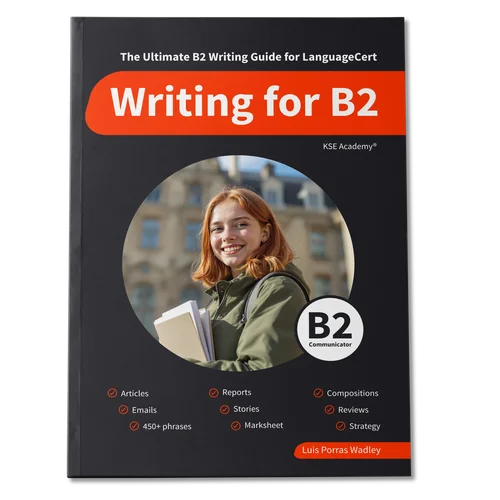
For Speaking there’s nothing like practising out loud, but if you’re also preparing the written part of the exam, there’s my guide to B2 Communicator Writing and the KSE Academy book for LanguageCert B2 Writing, with every task type, model answers and useful expressions. It’ll help with Speaking too, because much of the B2 vocabulary and linking language is the same.
And that’s everything you need to know about B2 Communicator Speaking. If you still have any questions, leave me a comment and I’ll be happy to help. 🙂
