

Table of contents
LanguageCert C2 Mastery Speaking is the longest and most demanding speaking exam in the series: it lasts 17 minutes, you take it on your own with an interlocutor and it ends with a three-minute long turn on an abstract topic. Communicating well isn’t enough here: you’re expected to argue with nuance, adapt your register to each situation and lead the conversation yourself.
In my experience as an exam trainer, what makes the difference at C2 isn’t rare vocabulary but the ability to organise complex ideas as you speak. That’s why in this guide I explain what C2 Mastery Speaking is like, what you have to do in each of its four parts, how it’s marked and, most importantly, I show you an example of every part with a C2 model answer and a short analysis. Let’s get started!
C2 Mastery Speaking: what C2 level means
C2 Mastery certifies C2 level on the Common European Framework of Reference for Languages (CEFR), the highest level on the scale. When it comes to conversation, the CEFR says a C2 speaker:
Can take part effortlessly in any conversation or discussion and has a good familiarity with idiomatic expressions and colloquialisms. Can express themselves fluently and convey finer shades of meaning precisely. If they do have a problem, they can backtrack and restructure around the difficulty so smoothly other people are hardly aware of it.
In exam terms, in C2 Mastery Speaking you need to be able to:
- Give well-developed opinions on current issues, acknowledging how complex they are.
- Handle delicate situations with the right tone and register: apologising sincerely, breaking bad news, negotiating tactfully…
- Discuss and prioritise options, justifying your position, challenging the interlocutor’s and qualifying your views when needed.
- Talk for three minutes without stopping on an abstract topic, with a clear structure and a conclusion.
What sets a C2 speaker apart isn’t making no mistakes at all, but the precision, naturalness and ease with which you handle complex ideas.
What C2 Mastery Speaking is like
Speaking is the Spoken Exam of C2 Mastery and it’s separate from the Written Exam (Listening, Reading and Writing), so you can take it on a different day. These are its main features:
- It’s one to one: just you and an interlocutor, with no partner.
- It lasts 17 minutes and has four parts.
- You can take it at a centre, face to face, or online from home. Either way, the interlocutor is with you live.
- It’s recorded, and you aren’t marked by the interlocutor but by a LanguageCert examiner who listens to the recording later.
- In Part 2 the interlocutor plays a role (your neighbour, your boss, an organiser…), but you never have to play anyone else: you always speak as yourself.
- At C2, the interlocutor lets you lead the conversation.
| Part | Time | What you have to do |
|---|---|---|
| Part 1 | 4 minutes | Spell your surname, say where you’re from and answer up to 5 opinion questions on current issues. |
| Part 2 | 4 minutes | Two role plays where tone and register count: in one the interlocutor starts and in the other you start. |
| Part 3 | 4 minutes | After 20 seconds to think, discuss a list of options with the interlocutor to rank or prioritise them. |
| Part 4 | 5 minutes | After 30 seconds to make notes, talk for 3 minutes on an abstract topic and answer follow-up questions. |
The four parts of C2 Mastery Speaking
Part 1
It starts as at every level: the interlocutor asks you to spell your surname and asks where you’re from. Then you’re asked up to five questions, each on a different topic, but at C2 they aren’t about your routine. They’re about current issues: education, technology, tourism… You’re expected to give a nuanced opinion, with arguments and an example, in three or four sentences.
Part 2
This part assesses how you deal with real situations that have some complexity. The interlocutor sets up at least two situations:
- In the first, the interlocutor starts («I start.») and you respond.
- In the second, you start («You start.»), so you’re the one who opens the conversation.
The exchanges are longer than at lower levels, and at C2 what makes the difference is register and tone: how much you soften a complaint, how you break bad news, how you suggest a solution without sounding either too blunt or too apologetic.
Part 3
This is a discussion or negotiation based on a written prompt, usually a list of options. You have 20 seconds to think, and then you rank them, prioritise them, rule some out or hypothesise. To do it well you need to justify your position, challenge the interlocutor’s, ask for clarification and, ideally, sum up what you’ve decided at the end.
Part 4
This is your long turn, and at C2 it really is long. The interlocutor chooses one of three topics, usually abstract ones, and gives you paper and a pen so you can make notes for 30 seconds. Then you talk for three minutes without help and, when you finish, answer a few follow-up questions.
C2 Mastery Speaking examples
Now for the practical part. Here’s a task for every part, written by me following the exam format, with a C2 model answer and an analysis of why it works. In the real exam you’ll be speaking, so the idea isn’t to memorise these answers but to notice how they’re built.
C2 Mastery Speaking example: Part 1
These could be the Part 1 questions:
Part 1. The interlocutor asks you to spell your surname and says Where are you from? Then you’ll be asked up to five questions on different topics, for example:
- Education: Should universities focus on preparing students for the job market?
- Technology: Have we given up too much privacy in exchange for convenience?
- Tourism: Is mass tourism doing more harm than good to the places people visit?
- Ageing: How should society adapt to people living much longer?
- Language: To what extent does the language we speak shape the way we think?
And this is how a C2 candidate might answer them:
Interlocutor: Should universities focus on preparing students for the job market?
Candidate: Up to a point. It would be naive to pretend graduates don’t need to earn a living, but if universities turn into glorified training centres, we lose the very thing that makes them valuable: the space to think critically about ideas that have no immediate market value. Ironically, that’s often what employers end up wanting most.
Interlocutor: Have we given up too much privacy in exchange for convenience?
Candidate: I’d say we have, largely without noticing. Each individual trade-off seems trivial, a postcode here, a fingerprint there, but taken together they amount to a remarkably detailed portrait of our lives, held by companies whose interests don’t necessarily coincide with ours.
Interlocutor: Is mass tourism doing more harm than good to the places people visit?
Candidate: In some places it has clearly tipped the balance. When residents are priced out of their own neighbourhoods and city centres become theme parks, the very charm that attracted visitors in the first place starts to evaporate. That said, for many smaller towns tourism is a lifeline, so it’s more a question of management than of tourism as such.
Interlocutor: How should society adapt to people living much longer?
Candidate: We’ll have to rethink the whole idea of a single career followed by retirement. A more flexible model, where people can retrain in their fifties or work part-time well into their seventies, strikes me as both fairer and more realistic.
Interlocutor: To what extent does the language we speak shape the way we think?
Candidate: I’m sceptical of the strong version of that claim, but having lived in two languages, I’m convinced it shapes what we notice. Spanish, for instance, forces you to decide how formal to be with someone straight away, whereas in English that negotiation is far more subtle.
Why it works:
Why it works:
Why it works:
Why it works:
- It never answers with a plain yes or no: it qualifies from the first word (Up to a point., I’d say we have, largely without noticing.).
- It acknowledges the other side before giving its own view (That said, for many smaller towns…), a very clear sign of C2.
- Precise, idiomatic vocabulary that doesn’t sound forced: glorified training centres, tipped the balance, priced out of, a lifeline.
Useful expressions: Up to a point., It would be naive to pretend…, That said,…, …strikes me as…, I’m sceptical of…, but…, It’s more a question of… than of…
C2 Mastery Speaking example: Part 2
In the first situation, the interlocutor starts:
Part 2, first situation. We’re neighbours. I start.
I hope you don’t mind me mentioning it, but your builders have been parking across my drive all week.
Interlocutor: I hope you don’t mind me mentioning it, but your builders have been parking across my drive all week.
Candidate: Not at all, I’m glad you told me, and I’m really sorry. I had no idea. They’re supposed to use the space round the corner, so I’ll have a word with them first thing tomorrow.
Interlocutor: The thing is, I nearly missed an appointment yesterday because I couldn’t get my car out.
Candidate: That’s completely unacceptable, and I can only apologise. Look, let me give you my number. If it happens again, even once, ring me straight away and I’ll get them to move the van there and then. And if there’s anything I can do to make up for yesterday, please do let me know.
In the second, you’re the one who has to start:
Part 2, second situation. I’m organising a conference where you’re due to give a talk next week. You have to pull out. You start.
Candidate: Hello, Ms Clarke. I’m afraid I’m calling with some rather awkward news. Owing to a family emergency, I’m not going to be able to give my talk next week, and I wanted to let you know as soon as possible.
Interlocutor: Oh, dear. I’m sorry to hear that. It does leave us in a difficult position, though, with the programme already printed.
Candidate: I completely understand, and I feel terrible about the timing. If it would help, I could record the talk in advance so that it could be shown on the day, or I could ask a colleague who works on the same project whether she’d be willing to step in.
Interlocutor: A colleague might work. Would she be up to speed with the material?
Candidate: Absolutely. We co-wrote most of it, so she knows it inside out. I’ll speak to her this afternoon and get back to you by tomorrow morning at the latest.
- With the neighbour, the apology grows as the problem turns out to be more serious, and ends with a concrete solution and an offer to make amends.
- With the organiser, the candidate breaks the bad news tactfully (I’m afraid I’m calling with some rather awkward news), takes responsibility and offers alternatives instead of leaving the problem hanging.
- The register is right in each case: friendly with the neighbour, and professional but warm with the organiser.
Useful expressions: I’m glad you told me., I can only apologise., I’ll have a word with…, I’m afraid I’m calling with…, Owing to…, If it would help, I could…, …at the latest.
C2 Mastery Speaking example: Part 3
This could be the Part 3 list:
Part 3. Our city council has a one-off budget to improve life for young people. Here are some of the proposals. Let’s discuss them and decide which would make the biggest difference and which the least. You have twenty seconds to prepare before we begin.
How should the money be spent?
- affordable housing schemes
- free public transport for under-25s
- mental health support services
- apprenticeships with local businesses
- late-night cultural venues
- new sports facilities
- anything else?
Candidate: Shall I start? For me, affordable housing has to be the top priority. Most of the other problems on the list, from mental health to young people leaving the city, stem at least partly from the fact that they simply can’t afford to live independently.
Interlocutor: But isn’t housing far too expensive for a one-off budget to make any real difference?
Candidate: That’s a fair point. A single payment won’t solve a structural problem. But it could fund something targeted, say, converting empty buildings into shared flats for under-thirties, which would have a lasting effect. Would you put mental health services higher?
Interlocutor: I think I would. The waiting lists are enormous.
Candidate: I’d go along with that. And arguably, they’re interconnected: insecure housing feeds anxiety, and anxiety makes it harder to hold down a job. So perhaps housing and mental health share first place, if you’ll allow me to cheat slightly.
Interlocutor: What about the apprenticeships?
Candidate: I’d put them just behind. They tackle the root of the problem rather than the symptoms, though their success depends heavily on whether local businesses commit to them. Free transport, on the other hand, sounds attractive but strikes me as the least effective: it benefits everyone under twenty-five equally, including those who don’t need it.
Interlocutor: And the cultural venues and sports facilities?
Candidate: Both worthwhile, but I’d see them as nice to have rather than essential. So, to sum up: housing and mental health first, apprenticeships next, culture and sport after that, and free transport at the bottom.
- The candidate takes the lead and sets a criterion from the start: which problems lie at the root of the others.
- The candidate concedes and redirects when the interlocutor raises an objection (That’s a fair point… But…), without abandoning their position.
- The candidate connects the options instead of going through them one by one, and allows themselves a touch of humour (if you’ll allow me to cheat slightly).
- The candidate sums up the final decision in a single sentence.
Useful expressions: …has to be the top priority., …stem from…, That’s a fair point., I’d go along with that., Arguably,…, …strikes me as the least effective., So, to sum up,…
C2 Mastery Speaking example: Part 4
These could be the three Part 4 topics:
Part 4. Now it’s your long turn. The interlocutor picks one of these topics and hands you paper and a pen, and you get thirty seconds to jot down some notes:
- A Whether tradition still matters in a globalised world
- B The value of failure
- C How far we should trust experts
Talk for three minutes. Then answer the interlocutor’s follow-up questions.
Let’s say you get topic B. This is what a C2 candidate’s notes and talk might look like, with the follow-up questions at the end:
Notes (30 seconds): culture of success / failure = information / my first job / resilience: friends / careful: romanticising? / conditions: safe to fail / education, grades / conclusion
Candidate: We live in a culture that celebrates success so relentlessly that failure has become something almost shameful, something to be hidden from a CV or airbrushed out of a social media profile. And yet I’d argue that failure, handled well, is one of the most valuable experiences we can have.
Candidate: The first reason is quite simple: failure is information. When something works, we rarely stop to ask why. When it goes wrong, we’re forced to examine our assumptions. I learnt this the hard way in my first job, when a project I’d been leading for months was cancelled. At the time it felt like a disaster, but going back over what had happened taught me more about planning and about people than any course ever did.
Candidate: Secondly, failure builds a kind of resilience that success simply can’t. If you’ve only ever succeeded, the first serious setback can be devastating. Whereas if you’ve failed before and recovered, you know that it isn’t the end of the world, and that knowledge frees you to take risks. I’ve seen this in friends who sailed through school and university without ever really struggling: the first time something went badly wrong at work, they had no idea how to cope, while others who’d had a much bumpier ride simply shrugged, worked out what had gone wrong and moved on.
Candidate: That said, I think we need to be careful not to romanticise failure. There’s a fashionable idea, particularly in the business world, that failing is somehow admirable in itself. It isn’t. What matters is whether you learn from it, and crucially, whether you can afford to fail. For someone with savings and a supportive family, a failed business is a lesson. For someone without that safety net, it can be ruinous. So the value of failure depends very much on the conditions surrounding it.
Candidate: This is where I think education has a role to play. Schools tend to punish mistakes through grades, which teaches children to avoid risks rather than to learn from them. If students were given more opportunities to try things, get them wrong and try again without being penalised, we might end up with adults who are less afraid of failure and, paradoxically, more likely to succeed.
Candidate: So, to sum up, I’d say failure is valuable not in itself but in what we make of it, and that we’d do well to create a society in which it’s safe to fail.
Interlocutor: Thank you. Do you think some cultures are more tolerant of failure than others?
Candidate: Undoubtedly. In some countries, going bankrupt carries a stigma that can follow you for life, whereas elsewhere it’s almost seen as a rite of passage for entrepreneurs. Those attitudes have a real impact on how willing people are to innovate.
Interlocutor: Should we tell children about our own failures?
Candidate: I think so, provided we tell them the whole story, including how we got back on our feet. Children who only ever see adults succeeding can come to believe that competence comes naturally, which is exactly the wrong lesson.
- The notes are an outline of the talk, not sentences: in 30 seconds there’s only time to fix the order of the ideas.
- The candidate states a thesis at the start and develops it with arguments, a personal example and an objection to their own position (That said, I think we need to be careful not to romanticise failure.).
- The candidate organises the talk with clear signposting: The first reason…, Secondly…, That said…, This is where…, So, to sum up…
- In the follow-up questions, the candidate answers just as precisely, adding new ideas rather than repeating the talk.
Useful expressions: And yet I’d argue that…, I learnt this the hard way…, Whereas…, Crucially,…, Paradoxically,…, We’d do well to…
C2 Mastery Speaking sample video
Here’s the recording of a C2 Mastery Speaking exam, the same one you’ll find in my guide to the level. There are no official examiner comments for this one, so I can’t tell you what mark it got, but it’ll give you a feel for the real pace of the exam and how the interlocutor moves from one part to the next.
As you watch, compare it with the examples above: notice how long the answers are and how the ideas are linked.
How C2 Mastery Speaking is marked
The examiner listens to the recording and gives you a mark for four criteria, each from 0 to 3, based on your performance across the whole exam:
| Criterion | What is assessed |
|---|---|
| Task Fulfilment and Coherence | Whether you lead the conversation with ease, whether what you say is relevant and whether your speech stays clearly structured even when the ideas are complex. |
| Accuracy and Range of Grammar | Whether you use a very wide range of structures naturally and keep control even of the most complex ones. |
| Accuracy and Range of Vocabulary | Whether your vocabulary is precise and idiomatic and whether you choose the right register for each situation. |
| Pronunciation, Intonation and Fluency | Whether you speak fluently and naturally, and whether you use intonation to convey nuance. |
So the top mark is 12, which is then converted to a score out of 50. To pass you need 25 out of 50 (Pass), and from 38 out of 50 you get a High Pass. The thresholds are the same as at every other level, but what it takes to get a 2 or a 3 is what’s typical of C2.
Tips for C2 Mastery Speaking
These are the tips I give my students for C2 Mastery Speaking:
- Qualify your views, don’t just state them. At C2, a flat opinion with no nuance sounds weak. Acknowledge the complexity, concede something, then defend your position.
- Watch your register in Part 2. Practise the same situation with a friend, a boss and a stranger, and notice how the words and the tone change.
- Lead the conversation in Part 3. Suggest a criterion for ranking the options, ask questions, challenge and sum up at the end.
- Train for the three minutes. Three minutes is a long time without a structure: a thesis, two or three arguments, an example, an objection and a conclusion.
- Use your notes as an outline. In 30 seconds just jot down the order of your ideas, not sentences.
- If a word escapes you, rephrase. At C2, getting round a gap without anyone noticing counts for more than freezing.
- If you’re taking the exam online, get your equipment ready. Check your connection, microphone and camera before you start, and find somewhere quiet.
If you’re deciding between exams, there’s also my guide to Cambridge C2 Proficiency Speaking, so you can compare the two formats. And to see the whole exam, here’s my guide to LanguageCert C2 Mastery.
And for C2 Mastery Writing…
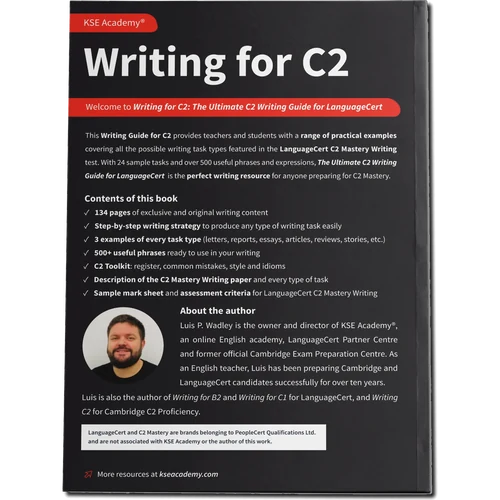
For Speaking there’s nothing like practising out loud, but if you’re also preparing the written part of the exam, there’s my guide to C2 Mastery Writing and the KSE Academy book for LanguageCert C2 Writing, with every task type and model answers. It’s a Writing book, not a Speaking one, but much of the vocabulary and the language for building an argument will help you when you speak too.
And that’s everything you need to know about C2 Mastery Speaking. If you still have any questions, leave me a comment and I’ll be happy to help. 🙂
