
Table of contents
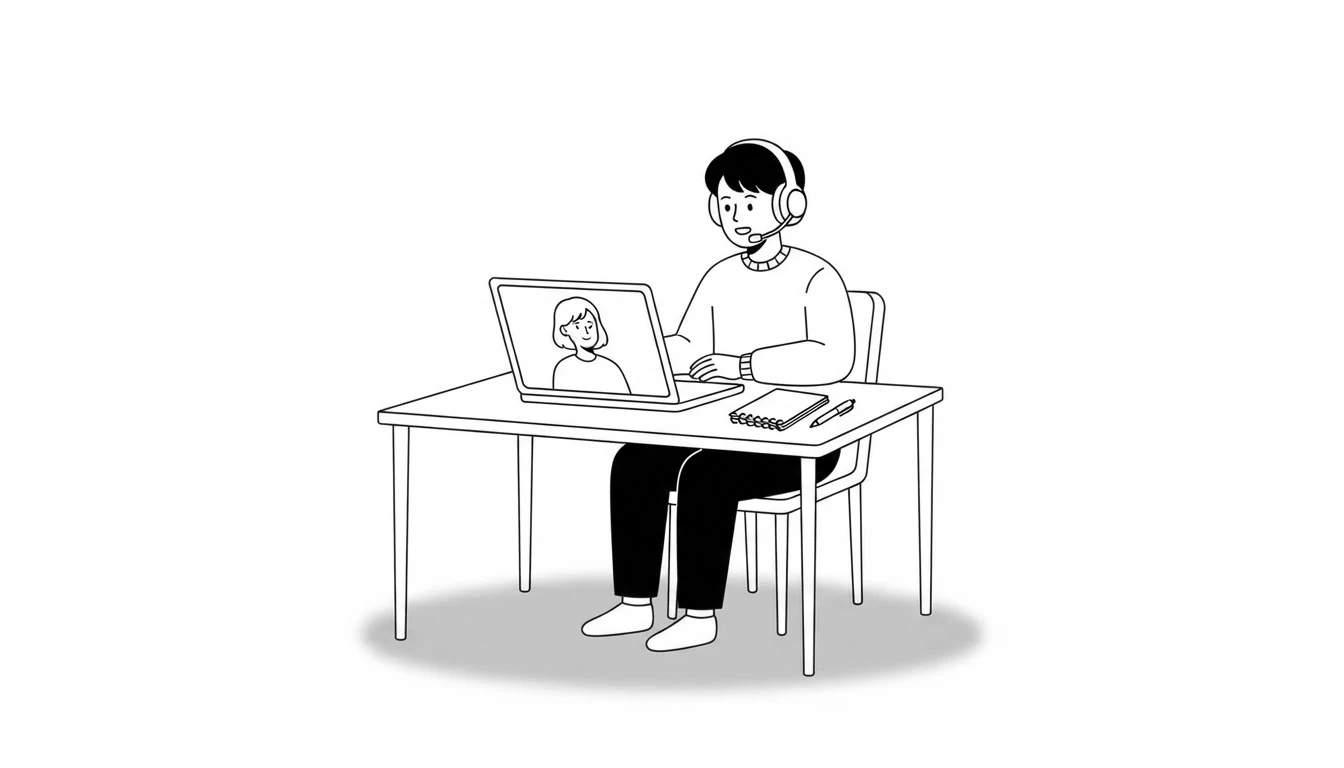
The LanguageCert C1 Expert Speaking exam is one of the most unusual you’ll come across: you take it on your own with an interlocutor, with no partner, and the person who marks you isn’t in the room, because the exam is recorded and marked by an examiner afterwards. At C1, what’s more, the interlocutor lets you lead the conversation, so a lot of the work is up to you.
In my experience as an exam trainer, the difference between passing C1 Speaking comfortably and falling short lies in knowing exactly what’s expected in each part. So in this guide I’ll explain how C1 Expert Speaking works, what you have to do in each of its four parts, how it’s marked and, most importantly, I’ll show you an example of every part with a C1 model answer and a short analysis. Let’s get started!
C1 Expert Speaking: what C1 level means
The C1 Expert certifies a C1 level on the Common European Framework of Reference for Languages (CEFR), an advanced level. As far as speaking is concerned, the CEFR says a C1 speaker:
Can express ideas fluently and spontaneously without much obvious searching for expressions, use language flexibly and effectively for social and professional purposes, and present clear, detailed descriptions of complex subjects, developing particular points and rounding off with an appropriate conclusion.
In exam terms, in C1 Expert Speaking you need to be able to:
- Give well-developed opinions on current issues, not just on your own life.
- Adapt your register and tone to each situation: you don’t talk to your boss the way you talk to a friend, and you don’t ask a favour the way you make a complaint.
- Discuss: justify, challenge, persuade and ask for clarification.
- Speak in depth for two minutes on an abstract or complex topic, in a well-structured way.
As you can see, the jump from B2 isn’t so much in the format, which is very similar, as in the depth of what you say, the precision of your vocabulary and how naturally you lead the conversation.
What C1 Expert Speaking is like
Speaking is the Spoken Exam of the C1 Expert. It’s separate from the Written Exam (Listening, Reading and Writing), so you can take it on a different day. These are its main features:
- It’s one to one: just you and an interlocutor, with no partner.
- It lasts 15 minutes and has four parts.
- You can take it at a centre, face to face, or online from home. Either way, the interlocutor is with you live.
- It’s recorded, and you aren’t marked by the interlocutor but by a LanguageCert examiner who listens to the recording afterwards.
- In some parts the interlocutor plays a role (your boss, your neighbour…), but you never have to play anyone else: you always speak as yourself.
| Part | Time | What you have to do |
|---|---|---|
| Part 1 | 3 minutes | Spell your surname, say where you’re from and answer up to 5 questions on a range of topics, including current issues. |
| Part 2 | 3 minutes | Role plays where register and tone count: the interlocutor starts one and you start the other. |
| Part 3 | 4 minutes | After 20 seconds to think, discuss a list with the interlocutor to rank or prioritise the options. |
| Part 4 | 5 minutes | After 30 seconds to make notes, talk for 2 minutes on a topic and answer follow-up questions. |
The four parts of C1 Expert Speaking
Part 1
It starts as at other levels: the interlocutor asks you to spell your surname and asks where you’re from. Then he or she asks up to five questions, each on a different topic. The difference is that at C1 the questions go beyond your personal life and ask for your opinion on current issues: advertising, social media, how cities are changing… The interlocutor may also follow up with another question.
Part 2
These are role plays of real situations, as at B2, but longer and more demanding. In the first situation the interlocutor starts and in the second you start. What makes the difference at C1 is register: you need to be able to ask a delicate favour, complain tactfully or talk to someone senior without sounding either blunt or overly deferential. And here the interlocutor expects you to lead the conversation.
Part 3
Here it’s no longer about making a plan, as at B2, but about discussion. The interlocutor gives you a sheet with a list of options (ways of tackling a problem, factors to consider…) and you have to rank them, prioritise them or rule some out. You get 20 seconds to think and then you’re expected to justify your position, challenge the interlocutor’s, give examples and ask for clarification. As at B2, how you discuss matters more than reaching full agreement.
Part 4
This is your long turn. The interlocutor chooses one of three topics, usually abstract or complex, and gives you paper and a pen to make notes for 30 seconds. Then you talk for two minutes and answer follow-up questions, which at C1 usually ask you to go deeper or defend what you’ve said.
C1 Expert Speaking examples
Now for the practical part. Here’s a task for every part, written by me in the exam format, with a C1 model answer and an analysis of why it works. The point isn’t to memorise these answers but to notice how they’re built, because in the real exam everything will be spontaneous.
C1 Expert Speaking example: Part 1
These would be the Part 1 questions:
Part 1. The interlocutor asks you to spell your surname and says Where are you from? Then you’ll be asked up to five questions on different topics, for example:
- Cities: In what ways has your city changed over the last ten years?
- Advertising: Do you think advertising influences you more than you’d like to admit?
- Reading: Has the way people read changed, in your view?
- Volunteering: Should young people be encouraged to do voluntary work?
- Social media: How has social media changed the way we keep in touch?
And this is how a C1 candidate might answer them:
Interlocutor: In what ways has your city changed over the last ten years?
Candidate: Quite dramatically, actually. The old town has been almost entirely pedestrianised, which has made it far more pleasant to walk around, but it’s also pushed rents up, so a lot of the small family-run shops have been replaced by chains and tourist flats.
Interlocutor: Do you think advertising influences you more than you’d like to admit?
Candidate: Almost certainly. I like to think I’m immune to it, but every now and then I catch myself buying a brand simply because it feels familiar, and that familiarity is exactly what advertisers are paying for.
Interlocutor: Has the way people read changed, in your view?
Candidate: I’d say we read more than ever, but in much shorter bursts. We skim headlines, posts and messages all day long, whereas sitting down with a book for an hour has become something you have to make a conscious effort to do.
Interlocutor: Should young people be encouraged to do voluntary work?
Candidate: Encouraged, yes, but not forced. Volunteering can open young people’s eyes to realities they’d never otherwise come across, but if it becomes compulsory, it risks turning into just another box to tick on a CV.
Interlocutor: How has social media changed the way we keep in touch?
Candidate: It’s made it effortless to keep up with people’s lives, but I’m not convinced it’s made us any closer. Liking someone’s photo isn’t quite the same as picking up the phone, and I suspect many friendships now survive on very little real contact.
Why it works:
Why it works:
Why it works:
Why it works:
- Nuanced opinions, not yes or no answers: Encouraged, yes, but not forced.
- Every answer includes a contrast or a consequence, which is what gives it depth.
- Precise C1 vocabulary: pedestrianised, immune to, in short bursts, another box to tick, keep up with.
Useful expressions: Quite dramatically, actually., I like to think…, but…, I’d say…, whereas…, I’m not convinced…, I suspect…
C1 Expert Speaking example: Part 2
In the first situation the interlocutor starts, playing your manager:
Part 2, first situation. I’m your manager. I start.
I’ve noticed you’ve been staying late almost every evening this week. Is everything all right?
Interlocutor: I’ve noticed you’ve been staying late almost every evening this week. Is everything all right?
Candidate: Thanks for asking. To be honest, I’ve been struggling to keep on top of things since the Hamilton project was brought forward. I didn’t want to make a fuss, but the new deadline is a bit tight for one person.
Interlocutor: I see. Why didn’t you say something earlier?
Candidate: I suppose I thought I could handle it on my own, and I didn’t want to give the impression I wasn’t coping. But if it’s at all possible, it would make a huge difference if someone from the team could take over the reporting side, at least until the end of the month.
In the second, you’re the one who has to start:
Part 2, second situation. We’re flatmates. You’d like me to stop practising the drums late at night. You start.
Candidate: Hey, Sam, have you got a minute? There’s something I’ve been meaning to mention. I really don’t want to make a big deal of it, but would you mind not practising the drums after about ten at night?
Interlocutor: Oh. Is it that loud?
Candidate: I’m afraid it is, yes. My room’s right next to yours, and with my early shifts I’m up at six, so I’ve been finding it really hard to get to sleep. I know you’ve got the gig coming up, though, so I’m not asking you to stop altogether.
Interlocutor: But the evenings are the only time I can practise.
Candidate: I completely understand. How about this, then: you practise as much as you like until ten, and at weekends it doesn’t matter so much. Or, if you’re up for it, we could look into those rubber pads that muffle the sound. I’d happily chip in.
- With the manager, the register is professional but honest: the candidate admits the problem without complaining and proposes a concrete solution (if it’s at all possible…).
- With the flatmate, the complaint is softened (I really don’t want to make a big deal of it), the candidate shows understanding and offers alternatives when the other person objects.
- In both situations the candidate leads the conversation, which is exactly what’s expected at C1.
Useful expressions: To be honest, I’ve been struggling to…, It would make a huge difference if…, There’s something I’ve been meaning to mention., Would you mind…?, How about this, then:…
C1 Expert Speaking example: Part 3
In Part 3 the candidate and the interlocutor have the same list, and they have to rank it:
Part 3. We’ve been asked to rank some ideas for encouraging people in our town to leave their cars at home. We need to agree on which would work best and which would make the least difference. You have twenty seconds to prepare before we begin.
How can we get people out of their cars?
- cheaper public transport
- more cycle lanes
- higher parking charges in the centre
- a car-free day once a month
- a park-and-ride scheme
- more people working from home
Candidate: Well, for me, the most effective measure would have to be cheaper public transport. Most people don’t drive because they love driving; they drive because it’s the most convenient or the cheapest option. If buses and trains cost less, a lot of them would switch overnight.
Interlocutor: I’m not so sure. Cheap transport doesn’t help if the buses are slow or don’t go where you need them.
Candidate: That’s a fair point, although I’d argue the two go hand in hand. If more people used public transport, the town would have the money to improve the service. But tell me, which one would you put first?
Interlocutor: Higher parking charges. People only change their habits when it hits their pocket.
Candidate: I can see the logic, but wouldn’t that be rather unfair on people who have no alternative? Think of someone who works night shifts, for instance. I’d rather reward people for leaving the car at home than punish those who can’t. So I’d put parking charges somewhere in the middle, and only once the alternatives are in place.
Interlocutor: And the car-free day?
Candidate: Personally, I’d rank that last. It’s a nice symbolic gesture and it raises awareness, but one day a month doesn’t change anyone’s daily routine. A park-and-ride scheme, on the other hand, tackles the real problem, which is people driving into the centre, so I’d put that second, just after cheap transport.
Interlocutor: What about cycle lanes and working from home?
Candidate: Cycle lanes are essential, but they only work for shorter journeys and for people who feel safe on a bike, so third or fourth. As for working from home, it’s effective, but it isn’t really something a town council can control. So, if we’re agreed: cheaper transport first, park-and-ride second, then cycle lanes, working from home, parking charges, and the car-free day last?
Interlocutor: I can live with that.
- Every position is justified with an argument, not just an «I think».
- The candidate challenges politely (I can see the logic, but wouldn’t that be…?) and uses examples to back up the argument.
- The candidate asks for the interlocutor’s view (which one would you put first?), so it’s a real discussion.
- The candidate rounds off by proposing a final order and checking they agree.
Useful expressions: For me, the most effective… would have to be…, That’s a fair point, although I’d argue…, I can see the logic, but…, I’d rather… than…, On the other hand,…, So, if we’re agreed:…
C1 Expert Speaking example: Part 4
These would be the three Part 4 topics:
Part 4. Now it’s your long turn. The interlocutor picks one of these topics and hands you paper and a pen, and you get thirty seconds to jot down some notes:
- A The role of museums today
- B Whether fame is worth the price
- C Why people take risks
Talk for two minutes. Then answer the interlocutor’s follow-up questions.
Let’s say you get topic A. This is what a C1 candidate’s notes and talk might look like, with the follow-up questions at the end:
Notes (30 seconds): museums: not dusty / education + identity / competition: internet, screens / must adapt: interactive, free days / but: not theme parks / conclusion
Candidate: I’ve chosen to talk about the role of museums today, which I think is a more interesting question than it might first appear.
Candidate: There’s a widespread idea that museums are dusty, silent places that only appeal to tourists and school trips, but I’d say they matter more now than ever. In an age when we’re bombarded with images on our screens, a museum is one of the few places where you can stand in front of the real thing, whether it’s a painting, a fossil or a piece of machinery, and that experience is very hard to replicate online.
Candidate: Museums also play a crucial role in preserving a community’s identity. They tell us where we come from and, just as importantly, they can challenge the version of history we were taught at school.
Candidate: That said, museums are undeniably competing for people’s attention with streaming platforms and social media, so they’ve had to adapt. Many have introduced interactive exhibits, late-night openings or free entry on certain days, and I think that’s largely positive, especially if it attracts people who would never have set foot in one otherwise.
Candidate: Where I’d draw the line, though, is when a museum starts behaving like a theme park. If everything has to be entertaining and photographable, there’s a risk that the content becomes secondary and visitors leave having taken plenty of selfies but having learnt very little.
Candidate: So, on balance, I’d say museums are as relevant as ever, provided they manage to strike a balance between reaching new audiences and staying true to their purpose.
Interlocutor: Thank you. Should entry to national museums be free?
Candidate: Ideally, yes. Free entry sends the message that culture belongs to everyone, not just to those who can afford it. The obvious drawback is funding, but a voluntary donation system seems to work reasonably well in countries like the UK.
Interlocutor: Do you think virtual tours could ever replace a real visit?
Candidate: They’re a wonderful complement, particularly for people who can’t travel, but I doubt they’ll ever replace the real thing. Seeing the actual scale and texture of an object is something a screen simply can’t convey.
- It introduces the topic and states a clear position from the start: museums matter more than ever.
- It develops the ideas and considers the other side (That said…, Where I’d draw the line, though…), which is what marks out a C1 talk.
- It ends with a conclusion that sums up the main idea (So, on balance…).
- C1 grammar and vocabulary used naturally: would never have set foot in one, having taken plenty of selfies but having learnt very little, strike a balance.
Useful expressions: I’ve chosen to talk about…, There’s a widespread idea that…, but…, That said,…, Where I’d draw the line, though, is…, So, on balance,…, provided that…
C1 Expert Speaking sample video
LanguageCert has published a real C1 Speaking exam, recorded with a candidate called Aron, together with the mark the examiner gave. The result is a High Pass: 9 out of 12, which is 38 out of 50, right on the High Pass boundary. The strongest area is task fulfilment, with relevant, flexible and well-structured contributions. There’s a good range of C1 grammar and vocabulary, with some errors (a few of them self-corrected), and pronunciation and fluency are good, with very little hesitation.
Notice that you don’t need perfect English to get a High Pass at C1: what counts is flexibility and organisation.
How C1 Expert Speaking is marked
The examiner listens to the recording and gives you a mark for four criteria, each from 0 to 3, based on your performance across the whole exam:
| Criterion | What is assessed |
|---|---|
| Task Fulfilment and Coherence | Whether you do what each task asks with flexibility, whether your contributions are relevant and whether what you say is well structured. |
| Accuracy and Range of Grammar | Whether you use a wide range of C1 structures with good control. |
| Accuracy and Range of Vocabulary | Whether your vocabulary is broad and precise, and whether you choose the right words for each context. |
| Pronunciation, Intonation and Fluency | Whether you’re easy to understand, use intonation well and speak without apparent effort. |
So the maximum is 12 marks, which are then converted to a score out of 50. You need 25 out of 50 to pass (Pass), and from 38 out of 50 you get a High Pass.
Tips for C1 Expert Speaking
These are the tips I give my students for C1 Expert Speaking:
- Lead the conversation. At C1 the interlocutor lets you, so suggest, ask and expand without waiting to be guided.
- Watch your register in Part 2. Before you speak, think about who you’re talking to and how direct you should be.
- Justify everything in Part 3. A ranking without arguments proves nothing. Use examples and ask the interlocutor to justify their choices too.
- Structure your two minutes in Part 4. An introduction, two or three developed ideas, the other side of the argument and a conclusion.
- Keep up with current affairs. You don’t need to be an expert, but you do need an opinion on technology, the environment, work or society.
- Don’t chase perfection. Correcting yourself now and then is natural and doesn’t cost you marks. Stopping after every sentence does.
- If you take the exam online, check your equipment. Test your connection, microphone and camera beforehand and find a quiet place.
If you’re deciding between exams, have a look at my guide to Cambridge C1 Advanced Speaking to compare the two formats. And to see the whole exam, here’s my guide to the LanguageCert C1 Expert.
And for C1 Expert Writing…
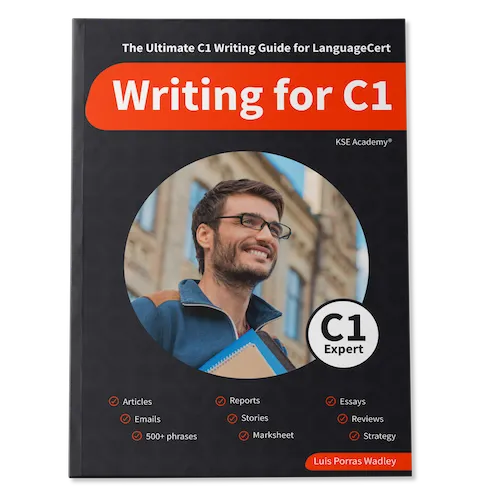
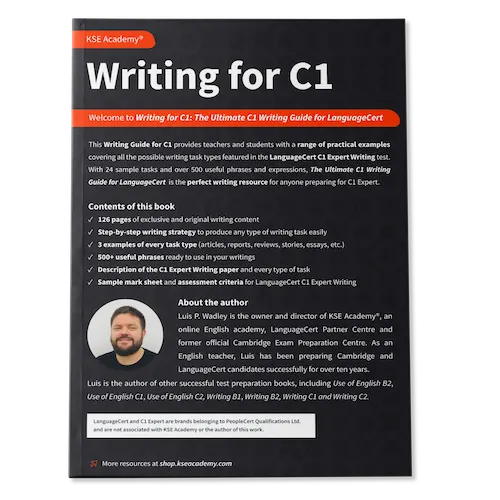
For Speaking there’s nothing like practising out loud, but if you’re also preparing the written part of the exam, there’s my guide to C1 Expert Writing and the KSE Academy book for LanguageCert C1 Writing, with every task type, model answers and over 500 useful expressions. It’ll help with Speaking too, because much of that C1 vocabulary and linking language works just as well when you speak.
And that’s everything you need to know about C1 Expert Speaking. If you still have any questions, leave me a comment and I’ll be happy to help. 🙂
