
Table of contents
LanguageCert C2 Mastery Listening is the first part of the written exam, which has an upside and a downside. The upside: you start fresh and you hear everything twice. The downside: you can’t pause or go back, and if you don’t know the format well, first-minute nerves can cost you marks.
In my experience as an exam trainer, Listening is where practising with real recordings shows the most. So in this guide I explain what C2 Mastery Listening is like, what you have to do in each of its four parts and how it’s marked. And so you can practise with the real thing, I’ve included all four parts of the official LanguageCert Practice Paper 1, with the audio, the questions and every answer explained. Let’s get started!
C2 Mastery Listening: what C2 level means
C2 Mastery certifies C2 on the Common European Framework of Reference for Languages (CEFR), the highest level. In listening, that means you understand virtually anything you hear, live or recorded, with no effort, even when people speak fast, use very idiomatic language or build a subtle, loosely structured argument.
In exam terms, in C2 Mastery Listening you need to be able to:
- Understand the context, purpose and tone of a short sentence, full of idioms and register shifts, well enough to know how someone would respond.
- Pick up the topic, purpose, relationship between the speakers and their attitudes.
- Extract specific information from a lecture or a talk dense with facts.
- Follow a longer conversation between two people, with opinions, examples, causes and effects.
What C2 Mastery Listening is like
Listening is part of the Written Exam, together with Reading and Writing. These are its main features:
- It’s the first part of the written exam and lasts about 30 minutes.
- It has four parts and 26 questions, and each correct answer is worth 1 mark.
- You hear each recording twice, with pauses to read the questions and check your answers.
- You then transfer your answers to the Answer Sheet.
- You can take it at a centre or online from home, in the same format.
| Part | What you hear | Task | Questions |
|---|---|---|---|
| Part 1 | 6 short sentences, with idioms and register shifts | Choose the best reply or continuation (a, b or c) | 6 |
| Part 2 | 3 conversations between two people | 2 multiple-choice questions per conversation | 6 |
| Part 3 | A monologue dense with facts: a lecture, a radio programme, a presentation… | Complete notes with 7 headings, in 1 to 5 words | 7 |
| Part 4 | A longer discussion (in this paper, between three people) | Multiple choice (a, b or c) | 7 |
The four parts of C2 Mastery Listening
Part 1
You hear six short sentences, each with a different function and context, and choose the best reply or continuation. As at C1, they’re full of idioms, colloquialisms and register shifts, and intonation tells you a lot about each speaker’s attitude. The three options are usually fixed expressions, so understanding the recording isn’t enough: you need to know what each expression means.
Part 2
You hear three conversations between two people and answer two multiple-choice questions about each one. The questions can be about the topic, the purpose, where the speakers are, their relationship or how they feel. Often the answer isn’t said in those words but has to be worked out from the tone.
Part 3
You hear one person talking (a lecture, a radio programme, a presentation…), with a dense, fact-heavy text, and complete a set of notes with seven headings, writing answers of one to five words. The headings follow the order of the recording. It’s the most fact-based part, but be careful: the speaker usually mentions several similar things, and only one answers the heading exactly.
Part 4
You hear a longer discussion (in Practice Paper 1, a meeting between three people) and answer seven multiple-choice questions. You get a minute to read them before you listen. This part is about following the discussion and picking up nuances and attitudes (irony, criticism, boasting…): who thinks what, which examples they give, what causes what. The wrong options often mention things that are actually said but don’t answer the question.
C2 Mastery Listening examples
For Listening, the best practice is official recordings, so instead of writing my own examples I’ve included all four parts of the official LanguageCert Practice Paper 1 for C2 Mastery: the audio and the questions are LanguageCert’s, and the explanations of the answers are mine. You can download the full paper, along with the other sample papers, from the official C2 Mastery page or from my C2 Mastery guide.
Do each part as you would in the exam: read the questions, listen to the whole recording (in the exam you hear everything twice) and then check your answers.
C2 Mastery Listening example: Part 1
Six unfinished conversations. Choose the sentence that best continues each one:
You will hear some sentences. You will hear each sentence twice. Choose the best reply to each sentence.
- a) I’m afraid you may well be right.
- b) No, she meant to do it.
- c) A most unfortunate accident.
- a) It’s not very well-printed, is it?
- b) Yes, you need to read between the lines.
- c) Yes, I’d say it was self-explanatory.
- a) It is rather old-fashioned, isn’t it?
- b) I agree it’s well-decorated.
- c) Yes, really state of the art.
- a) Measure it yourself if you like.
- b) Not at all, only if I know I’m right.
- c) That’s why I’m so easy-going.
- a) No, you seemed very calm.
- b) Yes, they were in the garden.
- c) I’m sure you’ll be fine.
- a) I’ll take that as a yes, then.
- b) Thanks for apologizing.
- c) I assume that means you won’t.
Show answers
- a: Accidentally-on-purpose: the reply agrees with the suspicion.
- b: More than meets the eye: you need to read between the lines.
- c: All mod cons = all the modern conveniences: state of the art.
- b: Argue the toss = argue about everything: the reply defends itself, ‘only if I know I’m right’.
- a: Have butterflies = be nervous: ‘No, you seemed very calm.’
- c: A bad hair day = a day when everything goes wrong: you understand they won’t do what’s asked.
C2 Mastery Listening example: Part 2
Three conversations with two questions each:
You will hear some conversations. You will hear each conversation twice. Choose the correct answers for each conversation.
Conversation 1
- The conversation is taking place
- a) outdoors.
- b) in a public building.
- c) in a private home.
- Who thinks the celebration will be successful?
- a) The woman.
- b) The man.
- c) Both speakers.
Conversation 2
- The hotel guest is dissatisfied with the
- a) price of the room.
- b) size of the room.
- c) facilities in the room.
- The receptionist appears to be
- a) indifferent to the complaint.
- b) accustomed to this complaint.
- c) surprised by the guest’s attitude.
Conversation 3
- The speakers are
- a) neighbours.
- b) old friends.
- c) strangers.
- The man can’t accept the woman’s invitation because of
- a) a medical appointment.
- b) travel plans.
- c) family matters.
Show answers
- b: The meeting is ‘in that room at the end of the corridor’, and she mentioned an exhibition: a public building.
- a: She thinks the celebrations will be terrific; he thinks they’re badly organised.
- c: He doesn’t mind the size; he complains that the TV doesn’t work and there’s no kettle or coffee.
- b: ‘Not even the first today’: she’s heard this complaint before.
- b: ‘Hello, stranger! Haven’t seen you for ages’: they’ve known each other a long time.
- c: He has to go to the hospital, but because his daughter has just had a baby.
C2 Mastery Listening example: Part 3
A man presents an organisation that promotes the UN’s international years. Complete the notes with answers of one to five words:
You will hear someone talking. You will hear the person twice. Complete the information. Write short answers of one to five words.
The Year Of…
- Reason for no handouts: _______________
- Gregory has represented YEAROF since: _______________
- Gregory thought public awareness was: _______________
- Amount YEAROF receives from government: _______________
- YEAROF’s focus in coming year: _______________
- Main reason for chosen college: _______________
- Medium not used for presentations: _______________
Show answers
- to save trees / stop wasting trees
- last year / a year ago
- disappointing / a disappointment
- nothing / nil
- (only) forests / forestry
- it’s (genuinely) international
- newspapers
These are the answers from the official key, with the accepted variants. Several require inference: Gregory doesn’t say ‘since last year’, but that his first year was the year of astronomy, and the government gives ‘nothing’ because YEAROF relies only on businesses. Item 5 has a trap: chemistry and forests are both mentioned, but they choose forests only.
C2 Mastery Listening example: Part 4
A meeting between Linda, Peter and Alistair to name the streets on a new housing estate:
You will hear a conversation. You will hear the conversation twice. Choose the correct answers.
- Who has worked on the same committee before?
- a) All three of them.
- b) The woman and each man.
- c) The two men only.
- How did Peter react when he received the invitation to join the committee?
- a) He thought it was a joke.
- b) He wrote to decline.
- c) He felt honoured.
- Alistair objects to Peter’s idea about using numbers as street names
- a) because it has been done before.
- b) because it could be confusing.
- c) simply because it is Peter’s idea.
- Linda thinks that Peter
- a) did not really understand what Alistair said.
- b) is right to laugh at Alistair’s comments about house prices.
- c) doesn’t understand how seriously people take street names.
- Alistair’s offer to write letters to members of the public is
- a) put off until later.
- b) discussed at length.
- c) declined.
- Linda’s comment about the restaurant is intended to
- a) speed up the meeting.
- b) interrupt the discussion.
- c) indicate when the meeting will end.
- The suggestion to use trees as street names
- a) descends into a silly argument.
- b) develops into a serious discussion.
- c) involves all three speakers in lively debate.
Show answers
- b: Linda has sat on committees with each of them, but Peter and Alistair have never worked together.
- a: He thought it was a spoof email from a colleague.
- b: ‘Four’ sounds like ‘fore’, and ‘Six Street’ could give the wrong message: it could be confusing.
- c: She rebukes him for laughing: people do pay more because of a street name.
- c: Head office has already decided not to reply: she politely declines the offer.
- a: The restaurant closes at two: she doesn’t want to waste time reading every letter.
- b: It starts with an objection, but they end up discussing planting trees seriously.
How C2 Mastery Listening is marked
Listening has 26 questions and each correct answer is worth 1 mark, so the maximum is 26 marks. There’s no penalty for wrong answers, so always answer, even if you have to guess.
That mark is then converted to a score out of 50, just like Reading and Writing. The three add up to a score out of 150 for the whole Written Exam, and you need 75/150 to pass (Pass). From 101/150 you get a High Pass. In other words, there’s no pass mark per skill: a weaker Listening can be made up for with a good Reading or Writing.
Tips for C2 Mastery Listening
These are the tips I give my students for C2 Mastery Listening:
- Use the pauses to read. Before each recording, read the questions and underline the key words.
- In Part 1, revise idioms. Many answers are fixed expressions (the buck stops with him, over my dead body), and intonation tells you whether the speaker is annoyed, ironic or defensive.
- In Parts 2 and 4, listen to the tone. Questions about feelings and attitudes are answered more by tone than by words.
- In Part 3, write only what you need. One to five words. If you’re not sure how to spell something, write it as it sounds: if it’s recognisable, it usually counts.
- Use the second listening to check. The first time, mark what you’re sure of; the second time, focus on what’s missing.
- Don’t get stuck. If you miss an answer, move on: the recording won’t wait.
- Practise with a variety of audio. Podcasts, news and interviews in British English will get you used to the speed and the accents.
For the full exam, here’s my guide to LanguageCert C2 Mastery, with all the official sample papers to download.
And for C2 Mastery Writing…
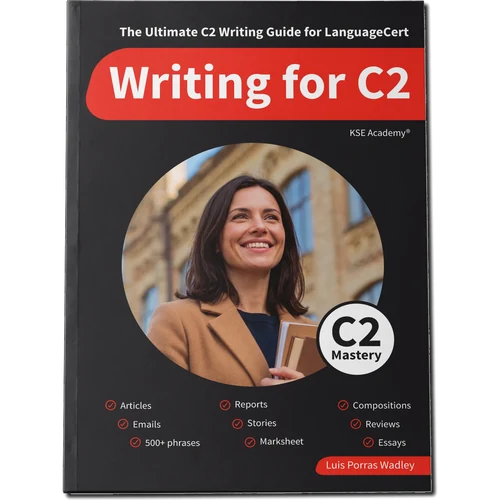
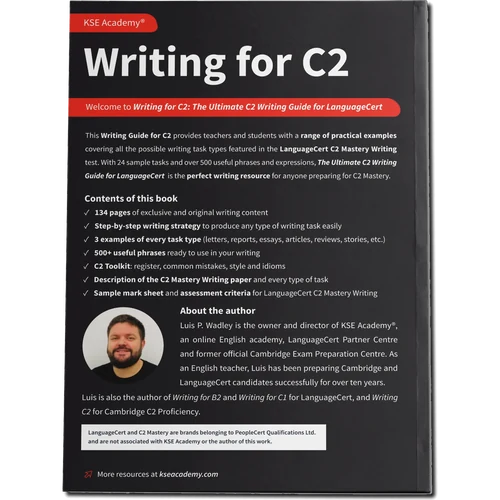
For Listening there are no shortcuts: you need to listen a lot. But if you’re also preparing the written part of the exam, you have my guide to C2 Mastery Writing and the KSE Academy book for LanguageCert C2 Writing, with every task type, model answers and useful language. It’s a Writing book, not a Listening one, but since you pass the written exam as a whole, a strong Writing gives you a margin elsewhere.
And that’s everything you need to know about C2 Mastery Listening. If you have any questions, leave me a comment and I’ll be happy to answer. 🙂
