

Table of contents
LanguageCert C1 Expert Listening is the first part of the written exam, which has an upside and a downside. The upside: you start fresh and you hear everything twice. The downside: you can’t pause or go back, and if you don’t know the format well, first-minute nerves can cost you marks.
In my experience as an exam trainer, Listening is where practising with real recordings shows the most. So in this guide I explain what C1 Expert Listening is like, what you have to do in each of its four parts and how it’s marked. And so you can practise with the real thing, I’ve included all four parts of the official LanguageCert Practice Paper 1, with the audio, the questions and every answer explained. Let’s get started!
C1 Expert Listening: what C1 level means
C1 Expert certifies C1 on the Common European Framework of Reference for Languages (CEFR), an advanced level. In listening, that means you understand extended speech even when it isn’t clearly structured, you pick up what is implied rather than said, and you recognise idioms, colloquialisms and shifts in register, including from intonation.
In exam terms, in C1 Expert Listening you need to be able to:
- Understand the context, purpose and tone of a short conversation, full of idioms and register shifts, well enough to know how it would continue.
- Pick up the topic, purpose, relationship between the speakers and their attitudes.
- Extract specific information from a lecture or a talk dense with facts.
- Follow a longer conversation between two people, with opinions, examples, causes and effects.
What C1 Expert Listening is like
Listening is part of the Written Exam, together with Reading and Writing. These are its main features:
- It’s the first part of the written exam and lasts about 30 minutes.
- It has four parts and 26 questions, and each correct answer is worth 1 mark.
- You hear each recording twice, with pauses to read the questions and check your answers.
- You then transfer your answers to the Answer Sheet.
- You can take it at a centre or online from home, in the same format.
| Part | What you hear | Task | Questions |
|---|---|---|---|
| Part 1 | 6 short unfinished conversations, with idioms and register shifts | Choose the best continuation (a, b or c) | 6 |
| Part 2 | 3 conversations between two people | 2 multiple-choice questions per conversation | 6 |
| Part 3 | A monologue dense with facts: a lecture, a radio programme, a presentation… | Complete notes with 7 headings, in 1 to 5 words | 7 |
| Part 4 | A longer conversation between two people | Multiple choice (a, b or c) | 7 |
The four parts of C1 Expert Listening
Part 1
You hear six very short conversations between two people that are left unfinished, and you choose the sentence that best continues each one. Unlike B2, they’re full of idioms, colloquialisms and register shifts, and intonation tells you a lot about each speaker’s attitude. The three options are usually fixed expressions, so understanding the recording isn’t enough: you need to know what each expression means.
Part 2
You hear three conversations between two people and answer two multiple-choice questions about each one. The questions can be about the topic, the purpose, where the speakers are, their relationship or how they feel. Often the answer isn’t said in those words but has to be worked out from the tone.
Part 3
You hear one person talking (a lecture, a radio programme, a presentation…), with a dense, fact-heavy text, and complete a set of notes with seven headings, writing answers of one to five words. The headings follow the order of the recording. It’s the most fact-based part, but be careful: the speaker usually mentions several similar things, and only one answers the heading exactly.
Part 4
You hear a longer conversation between two people and answer seven multiple-choice questions. You get a minute to read them before you listen. This part is about following the discussion and picking up nuances and attitudes (irony, criticism, boasting…): who thinks what, which examples they give, what causes what. The wrong options often mention things that are actually said but don’t answer the question.
C1 Expert Listening examples
For Listening, the best practice is official recordings, so instead of writing my own examples I’ve included all four parts of the official LanguageCert Practice Paper 1 for C1 Expert: the audio and the questions are LanguageCert’s, and the explanations of the answers are mine. You can download the full paper, along with the other sample papers, from the official C1 Expert page or from my C1 Expert guide.
Do each part as you would in the exam: read the questions, listen to the whole recording (in the exam you hear everything twice) and then check your answers.
C1 Expert Listening example: Part 1
Six unfinished conversations. Choose the sentence that best continues each one:
You will hear some short conversations. You will hear each conversation twice. Choose the correct answer to complete each conversation.
- a) That’s obvious, surely.
- b) I only wish there were.
- c) I’m in no position to argue.
- a) My mind’s made up.
- b) I’m just being selfish.
- c) I’m really not in the mood.
- a) In a word, yes.
- b) Too many things.
- c) No, not at all.
- a) No, I couldn’t care less.
- b) But the buck stops with him.
- c) But he’s got to get a better job.
- a) Over my dead body, you will!
- b) Dicing with death, you are!
- c) Yes, cut out all the dead wood!
- a) I’ll come right out with it.
- b) Not the point of the exercise.
- c) All very well for you to say.
Show answers
- b: ‘Surely there’re other options?’: ‘I only wish there were’ means there’s no cheaper alternative.
- c: He doesn’t want to go somewhere posh and she insists: ‘I’m really not in the mood’.
- a: He asks, disappointed, whether she has really tried everything (banks, friends, relatives): ‘In a word, yes’.
- b: He backs down (‘I’m not into blaming anyone in particular’) and she replies that John is ultimately responsible: ‘the buck stops with him’.
- a: She says she’ll work through the night and he, having already insisted on a break, refuses point-blank: ‘Over my dead body, you will!’.
- c: He criticises her work coldly and she, annoyed, replies that that’s easy for him to say: ‘All very well for you to say’.
At C1, this part relies heavily on idioms and intonation. If you don’t know the buck stops with him or over my dead body, it’s very hard to get the answer, so it’s worth revising the most common expressions.
C1 Expert Listening example: Part 2
Three conversations with two questions each:
You will hear some conversations. You will hear each conversation twice. Choose the correct answers for each conversation.
Conversation 1
- Where are the speakers?
- a) In a television studio.
- b) In a live festival audience.
- c) On stage at a book festival.
- What do the speakers agree about, regarding Ali Ball’s book Cold Spies?
- a) It would not make a good film.
- b) The characterisation is poor.
- c) It is better than his previous one.
Conversation 2
- What does the lawyer think?
- a) Magistrates’ decisions are unpredictable.
- b) The prosecution won’t have any evidence.
- c) Technicalities will assist her case.
- Sam is most concerned that
- a) Ann will lose her driving licence.
- b) imprisonment is unlikely.
- c) Ann may receive two penalties.
Conversation 3
- What’s the purpose of the conversation?
- a) To understand a process.
- b) To resolve a problem.
- c) To decide who is right.
- What is the manager’s attitude?
- a) Embarrassed.
- b) Businesslike.
- c) Indifferent.
Show answers
- c: They’re live in front of a literary festival audience, but on stage: ‘On stage with me are…’. They’re not in the audience or in a studio (‘instead of being studio-bound’).
- a: Both agree it wouldn’t make a good film (‘like watching paint dry’). They disagree about the characters and the plot.
- a: ‘Highly unlikely but you can never tell with magistrates’: the lawyer thinks the magistrates’ decision is unpredictable.
- c: Sam doesn’t care about the licence; what worries him, as it worries Ann, is that she might get a fine and a prison sentence (‘or both’).
- b: The customer is furious about her hair colour and the manager looks for a solution: redoing it that afternoon.
- b: The manager stays calm, explains what went wrong, proposes a concrete solution and offers compensation: a professional attitude.
C1 Expert Listening example: Part 3
A talk about franchising. Complete the notes with answers of one to five words:
You will hear someone talking. You will hear the person twice. Complete the information. Write short answers of one to five words.
Franchising notes
- Quality required for entrepreneurship: _______________
- Australian franchise percentage: _______________
- Main reason entrepreneurs choose franchising: _______________
- Benefit of promoting well-known goods: _______________
- Type of training to franchisees: _______________
- Amount of ongoing service fee: _______________
- Acronym of association: _______________
Show answers
- self-reliance
- forty-six / 46 (per cent)
- limited risk of failure
- national advertising
- how to grow the business
- percentage of (annual) turnover
- BFA
These are the answers from the official key, with the accepted variants. Notice the trap in item 2: the speaker gives two percentages one after the other, 50% for the US and 46% for Australia, and the question asks only about Australia.
C1 Expert Listening example: Part 4
A conversation between Paul and Sue about whether to let their flat:
You will hear a conversation. You will hear the conversation twice. Choose the correct answers.
- Paul tries to reassure Sue that letting the flat
- a) makes financial sense.
- b) doesn’t involve legal fees.
- c) is the most secure option.
- Sue thinks that gathering references appears to be an
- a) awkward process.
- b) expensive business.
- c) invasion of privacy.
- Paul says that Winnie would know about any disadvantages of
- a) renting out a property.
- b) getting suitable tenants.
- c) using a management company.
- When discussing getting their deposits back when they were younger, Sue is
- a) boastful.
- b) reassuring.
- c) sarcastic.
- What would be the main reason for ensuring the flat is in good order?
- a) To support the guarantee by the landlord.
- b) To forestall any tenant complaints.
- c) To discourage abuse of the property.
- At the point of discussing tenants being in residence, what does Paul rebuke Sue for?
- a) Wanting to call Winnie.
- b) Being too intrusive.
- c) Not listening to him.
- How would permission be agreed for the landlord to enter the flat?
- a) It would be stated in the contract.
- b) It would be left up to the tenant.
- c) It would be negotiated at the time.
Show answers
- a: ‘It’s financially worthwhile, certainly’: letting it makes financial sense while they wait for the market to recover.
- c: ‘Oh, that seems very intrusive… checking up on people… snooping about’: for Sue, asking for references means prying into people’s lives.
- c: Winnie ‘has got a flat rented out through one of these companies’: she’d know the pitfalls of using a management company.
- a: ‘Oh, really? I always did, Paul!’: Sue boasts that she always got her full deposit back.
- b: ‘If everything’s in good working order, tenants aren’t likely to have any issues’: it prevents complaints.
- b: ‘Oh, come on Sue! That really would be a bit too nosey!’: Paul tells her off for being too intrusive.
- a: ‘I’m sure that’d be included in the agreement’: it would be in the contract, with 24 hours’ notice.
How C1 Expert Listening is marked
Listening has 26 questions and each correct answer is worth 1 mark, so the maximum is 26 marks. There’s no penalty for wrong answers, so always answer, even if you have to guess.
That mark is then converted to a score out of 50, just like Reading and Writing. The three add up to a score out of 150 for the whole Written Exam, and you need 75/150 to pass (Pass). From 101/150 you get a High Pass. In other words, there’s no pass mark per skill: a weaker Listening can be made up for with a good Reading or Writing.
Tips for C1 Expert Listening
These are the tips I give my students for C1 Expert Listening:
- Use the pauses to read. Before each recording, read the questions and underline the key words.
- In Part 1, revise idioms. Many answers are fixed expressions (the buck stops with him, over my dead body), and intonation tells you whether the speaker is annoyed, ironic or defensive.
- In Parts 2 and 4, listen to the tone. Questions about feelings and attitudes are answered more by tone than by words.
- In Part 3, write only what you need. One to five words. If you’re not sure how to spell something, write it as it sounds: if it’s recognisable, it usually counts.
- Use the second listening to check. The first time, mark what you’re sure of; the second time, focus on what’s missing.
- Don’t get stuck. If you miss an answer, move on: the recording won’t wait.
- Practise with a variety of audio. Podcasts, news and interviews in British English will get you used to the speed and the accents.
For the full exam, here’s my guide to LanguageCert C1 Expert, with all the official sample papers to download.
And for C1 Expert Writing…
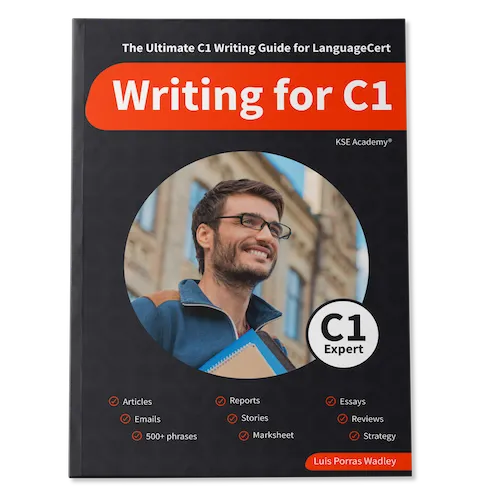
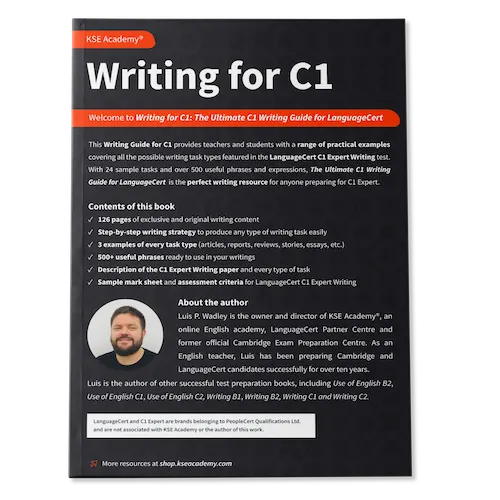
For Listening there are no shortcuts: you need to listen a lot. But if you’re also preparing the written part of the exam, you have my guide to C1 Expert Writing and the KSE Academy book for LanguageCert C1 Writing, with every task type, model answers and useful language. It’s a Writing book, not a Listening one, but since you pass the written exam as a whole, a strong Writing gives you a margin elsewhere.
And that’s everything you need to know about C1 Expert Listening. If you have any questions, leave me a comment and I’ll be happy to answer. 🙂
