
Tabla de contenidos
El C1 Expert de LanguageCert se ha convertido en una de las alternativas más populares al C1 Advanced de Cambridge, y su Writing es, sin duda, la parte que más respeto impone. No es para menos: tienes que escribir dos textos bastante largos, uno formal y otro informal, y demostrar que tu inglés está a la altura de un C1.
Pero no te preocupes, porque, desde mi experiencia como preparador de exámenes, el Writing es también la parte en la que antes se nota el trabajo bien hecho. En esta guía te explico cómo es el Writing del C1 Expert, qué te piden en la Part 1 y en la Part 2, cómo se corrige y, lo más importante, te enseño un ejemplo de Writing de cada tipo de tarea, con un análisis de lo que lo convierte en un texto de nivel C1. ¡Vamos allá!
Writing C1 Expert: qué es el nivel C1
El C1 Expert certifica un nivel C1 según el Marco Común Europeo de Referencia para las Lenguas (MCER). Es un nivel avanzado, y en lo que a expresión escrita se refiere, el MCER lo describe así:
Escribe textos claros y bien estructurados sobre temas complejos, resaltando las ideas principales, ampliando con cierta extensión y defendiendo puntos de vista con ideas complementarias, motivos y ejemplos adecuados, y terminando con una conclusión apropiada.
LanguageCert concreta qué espera de ti en el Writing de este nivel. En resumen, tienes que ser capaz de:
- Escribir textos bien estructurados y detallados sobre temas complejos, transmitiendo ideas, impresiones, sentimientos y opiniones.
- Escribir narraciones y descripciones complejas, adaptando el estilo.
- Desarrollar un argumento, destacando los puntos importantes y apoyándolos con ideas relevantes.
- Escribir cartas formales, reports y articles para muchas funciones distintas, incluidas las que requieren tacto.
- Usar una amplia variedad de vocabulario y de estructuras complejas, con pocos errores, y expresiones idiomáticas de forma natural.
- Adaptar el registro con eficacia según el propósito del texto.
- Organizar el texto y enlazar las ideas con una buena variedad de conectores y mecanismos de cohesión, y puntuar con precisión.
Como ves, la diferencia con el B2 no está tanto en los tipos de texto como en la calidad: más precisión, más variedad, más matices y un control del registro mucho más fino. Veamos ahora cómo es el examen.
Cómo es el Writing del C1 Expert
El Writing forma parte del Written Exam del C1 Expert, junto con el Listening y el Reading. El Listening va siempre primero, y después tienes 2 horas y 40 minutos para hacer el Reading y el Writing, en el orden que prefieras. No hay un tiempo fijo para el Writing, así que gestionarlo bien es parte del reto (más abajo te doy mis consejos).
En el Writing tienes que escribir dos textos:
| Part 1 | Part 2 | |
|---|---|---|
| Palabras | 150–200 | 250–300 |
| Registro | formal | informal |
| Lector | un público general (un periódico, una revista, una institución…) | un lector concreto (un amigo, un profesor, los lectores de una web…) |
| Qué tienes que hacer | responder a un texto, un gráfico o una imagen, expresando y justificando tu postura | escribir un texto más personal o creativo en el que tendrás que persuadir, argumentar, valorar, plantear hipótesis… |
| Tipos de texto | carta o email formal, article, report, review | carta o email personal, story, argumentative essay, descriptive composition, review |
| Puntuación | 12 puntos | 12 puntos |
En cada parte hay una sola tarea, así que no puedes elegir. A diferencia del B2, en el C1 los puntos que tienes que tratar no suelen aparecer en una lista con viñetas, sino integrados en las instrucciones (summarising the main findings and recommending two measures…). Por eso es fundamental leer el enunciado con lupa.
Tipos de Writing C1 Expert
Veamos qué te pueden pedir en cada parte. Todas las tareas de esta guía las he escrito yo siguiendo el formato del examen, así que no son oficiales, pero son exactamente del mismo estilo. Los datos de los textos de partida también son inventados.
Writing C1 Expert: Part 1
En la Part 1 tienes que responder de forma formal a un material de partida, que puede ser escrito, gráfico o visual: un artículo, dos opiniones de un periódico, los resultados de una encuesta, una tabla, un folleto… Además de usar la información, tendrás que posicionarte: dar tu opinión, justificarla, recomendar o argumentar.
Report
El report es el tipo de texto más típico cuando el material de partida es un gráfico o una tabla. Tienes que resumir los datos más relevantes y hacer recomendaciones, con un tono objetivo e impersonal:
Your local council recently carried out a survey on how residents travel to work or college. Study the results below and write a report for the council summarising the main findings and recommending two measures to reduce car use in the town.
How do residents travel to work or college?
| 2016 | 2026 | |
|---|---|---|
| Car | 58% | 52% |
| Bus | 21% | 16% |
| Bicycle | 6% | 14% |
| On foot | 15% | 18% |
Main reasons given for not cycling (2026): roads feel unsafe (61%), no secure bicycle parking (27%), distance (12%).
Write between 150 and 200 words.
Article
En un article para una revista o una web tienes que usar la información de partida para desarrollar un tema y dar tu opinión, enganchando al lector:
You read the following findings from a trial of a four-day working week. Using this information, write an article for an online business magazine discussing the possible advantages and drawbacks of the idea and saying whether you think it could work in your country.
Four-day week trial: the results
- 40 companies took part for one year.
- Productivity remained stable.
- Sick days fell by half.
- 85% of companies chose to keep the four-day week after the trial.
- Small shops and clinics found it harder to cover their usual opening hours.
Write between 150 and 200 words.
Formal letter / formal email
Una tarea muy habitual en la Part 1 es escribir una carta al director de un periódico comentando dos opiniones enfrentadas y dando la tuya. También puede ser un email formal a una empresa o institución:
You read the following two opinions in your local newspaper about plans to close the old town centre to cars. Write a letter to the editor commenting on both views and expressing your own opinion.
«Closing the old town to traffic is long overdue. The streets are too narrow, the air is dirty and pedestrians are constantly in danger. Other cities have done it successfully.»
«This plan will be the end of local businesses. Shoppers will simply drive to the out-of-town shopping centre instead, and older residents will find it impossible to get around.»
Write between 150 and 200 words.
Review
En una review valoras algo que has visitado o probado (una exposición, un hotel, un servicio…) para los lectores de una web o una revista. En la Part 1 suele partir de un anuncio, y el registro es neutro o formal:
You recently visited the exhibition advertised below. Write a review for an arts and culture website, commenting on the content of the exhibition, the way it was presented and whether you would recommend it.
Light and Shadow: A Century of Street Photography
City Art Gallery, until 30 June. Over 200 photographs from around the world, interactive displays and free audio guides. Open daily from 10 a.m. to 8 p.m.
Write between 150 and 200 words.
Writing C1 Expert: Part 2
En la Part 2 tienes que escribir un texto más largo (250–300 palabras), más personal o creativo y con un registro informal, para un lector concreto. Las instrucciones te piden funciones de nivel C1: persuadir, argumentar, plantear hipótesis, expresar estados de ánimo, valorar o justificar.
Personal letter / informal email
Escribir a un amigo para aconsejarle, convencerle de algo o contarle una experiencia y lo que significó para ti:
Your friend has been offered a job in another country but cannot decide whether to accept it. Write a letter to your friend, helping them weigh up the decision and persuading them to make the choice you think is right.
Write between 250 and 300 words.
Story
Un relato sobre algo que te ocurrió (o que inventas), con una reflexión sobre por qué fue importante:
Write a story for a creative writing website about an unexpected encounter with a stranger during a journey. Describe what happened and explain why the experience has stayed with you.
Write between 250 and 300 words.
Argumentative essay
Un texto en el que analizas los dos lados de una cuestión y das tu opinión. Aunque esté en la Part 2, suele ir dirigido a un profesor o a una clase, así que el registro es neutro:
Your teacher has asked you to write an essay for a class debate with the title ‘Social media has done more to divide people than to bring them together’. Discuss both sides of the argument and give your own opinion.
Write between 250 and 300 words.
Descriptive composition
Describir una persona, un lugar o una experiencia y explicar qué ha significado para ti:
Write a composition for a collection of student writing describing a person who has had a strong influence on you and explaining how they have shaped the way you see the world.
Write between 250 and 300 words.
La review también puede aparecer en la Part 2, pero con un tono más personal e informal. La estructura es la misma que la del ejemplo de la Part 1 que verás a continuación.
Ejemplos de Writing C1 Expert
En esta sección tienes una respuesta modelo para cada tarea. Todas son originales y están escritas para simular un nivel C1, sin llegar a un C2, para que veas qué se espera de ti de forma realista. Debajo de cada una te explico qué la hace funcionar.
Ejemplo de Writing C1 Expert: report
Respuesta a la tarea de la encuesta sobre transporte. Fíjate en que no se copian los datos sin más, sino que se seleccionan y se interpretan:
Reducing Car Use in Our Town
Introduction
This report summarises the findings of the recent survey on residents’ travel habits and puts forward two measures aimed at reducing car use.Main findings
Although the car remains by far the most common means of transport, its share has fallen from 58% to 52% over the past decade. Cycling has seen the most significant growth, more than doubling to 14%, whereas bus use has declined noticeably and walking has risen slightly to 18%. The survey also reveals that the main obstacle to cycling is the perception that the roads are unsafe, cited by 61% of those who do not cycle, followed by a lack of secure bicycle parking.Recommendations
In light of these results, it is recommended that the council first invest in a network of protected cycle lanes linking residential areas with the town centre. Secondly, installing secure bicycle parking at key locations, such as the railway station and the college, would address the second most common concern.Conclusion
Should these measures be implemented, the upward trend in cycling is likely to continue, which would in turn ease congestion and improve air quality.
- Estructura con subtítulos y un tono totalmente impersonal: no hay ni un solo I think.
- Datos seleccionados y comparados, no copiados: has fallen from 58% to 52%, more than doubling to 14%, cited by 61% of those who do not cycle.
- Recomendaciones conectadas con los datos: cada medida responde a uno de los motivos de la encuesta.
- Estructuras de C1: pasiva impersonal (it is recommended that the council invest), inversión condicional (Should these measures be implemented) y conectores como In light of these results o in turn.
Ejemplo de Writing C1 Expert: article
Respuesta a la tarea de la semana laboral de cuatro días. Un article de C1 combina información, opinión y un estilo que mantiene el interés del lector:
Is the Four-Day Week Too Good to Be True?
Imagine working one day less every week for the same salary. It sounds like a fantasy, yet a recent year-long trial involving 40 companies suggests that it may be more realistic than many of us assume.
The headline figures are certainly striking. Not only did productivity remain stable, but sick days were cut by half, and 85% of the firms chose to keep the scheme. For employees, the benefits are obvious: more time for family, rest and personal projects, which in turn seems to make them more focused at work.
That said, the four-day week is no miracle cure. Small shops and clinics struggled to stay open for their usual hours, and it is hard to see how hospitals or schools could adopt the model without hiring more staff.
In my country, where long working days are still the norm, I suspect the idea would initially be met with scepticism. Nevertheless, if office-based companies were willing to lead the way, it could become far more widespread than we might expect.
- Inicio que engancha: un imperativo (Imagine working…) y un contraste inmediato (It sounds like a fantasy, yet…).
- Uso crítico de los datos: ventajas e inconvenientes, y no solo un resumen de las cifras.
- Estructuras de C1: inversión con Not only did…, That said, no miracle cure, would initially be met with scepticism.
- Opinión matizada en el último párrafo, vinculada a la realidad del país, como pide la tarea.
Ejemplo de Writing C1 Expert: formal letter
Respuesta a la tarea del centro histórico. Es una tarea que exige tacto: hay que reconocer los argumentos de ambas partes antes de dar tu opinión.
Dear Editor,
I am writing in response to the two opinions published in last Friday’s edition regarding the proposal to close the old town centre to cars.
I wholeheartedly agree with the first writer that the current situation is unsustainable. Anyone who has tried to walk along the main street at rush hour will know how narrow the pavements are and how unpleasant the fumes can be. Moreover, experience elsewhere suggests that pedestrianised areas tend to become more attractive, not less.
Nevertheless, the concerns raised by the second writer should not be dismissed. Many shops in the old town depend on passing trade, and older residents with limited mobility could indeed find themselves isolated.
In my view, the solution lies in introducing the scheme gradually and with the right support. Frequent electric minibuses, car parks on the edge of the centre and access permits for residents and deliveries would go a long way towards addressing these concerns.
I would therefore urge the council to go ahead with the plan, provided that local people are properly consulted beforehand.
Yours faithfully,
Ana Torres
- Primer párrafo con el motivo de la carta, con referencia concreta a las dos opiniones publicadas.
- Un párrafo para cada opinión, valorándolas con equilibrio: I wholeheartedly agree with… / should not be dismissed.
- Una propuesta propia que intenta conciliar ambas posturas (the solution lies in…, would go a long way towards…).
- Registro formal impecable: sin contracciones, Yours faithfully y un cierre con una petición clara (I would therefore urge the council…).
Ejemplo de Writing C1 Expert: review
Respuesta a la tarea de la exposición de fotografía. Una buena review de C1 no se limita a decir si algo te gustó, sino que valora con matices:
Light and Shadow: A Century of Street Photography
Anyone with even a passing interest in photography will find plenty to admire in this ambitious exhibition at the City Art Gallery, although it is not without its flaws.
The collection itself is outstanding. Spanning more than a hundred years, it ranges from grainy shots of 1920s Paris to vivid scenes of present-day Lagos. What makes it so compelling is the way ordinary moments, such as a child chasing a pigeon or a couple arguing at a bus stop, are turned into something quietly extraordinary.
Where the exhibition falls short is in its presentation. The rooms are rather crowded, and the interactive displays, while well-intentioned, feel more like a distraction than a genuine addition. The free audio guide, on the other hand, is excellent, offering insightful background on each photographer without ever becoming tedious.
On balance, this is an exhibition well worth seeing, provided you go early in the day to avoid the crowds. Allow at least two hours: you will need them.
- Una primera frase que resume la valoración con matiz: plenty to admire… although it is not without its flaws.
- Vocabulario evaluativo preciso: outstanding, compelling, quietly extraordinary, falls short, insightful, tedious.
- Los tres aspectos de la tarea en orden: contenido, presentación y recomendación.
- Estructuras de C1: What makes it so compelling is…, Where the exhibition falls short is…, while well-intentioned.
Ejemplo de Writing C1 Expert: personal letter
Respuesta a la tarea del trabajo en el extranjero. Aquí la función principal es persuadir, sin perder la naturalidad de una carta a un amigo:
Dear Marta,
I’ve just read your letter, and I can only imagine how torn you must be feeling. A job offer in Copenhagen isn’t something that comes along every day, so let me tell you what I honestly think.
Let’s start with the obvious: this is exactly the kind of role you’ve been dreaming about since university. You’d be working for a company that’s leading the way in renewable energy, and from what you’ve told me, the salary would be considerably higher than what you’re earning now. If you turned it down, I suspect you’d spend years wondering «what if?».
I know what’s holding you back, though. Leaving your family and friends behind is a huge step, and I completely understand your worries about the language and the long, dark winters. But think about it: you wouldn’t be moving to the other side of the world. Flights home are cheap and fairly short, and with video calls you’d hardly have time to miss us! As for the language, most Danes speak excellent English, and you’ve always picked things up incredibly quickly.
Had I been offered an opportunity like this, I’d have jumped at the chance. Besides, nothing is set in stone. If, after a year or two, you decided it wasn’t for you, you could always come back with valuable experience and a few great stories to tell.
So my advice is simple: say yes. You’ll regret the chances you didn’t take far more than the ones you did. And of course, I’m already planning my first visit!
Write back soon and let me know what you decide.
Lots of love,
Elena
- Registro informal pero rico: contracciones y expresiones como torn, comes along, what’s holding you back, set in stone, jumped at the chance.
- Estructura persuasiva: ventajas, objeciones previstas y su respuesta, y un consejo final claro (So my advice is simple: say yes).
- Hipótesis con condicionales variadas, incluida una inversión: Had I been offered an opportunity like this…
- Cierre afectuoso que vuelve al tono personal del principio.
Ejemplo de Writing C1 Expert: story
Respuesta a la tarea del encuentro inesperado. En una story de C1 cuenta tanto lo que pasa como cómo lo cuentas:
The Man with the Paper Birds
It was close to midnight when my train ground to a halt in the middle of nowhere. An announcement crackled through the speakers: a fallen tree was blocking the line, and we would be stuck for at least three hours. Around me, passengers groaned and began complaining to anyone who would listen.
Everyone, that is, except the elderly man sitting opposite me. Without a word, he took a sheet of paper from his coat pocket and began folding it with remarkable precision. Within minutes, he had made a tiny, perfect bird, which he placed silently on the table between us.
Curiosity got the better of me, and I asked him where he had learnt to do it. He told me that his late wife had taught him when they were young, and that he had made one on every journey since she passed away. «Delays are a gift,» he said with a smile. «They’re the only time nobody expects anything from you.»
For the next three hours, he taught me how to fold birds, boats and even a slightly lopsided frog. By the time the train finally started moving again, our table was covered in paper animals, and I had almost forgotten I had somewhere to be.
When we reached the city, he wished me luck and disappeared into the crowd. I never even asked his name. Yet whenever I find myself stuck in traffic or waiting in an endless queue, I think of him and reach for a scrap of paper. What could have been a thoroughly frustrating night turned into a lesson in patience I have never forgotten.
- Vocabulario narrativo y descriptivo: ground to a halt, crackled through the speakers, with remarkable precision, lopsided.
- Tiempos narrativos combinados, incluido el past perfect (he had made one on every journey), y estilo directo para dar vida al personaje.
- Recursos de estilo: Everyone, that is, except…, Curiosity got the better of me.
- Reflexión final que responde a la segunda parte de la tarea: por qué la experiencia se le ha quedado grabada.
Ejemplo de Writing C1 Expert: argumentative essay
Respuesta a la tarea sobre las redes sociales. Lo importante es presentar ambos lados con argumentos sólidos antes de llegar a una conclusión propia:
Connected but Divided?
When social media first appeared, it promised to bring the world closer together. Two decades later, many people believe it has had precisely the opposite effect. So which view is closer to the truth?
There is no denying that social media can drive people apart. Algorithms are designed to keep us scrolling, and they do so by showing us content that confirms what we already believe. As a result, users can end up trapped in «echo chambers», where opposing views are either invisible or presented as ridiculous. Add to this the anonymity that encourages aggressive comments, and it is hardly surprising that online debates so often descend into insults.
On the other hand, it would be unfair to ignore the ways in which these platforms have connected people. Families separated by thousands of kilometres can share their daily lives, and people with rare illnesses or unusual interests can find communities that simply would not exist offline. What is more, social media has given a voice to groups traditionally ignored by the mainstream press.
In my view, the problem lies not so much in social media itself as in the way it is designed and used. A tool that rewards outrage will inevitably amplify division, but the same tool can foster genuine connection when people use it with a little more critical thinking. Rather than simply blaming the platforms, then, we should demand greater transparency from the companies behind them and teach young people how to navigate them wisely.
Ultimately, social media is a mirror: it reflects, and sometimes magnifies, who we already are.
- Introducción que plantea el debate y termina con una pregunta que el texto va a responder.
- Un párrafo para cada postura, con argumentos desarrollados y ejemplos (echo chambers, comunidades de personas con enfermedades raras).
- Conectores y estructuras de C1: There is no denying that, Add to this…, it is hardly surprising, What is more, not so much… as…
- Opinión matizada y una frase final memorable con una metáfora (social media is a mirror).
Ejemplo de Writing C1 Expert: descriptive composition
Respuesta a la tarea sobre una persona influyente. La clave está en combinar la descripción con la reflexión sobre cómo te ha cambiado:
The Woman Who Taught Me to Look Closer
My grandmother Rosa was not the kind of person who stood out in a crowd. She was small and softly spoken, with silver hair always tied back in a neat bun and hands roughened by decades of gardening. Yet, looking back, nobody has influenced me more.
What struck me most about her was her extraordinary ability to pay attention. While the rest of us rushed from one task to the next, she would stop in the middle of a walk to examine the pattern on a leaf or listen to a blackbird singing on a rooftop. As a restless ten-year-old, I found this incredibly frustrating. Only years later did I realise that she was teaching me something far more valuable than patience.
She also had a remarkable gift for listening. Whenever I came to her with a problem, she would let me talk for as long as I needed before asking a single question that somehow made everything clearer. She never told me what to do; she simply helped me work it out for myself.
It is largely thanks to her that I have learnt to slow down and notice the small details that most people overlook, whether it is the changing light on a winter afternoon or the hesitation in a friend’s voice. In a world that constantly pushes us to move faster, she showed me that the most meaningful things are often found when we pause.
She passed away three years ago, but every time I stop to watch the sky change colour at sunset, I feel as if she is standing right beside me.
- Descripción física y de carácter con detalles concretos: softly spoken, a neat bun, hands roughened by decades of gardening.
- Anécdotas que ilustran la personalidad en lugar de una lista de adjetivos.
- Estructuras de C1: What struck me most about her was…, Only years later did I realise…, whether it is… or…
- El segundo punto de la tarea (cómo ha influido en tu forma de ver el mundo) desarrollado en el penúltimo párrafo, y un cierre emotivo.
Cómo se evalúa el Writing del C1 Expert
Cada tarea se corrige por separado según cuatro criterios, y en cada uno puedes sacar de 0 a 3 puntos. Es decir, cada tarea vale 12 puntos y el Writing completo, 24.
| Criterio | Qué se valora |
|---|---|
| Task Fulfilment | Si cumples la tarea por completo: el lector queda bien informado, el género y el tono son los adecuados y respetas el número de palabras. |
| Accuracy and Range of Grammar | Si usas una amplia variedad de estructuras simples y complejas con control y flexibilidad. |
| Accuracy and Range of Vocabulary | Si usas vocabulario variado y preciso, incluidas palabras y expresiones menos comunes. |
| Organisation | Si el texto está bien organizado y es coherente, con una variedad de mecanismos de cohesión y una estructura adecuada al tipo de texto. |
Para sacar la máxima nota en cada criterio, los errores tienen que ser como mucho despistes, y el vocabulario y las estructuras complejas tienen que aparecer de forma natural, no forzada.
Después, los puntos del Writing se convierten a una escala sobre 50 y se suman a los del Listening y el Reading. Para aprobar el Written Exam necesitas 75 de 150 en total (Pass), y a partir de 101 obtienes un High Pass. Te lo explico con un ejemplo en mi guía completa del C1 Expert.
¿Me penalizan si me paso o me quedo corto de palabras?
Según los criterios de LanguageCert:
- Si no llegas al mínimo, se tiene en cuenta al puntuar el Task Fulfilment, así que te puede costar puntos.
- Si te pasas, no hay una penalización directa, pero escribir de más suele traducirse en más errores y en un texto de menor calidad.
- Si el texto no trata el tema de la tarea (off-topic), no recibe ningún punto.
Mi recomendación: apunta a unas 180–195 palabras en la Part 1 y a unas 270–295 en la Part 2. Se acepta tanto la ortografía británica como la americana, siempre que seas coherente.
Consejos para el Writing del C1 Expert
Estos son los consejos que doy a mis alumnos de C1 Expert:
- Reserva tiempo de sobra para el Writing. Entre las dos tareas tienes que escribir hasta 500 palabras, y eso lleva tiempo. Como el Reading y el Writing comparten 2 horas y 40 minutos, mi recomendación es dedicar al menos una hora y cuarto al Writing. No te quedes atascado en una pregunta difícil del Reading: siempre puedes volver a ella al final.
- Lee el enunciado con lupa. En el C1 los puntos de contenido van integrados en las instrucciones. Subraya cada verbo (summarise, recommend, comment on, explain…) y asegúrate de que cada uno tiene su lugar en tu texto.
- No copies el material de partida. En la Part 1, sobre todo en los reports, usa la información, pero con tus propias palabras: selecciona, compara e interpreta.
- Cuida el registro. La Part 1 es formal y la Part 2 informal, pero en el C1 se espera un control fino: un report no suena igual que un article, ni una carta a un amigo igual que un essay para tu profesor.
- Demuestra tu nivel con naturalidad. Inversiones, cleft sentences, pasivas impersonales, expresiones idiomáticas… Úsalas, pero solo donde encajen. Un texto lleno de estructuras forzadas suena peor que uno sencillo y bien escrito.
- Planifica y revisa. Haz un esquema rápido antes de escribir y reserva unos minutos al final para revisar la gramática, la ortografía y la puntuación.
Si estás dudando entre exámenes, también tienes mi guía del Writing del C1 Advanced de Cambridge, para que compares los dos formatos. Y si te estás preparando el nivel anterior, aquí tienes la guía del Writing del B2 Communicator.
Guía para el Writing C1 Expert con ejemplos
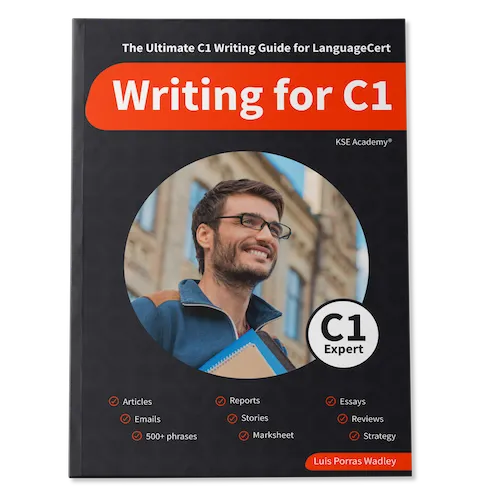
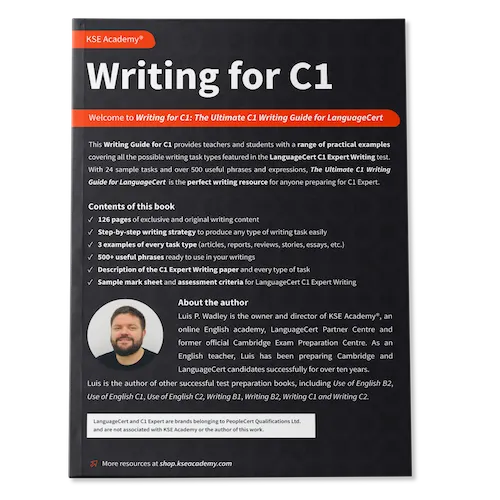
Si quieres practicar con muchos más ejemplos, tienes la guía de KSE Academy para el Writing C1 de LanguageCert. En ella encontrarás:
- Todos los tipos de tarea de la Part 1 y la Part 2, explicados en detalle.
- 3 tareas de ejemplo con su respuesta modelo para cada tipo de texto.
- Más de 500 expresiones útiles para tus writings.
- Una estrategia de escritura paso a paso para cualquier tipo de tarea.
- Los criterios de corrección y una hoja de evaluación de ejemplo.
Y con esto ya tienes todo lo que necesitas saber del Writing del C1 Expert. Si te queda alguna duda, déjame un comentario y te respondo encantado. 🙂
