
Tabla de contenidos
El C2 Mastery de LanguageCert es el nivel más alto de la serie International ESOL, y su Writing es la parte en la que más se nota si tu inglés está realmente a la altura de un C2. Tienes que escribir dos textos, uno formal y otro más personal, con la precisión y la naturalidad de un usuario experto del idioma.
Pero no te preocupes, porque, desde mi experiencia como preparador de exámenes, el Writing es también la parte en la que antes se nota el trabajo bien hecho. En esta guía te explico cómo es el Writing del C2 Mastery, qué te piden en la Part 1 y en la Part 2, cómo se corrige y, lo más importante, te enseño un ejemplo de Writing de cada tipo de tarea, con un breve análisis de lo que lo convierte en un texto de nivel C2. ¡Vamos allá!
Writing C2 Mastery: qué es el nivel C2
El C2 Mastery certifica un nivel C2 según el Marco Común Europeo de Referencia para las Lenguas (MCER). Es el nivel más alto del marco, y en lo que a expresión escrita se refiere, la tabla de autoevaluación del MCER lo describe así:
Soy capaz de escribir textos claros y fluidos en un estilo apropiado. Puedo escribir cartas, informes o artículos complejos que presentan argumentos con una estructura lógica y eficaz que ayuda al oyente a fijarse en las ideas importantes y a recordarlas. Puedo escribir resúmenes y reseñas de obras profesionales o literarias.
LanguageCert concreta qué espera de ti en el Writing de este nivel. En resumen, tienes que ser capaz de:
- Escribir textos bien estructurados sobre temas complejos o abstractos.
- Escribir cartas formales, reports y articles claros y fluidos, con un estilo adecuado al propósito y al lector.
- Narrar y describir con naturalidad, manteniendo el estilo de principio a fin.
- Desarrollar argumentos sólidos.
- Mantener un control constante de las estructuras complejas y usar un vocabulario muy amplio, con matices de significado y expresiones idiomáticas.
- Manejar con tacto situaciones delicadas, como quejas o desacuerdos.
- Organizar el texto con una buena variedad de mecanismos de cohesión y puntuar con precisión.
Como ves, los tipos de texto se parecen mucho a los del C1. La diferencia está en la calidad: más precisión, más naturalidad y un control del registro todavía más fino. Veamos ahora cómo es el examen.
Cómo es el Writing del C2 Mastery
El Writing forma parte del Written Exam del C2 Mastery, junto con el Listening y el Reading. El Listening va siempre primero, y después tienes 2 horas y 40 minutos para hacer el Reading y el Writing, en el orden que prefieras. No hay un tiempo fijo para el Writing, así que gestionarlo bien es parte del reto (más abajo te doy mis consejos).
En el Writing tienes que escribir dos textos:
| Part 1 | Part 2 | |
|---|---|---|
| Palabras | 200-250 | 250-300 |
| Registro | formal | informal o semiformal |
| Lector | un público general (un periódico, una empresa, los lectores de una revista…) | un lector concreto (un amigo, los lectores de una revista, el jurado de un concurso…) |
| Qué tienes que hacer | responder a un texto, unos datos o unas notas, expresando y justificando tu postura | escribir un texto más personal o creativo en el que tendrás que persuadir, argumentar, plantear hipótesis, valorar… |
| Tipos de texto | carta o email formal, report, argumentative essay, article (y a veces review) | carta o email personal, story, descriptive composition (y a veces article) |
| Puntuación | 12 puntos | 12 puntos |
En cada parte hay una sola tarea, así que no puedes elegir. Como en el C1, los puntos que tienes que tratar no suelen aparecer en una lista con viñetas, sino integrados en las instrucciones o en el propio material de partida. Por eso es fundamental leer el enunciado con lupa.
Tipos de Writing C2 Mastery
Veamos qué te pueden pedir en cada parte. Todas las tareas de esta guía las he escrito yo siguiendo el formato del examen, así que no son oficiales, pero son exactamente del mismo estilo. Los datos de los textos de partida también son inventados.
Writing C2 Mastery: Part 1
En la Part 1 tienes que responder de forma formal a un material de partida, que puede ser escrito, gráfico o una lista de notas: una columna de opinión, los resultados de una encuesta, una tabla… Además de usar la información, tendrás que posicionarte: dar tu opinión, justificarla, recomendar o argumentar. Una diferencia con el C1: aquí el argumentative essay forma parte de la Part 1.
Formal letter / formal email
Una tarea muy habitual es escribir una carta al director de un periódico respondiendo a un artículo de opinión. También puede ser un email formal a una empresa o a una institución:
The extract below appeared in a column in your local newspaper. Write a letter to the paper in which you react to the columnist’s argument and say whether you think the town should follow his advice.
Time to close the book on libraries
by Daniel Price
Our town spends almost half a million pounds a year keeping three public libraries open, yet most of us now read on screens, and anything a library holds can be found online. These buildings are quiet because they are no longer needed. The council should sell them and give every resident a free e-book subscription instead.
Write between 200 and 250 words.
Report
El report es el tipo de texto más típico cuando el material de partida es una encuesta o una tabla. Tienes que resumir los datos más relevantes y hacer recomendaciones, con un tono objetivo:
The company you work for, Northway Logistics, has seen a rise in the number of staff leaving. The Human Resources Director would like a report that sums up what the exit interviews held over the past two years revealed and proposes ways of keeping more employees.
Exit interviews 2025-2026: main reason for leaving (160 employees)
| Workload and long hours | 38% |
| No clear career progression | 29% |
| Salary | 21% |
| Moving to another area | 12% |
62% of leavers had worked for the company for less than three years.
Write between 200 and 250 words.
Argumentative essay
Un texto en el que defiendes una postura razonada sobre un tema de interés público, a menudo a partir de una cita o de dos opiniones enfrentadas:
A current affairs journal is publishing readers’ essays on whether young people should be required to complete a year of civic service. Write an essay for the journal in which you consider both opinions below and give your own view.
«A compulsory year of service, in hospitals, schools or conservation projects, would give young people skills, purpose and a real sense of belonging to their community.»
«Forcing young adults to work for a year, often for little or no pay, would delay their studies and careers and treat them as cheap labour.»
Write between 200 and 250 words.
Article
En un article para un periódico, una revista o una web tienes que comentar la información de partida y dar tu opinión, enganchando al lector:
A health and wellbeing magazine is running a series on modern lifestyles. Using the survey results below, write an article for the magazine in which you comment on what they reveal and say whether you think people are likely to change their habits.
How well do we sleep?
Survey of 1,800 adults by the Restwell Foundation
- Average sleep on weeknights: 6 hours 20 minutes (recommended: 7 to 9 hours).
- 48% look at their phone in the last ten minutes before going to sleep.
- 1 in 3 are kept awake by worries about work at least once a week.
- 71% believe they would be more productive if they slept more.
- Only 15% have changed their routine in the past year to sleep better.
Write between 200 and 250 words.
Review
La review no aparece en la lista oficial de tareas de la Part 1, pero ha salido en los exámenes de práctica de LanguageCert, así que conviene tenerla preparada. En ella valoras algo que has visto, leído o visitado:
A website for television and streaming fans has asked readers to review a recent documentary. You have just watched the series in your notes below. Write a review for the website, describing the series, giving your opinion of it and saying who you would recommend it to.
The Deep Unknown: 5 episodes, streaming on OceanView
- Deep-sea creatures never filmed before: astonishing
- Presenter Dr Amara Osei: warm, clear, never patronising
- Ep. 3 on deep-sea mining: important but one-sided
- Music sometimes over the top
- Ep. 5 ending: hopeful, moving
- Families with older children
Write between 200 and 250 words.
Writing C2 Mastery: Part 2
En la Part 2 tienes que escribir un texto más largo (entre 250 y 300 palabras) y más personal o creativo, para un lector concreto. Aquí no hay material de partida, solo las instrucciones. Las cartas a un amigo son informales, y las stories y compositions, semiformales. Las instrucciones te piden funciones de nivel C2: persuadir, argumentar, plantear hipótesis, expresar estados de ánimo o valorar.
Personal letter / informal email
Escribir a un amigo o a un familiar para aconsejarle, convencerle de algo o contarle una experiencia y cómo te sentiste:
Last month you decided to live without your smartphone for four weeks as an experiment. Write an email to a friend describing how you felt during the experience, imagining how your friend would cope without their own phone, and persuading them to try it.
Write between 250 and 300 words.
Story
Un relato, normalmente para un concurso o una revista, que tiene que responder claramente a lo que pide la tarea (un título, una situación, un refrán…):
A literary magazine is inviting entries for its annual short story prize. Every story must illustrate the proverb «Be careful what you wish for». Send in your entry.
Write between 250 and 300 words.
Descriptive composition
Describir una persona, un lugar o una experiencia y explicar qué ha significado para ti:
A magazine has launched a series called «The View from My Window», in which readers describe a view they have known for many years. Write a composition describing the view and the way it changes, and explain what living with it every day has meant to you.
Write between 250 and 300 words.
En la Part 2 también puede aparecer un article, con un tono más personal que el de la Part 1. La estructura es la misma que la del ejemplo de article que verás a continuación.
Ejemplos de Writing C2 Mastery
En esta sección tienes una respuesta modelo para cada tarea. Todas son originales y están escritas para simular un nivel C2, para que veas qué se espera de ti de forma realista. Debajo de cada una te explico brevemente qué la hace funcionar.
Ejemplo de Writing C2 Mastery: formal letter
Respuesta a la tarea de la columna sobre las bibliotecas. Es una carta que discrepa con firmeza, pero con tacto:
Dear Editor,
I read Daniel Price’s column on the future of our public libraries with growing disbelief. His proposal may sound modern, but it rests on a view of libraries that is at least twenty years out of date.
Mr Price assumes that a library is simply a warehouse for books, and that once the books can be downloaded, the building serves no purpose. Anyone who has visited the Central Library on a weekday afternoon will know otherwise. It is where pensioners learn to bank online, where job seekers without a printer apply for work and where teenagers from crowded homes find somewhere quiet to revise. None of this can be delivered through an e-book subscription.
His point about cost is equally unconvincing. Half a million pounds is a modest sum when set against everything the libraries provide, and the money raised by selling three buildings could only be spent once, whereas the loss would be permanent. A free subscription, moreover, is of little use to residents who own no device or lack the confidence to use one.
I do accept that our libraries must change if they are to survive. Longer opening hours, up-to-date computers and closer ties with local schools would draw in the very people Mr Price believes have stopped coming. The question the council should be asking, therefore, is not whether we can afford our libraries, but whether we can afford to lose them.
Yours faithfully,
Laura Bennett
- Una respuesta a cada argumento de la columna (la utilidad de las bibliotecas y el coste), con ejemplos concretos de quién las usa.
- Una concesión antes del cierre (I do accept that our libraries must change), que hace la carta más convincente.
- Registro formal impecable y una frase final muy redonda: not whether we can afford our libraries, but whether we can afford to lose them.
Ejemplo de Writing C2 Mastery: report
Respuesta a la tarea de las entrevistas de salida. Fíjate en que los datos no se copian, sino que se interpretan:
Staff Turnover at Northway Logistics
Introduction
This report outlines what departing employees told us in exit interviews over the past two years and proposes measures that could reduce staff turnover.Findings
Workload emerged as the principal cause of resignations, mentioned by 38% of the 160 leavers, many of whom described regular overtime as unsustainable. Close behind came the absence of a clear career path (29%), while pay was the deciding factor for roughly one in five. Only 12% left for reasons beyond our control, namely moving away. Perhaps most telling is that almost two thirds had been with us for under three years, which indicates that we are losing staff just as their training begins to pay off.Recommendations
With this in mind, I would propose that the company:
• review staffing levels in the busiest departments, so that overtime becomes the exception rather than the rule;
• give every new employee a development plan, reviewed after their first twelve months;
• compare its salaries with those of competitors and close any significant gaps.Conclusion
Keeping experienced staff costs considerably less than recruiting and training their replacements. Should these measures be adopted, there is every reason to expect turnover to fall and the company to benefit from a more settled, motivated workforce.
- Datos reformulados y comparados: Close behind came…, roughly one in five, almost two thirds.
- Una conclusión propia a partir de los datos: we are losing staff just as their training begins to pay off.
- Recomendaciones conectadas con cada resultado y una inversión condicional en la conclusión (Should these measures be adopted).
Ejemplo de Writing C2 Mastery: argumentative essay
Respuesta a la tarea sobre el servicio cívico. En el C2 no basta con dar argumentos a favor y en contra: el texto tiene que llevar a una conclusión propia:
A Year for the Common Good?
Few proposals divide opinion as sharply as the idea that every young adult should spend a year serving the community. Supporters regard it as an investment in citizenship; critics, as an unfair demand on a generation already under considerable pressure.
The case in favour is not hard to make. A year spent caring for the elderly or restoring woodland would expose young people to lives very different from their own, and many would discover abilities that no classroom had ever drawn out. Society would gain too, since chronically understaffed services could count on a steady supply of willing hands.
However, the word «compulsory» changes everything. Service that is imposed rather than chosen risks breeding resentment, and those who stand to gain most are seldom the ones eager to take part. Unless participants were properly paid, the scheme would also penalise students from poorer families, for whom twelve months without earnings could mean giving up on university altogether.
In my view, the principle deserves support, but compulsion does not. A well-funded voluntary programme, valued by employers and universities and offering a fair allowance, would capture most of the benefits without the drawbacks. Were governments to make such a year genuinely attractive, they might well discover that obliging anyone to serve had never been necessary.
- Las dos opiniones de la tarea tratadas en un párrafo cada una, con argumentos desarrollados.
- Una opinión matizada que acepta la idea pero rechaza la obligación: the principle deserves support, but compulsion does not.
- Estructuras de C2 como Few proposals divide opinion as sharply as… o Were governments to make such a year genuinely attractive.
Ejemplo de Writing C2 Mastery: article
Respuesta a la tarea de la encuesta sobre el sueño. Un article de C2 combina datos, opinión y un estilo que mantiene el interés del lector:
Wide Awake: Why We Know Better but Sleep Worse
Most of us would never skip a meal to answer an email, yet we routinely sacrifice sleep for exactly that reason. According to a new survey by the Restwell Foundation, the average adult now manages just six hours and twenty minutes on a weeknight, well short of what experts recommend.
The causes will surprise nobody. Almost half of the 1,800 people questioned admit to scrolling through their phones in the final minutes before turning off the light, and one in three is regularly kept awake by worries about work. Our bedrooms, it seems, have quietly become extensions of the office.
What is striking is not that we sleep badly, but that we know it. A remarkable 71% believe more rest would make them more productive, and yet a mere 15% have done anything about it in the past year. Knowing what is good for us, evidently, is not the same as acting on it.
Will this change? Not of its own accord. Habits formed over years rarely give way to statistics, however alarming. Change is more likely to come from employers who discourage late-night messages, and from small routines such as leaving the phone in another room. Until then, many of us will go on lying awake, perfectly aware of what we ought to be doing.
- Un inicio que engancha con una comparación inesperada: saltarse una comida frente a sacrificar horas de sueño.
- Uso crítico de los datos: el texto se fija en la contradicción entre lo que sabemos y lo que hacemos.
- Un último párrafo que responde a la segunda parte de la tarea (si cambiaremos nuestros hábitos).
Ejemplo de Writing C2 Mastery: review
Respuesta a la tarea del documental. Una buena review de C2 valora con matices y no se limita a decir si te ha gustado:
Into the Dark: The Deep Unknown
Television has taken us to the ocean floor before, but seldom with such a sense of genuine discovery. The Deep Unknown, a five-part series now streaming on OceanView, brings back footage of creatures no camera had ever recorded, and the results are frequently astonishing.
Much of the credit belongs to its presenter, the marine biologist Dr Amara Osei. Her enthusiasm is infectious, and she has a rare gift for explaining complex science without ever talking down to her audience.
The series is not flawless. The third episode, on the impact of deep-sea mining, raises questions that urgently need asking, but it gives the industry’s side so little time that it feels more like a campaign than an investigation. The soundtrack, too, occasionally swells to a pitch better suited to a disaster film, as if the images were not dramatic enough on their own.
These reservations aside, this is documentary making of a very high order. The final episode, which follows scientists working to protect a newly discovered reef, ends on a note of cautious hope that is all the more moving for being understated. Families with older children will find it both thrilling and thought-provoking, and I would recommend it to anyone who has ever wondered what lies beneath the waves.
- Todos los puntos de las notas, convertidos en texto con un vocabulario evaluativo preciso: infectious, talking down to, understated.
- Equilibrio: una valoración muy positiva que reconoce dos defectos.
- Una recomendación clara para el público que indicaban las notas.
Ejemplo de Writing C2 Mastery: personal letter
Respuesta a la tarea del mes sin móvil. Aquí hay que expresar estados de ánimo, plantear hipótesis y persuadir, sin perder la naturalidad de un email a un amigo:
Hi Sam,
You’ll never guess what I’ve been up to. Remember how I kept moaning that I spent half my life staring at a screen? Well, I finally did something about it: I locked my phone in a drawer for a whole month and made do with an ancient model that only makes calls.
I won’t pretend the first week was easy. I kept reaching for my pocket every few minutes, and I felt strangely on edge, as if the world were carrying on without me. Getting around was a nightmare too, with nothing but a paper map and the kindness of strangers.
By the second week, though, something had shifted. I read on the bus instead of scrolling, I slept far better and I actually remembered conversations, because I’d been listening rather than half-checking messages. Had anyone told me a month ago that I’d enjoy it, I’d have laughed in their face. What surprised me most was how little I’d missed: the news still happened, my friends still found me, and nobody minded waiting a day for a reply.
Now, I know exactly what you’re thinking: «That’s fine for you, but I’d go mad.» And you probably would, for about three days! You’d miss the football scores and the group chat, and you’d be convinced something dreadful was happening without you. But knowing you, once the withdrawal wore off, you’d love having your evenings back.
So here’s my challenge: try it for a fortnight. If nothing changes, you can tell me I’m turning into my grandmother and I won’t argue. If it does, you owe me dinner.
Write back soon (by email, obviously)!
Love,
Alex
- Registro informal pero rico: contracciones y expresiones como moaning, made do with, on edge o laughed in their face.
- La evolución de lo que sintió, de la ansiedad de la primera semana a la sorpresa posterior.
- Hipótesis sobre su amigo (you’d miss the football scores…) y un reto final con humor.
Ejemplo de Writing C2 Mastery: story
Respuesta a la tarea del concurso de relatos. La historia ilustra el refrán sin necesidad de explicarlo hasta el final:
Be Careful What You Wish For
For three years, Martin had wished, every single night, that the man upstairs would move out. Mr Kowalski practised the trumpet at seven each morning, dropped what sounded like bowling balls onto his floor at midnight and sang, badly, in the shower. Martin had complained, slipped polite notes under his door and, eventually, stopped speaking to him altogether.
So when he came home one wet Tuesday to find a removal van outside the building, he could hardly contain his delight. That evening, for the first time in years, the flat above was silent. Martin opened a bottle of wine and toasted his good fortune.
The silence lasted precisely four days. On the fifth, the new tenants arrived: a young couple, a toddler, a drum kit and, judging by the barking, at least two large dogs. Within a week, Martin was lying awake at three in the morning, listening to a nursery rhyme being hammered out on the drums and wondering how he had ever found the trumpet annoying.
Then, one Sunday, a postcard dropped through his letterbox. It was from Mr Kowalski, who now lived by the sea. «Sorry for all the noise,» it read. «I was learning to play for my granddaughter’s wedding. She says I’m almost good enough now. Thank you for your patience.»
Martin read it twice and sat down heavily. Not once in three years, it dawned on him, had he asked his neighbour why he played. He stuck the postcard on the fridge, where it stayed for many years: a reminder that the thing we most long to be rid of is sometimes the thing we end up missing.
- Un personaje y un conflicto claros desde la primera frase.
- Humor y detalles concretos en lugar de adjetivos genéricos: a nursery rhyme being hammered out on the drums.
- Un giro final que da sentido al título, con una inversión (Not once in three years… had he asked).
Ejemplo de Writing C2 Mastery: descriptive composition
Respuesta a la tarea de la vista desde la ventana. La clave está en combinar la descripción con la reflexión sobre lo que ha significado para ti:
The Wall Opposite
My bedroom window never offered anything that might appear on a postcard. For the eighteen years I lived in my parents’ flat, it looked out onto the back of an old textile factory: a vast brick wall, blackened in places, with a single row of windows near the top and a drainpipe that ran crookedly from the roof to the yard below.
As a child, I resented it. My friends had views of parks or of the river; I had bricks. Yet over the years I came to know that wall more intimately than any landscape. In winter, frost gathered in the gaps between the bricks, so that on clear mornings the whole surface seemed to glitter. In spring, a stubborn buddleia forced its way out of the gutter, and by July it was covered in purple flowers and visited by butterflies that had no business being in the middle of a city. And on summer evenings the setting sun turned the brickwork the colour of copper, so that for ten minutes my dull view became something close to beautiful.
It was that wall, I suspect, that taught me to look closely. When there is little to see, you begin to notice everything: the pigeon that returned to the same broken pane each spring, the way rain darkened the bricks from the top down.
These days I live on the top floor of a building with a view of the mountains that guests never fail to photograph. It is, by any standard, a finer view. And yet, on grey mornings, I sometimes find myself missing that wall, which asked nothing of me and taught me more than I ever realised.
- Una vista poco atractiva que se vuelve interesante gracias a los detalles de cada estación.
- Vocabulario descriptivo preciso: blackened, crookedly, glitter, the colour of copper.
- La reflexión que pide la tarea y un cierre que contrasta la vista de antes con la de ahora.
Cómo se evalúa el Writing del C2 Mastery
Cada tarea se corrige por separado según cuatro criterios, y en cada uno puedes sacar de 0 a 3 puntos. Es decir, cada tarea vale 12 puntos y el Writing completo, 24.
| Criterio | Qué se valora |
|---|---|
| Task Fulfilment | Si cumples la tarea por completo: el lector queda bien informado, el género y el tono son los adecuados y respetas el número de palabras. |
| Accuracy and Range of Grammar | Si usas con seguridad una gama completa de estructuras complejas. |
| Accuracy and Range of Vocabulary | Si usas un vocabulario amplio y preciso, incluidas palabras y expresiones menos comunes. Aquí también cuenta la ortografía. |
| Organisation | Si el texto está bien organizado y es coherente, con variedad de mecanismos de cohesión y una estructura adecuada al tipo de texto. Aquí también cuenta la puntuación. |
Para sacar la máxima nota en cada criterio, los errores tienen que ser como mucho despistes, y el vocabulario y las estructuras complejas tienen que aparecer de forma natural, no forzada.
Después, los puntos del Writing se convierten a una escala sobre 50 y se suman a los del Listening y el Reading. Para aprobar el Written Exam necesitas 75 de 150 en total (Pass), y a partir de 101 obtienes un High Pass. Te lo explico con un ejemplo en mi guía completa del C2 Mastery.
¿Me penalizan si me paso o me quedo corto de palabras?
Según los criterios de LanguageCert:
- Si no llegas al mínimo, se tiene en cuenta al puntuar el Task Fulfilment, así que te puede costar puntos.
- Si te pasas, no hay una penalización directa, pero escribir de más suele traducirse en más errores y en un texto de menor calidad.
- Si el texto no trata el tema de la tarea (off-topic), no recibe ningún punto.
Mi recomendación: no te quedes cerca del mínimo y apunta a la parte alta del rango en las dos tareas. Se acepta tanto la ortografía británica como la americana, siempre que seas coherente.
Consejos para el Writing del C2 Mastery
Estos son los consejos que doy a mis alumnos de C2 Mastery:
- Reserva tiempo de sobra para el Writing. Entre las dos tareas tienes que escribir hasta 550 palabras, y eso lleva tiempo. Como el Reading y el Writing comparten 2 horas y 40 minutos, dedica al Writing al menos una hora y cuarto.
- Lee el enunciado con lupa. Asegúrate de que todo lo que te piden las instrucciones y el material de partida tiene su lugar en tu texto.
- No copies el material de partida. Usa la información, pero con tus propias palabras.
- Cuida el registro. La Part 1 es formal y la Part 2 más personal, pero en el C2 se espera un control muy fino del tono.
- Demuestra tu nivel con naturalidad. Un texto lleno de estructuras y palabras forzadas suena peor que uno sencillo y bien escrito.
- Planifica y revisa. Haz un esquema rápido antes de escribir y reserva unos minutos al final para revisar.
Si estás dudando entre exámenes, también tienes mi guía del Writing del C2 Proficiency de Cambridge, para que compares los dos formatos. Y si te estás preparando el nivel anterior, aquí tienes la guía del Writing del C1 Expert. Si quieres que un profesor corrija tus textos, echa un vistazo a mi servicio de corrección de Writing C2 Mastery.
Guía para el Writing C2 Mastery con ejemplos
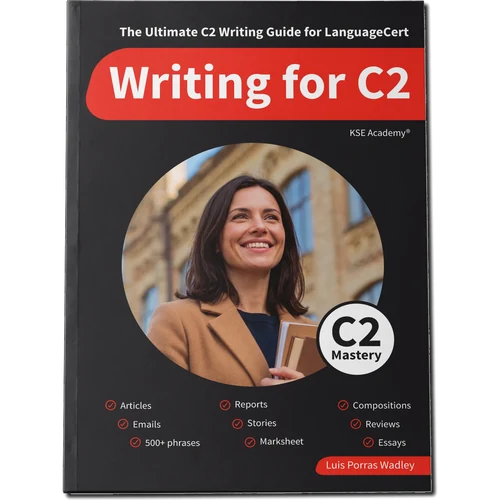
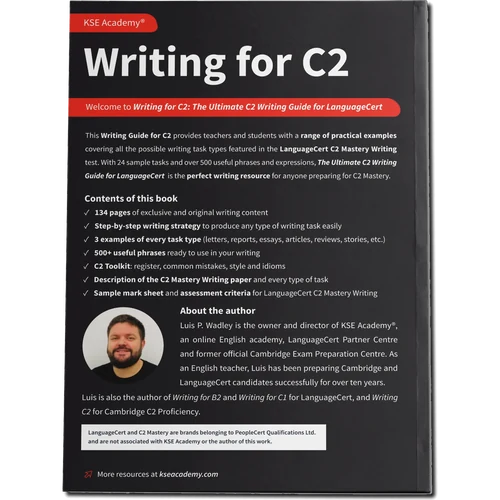
Si quieres practicar con muchos más ejemplos, tienes la guía de KSE Academy para el Writing C2 de LanguageCert. En ella encontrarás:
- Todos los tipos de tarea de la Part 1 y la Part 2, explicados en detalle.
- 3 tareas de ejemplo con su respuesta modelo para cada tipo de texto.
- Más de 500 expresiones útiles para tus writings.
- Una estrategia de escritura paso a paso para cualquier tipo de tarea.
- Los criterios de corrección y una hoja de evaluación de ejemplo.
Y con esto ya tienes todo lo que necesitas saber del Writing del C2 Mastery. Si te queda alguna duda, déjame un comentario y te respondo encantado. 🙂
