
Table of contents
The C2 Proficiency (CPE) Reading paper is, for many candidates, the toughest part of the whole exam, and with good reason. The texts are long, the vocabulary is literary and the wrong options are written to look right to anyone reading in a hurry. Yet what the exam asks of you never really changes: read precisely, pick up what the writer implies and don’t be swayed by words that simply reappear in the options.
Here you’ll see how the Cambridge C2 Reading is organised, which parts actually count as Reading (Part 1 may surprise you), how much it weighs in your final result and how to split your time. Most useful of all, you’ll find Parts 5, 6 and 7 of the official sample paper fully solved, with an explanation for every answer and for why the traps don’t work. 🙂
What the C2 Proficiency Reading looks like
At C2 Proficiency, Reading doesn’t stand alone. It shares a single paper with Use of English, Reading and Use of English, which lasts 1 hour 30 minutes and has seven parts and 53 questions. There’s no separate clock for each section, so dividing up the time is down to you.
| Part | What you read | Task | Questions | Marks | Counts as |
|---|---|---|---|---|---|
| 1 | A short text with eight gaps | Multiple-choice cloze: choose from four options | 8 | 8 | Reading |
| 2 | A text with eight gaps | Open cloze: write one word | 8 | 8 | Use of English |
| 3 | A text with eight gaps | Word formation: change the word given | 8 | 8 | Use of English |
| 4 | Six separate sentences | Key word transformation: rewrite in 3 to 8 words | 6 | 12 | Use of English |
| 5 | One long text (fiction, essay, article) | Multiple choice: six four-option questions | 6 | 12 | Reading |
| 6 | A text with seven paragraphs removed | Gapped text: put paragraphs A-H back (one is extra) | 7 | 14 | Reading |
| 7 | One text in sections or several short texts | Multiple matching: match ten statements | 10 | 10 | Reading |
On paper, your answers go on a separate answer sheet and you must transfer them within those 90 minutes: there is no extra time at the end. In the computer-based exam you type straight onto the screen, and a timer shows how long you have left.
Which parts are Reading and which are Use of English?
This is where plenty of people go wrong, including quite a few preparation websites. Cambridge’s official handbook is perfectly clear: the Reading section is made up of Parts 1, 5, 6 and 7, and the Use of English section of Parts 2, 3 and 4. So Part 1, even though it looks like a vocabulary exercise, is scored as Reading.
Add up the marks in the table and Reading accounts for 44 of the paper’s 72 marks (8 + 12 + 14 + 10), with Use of English on 28. There’s another detail hardly anyone mentions: in Parts 5 and 6 each correct answer is worth two marks, while in Part 7 it’s worth one. A Part 6 question carries twice the weight of a Part 7 question, and that ought to shape how you plan your time.
How much does Reading count in your final result?
C2 Proficiency assesses five things: Reading, Use of English, Writing, Listening and Speaking. Each gets its own score on the Cambridge English Scale, and your overall result is the average of the five. They all carry equal weight, so Reading is 20% of your result, exactly like Use of English, even though both come from the same 90-minute paper.
In practice, that means a weaker Reading score can be offset by a strong Writing or Speaking, because the certificate depends on the average. If you’d like to crunch the numbers from your practice tests, try the C2 Proficiency score calculator.
What each Reading part tests
According to the handbook, each part has a different focus:
| Part | What it tests |
|---|---|
| 1 | Vocabulary: idioms, collocations, fixed phrases, phrasal verbs and semantic precision |
| 5 | Detail, opinion, attitude, tone, purpose, main idea, meaning from context, implication and text organisation |
| 6 | Cohesion, coherence, text structure and global meaning |
| 7 | Detail, opinion, attitude and specific information |
At this level, very little is stated outright. The text puts an idea one way and the correct option puts it another, so your job is to recognise the same idea in different clothes.
Part 1: Multiple-choice cloze
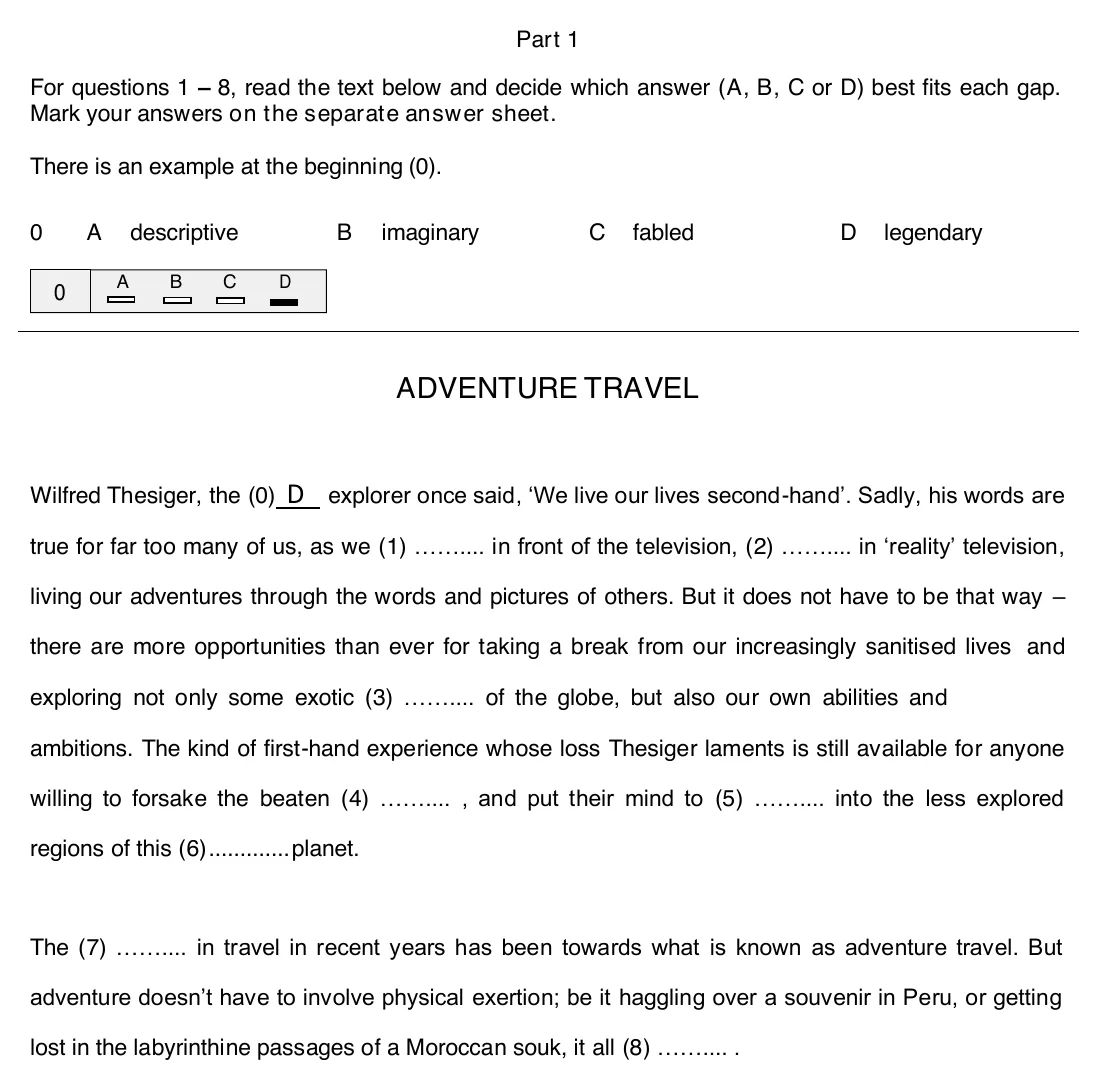
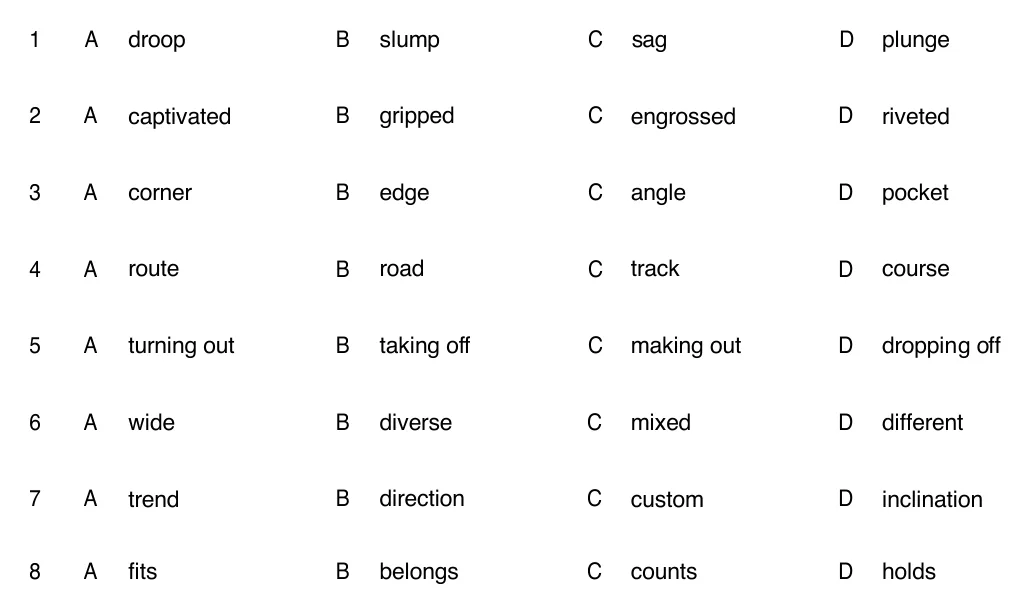
A short text with eight gaps and four options for each. The four options usually mean something similar, and only one fits because of the word it goes with: a collocation, a preposition or a fixed phrase. As I said above, this part officially counts as Reading, but it works like Use of English, which is why you’ll find it solved step by step in the C2 Proficiency Use of English guide.
In the sample paper, the text is about adventure travel, and one question rewards anyone who knows the beaten track: only track completes that phrase, even though route, road and course are all ways of getting somewhere. Here is the whole of Part 1:
Part 5: Multiple choice
One long text, often an extract from a novel or an essay, with six four-option questions that follow the order of the text. It’s the part closest to what most people picture when they think of a reading test, and it’s also the one that eats up most time. The questions revolve around how characters feel, what the writer implies and what a paragraph or a sentence is there for.
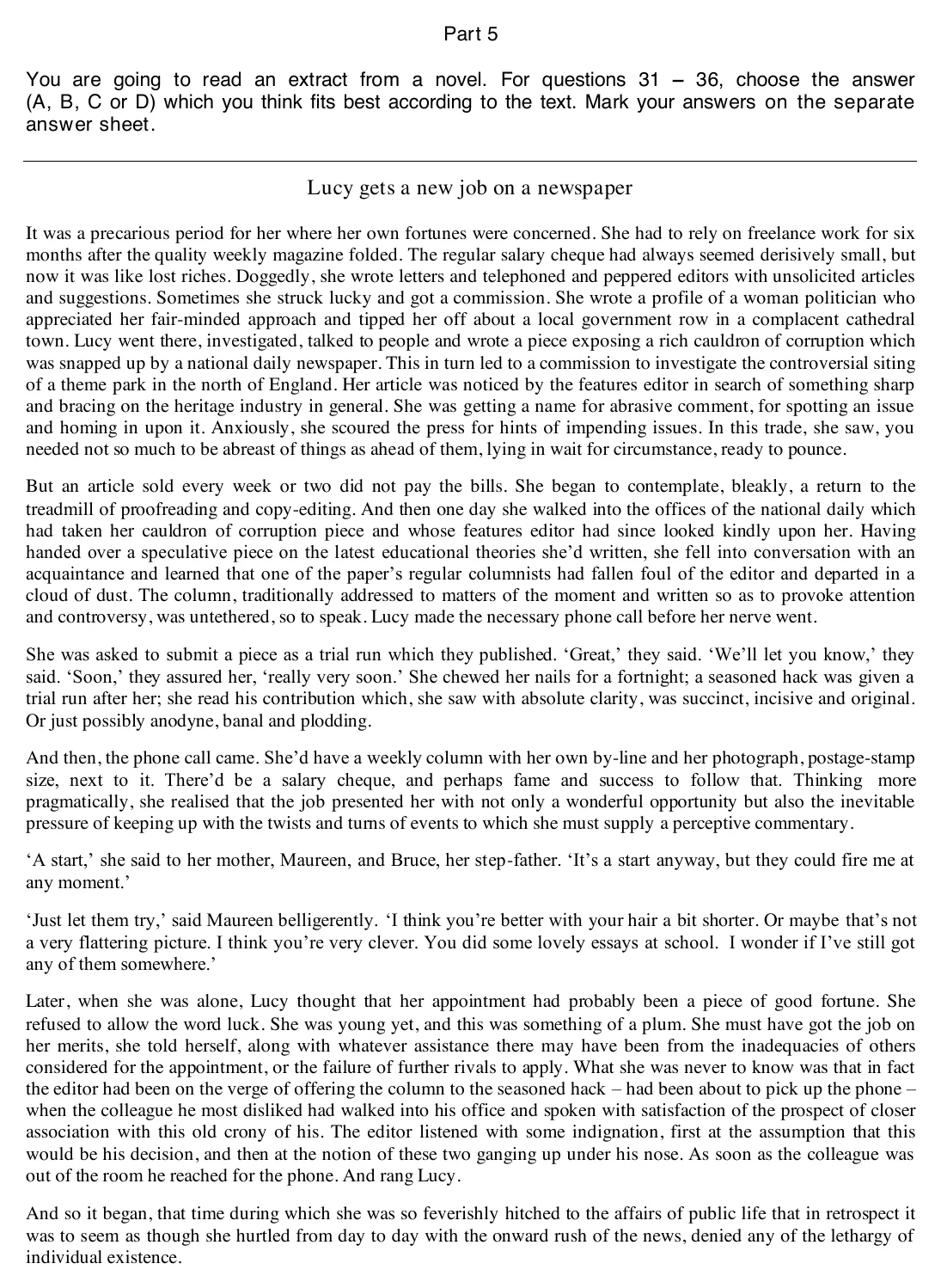
In the sample paper, the text is an extract from a novel in which Lucy, a journalist scraping a living as a freelancer, lands a column on a national newspaper. Here are the instructions and the questions, with the original text just below:
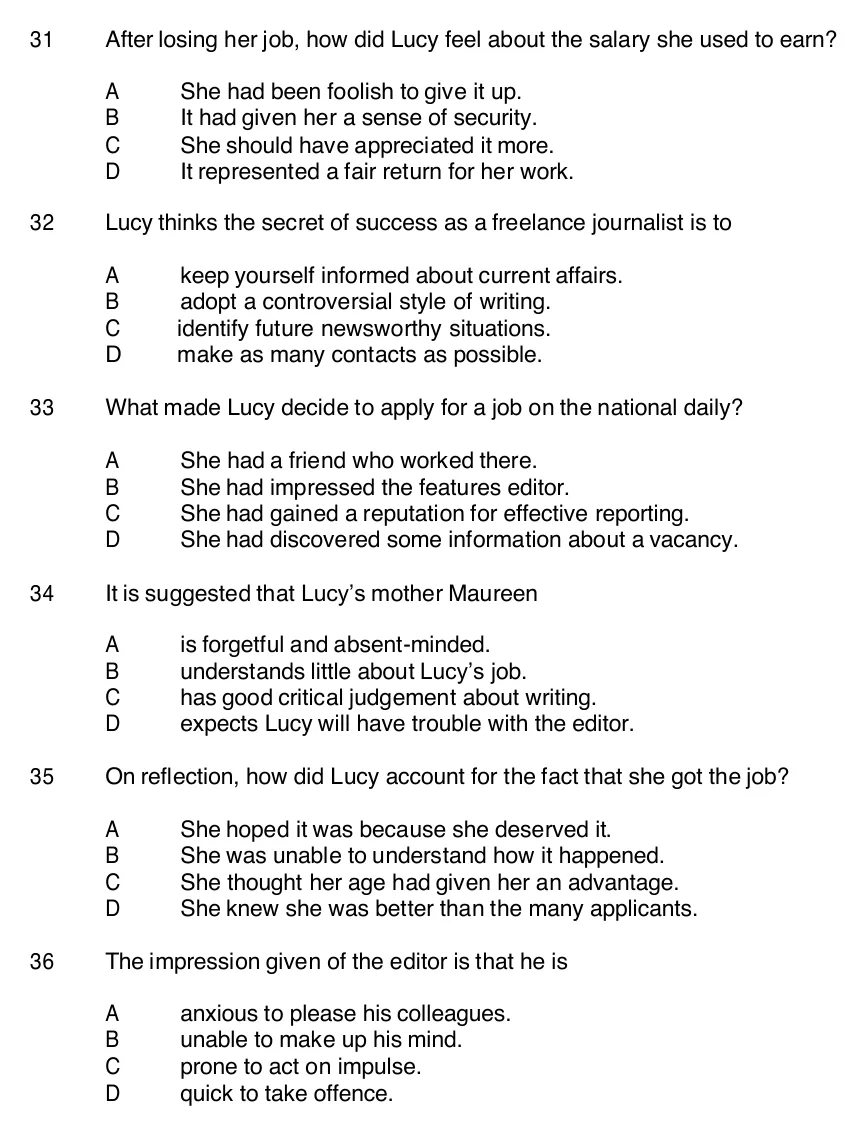
You are going to read an extract from a novel. For questions 31-36, choose the answer (A, B, C or D) which you think fits best according to the text. Mark your answers on the separate answer sheet.
- After losing her job, how did Lucy feel about the salary she used to earn?
- A) She had been foolish to give it up.
- B) It had given her a sense of security.
- C) She should have appreciated it more.
- D) It represented a fair return for her work.
- Lucy thinks the secret of success as a freelance journalist is to
- A) keep yourself informed about current affairs.
- B) adopt a controversial style of writing.
- C) identify future newsworthy situations.
- D) make as many contacts as possible.
- What made Lucy decide to apply for a job on the national daily?
- A) She had a friend who worked there.
- B) She had impressed the features editor.
- C) She had gained a reputation for effective reporting.
- D) She had discovered some information about a vacancy.
- It is suggested that Lucy’s mother Maureen
- A) is forgetful and absent-minded.
- B) understands little about Lucy’s job.
- C) has good critical judgement about writing.
- D) expects Lucy will have trouble with the editor.
- On reflection, how did Lucy account for the fact that she got the job?
- A) She hoped it was because she deserved it.
- B) She was unable to understand how it happened.
- C) She thought her age had given her an advantage.
- D) She knew she was better than the many applicants.
- The impression given of the editor is that he is
- A) anxious to please his colleagues.
- B) unable to make up his mind.
- C) prone to act on impulse.
- D) quick to take offence.
Show answers
- C: The regular salary cheque had always seemed derisively small, but now it was like lost riches. She once looked down on it and now she misses it, so she values it in a way she didn’t at the time. A fails because she didn’t give the job up: the magazine folded.
- C: The key is not so much to be abreast of things as ahead of them. A describes exactly what the text says is not enough (abreast means up to date), and B echoes Lucy’s name for abrasive comment, which isn’t what she identifies as the secret of the trade.
- D: In the newspaper office she hears from an acquaintance that a columnist had fallen foul of the editor and departed, and she phones before her nerve went. That news of an empty column is what triggers it. The acquaintance isn’t a friend on the staff (A), and the kindly features editor (B) is true but isn’t what makes her decide.
- B: Maureen talks about Lucy’s hair, whether the photo flatters her and the essays she wrote at school; not a word about the column or the paper. The implication is that she has little grasp of what the job involves. I wonder if I’ve still got any of them doesn’t make her absent-minded (A), and lovely essays is motherly pride, not critical judgement (C).
- A: She refused to allow the word luck and She must have got the job on her merits, she told herself. That told herself shows she wants to believe it, hence hoped. D overstates things: the text mentions the inadequacies of other candidates and rivals who never applied, not a certainty that she beat many applicants.
- C: He was about to phone the experienced journalist, gets annoyed with a colleague and as soon as the colleague was out of the room he reached for the phone. And rang Lucy. He reverses the decision on the spot, out of pique. D is tempting because of with some indignation, but nothing suggests he is generally touchy: what the scene shows is a snap decision.
Look back over the six answers and you’ll notice that none of them rests on a sentence that says the same as the option. In question 34, for instance, the text never states that Maureen doesn’t understand her daughter’s job: you infer it from the fact that she only talks about hair and the photo. And in question 32 the trap uses the very word from the text, abreast, in the option the writer rules out. When an option copies words from the text, be suspicious before you choose it.
Part 6: Gapped text
A long article with seven paragraphs taken out. They appear in jumbled order after the text, along with an eighth that doesn’t belong anywhere. At C2, whole paragraphs are removed rather than sentences, so checking the sentence before the gap isn’t enough: you need to follow the thread of the entire text.
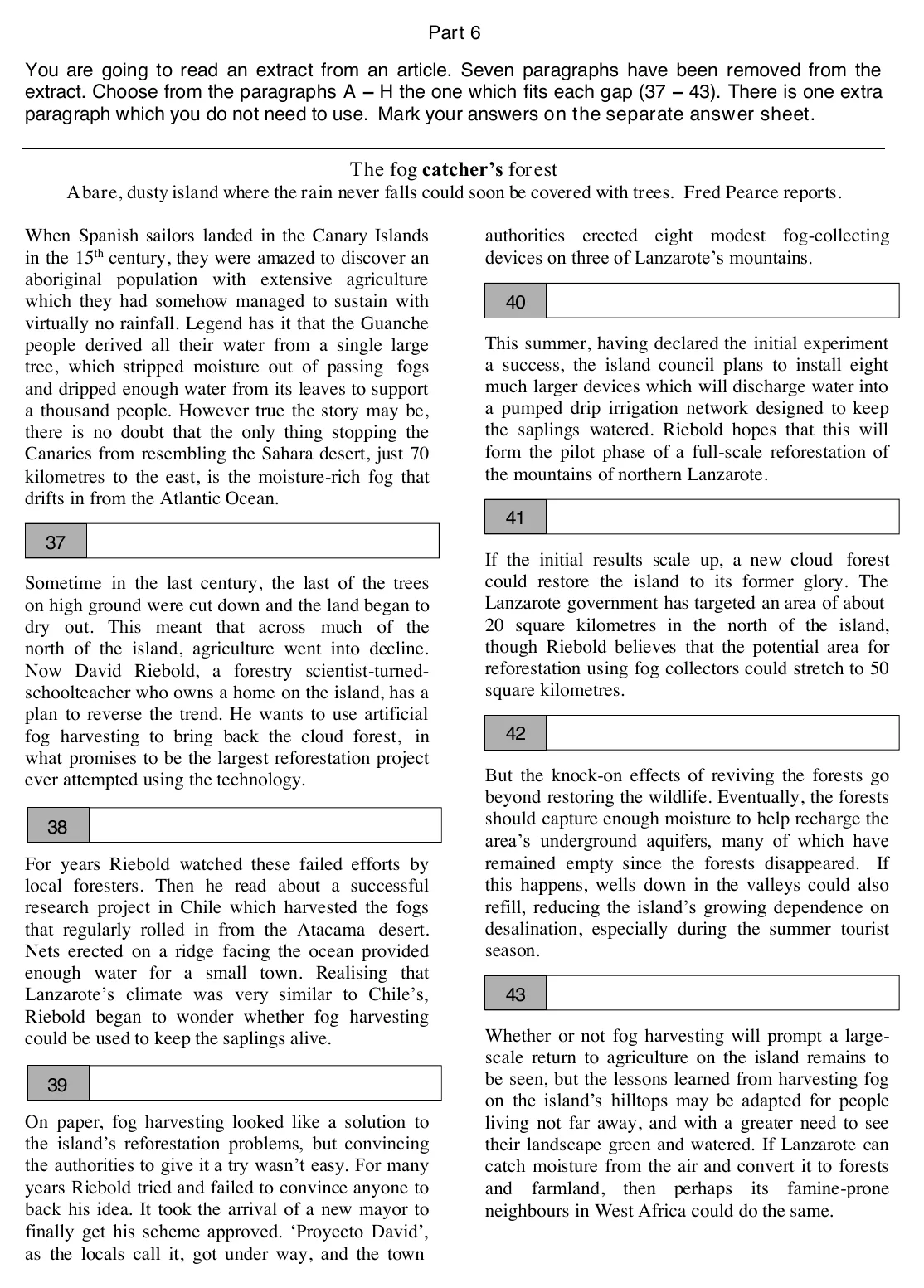
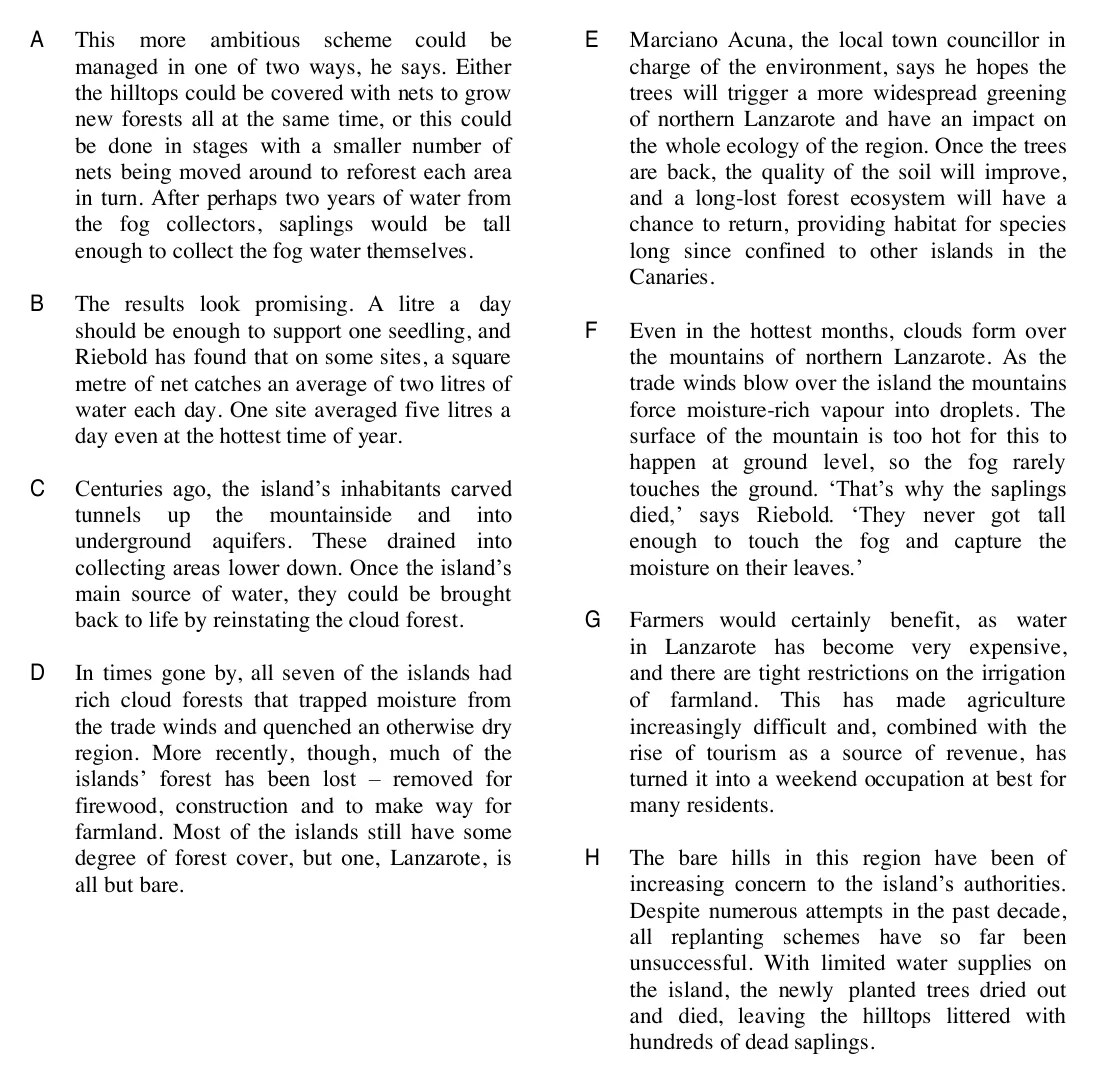
In the sample paper, the article describes a scientist’s plan to bring trees back to the mountains of northern Lanzarote using fog collectors. Here are the instructions, with the article and the paragraphs below:
You are going to read an extract from an article. Seven paragraphs have been removed from the extract. Choose from the paragraphs A-H the one which fits each gap (37-43). There is one extra paragraph which you do not need to use. Mark your answers on the separate answer sheet.
Show answers
- D: Before the gap, fog drifting in from the Atlantic; after it, the last of the trees on high ground were cut down. D says all seven islands once had cloud forests and that Lanzarote is now all but bare, which is exactly what the next paragraph goes on to explain.
- H: Next comes For years Riebold watched these failed efforts. That these needs failed attempts just before it, and H describes replanting schemes that failed and hundreds of dead saplings.
- F: Riebold wonders whether fog could keep the saplings alive. F explains why they died (They never got tall enough to touch the fog), and then the text moves on to On paper, fog harvesting looked like a solution.
- B: Eight modest fog-collecting devices go up; after the gap, having declared the initial experiment a success. B, The results look promising, with its litres per square metre, bridges the experiment and that success.
- A: This more ambitious scheme picks up the full-scale reforestation just mentioned, and If the initial results scale up afterwards continues the idea of expanding the project.
- E: After the gap: the knock-on effects of reviving the forests go beyond restoring the wildlife. To say beyond, someone must already have mentioned wildlife, and that is what the councillor does in E with providing habitat for species.
- G: Wells refilling and less dependence on desalination lead into Farmers would certainly benefit, and the text continues Whether or not fog harvesting will prompt a large-scale return to agriculture. C is the extra paragraph: its tunnels and aquifers are tempting at 43 because the previous paragraph mentions aquifers, but they don’t connect with the return to farming.
Almost every answer in this part is confirmed by what comes after the gap. These failed efforts at 38, the initial experiment at 40 and beyond restoring the wildlife at 42 only make sense if the previous paragraph has prepared the ground. Demonstratives (this, these), pronouns and words that sum up an earlier idea are your best clues; for more on them, see the post on former and latter. And the extra paragraph is rarely absurd: C is on topic and close to a detail near gap 43, but it doesn’t connect with what follows.
Part 7: Multiple matching
Ten statements and a text divided into sections (or several short texts by different writers). You decide which section each idea appears in, and the same section can be the answer more than once. Each correct answer is worth one mark, half the value of Parts 5 and 6, but there are ten questions and they can be answered fairly quickly if you read the statements carefully first.
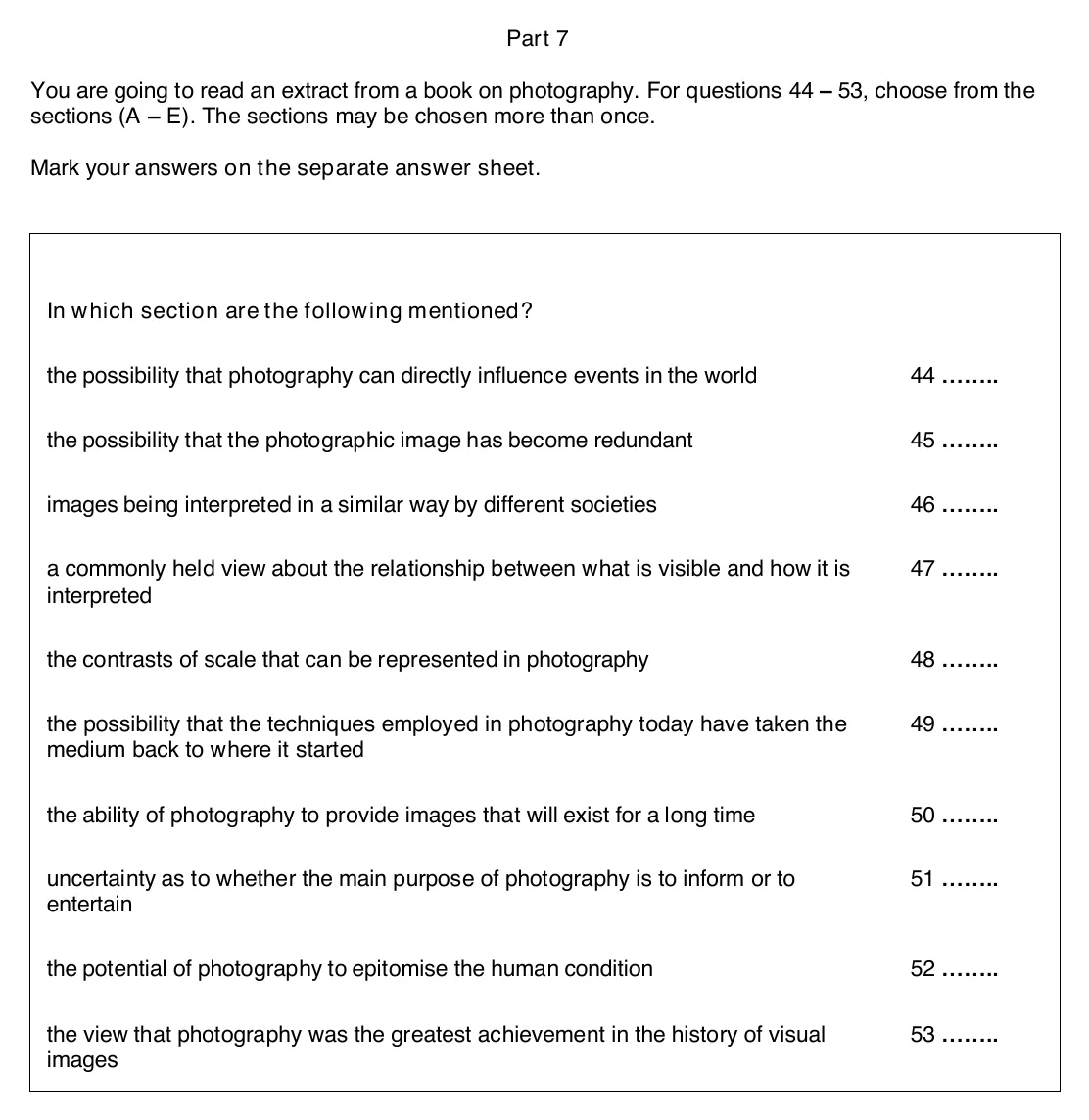
In the sample paper, the text is an extract from a book on the history of photography, in five sections. Here are the instructions and the ten statements, with the text below:
You are going to read an extract from a book on photography. For questions 44-53, choose from the sections (A-E). The sections may be chosen more than once. Mark your answers on the separate answer sheet.
In which section are the following mentioned?
- the possibility that photography can directly influence events in the world
- the possibility that the photographic image has become redundant
- images being interpreted in a similar way by different societies
- a commonly held view about the relationship between what is visible and how it is interpreted
- the contrasts of scale that can be represented in photography
- the possibility that the techniques employed in photography today have taken the medium back to where it started
- the ability of photography to provide images that will exist for a long time
- uncertainty as to whether the main purpose of photography is to inform or to entertain
- the potential of photography to epitomise the human condition
- the view that photography was the greatest achievement in the history of visual images
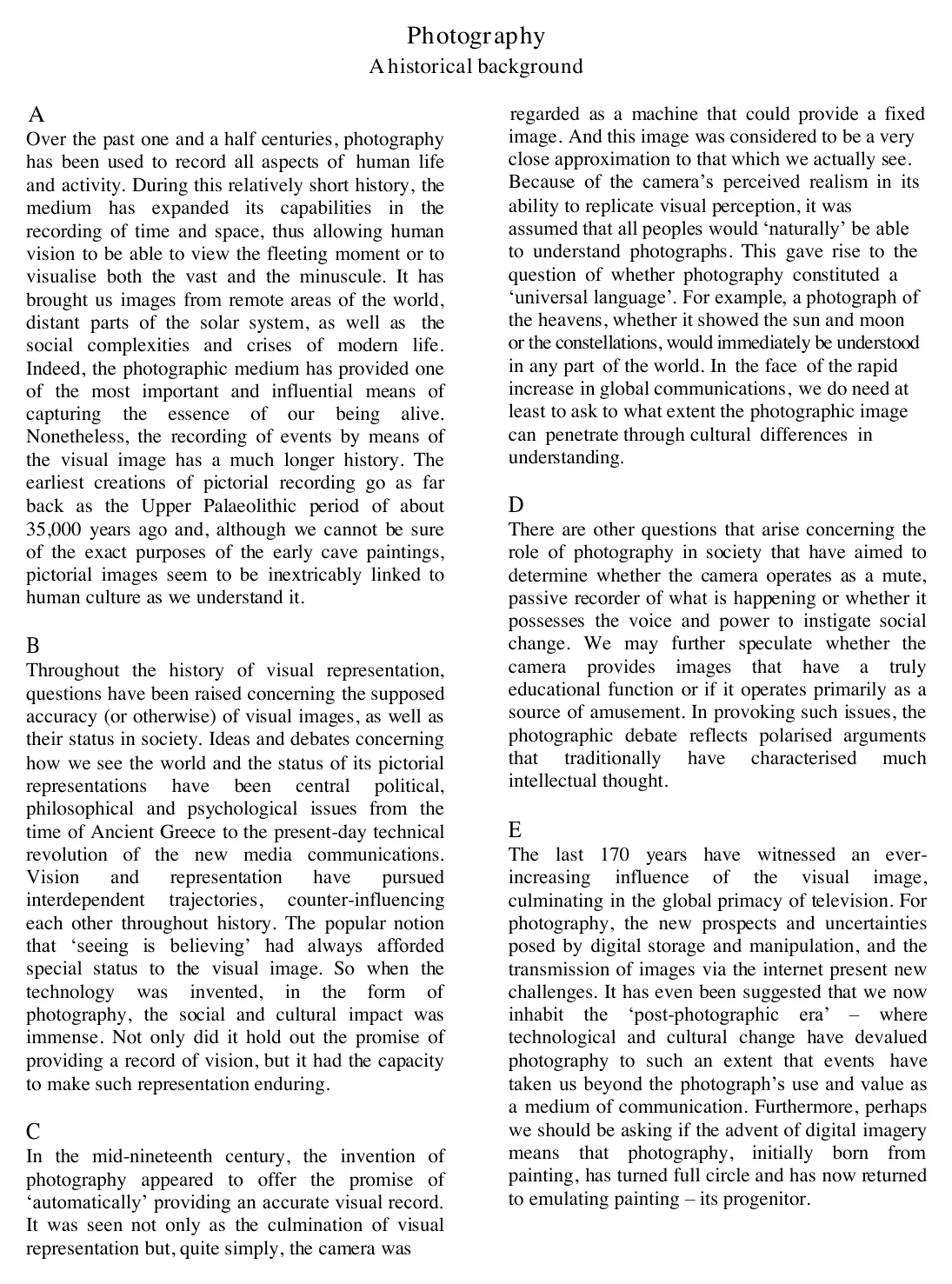
Show answers
- D: whether it possesses the voice and power to instigate social change. Instigating social change means directly influencing events in the world.
- E: the ‘post-photographic era’, in which photography has been devalued to the point where events have taken us beyond its use: that is redundant.
- C: it was assumed that all peoples would ‘naturally’ be able to understand photographs, the idea of a ‘universal language’.
- B: The popular notion that ‘seeing is believing’. Popular notion paraphrases commonly held view.
- A: to visualise both the vast and the minuscule. The huge and the tiny are the contrasts of scale.
- E: has turned full circle and has now returned to emulating painting. Imitating painting again, the art it was born from, is going back to where it started.
- B: it had the capacity to make such representation enduring. Enduring matches exist for a long time.
- D: a truly educational function or if it operates primarily as a source of amusement: informing versus entertaining.
- A: capturing the essence of our being alive. C also talks about photography recording reality, but only A reaches the human condition.
- C: the culmination of visual representation. If photography is the culmination of all visual representation, it is its greatest achievement.
This part is all about recognising paraphrase. Commonly held view turns up in the text as popular notion, exist for a long time as enduring and back to where it started as turned full circle. The sections repeat, too: in this paper each of the five is the answer twice. Having used a section already doesn’t stop it being the answer again.
How to split the 90 minutes
There’s no official rule, but a sensible plan for the whole Reading and Use of English paper would be:
- Part 1: about 7 minutes.
- Parts 2, 3 and 4 (Use of English): about 25 minutes for the three.
- Part 5: about 20 minutes.
- Part 6: about 20 minutes.
- Part 7: about 15 minutes.
That leaves three or four minutes to check and, on paper, to make sure everything is on the answer sheet. You can do the parts in any order; some candidates start with Part 7 to warm up. What you want to avoid is getting bogged down in Part 4 and reaching Part 6, the part with the most marks per question, in a rush.
Strategies that work in the C2 Reading
- Read the whole Part 5 text before the questions. A quick read to find out what it’s about, who’s speaking and how it ends saves you a lot of rereading later.
- Look for the idea, not the word. At C2 the correct answer is nearly always paraphrased. If an option repeats an expression from the text word for word, check whether it says the same thing or uses it for something else.
- In Part 6, read paragraphs A-H first. Get a sense of what each one says and which linking words it carries (this scheme, the results, these). Then, at each gap, check the paragraph before and the one after.
- In Part 7, underline the key word in each statement. In the sample paper, for example, redundant, scale or entertain. That way you know what you’re looking for as you scan the sections.
- Don’t leave anything blank. Wrong answers don’t lose marks, so a half-reasoned answer beats an empty space.
Common mistakes in the C2 Reading
- Picking the option that sounds true in general rather than the one the text supports. In question 31, a regular salary giving a sense of security is logical, but the text doesn’t say so.
- Stopping halfway through a sentence. Not so much to be abreast of things as ahead of them means the opposite if you stop at abreast of things.
- Confusing what a character believes with what is true. In question 35, Lucy tells herself she got the job on merit, and the text then reveals it wasn’t quite like that.
- Solving Part 6 with only the sentence before the gap. With whole paragraphs, the deciding link is usually with what comes after.
- Forgetting that Part 1 counts as Reading and treating it as a minor exercise. It’s eight of the 44 Reading marks.
How to prepare for the C2 Proficiency Reading
You prepare for the C2 Reading by reading a lot, and by reading demanding material: contemporary fiction, essays, opinion pieces and long-form features from the British press. The handbook itself recommends reading widely and following your own interests, which strikes me as the most sensible advice there is. If long texts feel daunting at first, short stories in English are a good way to build up stamina.
As you read, note down expressions you didn’t know and review them systematically, because vocabulary is what separates candidates at C2; there are ideas on how to do that in the post on how to memorise English vocabulary. For Part 6, pay attention to how ideas are linked, and brush up on your English linkers. Most of all, do full timed papers: the 90 minutes fly by the first time.
C2 Proficiency Reading FAQ
How long is the C2 Proficiency Reading?
Reading doesn’t have its own time limit: it’s part of the Reading and Use of English paper, which lasts 1 hour 30 minutes for all seven parts. How you divide that time is up to you.
Which parts of C2 Proficiency are Reading?
Parts 1, 5, 6 and 7, according to Cambridge’s official handbook. Parts 2, 3 and 4 make up the Use of English section.
How many questions and marks does the C2 Reading have?
The four Reading parts add up to 31 questions and 44 marks: 8 in Part 1, 12 in Part 5, 14 in Part 6 and 10 in Part 7. Questions in Parts 5 and 6 are worth two marks each.
Do wrong answers lose marks?
No. A wrong answer scores the same as a blank one, so it makes sense to answer everything.
Is there extra time to transfer answers to the answer sheet?
No. In the paper-based exam you must transfer your answers within the 90 minutes. You can do it after each part or at the end, but allow a few minutes for it.
Is the Reading the same on paper and on computer?
Yes in content: same parts, same questions and same length. What changes is how you answer (on screen, with no answer sheet) and the layout of some parts. The sample paper in this guide is the paper-based version.
Keep preparing for C2 Proficiency
To complete the Reading and Use of English paper, there’s the C2 Use of English guide, with Parts 1 to 4 of the same sample paper solved. For the rest of the exam, see the Listening, Writing and Speaking guides and some advice for Cambridge exam day. You can also head back to the C2 Proficiency main page.
If you’ve tried the sample paper, tell me in the comments which part gave you the most trouble. And if someone in your class is also going for CPE, send them the link.
See you in the next guide. Until then, don’t forget to keep smiling! 🙂
