
Table of contents
When we learn English, or any other language, one complaint comes up again and again: «I study lots of words and I forget them». Memorising vocabulary can feel discouraging and difficult, but with the right techniques it gets easier and far more effective. If you have ever spent an afternoon with a list of fifty words and the next day couldn’t remember even ten, you are not alone: it is completely normal, and it can be fixed.
In this guide I tell you about 10 techniques to memorise English vocabulary that I have been recommending to my students for years, with concrete examples, a revision plan you can copy as it is, routines depending on how much time you have, how to adapt it to your level and how it helps you in the Cambridge exams. Let’s get started! 🙂
Why we forget new words
Before the techniques, a little context. More than a century ago, the psychologist Hermann Ebbinghaus described what is known as the forgetting curve: if you learn something and never look at it again, you forget a good part of it very quickly, and every review makes the memory last longer. In other words, forgetting isn’t your fault, it is how the brain normally works. What changes the result is how you study: the context in which you learn the word, how many times you see it and whether you actually use it.
With that in mind, let’s look at the techniques.
1. Reading gives vocabulary meaning
Yes, reading isn’t everything, but I will never get tired of saying it: reading is the best way to work on vocabulary, grammar and spelling all at once. When you read, every word appears in context, so you see how it is used naturally, you use that context to take it in and you pick up new words along the way.
Choose texts at your level or slightly above, and don’t stop to look up every word: underline the ones that keep coming up or seem important and look them up when you finish. If you don’t know where to start, have a look at my guide to learning English with short stories.
2. Group words by semantic field
Lots of apps suggest learning one word a day, which sounds really easy but ends up as a jumble of unrelated words. What good is it to learn table one day and wheel the next? A table and a wheel don’t have much in common. It is better, and I always recommend this to my students, to learn words by semantic field: if you start with table, carry on with chair, sofa, armchair, furniture… words from the same field, the furniture in a house. That way you make it easier for your brain to store the information in an organised and meaningful way.
You have dozens of fields already prepared in my vocabulary posts by topic, such as daily routines vocabulary, food or sports.
3. Make sense of words: study their structure
When you see a new word, look at what it is made of: the root, the prefix, the suffix. On the one hand, it will be easier to work out its meaning; on the other, the simple act of analysing it helps you remember it. For example, likelihood is made from likely and the suffix -hood. If you know likely, you already know that likelihood is about probability. And if you know another word with -hood, like neighbourhood or childhood, you know it is a noun.
| 🇬🇧 Part | What it shows | Examples |
|---|---|---|
| -hood | a state or a group (noun) | childhood, neighbourhood, likelihood |
| un- | the opposite | unhappy, unlikely, unfair |
| -ful / -less | with / without | careful, careless, helpful, helpless |
| -able | can be done | readable, comfortable, reliable |
4. Memorise expressions, not single words
English teaching stopped focusing only on grammar and vocabulary a long time ago and moved on to lexis, which is the combination of both: a language doesn’t work with vocabulary alone or grammar alone. That is why I recommend you don’t learn that turn means «girar» and left means «izquierda», but the expression turn left. Don’t memorise pick, up and the phone separately, because they make no sense as individual units, but pick up the phone. Do you see the difference? This comes from Michael Lewis’s theory, and it is where the famous collocations come from.
| ❌ Single words | ✅ Whole expression |
|---|---|
| make = hacer, decision = decisión | make a decision |
| heavy = pesado, rain = lluvia | heavy rain |
| take = coger, a break = un descanso | take a break |
| pay = pagar, attention = atención | pay attention |
5. Avoid studying opposites together
Matching opposites is a typical coursebook exercise and it is useful for checking whether you know vocabulary, but it isn’t the best way to memorise it. Several authors claim that studying opposites at the same time tends to cause more confusion than benefit. It is probably because if you study expensive and cheap together, your brain stores them as «adjectives for talking about prices», but it isn’t so clear which one means «caro» and which one «barato». Study them at different times and each one in its own sentence.
6. Use your visual memory
Everybody learns differently, and for vocabulary it is often especially effective to go with the word with a funny or meaningful image. If you are studying drizzle, draw a small cloud with four drops; if you are studying to hug, add a drawing of a hug. The stranger or more personal the image, the better it sticks.
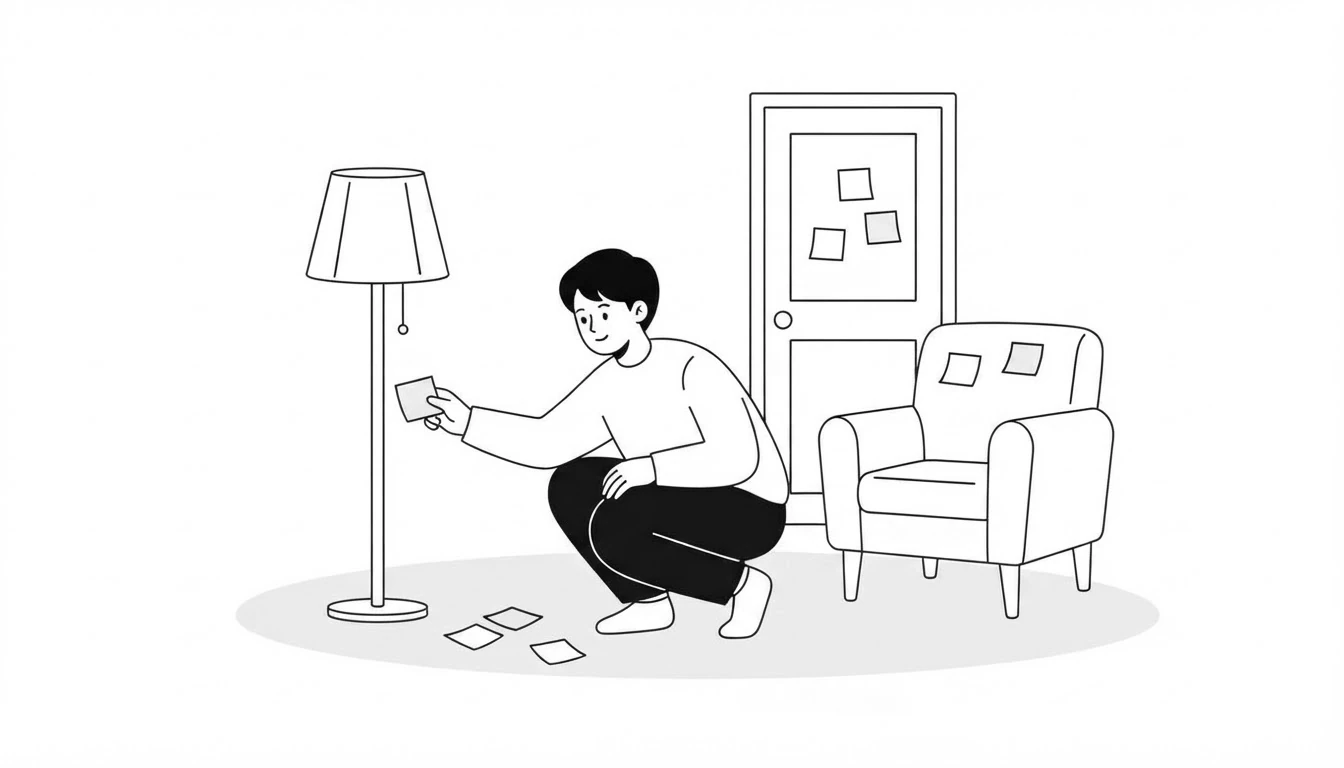
Another very practical trick is to fill your house with sticky notes: put lamp on the lamp, door on the door and armchair on the armchair. Every time you see them, you are revising without realising it.
7. Be realistic about your goals
For years we have made endless vocabulary lists taken from a dictionary with the translation next to each word. Stop doing that! Studying unconnected words with their translation isn’t an effective way to learn, although it is extremely boring. It is worth much more to note down a few words from a text, each one with a sentence that gives it meaning, and study them ten at a time, or five at a time if you are just starting. Better a little, well revised, than a lot, forgotten.
8. Review with spaced repetition
If you don’t review, you lose it. Effort is the basis of all learning, especially when it comes to retaining concepts. If you learnt ten words yesterday, make sure you don’t unlearn them tomorrow: review them before you forget them, and each time leave a longer gap. That is spaced repetition, and it is exactly what apps like Anki or Quizlet do with their flashcards, although you can also do it with paper and a calendar.
This is a schedule you can copy for each batch of new words:
| When | What you do |
|---|---|
| Day 1 | You learn the words inside sentences and review them once before going to bed. |
| Day 2 | First review: try to recall them without looking, then check. |
| Day 4 | Second review: only the ones you got wrong on day 2. |
| Day 8 | Third review: write a new sentence with each word. |
| Day 15 | Fourth review: if you remember them all, they go on your «mastered list». |
It is a rough guide, not a scientific rule: what matters is that every review arrives when it is already a bit hard to remember, but you haven’t forgotten yet.
9. Use the word: write it and say it out loud
Remembering a word for a few minutes is easy. Remembering it a day later, or a week later, is much harder. The trick? Use it. Write a sentence with it, one that is yours and memorable, and if you can, picture the scene while you write it. If you are learning several words at once, make up a little story that links them: a list is hard to remember, but a story is much easier.
And don’t stay on paper: say them out loud, tell someone what you have learnt or record yourself explaining a word on your phone. If you feel shy about talking to another person, practise at home first. When you don’t know how to ask about a word, you have my useful phrases in how to ask about new words in English.
10. Sleep well and let your brain work
Sleeping after studying helps to fix what you have learnt. You don’t need to turn it into a rule, but it is a good reason to leave the review of new words for the last hour of the day, just before bed, and to review them again the next morning. Your brain does a good part of the work while you sleep.

Study routines depending on your time
| Time per day | Plan |
|---|---|
| 10 minutes | Review the words that are due today according to the spaced repetition schedule. Nothing new. |
| 20 minutes | 10 minutes of review and 10 of new words: five words, each in a sentence of your own. |
| 30 minutes | Read a short text (10 minutes), underline and note 5 to 10 words (10 minutes) and review (10 minutes). |
How to adapt it to your level
| Level | What to focus on |
|---|---|
| A2 | Basic semantic fields (home, food, clothes), very frequent expressions and images. Five new words at a time. |
| B1 | More collocations and frequent phrasal verbs, and start reading simple texts. |
| B2 | Word structure (prefixes and suffixes), synonyms and differences between similar words. |
| C1 | More precise lexis and idiomatic expressions, always learnt inside authentic texts. |
How this helps in the Cambridge exams
Vocabulary is the basis of the whole exam, but there are parts where it shows especially:
- Use of English (B2 First and C1 Advanced): in Part 1 (multiple-choice cloze) you have to choose the word that fits a gap best, and it almost always depends on collocations and usage, not on meaning. In Part 3 (word formation) you have to form a word from another one with prefixes and suffixes, and this is where technique 3, studying word structure, helps.
- Writing: varied and precise vocabulary is one of the criteria that are assessed. Learning expressions instead of single words lets you write more naturally.
- Speaking: using words you have memorised «in a sentence» comes out much faster than trying to recall them one by one.
Frequently asked questions
How many words should I learn a day?
Fewer than you think. Between five and ten new words a day, always inside a sentence and with their review scheduled, works better than fifty at once. Consistency is what matters.
Paper flashcards or an app?
Both work. Apps organise your reviews for you; paper makes you write, which helps you remember. Choose the one you will really use every day.
How do I memorise a text in English?
Split it into small pieces (one or two sentences at a time), read it aloud, cover a part and try to say it from memory, and record yourself to compare. Repeat over several days instead of trying to do everything in one afternoon.
Is it worth studying lists of words with translations?
Not much. A single word with its translation is easily forgotten; the same word inside a sentence of your own, with an image and a scheduled review, stays much longer.
Conclusion
To sum up in three ideas: learn words with meaning (in context, by semantic field, as expressions and with their structure), use them (write them, say them, tell someone about them) and review them on time with spaced repetition. You don’t have to do it all at once: start today with one or two techniques and keep adding.
If you want to keep practising, you have my school vocabulary and social media and internet posts, with tables of words, collocations and phrasal verbs ready to study.
And what about you, what do you do to learn vocabulary in English? Do you use any of these techniques? Tell me in the comments.
Did you find this post useful? Share it with other students and English teachers. And if you want more content like this, subscribe to my newsletter and follow me on Facebook, Twitter, Pinterest, Instagram and YouTube.
See you in the next post. Until then, don’t forget to keep smiling! 🙂
