

Table of contents
The C2 Proficiency (CPE) Use of English is where very good English and genuinely masterful English part company. Nobody asks whether you’ve understood the text. What they want to know is whether you can find the exact word each gap is waiting for: the preposition that goes with an adjective, the noun hiding inside a verb, the fixed phrase a native speaker would reach for without thinking.
I’ll go through the C2 Use of English part by part, explain how it’s marked (including one point about Part 1 that confuses almost everyone) and share the strategies that save marks. You’ve also got the official Cambridge sample test for Parts 1 to 4, so you can do it right here and check every answer against its explanation. 🙂
What the C2 Proficiency Reading and Use of English paper looks like
There’s no stand-alone Use of English exam at C2. It sits inside a single paper, Reading and Use of English, which lasts 1 hour 30 minutes and has 7 parts and 53 questions. You do it in one go and decide for yourself how to split the time.
| Part | Task | What you do | Questions | Marks | Counts towards |
|---|---|---|---|---|---|
| 1 | Multiple-choice cloze | Choose from four options the word that fills each gap in a text | 8 | 8 | Reading |
| 2 | Open cloze | Write one word in each gap, with no options | 8 | 8 | Use of English |
| 3 | Word formation | Change the word in capitals so that it fits the gap | 8 | 8 | Use of English |
| 4 | Key word transformation | Rewrite a sentence with a key word, using 3 to 8 words | 6 | 12 | Use of English |
| 5 | Multiple choice | A long text with six four-option questions | 6 | 12 | Reading |
| 6 | Gapped text | Put the missing paragraphs back into a text | 7 | 14 | Reading |
| 7 | Multiple matching | Match ten questions to the sections of a text | 10 | 10 | Reading |
Parts 1 to 4 are the gap-fills and single sentences that most people mean when they say «Use of English». Parts 5, 6 and 7 are straight reading comprehension, and you’ll find them explained, with the sample test solved, in the guide to the C2 Proficiency Reading.
Is Part 1 Reading or Use of English?
It’s a common question, and there’s an official answer. According to the Cambridge handbook, the Reading section is Parts 1, 5, 6 and 7 and the Use of English section is Parts 2, 3 and 4. So, as far as your score goes, Part 1 counts towards Reading.
In terms of what it actually tests, though, Part 1 is Use of English through and through: collocations, fixed phrases, phrasal verbs and precise vocabulary. That’s why at KSE we prepare it alongside the other three, and why it’s solved on this page too.
How much does Use of English count?
Your C2 Proficiency result is the average of five equally weighted scores: Reading, Use of English, Writing, Listening and Speaking. Use of English is worth a fifth of the result, the same as Writing, even though it shares its 90 minutes with Reading.
Using the official breakdown, Use of English has 28 marks (8 for Part 2, 8 for Part 3 and 12 for Part 4) and Reading has 44 (8 for Part 1, 12 for Part 5, 14 for Part 6 and 10 for Part 7). Each section is converted separately to the Cambridge English Scale, and you need an average of 200 or above for the C2 certificate (between 180 and 199 you get a C1 certificate).
If you want to see what your raw marks would mean, try the C2 Proficiency score calculator. And if the scale has always seemed a bit of a mystery, I explain it in the guide on how Cambridge exam scores are calculated.
What each part tests
This is what the official handbook says each task focuses on, in a nutshell:
| Part | What Cambridge assesses |
|---|---|
| 1 | Mainly vocabulary: idioms, collocations, fixed phrases, complementation (which preposition or pattern follows a word), phrasal verbs and semantic precision |
| 2 | Awareness and control of grammar, with some focus on vocabulary |
| 3 | Vocabulary, specifically word formation: affixes, internal changes and compounding |
| 4 | Grammar, vocabulary and collocation |
Part 3 has a twist at C2 that you won’t have met at lower levels: alongside prefixes and suffixes, you get internal changes (strong → strengthen) and compounding (set → outset). A word may also need several changes at once: getting from doubt to undoubtedly takes three.
Try the official sample test
Below are Parts 1 to 4 of the official C2 Proficiency sample test (Sample Test 1), the paper-based version exactly as Cambridge publishes it. Under each part you’ll find the answers from the official key, with an explanation of why that answer and not another.
Time yourself. All four parts together should take you around 30 to 35 minutes at most, because on the day you’ll need the rest of the time for the long Reading texts. Jot your answers down on paper and only open the solutions once you’ve finished each part.
Part 1: multiple-choice cloze
A text with eight gaps and four options for each. At this level the four options usually mean roughly the same thing, so going with whatever «sounds right» won’t get you far. What settles the answer is nearly always the language around the gap: a preposition that only one option can take, a fixed phrase with a piece missing, or a shade of meaning that suits the context and none of the alternatives.
For questions 1-8, read the text below and decide which answer (A, B, C or D) best fits each gap. There is an example at the beginning (0).
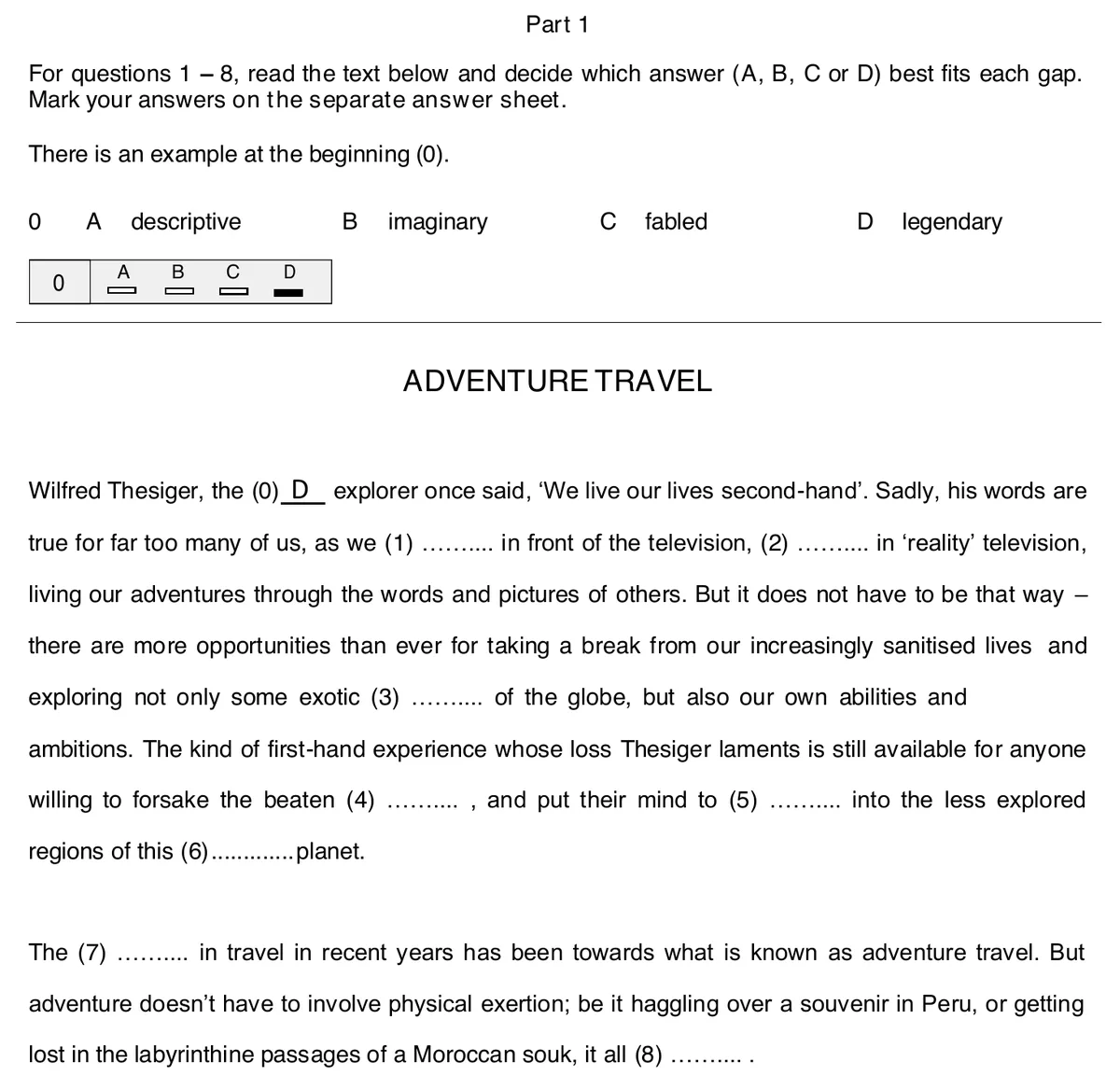
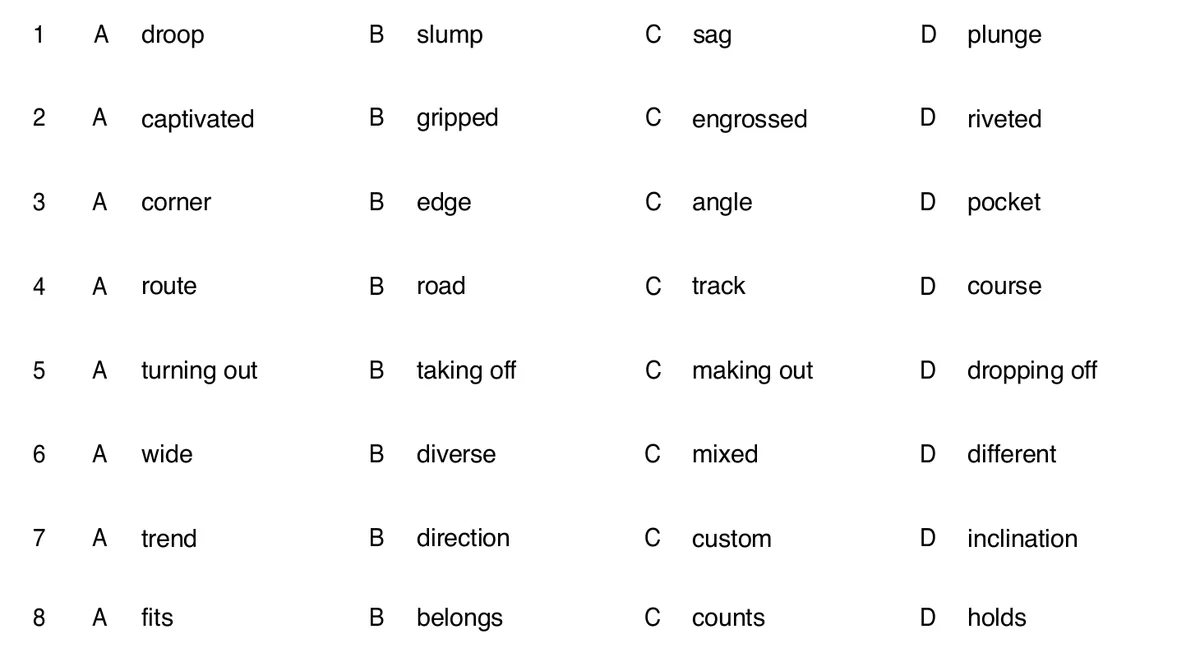
Official C2 Proficiency sample test (Sample Test 1), Reading and Use of English. © Cambridge University Press & Assessment.
Show answers
- B (slump): slump in front of the television means flopping down with no energy, which is exactly the picture the writer wants. Droop is what wilting flowers or heavy eyelids do, sag is what an old mattress does, and plunge is a sudden fall (prices, temperatures).
- C (engrossed): The preposition decides this one: you are engrossed in something. The other three mean much the same but need a different pattern: captivated by, gripped by, riveted to or by. With in after the gap, only one option works.
- A (corner): a corner of the globe (or of the world) is a fixed collocation for a remote place. A pocket is a small area inside something bigger (pockets of poverty), and the edge of the world means something else.
- C (track): A fixed phrase: off the beaten track, away from the usual tourist routes. Here it comes with a different verb, forsake the beaten track, but the noun is still track. Route, road and course don’t form that expression in British English.
- B (taking off): take off meaning to leave suddenly or head off somewhere: taking off into the less explored regions. It follows put their mind to, which needs an -ing form. Turn out (prove to be), make out (manage to see) and drop off (fall asleep, give someone a lift) make no sense here.
- B (diverse): Semantic precision: a planet full of varied places is diverse. Different would need something to compare it with, mixed goes with results or feelings (mixed feelings), and wide describes size, not variety.
- A (trend): the trend towards something is the general direction things are moving in, and towards confirms it. An inclination is a personal preference (an inclination to do something), direction doesn’t combine with in travel like this, and a custom is a tradition.
- C (counts): it all counts: all of that is valid, all of it qualifies as adventure. Holds would need true (it all holds true), and fits and belongs need something after them (fits in, belongs to) that isn’t there.
Questions 2 and 4 sum up C2 Part 1 nicely. In 2, captivated, gripped, engrossed and riveted mean practically the same, and only the word after the gap (in) leaves one standing. In 4 there’s nothing to work out: either you know the beaten track or you don’t. So whenever you learn a new word, note down the preposition it takes and the phrases it turns up in as well.
Part 2: open cloze
Another text with eight gaps, but this time there are no options: you write one word in each. It’s almost always a grammar word (a preposition, linker, pronoun, auxiliary or article) or the missing piece of a fixed phrase. Contractions aren’t allowed, and on the paper-based test you write in capital letters.
For questions 9-16, read the text below and think of the word which best fits each space. Use only one word in each space. There is an example at the beginning (0).
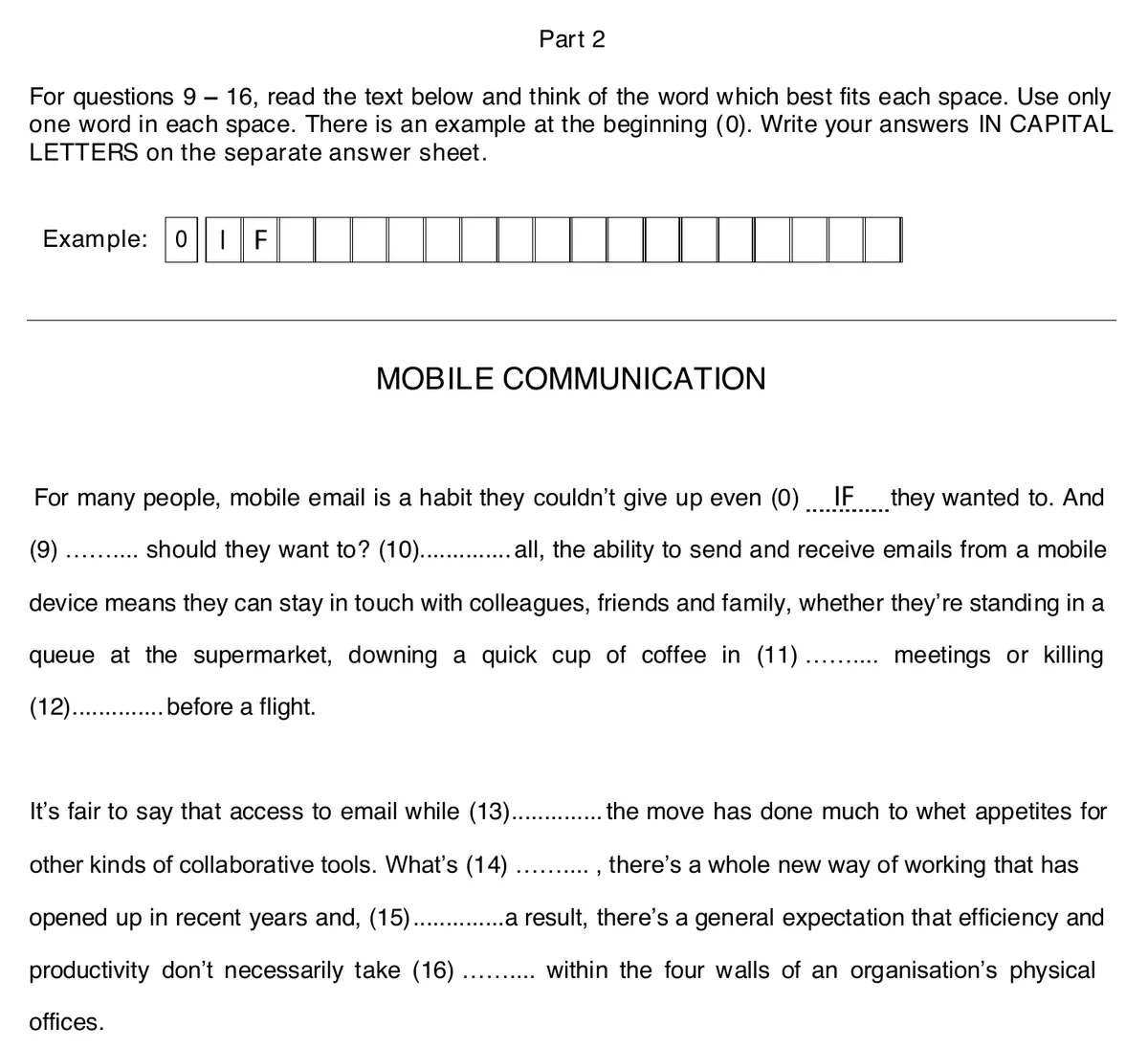
Official C2 Proficiency sample test (Sample Test 1), Reading and Use of English. © Cambridge University Press & Assessment.
Show answers
- why: And why should they want to? is a rhetorical question: why would they want to give it up? The question mark and the inversion should they call for a question word, and only why fits with what follows (the advantages).
- After: After all: introduces the reason that backs up the previous point. It’s a fixed two-word linker, so you just need to recognise it.
- between: in between meetings: in the short gaps between one meeting and the next. The in that’s already there is the clue; in between works as a unit.
- time: killing time: passing the time while you wait, here before a flight. A pure collocation.
- on: on the move: travelling around, not staying in one place. Another fixed phrase built on a preposition.
- more: What’s more: in addition, and even more importantly. It adds a stronger argument to the previous one.
- as: as a result: consequently. The article and the noun are given, so only the preposition is missing.
- place: take place: happen. The writer means efficiency and productivity no longer happen only inside the office.
None of the eight has an alternative in the official key: only that word is accepted.
Look closely and seven of the eight answers complete expressions of two or three words: after all, in between, killing time, on the move, what’s more, as a result, take place. None of them is unusual, but you need them so firmly in your head that you spot them straight away. Question 9 is the only one that calls for a bit of reasoning: the inversion should they and the question mark tell you a question word is missing.
Part 3: word formation
A text with eight gaps and a word in capitals at the end of some lines. You change that word so it fits the gap on the same line. First decide which word class you need (noun, verb, adjective, adverb), then whether it’s singular or plural and whether the meaning calls for a negative, and only then work out the form.
For questions 17-24, read the text below. Use the word given in capitals at the end of some of the lines to form a word that fits in the space in the same line. There is an example at the beginning (0).
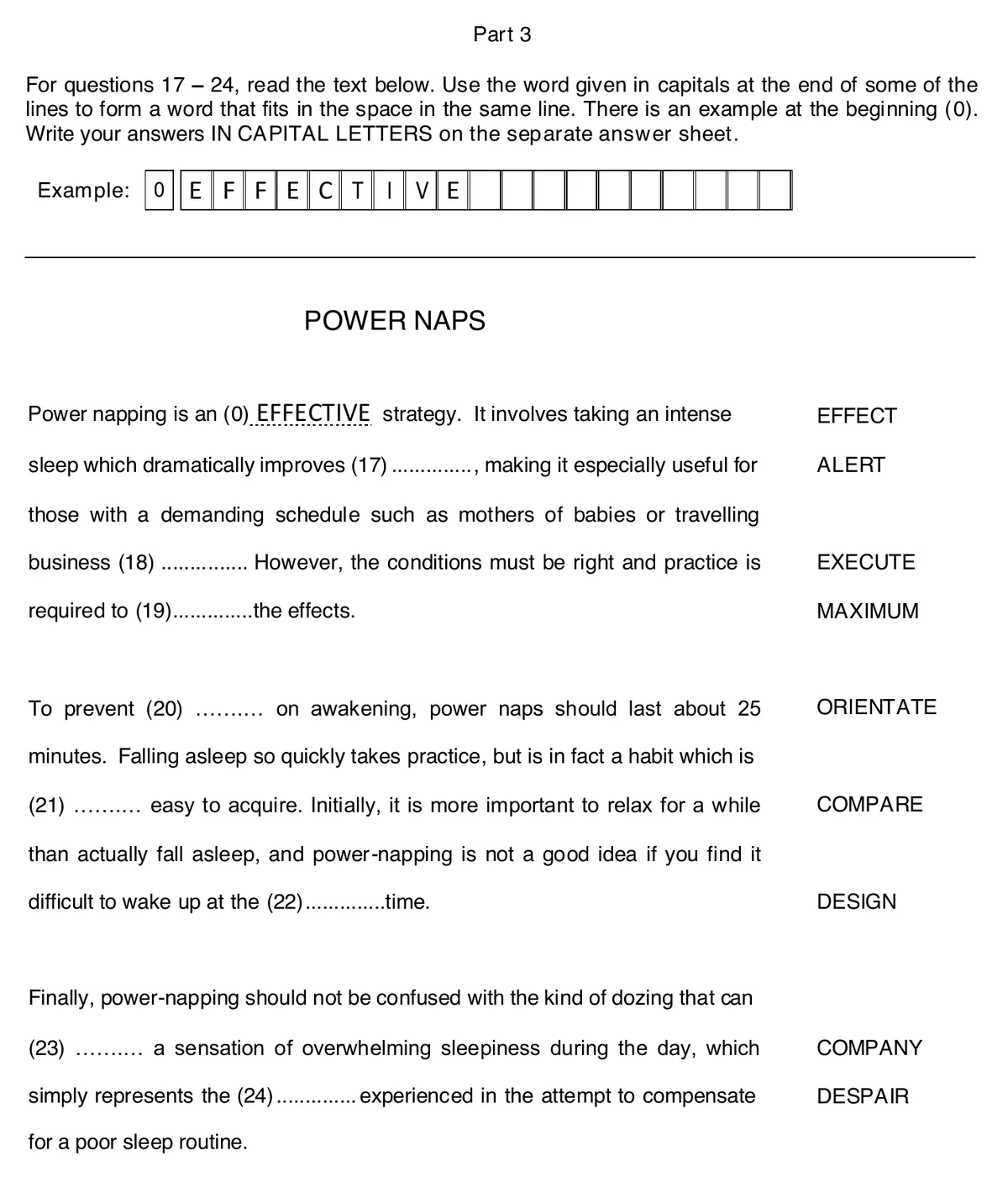
Official C2 Proficiency sample test (Sample Test 1), Reading and Use of English. © Cambridge University Press & Assessment.
Show answers
- alertness: improves needs a noun after it (the thing that improves): alert + -ness.
- executives: business executives. Two traps in one: the person noun isn’t executors (the people who carry out a will), and it has to be plural because it refers to that group of people in general.
- maximise / maximize: After to you need a verb: maximum becomes maximise. The key accepts both the British and the American spelling.
- disorientation: What you want to prevent when you wake up is a feeling of confusion, so you need a noun with a negative prefix: dis + orientat(e) + -ion. The meaning of the sentence, not the grammar, tells you to add the prefix.
- comparatively: It comes before an adjective (easy), so you need an adverb: comparatively easy, relatively easy. Compare → comparative → comparatively.
- designated: Between the and time you need an adjective: the designated time, the time you’ve set. The past participle of designate works as an adjective; designed doesn’t mean this.
- accompany: After can you need a verb, and company gives you accompany with a prefix. It’s one of those stems that seem to have no verb until you think of the prefix.
- desperation: An internal change: despair → desperate → desperation. Despair is already a noun and would fit grammatically, but in this part the word always has to change. If the stem fits as it is, look for another form.
Three clear lessons here. Question 18 punishes anyone who doesn’t read the whole sentence: executive without the s is a mark thrown away. Question 20 only works if you realise that what you want to avoid when you wake up is feeling disorientated, so it’s the meaning that tells you to add dis-. And question 24 is a reminder of a handbook rule: the word always changes, even when the original seems to fit. If you’d like to brush up on suffixes and prefixes, the guide on how to form adjectives in English is a good place to start.
Part 4: key word transformation
Six sentences. Under each one there’s a key word and a second, incomplete sentence, which you have to complete so that it means the same as the first, using the key word without changing it and between 3 and 8 words in total (the key word counts, and a contraction like don’t counts as two). At C1 the limit is 3 to 6, so C2 transformations are longer and combine more things at once.
Each sentence is worth 2 marks, one for each half of the answer, so a half-right answer still scores.
For questions 25-30, complete the second sentence so that it has a similar meaning to the first sentence, using the word given. Do not change the word given. You must use between three and eight words, including the word given. Here is an example (0).
0 Do you mind if I watch you while you paint?
OBJECTION
Do you have any objection to my watching you while you paint?
25 It’s impossible to predict how long it will take to do this job.
TELLING
There is ____________________ will take.
26 Not many people buy that particular product these days.
DEMAND
There ____________________ that particular product these days.
27 For me, his skill as a negotiator was most impressive.
HOW
I was most ____________________ negotiator he was.
28 Nobody expected Natalia to resign.
CAME
Natalia’s ____________________ everyone.
29 The area was completely devoid of vegetation.
WHATSOEVER
There ____________________ the area.
30 When he was at his most successful, the President had enormous influence.
HEIGHT
At ____________________, the President had enormous influence.
Official C2 Proficiency sample test (Sample Test 1), Reading and Use of English. © Cambridge University Press & Assessment.
Show answers
- no (way / chance of) telling | how long this / the job / work: There is no telling is a fixed way of saying it’s impossible to know; you can expand it to no way of telling or no chance of telling. One mark for that phrase, one for the indirect question how long this job (no inversion: how long will this job is wrong, because will take is already given at the end).
- is | (very) little demand for OR is not / isn’t | a lot of / much (of a) demand for: One mark for the verb (is) and one for the collocation demand for with its quantifier: little demand for or not much demand for. The preposition matters: it’s demand for, never demand of.
- impressed to see / by / with / at | (just) how skilled / skilful / skillful a: Impressive becomes impressed, which needs its preposition (first mark). The second mark is for the pattern how + adjective + a + noun: how skilful a negotiator he was. Write how good negotiator without the article in the right place and you lose that mark.
- resignation / resigning / decision to resign came | as a (total / complete) surprise / shock to: The verb resign has to become something that can follow Natalia’s: resignation, resigning or decision to resign. The second mark is for come as a surprise to someone, with its a and its to.
- was no / was not any vegetation | whatsoever in OR was nothing | whatsoever growing in: Whatsoever strengthens a negative and goes straight after the noun: no vegetation whatsoever. One mark for the negative with vegetation, one for placing whatsoever correctly and adding in.
- the height of | his success: at the height of something: at its peak. The adjective successful becomes the noun success, and that change of word class is exactly what the second half rewards.
The vertical bar | separates the two halves that are marked separately, one mark each. Words in brackets are optional, and slashes / separate equally valid alternatives.
Look at what each half is testing and a pattern appears: there’s nearly always a change of word class (impressive → impressed, resign → resignation, successful → success) plus a fixed phrase with its preposition (no telling, demand for, come as a surprise to, at the height of). This is the part that responds best to targeted practice, and it’s the reason I wrote Use of English C2 Part 4, with 120 key word transformations explained one by one and the 200 expressions and structures that come up most often.
Strategies that work in the C2 Use of English
- Read the whole text before filling anything in. The title tells you the topic, and in Part 3 some answers (negatives especially) only become clear once you’ve understood the paragraph.
- Look at what follows the gap. In Parts 1 and 2 the next word decides more answers than the previous one: a preposition, a to, a noun that needs a particular verb.
- Split Part 4 sentences into two halves. Work out what information is missing from the second sentence and what structure the key word forces on you. That shows you straight away where the two marks are.
- Count your words in Part 4. Nine words and you lose both marks, even if the answer is right.
- Reread the whole sentence with your answer in it. It’s the quickest way to catch a missing plural or a tense that doesn’t agree.
- Keep an eye on the clock. Don’t spend ten minutes on one gap. Write something sensible, mark it and come back at the end.
Common mistakes
Nearly every mark lost in this section goes through carelessness rather than a lack of level:
- Spelling mistakes. In Use of English every word must be spelt correctly. One letter too many or too few and the mark’s gone.
- Giving two answers. Write two options (or put one in brackets) and you lose the mark, even if one of them is right.
- Using contractions in Part 2. The gap takes one word, and isn’t is two.
- Changing the Part 4 key word. If you’re given how, you can’t use however; if you’re given came, come won’t do.
- Forgetting the plural or the negative in Part 3. The word can be perfectly formed and still be wrong for that gap.
- Copying out the whole sentence. Only the words that fill the gap go on the answer sheet.
How to prepare for the C2 Use of English
At this level, what makes the difference is how much language you’ve stored in chunks: collocations, verbs with their prepositions, fixed phrases. And you get that by reading a lot, with a notebook beside you. When a combination catches your eye (whet someone’s appetite, forsake the beaten track), write the whole thing down with an example and review it. The guide on how to memorise English vocabulary has techniques to stop it slipping away after a week.
On the grammar side, some topics keep turning up in C2 Parts 2 and 4: inversion, cleft sentences and other ways of adding emphasis, the passive voice in all its forms, adjectives with prepositions and advanced linkers.
Then there’s practice with exam tasks, which you can’t skip. My book Use of English C2 contains 10 complete tests of Parts 1 to 4, with answer sheets, the answer key and instructions for working out your score. Do them against the clock and go over every mistake until you can see why the right answer is the only one that works.
FAQ about the C2 Use of English
How many parts does the C2 Proficiency Use of English have?
Officially three: Parts 2, 3 and 4 of the Reading and Use of English paper, with 22 questions and 28 marks. Part 1 is very similar but counts towards Reading.
How much time do I get for Use of English?
There’s no separate time limit. You have 1 hour 30 minutes for all seven parts of Reading and Use of English and you organise it as you like. I’d spend around 30 to 35 minutes on Parts 1 to 4 and the rest on the Reading texts.
Do contractions count as one word or two?
Two. Wasn’t is two words in Part 4, and in Part 2 you can’t use contractions at all, because each gap takes a single word.
Can I change the form of the key word in Part 4?
No. The key word must appear exactly as it’s given. If you change it or leave it out, the answer scores zero.
Does spelling count?
Yes. In the Use of English section every word has to be spelt correctly. In Part 3, for instance, the key accepts both maximise and maximize, but not a misspelt version.
Is it very different from the C1 Use of English?
The format is very close, but the C2 paper has one part fewer (seven instead of eight), Part 4 allows up to 8 words instead of 6, and Part 3 includes internal changes and compound words. The vocabulary is also more idiomatic. If you’re coming from C1, the guide to the C1 Advanced Use of English will show you the differences.
Is it the same in the computer-based exam?
The tasks are the same. In the computer-based test you type your answers on screen rather than on an answer sheet, and the Part 1 options have no letters, but the content and the marking don’t change.
Keep preparing for C2 Proficiency
- C2 Proficiency (CPE): the exam guide
- C2 Proficiency Reading
- C2 Proficiency Writing
- C2 Proficiency Listening
- C2 Proficiency Speaking
- C2 Proficiency score calculator
- Cambridge exam day: what to bring and what to expect
The C2 Use of English has a reputation for being impossible, but once you understand what each part is after, it stops being a lottery. If any answer in the sample test left you scratching your head, write to me in the comments and we’ll go over it.
See you in the next guide. Until then, don’t forget to keep smiling! 🙂
