
Table of contents
You have been preparing for months and, just as the big day arrives, you realise you do not know whether you can take your phone, what time you need to be there or what happens if you forget your ID. It is more common than you think, and not being ready for what happens on the day can cost you the exam. In this guide I explain what a Cambridge exam day is like, what to bring and what to leave at home, and what to do if something goes wrong. It works for every level, from A2 Key to C2 Proficiency, on paper or on computer. Let’s get started! 🙂
One thing before we begin: the general rules are set by Cambridge (I summarise them here from its official documents, the Notice to Candidates and the Summary Regulations for Candidates), but your exam is run by your exam centre, and some things, such as arrival time or where to leave your belongings, are decided by the centre. If your centre tells you something different from what you read here, follow your centre.
Before exam day
Most exam day problems can be avoided in the days before. This is what you should have sorted:
- Your Confirmation of Entry (COE). This is the entry confirmation your centre sends you, usually by email a few days before. It has your candidate number, the dates and times of each paper, the address of the venue and the details you will need later to check your results. Keep it and, if it makes you feel more confident, bring a printed copy (it is not compulsory).
- The dates of each paper. The written papers (Reading, Use of English, Writing and Listening, depending on the level) and the Speaking test can take place on different days and even at different venues. Read your COE carefully so you do not turn up on the wrong day.
- The venue and the journey. Check the address, how to get there and how long it takes. Allow for transport delays.
- Paper-based or computer-based. The exams are the same, but the day feels slightly different depending on the format. I explain the differences below.
- Special requirements. If you need adjustments (extra time, adapted papers or others), tell your centre as soon as possible: depending on the case, Cambridge may need up to 3 months’ notice.
- Your ID. It is the most important thing, and I cover it in the next section.
Your ID: no ID, no exam
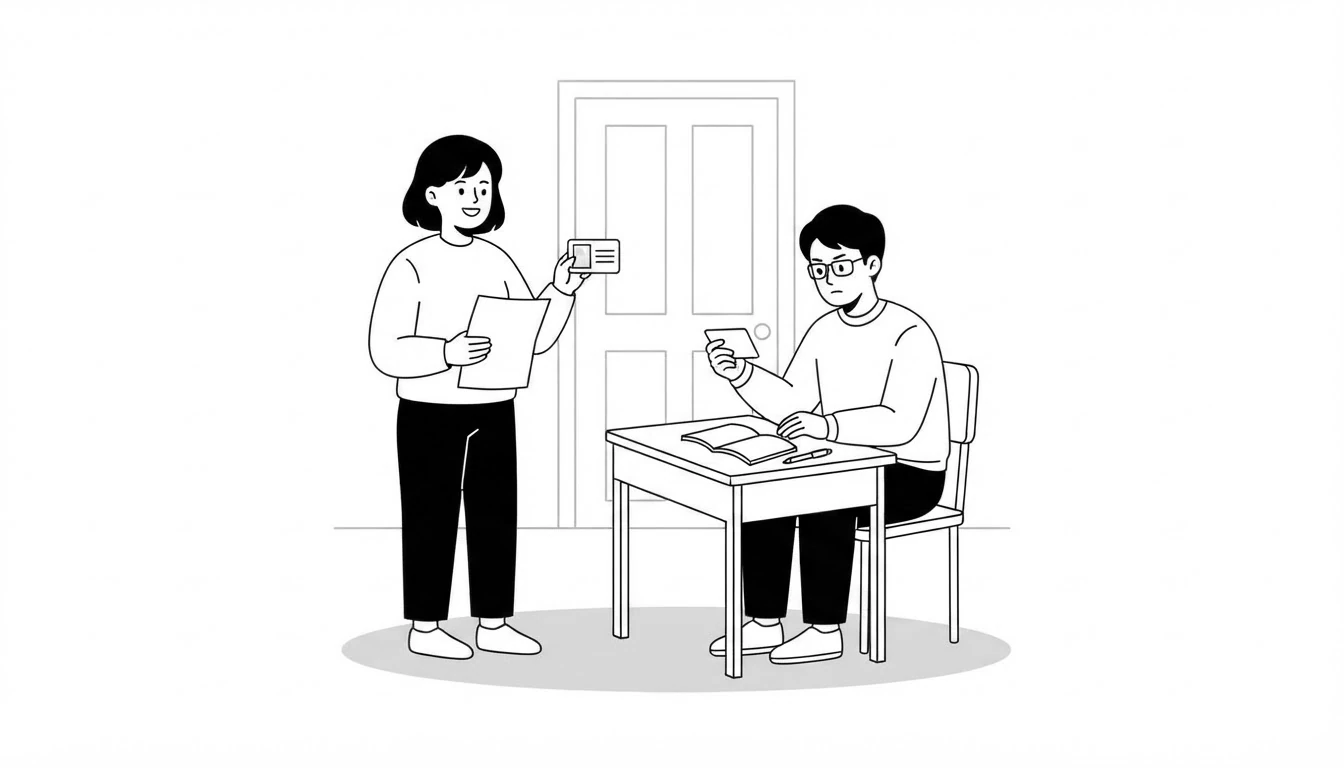
You must present a photo ID that is original, valid and in date, and you may be asked for it at every paper, not just when you arrive. A photocopy is not accepted, and neither is a picture of the document on your phone.
- Which documents usually work: your national ID card, a residence card or your passport. A driving licence is accepted by many centres but not all, so ask first. Cambridge requires a government-issued document.
- If your document has expired or you forget it: you may not be allowed to sit the exam, or you may not receive a result. Check the expiry date weeks beforehand, not the night before.
- If you take C1 Advanced outside your country of residence: under Cambridge’s regulations you must use your passport or national identity card.
- If you do not have a suitable document: tell your centre before you register, not on exam day.
The test day photo
At some levels you will also have your photo taken on the day of the exam to verify your identity. It is a quick step, but it is worth knowing about so it does not catch you off guard (and so you do not refuse: without a photo you may not be allowed to sit the exam, or your result may be withheld).
| Exam | Test day photo? |
|---|---|
| A2 Key | No |
| B1 Preliminary | No |
| B2 First (not for Schools) | ✅ Yes |
| C1 Advanced | ✅ Yes |
| C2 Proficiency | ✅ Yes |
That photo is stored on Cambridge’s verification site and lets a university or an employer check your result when you give them permission.
What to bring and what to leave at home
This is what causes the most doubts. The basic rule is simple: on your desk there can only be what is allowed for the exam, and everything else stays outside the exam room.
| ✅ Bring it | ❌ Not into the exam room |
|---|---|
| Original, valid photo ID | Mobile phone (switched off or not: not even during breaks) |
| Pen and pencil (with a rubber and sharpener) | Wristwatch, even an ordinary one |
| Your Confirmation of Entry, if it makes you feel more confident | Cameras, tablets, smartwatches and any other electronic device |
| A clear plastic water bottle without a label | Dictionaries, notes or books |
| Comfortable clothes you can layer (you do not choose the room temperature) | Erasable pens, correction fluid or tape |
| If you need them: tissues or medication (tell the invigilators first) | Food or any drink other than water |
A few details worth knowing:
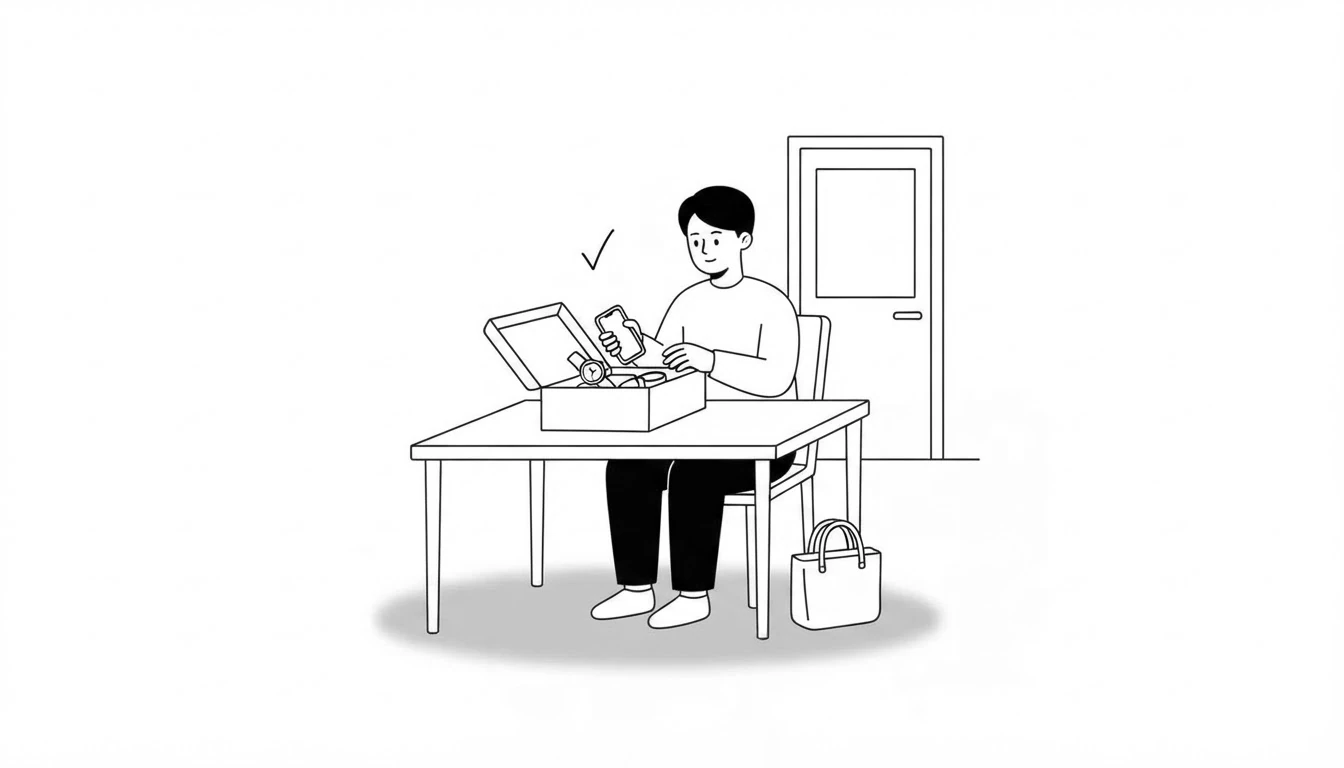
- Phone and watch: Cambridge does not allow electronic items or watches in the exam room. Before exam day, ask your centre where you can leave them: some centres offer secure storage and others do not, and in that case the best option is to leave them at home.
- Keeping track of time: there is usually a clock visible in the room and, in computer-based exams, a timer on the screen. Do not rely on your own watch.
- Pen and pencil: the centre usually has spares if you forget, but do not count on it. Ask what to use in each paper, and remember that erasable pens and correction fluid are banned.
- Water: it is the only thing you can drink. It is normally kept on the floor next to your desk, and the bottle should be clear and unlabelled.
- Tissues and medication: if you need them, tell the invigilators beforehand. It is the best way to avoid misunderstandings.
Exam day, step by step
- Arrive in plenty of time. Cambridge asks you to arrive «well before» the start time, and most centres ask for around 30 minutes early (some more). Check what your centre says. If you arrive late for a paper, tell the supervisor: depending on the centre’s policy you may be admitted, but not all of your work may be accepted, and you may not be let in at all.
- Leave your things where you are told. Bag, coat, phone and anything you cannot take into the room.
- ID check. The staff will check your ID (and take your photo, if your level requires it) and tell you where to sit. Keep your ID handy, not at the bottom of your bag.
- The supervisor’s instructions. Listen carefully: they explain what to do, how to fill in your details and how the exam works. It is normal to be asked to fill in an information sheet and, sometimes, to take a short control test that does not affect your result.
- The exam starts. Do not open anything until you are told to.
- When you finish, leave all the material on your desk and wait until you are told you can leave. You cannot take question papers, answer sheets or notes paper out of the room.
During the exam: when to put your hand up and what not to do
Supervisors cannot explain what a question means, but they can help with everything else. Put your hand up if:
- Your personal details on the answer sheet or on the screen are wrong.
- You think you have the wrong exam.
- The questions are incomplete, missing or badly printed.
- Your headphones are not working or you cannot hear the Listening. Do it straight away: there is usually a sound check at the start, so use it.
- You do not feel well. If you think your performance may be affected, tell a supervisor during the exam: your centre can report it to Cambridge so that it is taken into account when your result is decided.
- You are not sure what to do in a part. They will repeat the instructions, but they will not explain the questions.
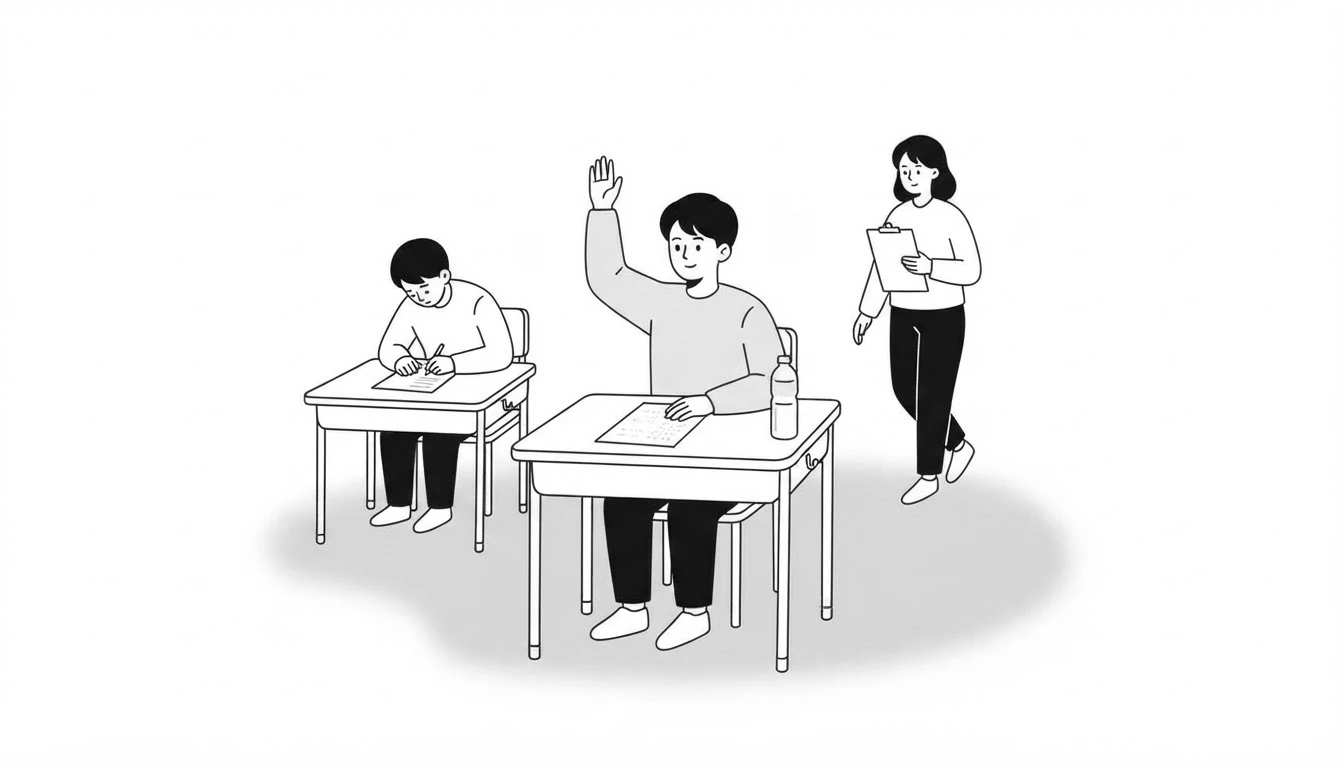
And these are things you must not do, because they can cost you the exam:
- Copy, help another candidate, talk to them or disturb them in any way.
- Get up or leave the room without permission.
- Keep writing when you are told to stop.
- Take question papers, answer sheets or notes paper out of the room.
- Take photos of the exam or share its content on social media or websites: the materials belong to Cambridge.
If you are found to have broken the rules, you may be disqualified and receive no result, and Cambridge reserves the right to withhold or cancel results if it believes the rules were broken, even through checks carried out after the exam.
If something goes wrong: what to do
| Situation | What to do |
|---|---|
| You arrive late | Tell the supervisor as soon as you arrive. It depends on your centre’s policy: you may be admitted, and part of your work may not be accepted. |
| You forget your ID (or it has expired) | Say so immediately. You may not be allowed to sit the exam or may not receive a result. That is why it pays to check the document in good time. |
| You feel unwell during the exam | Tell the supervisor straight away. Where appropriate, the centre reports it to Cambridge so it can be taken into account. |
| You cannot sit the exam because of illness | Contact your centre as soon as possible. With medical evidence, you may be given a full or partial refund of your entry fee. |
| You cannot hear the Listening properly | Put your hand up immediately, before the recording moves on. |
| There is a technical problem with the computer | Put your hand up and tell the supervisor. Do not try to fix it yourself. |
Paper-based or computer-based: what changes on exam day
Cambridge exams are the same in both formats, but the day feels different:
| Paper-based | Computer-based | |
|---|---|---|
| How you answer | On the answer sheet and in the booklet, with pencil or pen. | On the screen, with a mouse and keyboard. |
| Listening | Played through speakers in the room. | Through individual headphones: check you can hear properly. |
| Time | You keep track with the clock in the room. | There is a timer on your screen. |
| Notes | You write in the booklet. | You can use note paper, but you leave it on the desk when you finish. |
| Speaking | Face to face. | Face to face, without a computer, even if the rest is digital. |
| Results | Your centre tells you the date. | Normally in around 2 weeks. |
The Speaking test: what that day is like
The Speaking test at these levels is always face to face and with other candidates: normally in pairs, and the last group on the list may be a trio. You normally do not know who you will be with until the day, and you cannot choose. Some practical ideas:
- Talk to your partner: a large part of the test is interaction. Listen, respond to what they say and do not just recite what you prepared.
- It does not matter if your partner is more or less fluent than you: each candidate is assessed separately.
- The test may be recorded. It is part of Cambridge’s quality control and you do not need to do anything special.
- Because the Speaking test often falls on a different day or at a different time from the written papers, check your timetable and arrive with the same margin.
To prepare for it, you will find my Speaking guides on the page for each exam: B2 First, C1 Advanced and C2 Proficiency, among others.
After the exam
- Results. They are published on Cambridge’s Online Results Service. To see them you need to register with the candidate details (your ID and reference number) shown on your Confirmation of Entry, so keep it. Cambridge emails you when they are available.
- Your score. You do not get feedback on individual questions: the Statement of Results is all the information you receive. If you want to know what score you need, see my guide to the score you need to pass your Cambridge exam.
- Certificate. If you pass, Cambridge sends your certificate to your centre, which will tell you how to collect it. According to Cambridge, it arrives about 3 to 4 weeks after results for paper-based exams and about 2 to 3 weeks for computer-based ones.
- If you disagree with your result, talk to your centre as soon as possible: they will explain how enquiries work and any fees.
The 10 tips, summed up
- Check your ID weeks ahead: original, with a photo and in date.
- Keep your Confirmation of Entry and check the dates of each paper (the Speaking may be on another day).
- Check the venue and the journey before the day.
- Arrive early: 30 minutes before is typical, but follow what your centre says.
- Leave your phone and watch at home or where you are told. Nothing electronic in the room.
- Bring a pencil, a pen, a rubber and a clear water bottle.
- Follow the supervisor’s instructions and put your hand up if there is any problem.
- Do not copy or talk to other candidates: you can be disqualified.
- If you feel unwell, tell the supervisor during the exam, not afterwards.
- Get a good night’s sleep and arrive calm: what you have studied, you already know.
FAQ: Cambridge exam day
Can I bring my phone if I switch it off?
No. Electronic items are not allowed in the exam room, whether switched off or not, and not during breaks either. If your centre has somewhere to store it, use it; if not, leave it at home.
Can I wear a watch?
No. Cambridge does not allow watches in the exam room, not even non-smart ones. There is usually a visible clock in the room and, in computer-based exams, a timer on the screen.
What ID do I need for a Cambridge exam?
An original, valid photo ID: your national ID card, a residence card or a passport (a driving licence depends on the centre). Ask your centre which it accepts before exam day.
What time do I need to arrive?
Cambridge asks you to arrive in plenty of time, and most centres ask for around 30 minutes before. Check the time on your confirmation and arrive with a margin.
What happens if I am late?
Tell the supervisor as soon as you arrive. Depending on the centre’s policy you may be admitted, although not all of your work may be accepted.
Can I take water into the exam?
Yes, it is the only thing you can drink. It should be a clear plastic bottle, preferably without a label.
Will I have my photo taken on exam day?
At B2 First (not the for Schools version), C1 Advanced and C2 Proficiency, yes. At A2 Key and B1 Preliminary, it is not done.
Is the Speaking test done with another candidate?
Yes, in pairs, and the last group on the list may be a trio. It is face to face, even when the rest of the exam is on computer.
When do results come out?
For computer-based exams, normally in about 2 weeks. For paper-based exams, your centre tells you the date. You need your Confirmation of Entry to check them.
Where can I take a Cambridge exam in Spain?
See my guide to Cambridge exam centres in Spain, with addresses and how to contact each one.
Conclusion
If you remember three things: an original, valid ID, nothing electronic and no watch in the room and arriving early and following the supervisor’s instructions. With those sorted, all that is left is to sit the exam. If you are still choosing between exams, have a look at my Cambridge vs EOI comparison.
Do you have any questions about exam day? Write to me and I will help. And if you want to keep preparing, you will find everything in my guide to Cambridge English exams.
Did you find this post useful? Share it with other English students and teachers. And if you want more content like this, subscribe to my newsletter and follow me on Facebook, Twitter, Pinterest, Instagram and YouTube.
See you in the next post. Until then, don’t forget to keep smiling! 🙂
