
Table of contents
The C1 Advanced (CAE) Reading paper has a reputation for being exhausting, and it’s well earned. Across all its parts you’ll get through roughly 3,000 to 3,500 words of authentic text (essays, reviews, magazine features) while answering questions that can rarely be solved by copying a phrase. At this level Cambridge takes it for granted that you understand the words. What it checks is whether you can read the writer’s intentions, tell apart two opinions that look alike and see how one paragraph leads into the next.
In this guide I’ll explain which parts of the exam count as Reading (one of them catches nearly everybody out), how much it’s worth in your final result and how each task works. And so it doesn’t stay theoretical, you’ll find the Reading parts of Cambridge’s official sample paper, with every answer explained. 🙂
What the C1 Advanced Reading paper looks like
Reading isn’t a separate exam. It sits inside Reading and Use of English, a single paper lasting 1 hour 30 minutes, with eight parts and 56 questions. You sit it in one go, but Cambridge scores it as two different skills. According to its official score conversion document, Reading is made up of Parts 1, 5, 6, 7 and 8, and Use of English of Parts 2, 3 and 4:
| Part | What you read | Task | Questions | Marks | Section |
|---|---|---|---|---|---|
| 1 | A short text with 8 gaps | Multiple-choice cloze: four options per gap | 8 | 8 | Reading |
| 2 | A short text with 8 gaps | Open cloze: one word per gap, no options | 8 | 8 | Use of English |
| 3 | A short text with 8 gaps | Word formation: change the word you’re given | 8 | 8 | Use of English |
| 4 | Six separate sentences | Key word transformation: rewrite using a key word | 6 | 12 | Use of English |
| 5 | One long text | Multiple choice: six four-option questions | 6 | 12 | Reading |
| 6 | Four short texts on the same topic | Cross-text multiple matching: compare opinions across texts | 4 | 8 | Reading |
| 7 | A long text with six paragraphs removed | Gapped text: put each paragraph back (one is extra) | 6 | 12 | Reading |
| 8 | A text in sections or several short texts | Multiple matching: match 10 statements to the sections | 10 | 10 | Reading |
Add it up and Reading accounts for 50 of the paper’s 78 marks. Parts 5, 6 and 7 carry two marks per question; Parts 1 and 8, one.
A note on format: in the paper-based exam your answers go on a separate answer sheet and there’s no extra time to transfer them, so it all has to fit into the hour and a half. In the computer-based exam you answer on screen, with a timer showing how long you have left.
How much does Reading count in your C1 result?
Your overall C1 Advanced result is the average of five skills with exactly the same weight: Reading, Use of English, Writing, Listening and Speaking. So Reading is one fifth of your result, even though it shares a session with Use of English.
Those 50 marks are converted to the Cambridge English Scale. Using Cambridge’s official tables for practice tests, 32 out of 50 converts to 180 (the C1 threshold), 43 out of 50 to 200 (C2 level) and 23 out of 50 to 160 (B2). If you want to try your own numbers, use the C1 Advanced score calculator, and this guide explains how Cambridge exam scores are calculated.
What each Reading part tests
| Part | What Cambridge assesses |
|---|---|
| 1 | Precise vocabulary: collocations, fixed phrases, phrasal verbs, words that need a particular preposition |
| 5 | Detail, opinion, attitude, tone, purpose, main idea, implication and text organisation (examples, comparison, reference) |
| 6 | Opinions and attitudes, and where several writers agree or disagree |
| 7 | Cohesion, coherence and text structure |
| 8 | Detail, opinion, attitude and specific information |
The official sample paper, part by part
Below are the five Reading parts of Sample Paper 1, published by Cambridge for C1 Advanced, exactly as they appear in the question paper. Try them against the clock before opening the answers. Each explanation quotes the words in the text that decide the answer and shows why the most tempting wrong option fails.
Part 1: Multiple-choice cloze
A short text with eight gaps and four options for each. It looks like Use of English, and before 2015 that’s what it was, but today it counts as Reading. What it really tests is precise vocabulary: in the sample paper, about a biologist who studies black bears, gap 7 needs under no illusion and gap 3 contrary to popular belief, two fixed phrases where the other options mean almost the same thing but simply don’t fit.
For questions 1-8, read the text below and decide which answer (A, B, C or D) best fits each gap. There is an example at the beginning (0).
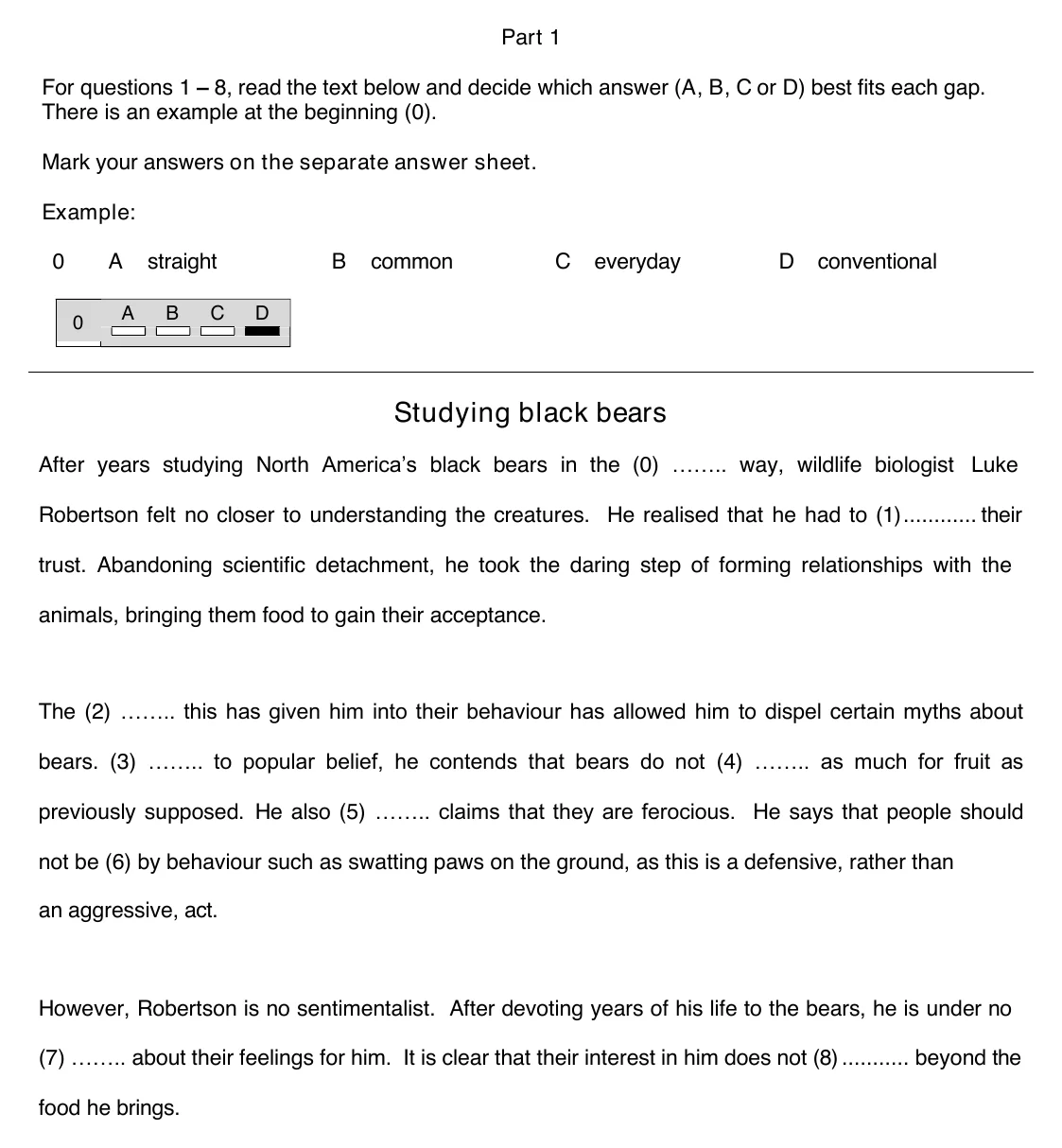
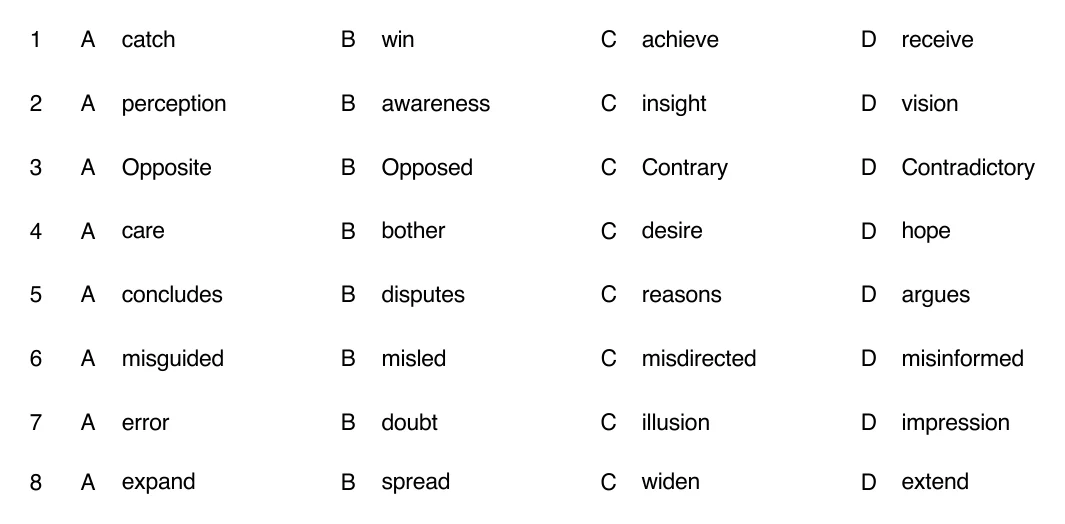
Tap a page to see it full size. Official C1 Advanced sample paper (Sample Paper 1, Reading and Use of English). © Cambridge University Press & Assessment. Text: Suzanne Goldenberg, © Guardian News & Media Ltd 2009.
I’ve already solved this part, with answers and tips, in the C1 Advanced Use of English guide, where it sits alongside Parts 2, 3 and 4 because you prepare for it in the same way.
Part 5: Multiple choice
One long text and six four-option questions that follow the order of the text. Finding the information isn’t enough here: many questions ask about the writer’s intention, an idea that runs through the whole text or the point of a bracketed remark. In the sample paper the text is the introduction to a book on the history of colour, in a fairly dense academic register.
You are going to read the introduction to a book about the history of colour. For questions 31-36, choose the answer (A, B, C or D) which you think fits best according to the text.
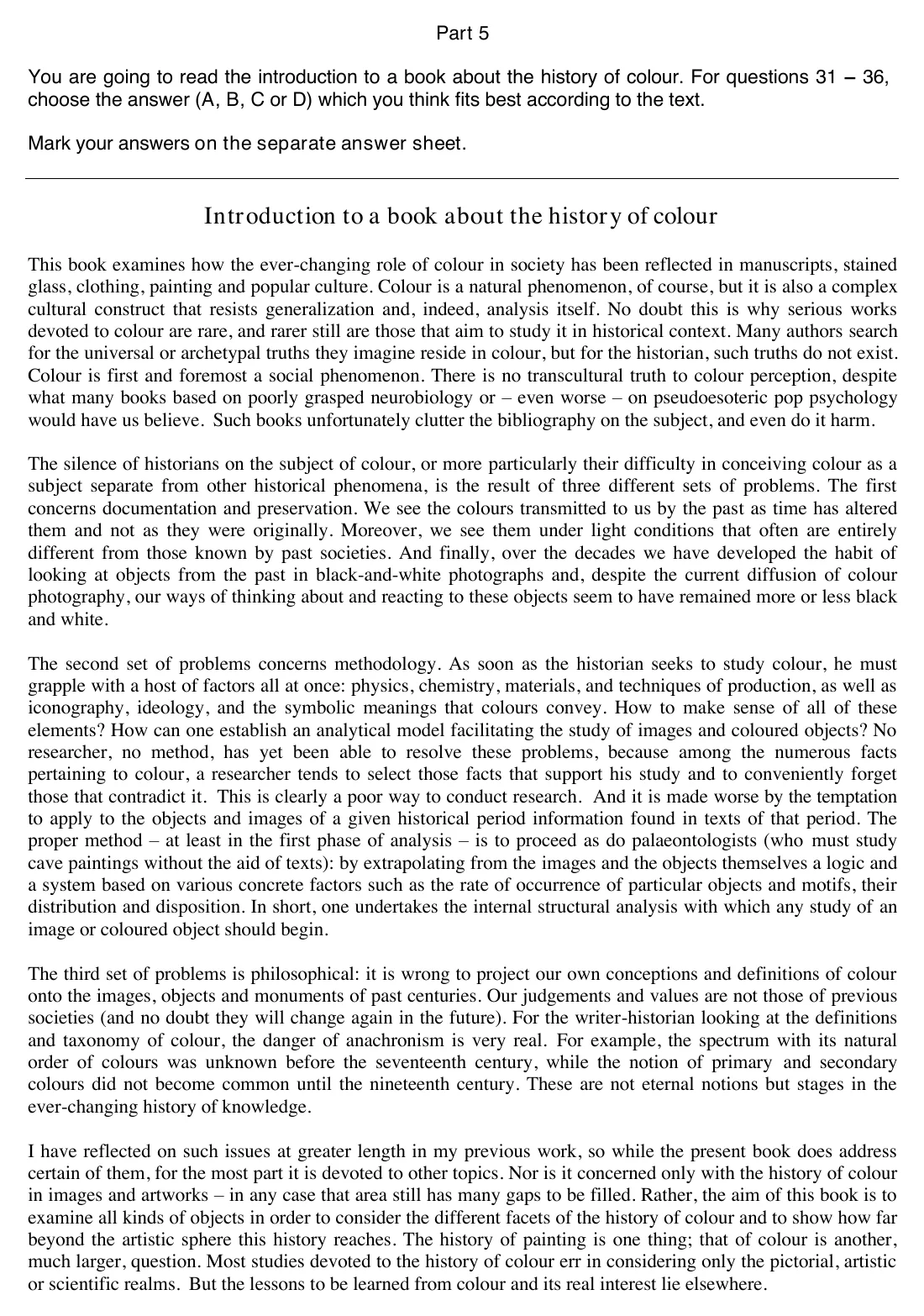
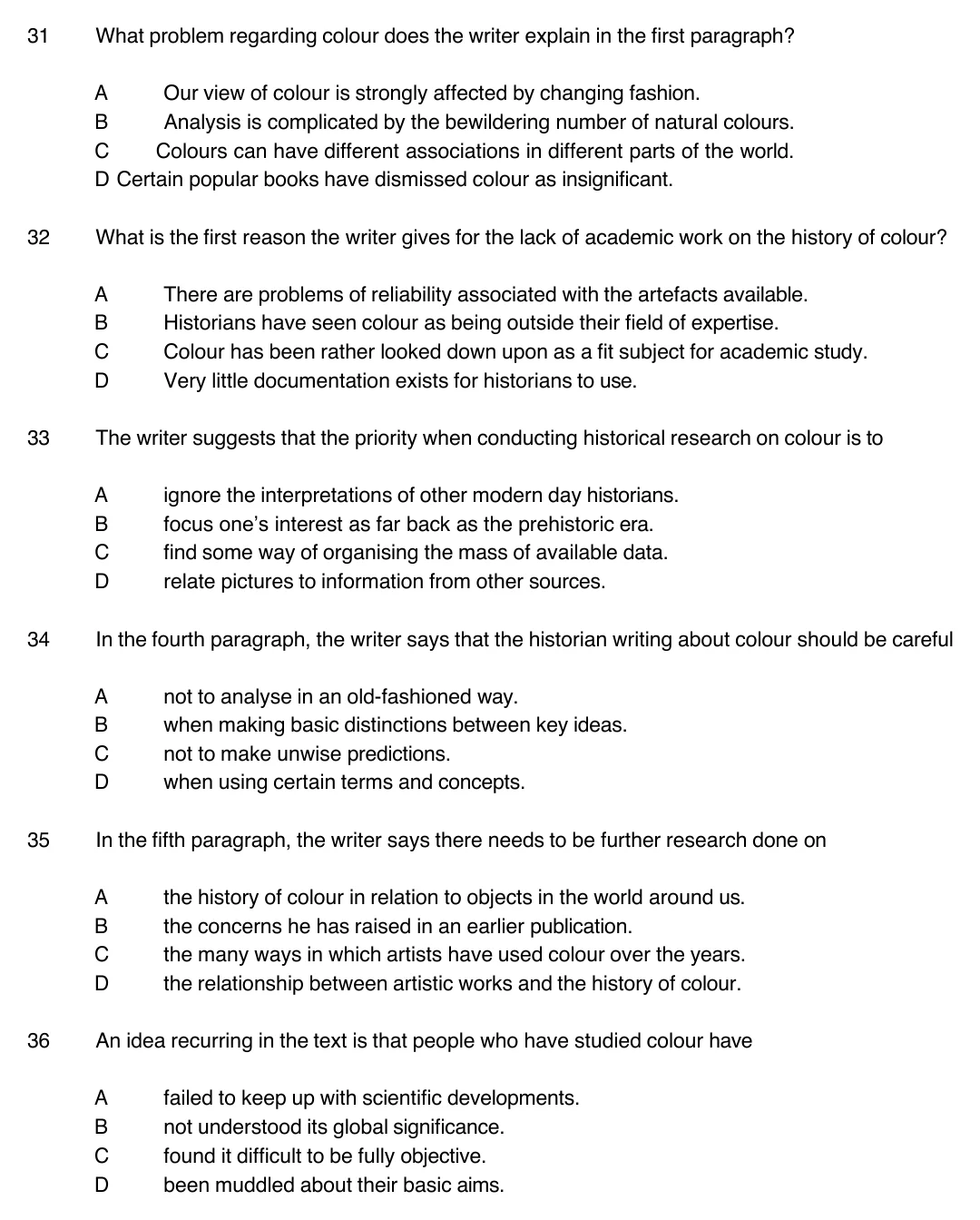
Tap a page to see it full size. Official C1 Advanced sample paper (Sample Paper 1, Reading and Use of English). © Cambridge University Press & Assessment.
Show answers
- C: The paragraph calls colour a complex cultural construct and first and foremost a social phenomenon, and says There is no transcultural truth to colour perception: each culture sees it in its own way. D is the trap: the writer criticises those books because they clutter the bibliography, but never says they treat colour as unimportant.
- A: The first problem is documentation and preservation: we see colours as time has altered them and not as they were originally, and under different light. In other words, the objects that have come down to us are unreliable. D plays on the word documentation, but the text never says there is little of it.
- C: The historian has to grapple with a host of factors all at once, and the proper method is to extract a logic and a system from the objects themselves, based on the rate of occurrence, distribution and disposition: organising a mass of data. D is exactly what the writer warns against (the temptation to apply… information found in texts), and the palaeontologists are only a comparison, not a call to study prehistory (B).
- D: The danger is anachronism: the spectrum was unknown before the seventeenth century and primary and secondary colours only became a common notion in the nineteenth. These are not eternal notions, so today’s terms and concepts must be handled with care. B sounds plausible because primary and secondary colours are mentioned, but the point is not distinguishing ideas, it’s not projecting ours. C hangs on a bracketed aside (they will change again in the future) that isn’t a warning at all.
- D: The key is in the brackets: the book isn’t only about colour in images and artworks, and in any case that area still has many gaps to be filled. That area is the history of colour in art. A is what this book does, not what still needs researching, and B refers to issues the writer has already dealt with in his previous work.
- C: The idea keeps coming back: authors looking for universal or archetypal truths they imagine reside in colour (paragraph 1), the researcher who selects those facts that support his study and forgets the rest (paragraph 2), the mistake of projecting our own conceptions (paragraph 4) and studies that err in considering only the pictorial, artistic or scientific realms (paragraph 5). They all see colour through their own assumptions. A rests on a single mention of poorly grasped neurobiology.
What this part teaches you. Two answers (32 and 35) depend on details a hurried reader skips: the word altered in the second paragraph and a bracket in the fifth. In 33, option D describes the very thing the writer argues against, which is a common C1 pattern: an option that borrows an idea from the text but reverses the writer’s view of it. Question 36 looks at the whole text, so it’s worth leaving it until last, when you’ve got the full picture.
Part 6: Cross-text multiple matching
This is the part that surprises students coming from B2, because it doesn’t exist there. You read four short texts by different writers on the same subject and answer four questions that only tell you the topic, never the opinion: you have to work out what each writer thinks and who agrees or disagrees with whom. In the sample paper they’re four reviews of Alain de Botton’s The Architecture of Happiness.
You are going to read four reviews of a book about how architecture can affect the emotions. For questions 37-40, choose from the reviews A-D. The reviews may be chosen more than once.
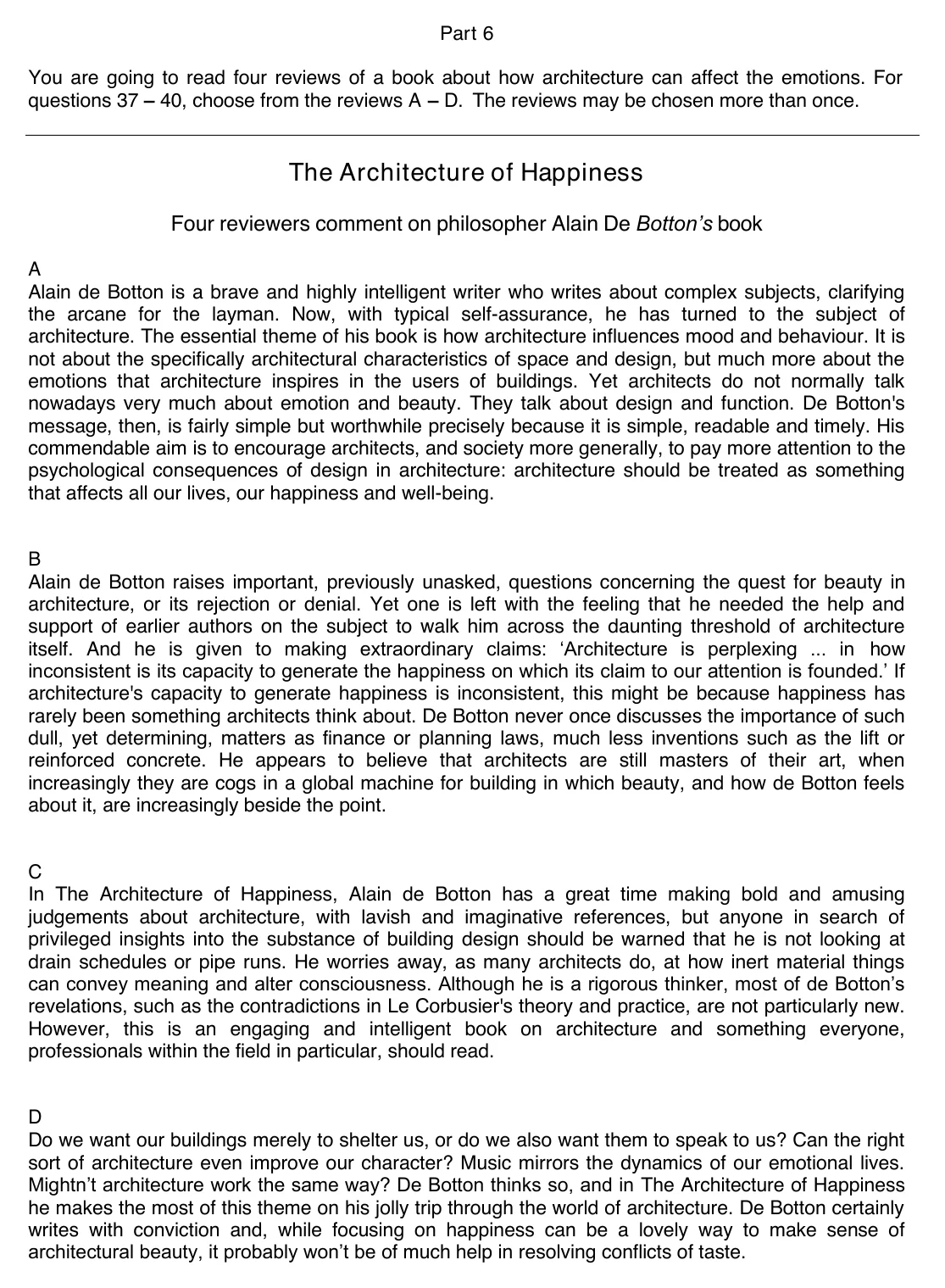
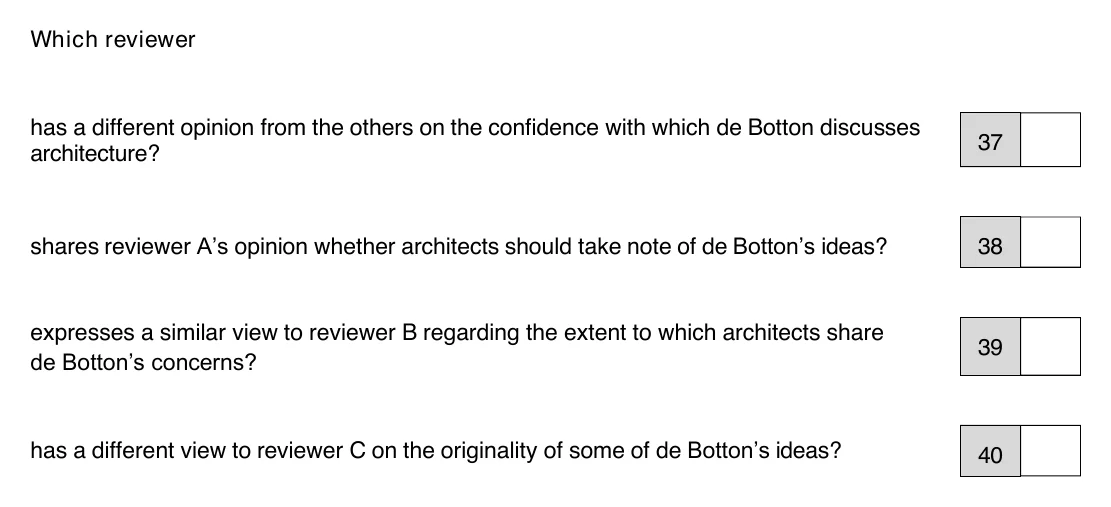
Tap a page to see it full size. Official C1 Advanced sample paper (Sample Paper 1, Reading and Use of English). © Cambridge University Press & Assessment. Text: © Hamish Hamilton, Fivedials.com.
Show answers
- B: Three reviews see him as very sure of himself: A mentions his typical self-assurance, C his bold… judgements and D says he writes with conviction. B is the odd one out: it suggests he needed the help and support of earlier authors to cross the daunting threshold of architecture.
- C: A wants architects, and society more generally to pay attention to the book’s ideas. C agrees: something everyone, professionals within the field in particular, should read. Those professionals within the field are the architects.
- A: For B, happiness has rarely been something architects think about. A says the same thing in other words: architects do not normally talk nowadays very much about emotion and beauty. They talk about design and function. C is the trap: as many architects do means architects do share his concern, the opposite view.
- B: C says his revelations are not particularly new. B thinks the opposite: he raises important, previously unasked, questions. Previously unasked is the decisive phrase.
What this part teaches you. Before you look at the questions, sum up in three or four words what each writer thinks about each aspect (the author’s confidence, originality, usefulness for architects). With that little mental grid, the questions almost answer themselves. And be wary of words two texts share: in 39, review C mentions architects in a sense opposite to B’s, even though the topic is the same.
Part 7: Gapped text
A long article with six paragraphs removed, which appear jumbled at the end together with a seventh that doesn’t belong anywhere. It’s a test of cohesion: pronouns that need something to refer to, contrast linkers, ideas introduced in one paragraph and developed in the next. In the sample paper the article is about the Scottish wildcat.
You are going to read an extract from a magazine article. Six paragraphs have been removed from the extract. Choose from the paragraphs A-G the one which fits each gap (41-46). There is one extra paragraph which you do not need to use.
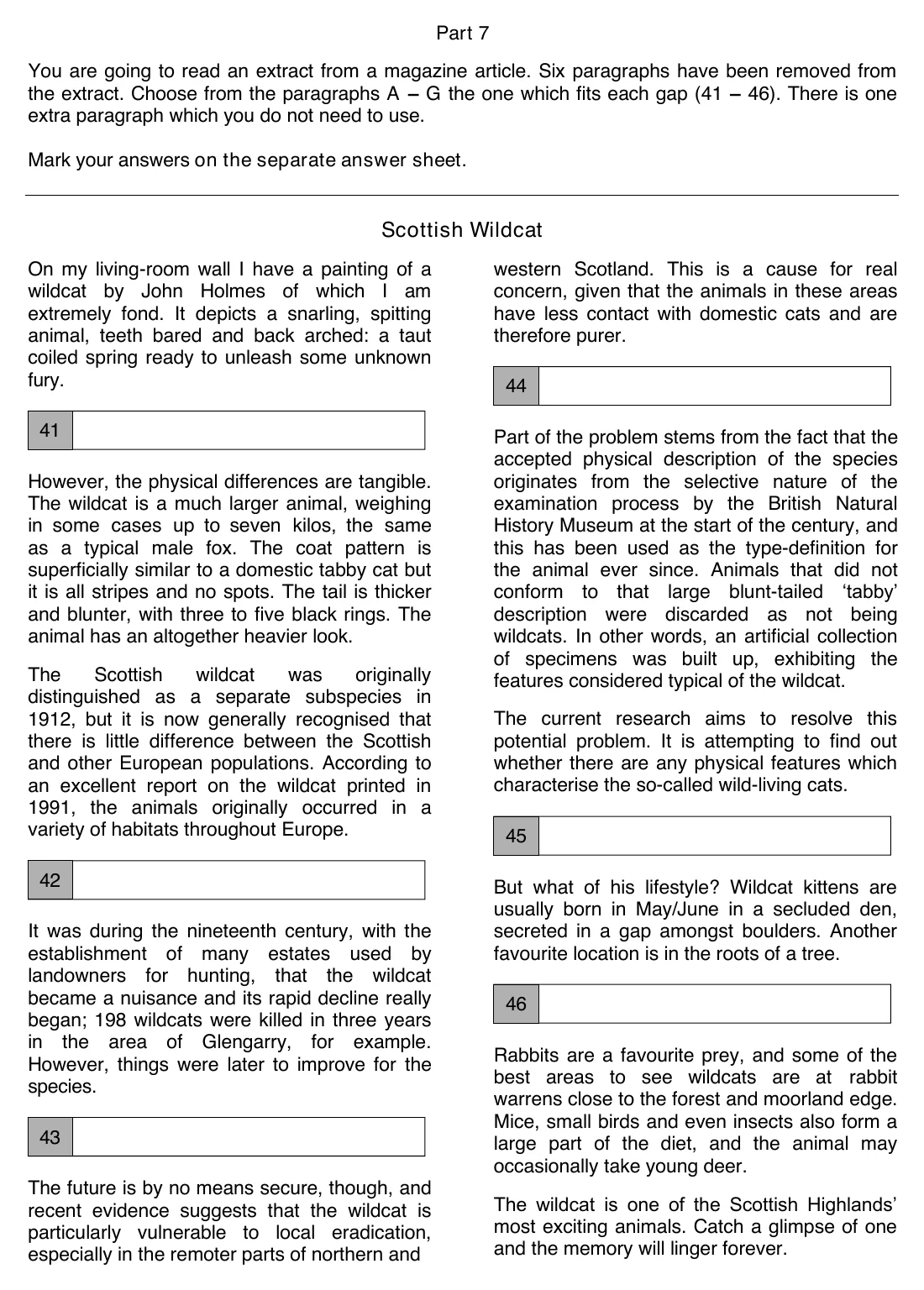
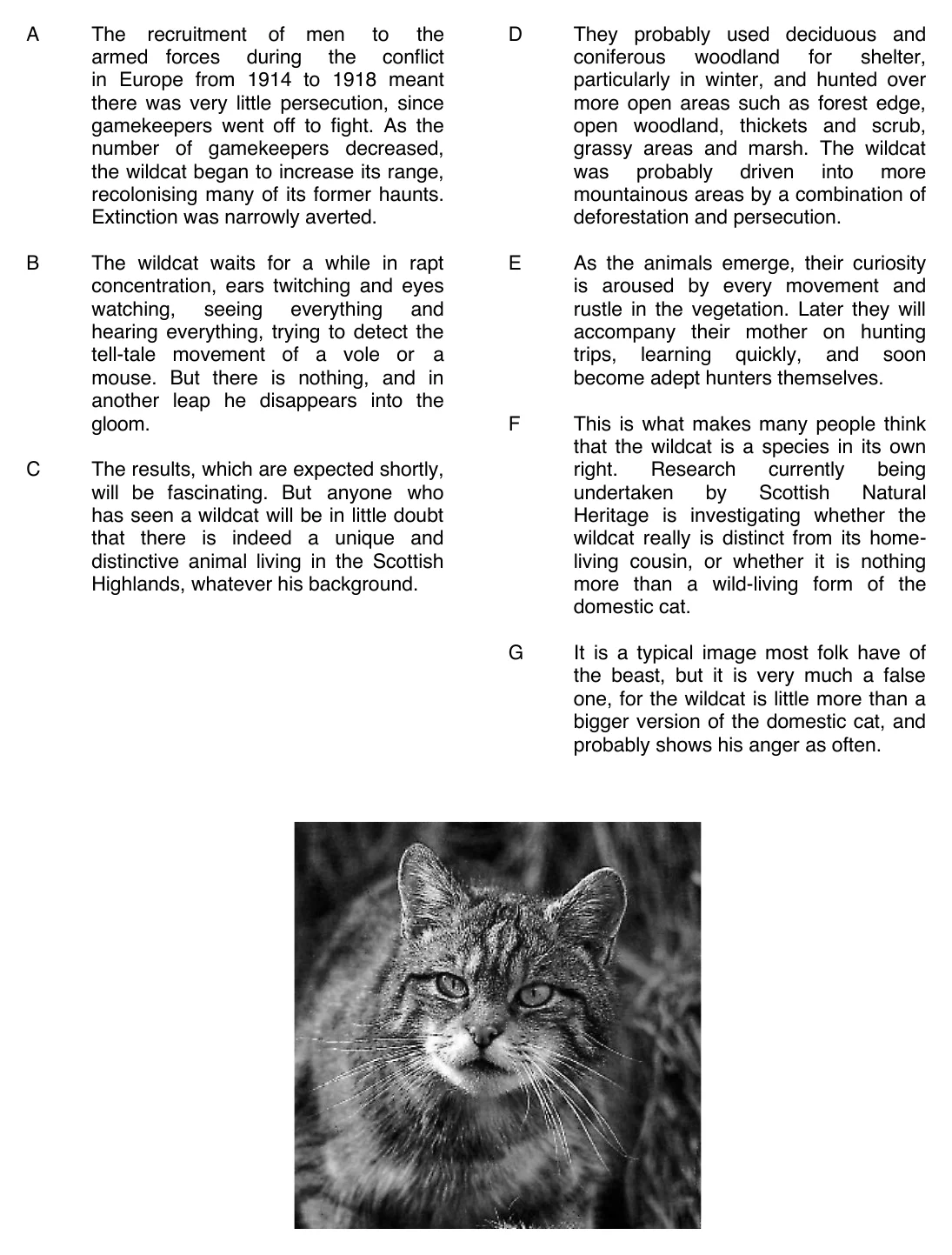
Tap a page to see it full size. Official C1 Advanced sample paper (Sample Paper 1, Reading and Use of English). © Cambridge University Press & Assessment.
Show answers
- G: It is a typical image: image picks up the painting the writer has just described. And what follows works as a reply: G says the wildcat is little more than a bigger version of the domestic cat, and the next paragraph qualifies that with However, the physical differences are tangible.
- D: They probably used…: They refers to the animals that, according to the 1991 report, originally occurred in a variety of habitats throughout Europe, and D describes those habitats. D also ends with persecution, which is exactly what the next paragraph develops: the nineteenth-century hunting estates.
- A: Before the gap: However, things were later to improve for the species. A explains the improvement (gamekeepers went off to fight in the First World War) and ends with Extinction was narrowly averted. Then comes the contrast: The future is by no means secure, though.
- F: This is what makes many people think…: This picks up the idea that cats in remote areas are purer because they have little contact with domestic cats. F also introduces the current research, and the next paragraph opens with Part of the problem: the problem of deciding whether it is a separate species.
- C: The results are those of the research mentioned just before (The current research…). And C ends with whatever his background, which sets up the contrast in the next paragraph: But what of his lifestyle?
- E: Before the gap, the kittens are born in their den; E continues with As the animals emerge and describes how they learn to hunt with their mother. That leads into the paragraph on prey: Rabbits are a favourite prey.
The extra paragraph is B. It mentions hunting and a mouse, so it looks like a candidate for 46, but it’s a narrated scene with a he that has no antecedent, and it neither follows on from the kittens nor leads into the list of prey.
What this part teaches you. Nearly every gap is solved by a pair of clues: a word at the start of the paragraph that points back (It is a typical image, They, This, The results) and something at the end that sets up what follows (whatever his background against But what of his lifestyle?). Always check both directions. A paragraph that fits what comes before but doesn’t link to what comes after is the classic trap, and paragraph B in this paper is built for exactly that.
Part 8: Multiple matching
Ten statements and a text divided into sections (here, five careers consultants giving advice to new graduates). You decide which section each idea comes from, and sections can be used more than once. It’s the quickest part to read if you know how to scan, but each question is worth just one mark, so don’t give it more time than it deserves.
You are going to read a magazine article in which five career consultants give advice about starting a career. For questions 47-56, choose from the consultants (A-E). The consultants may be chosen more than once.
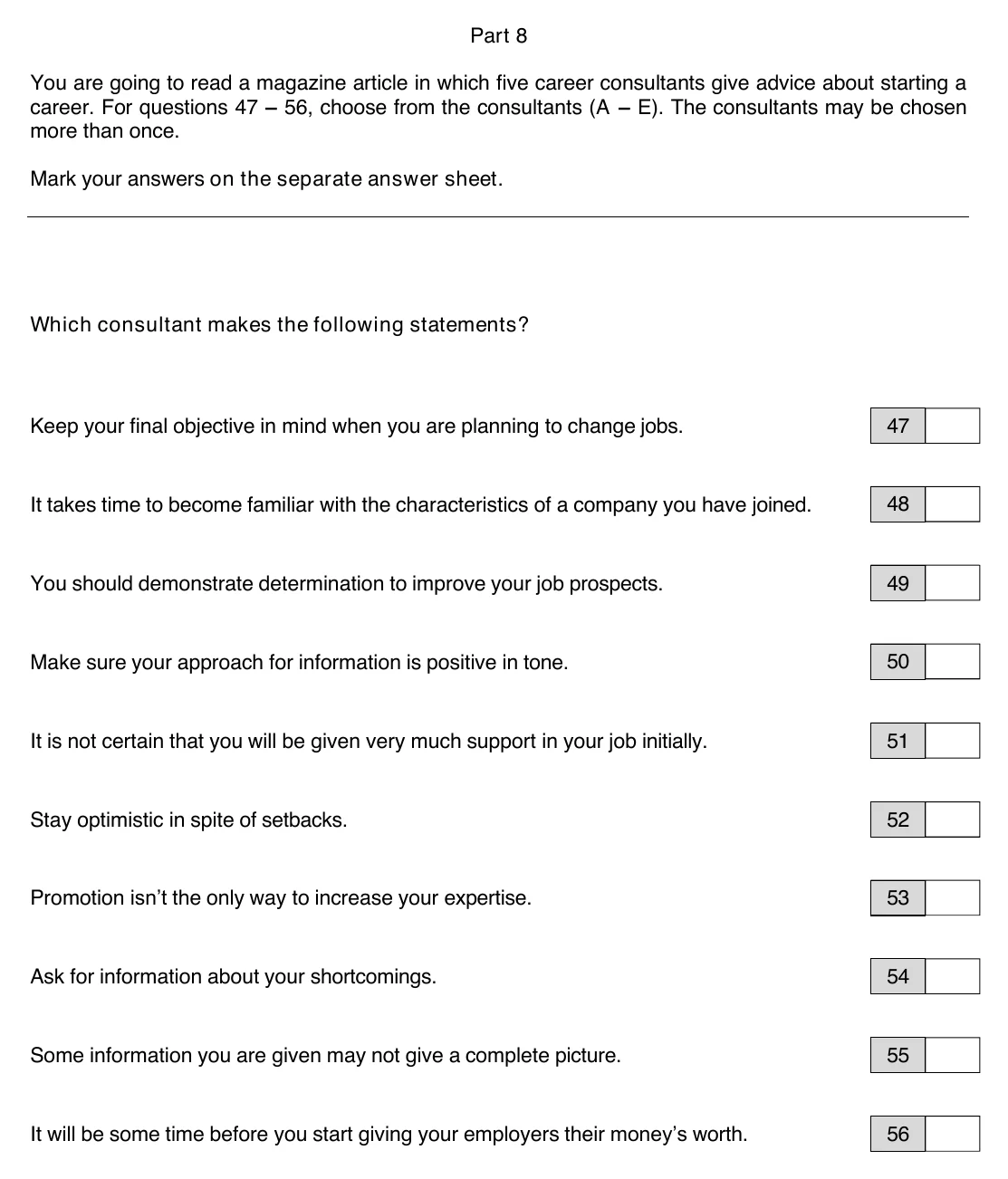
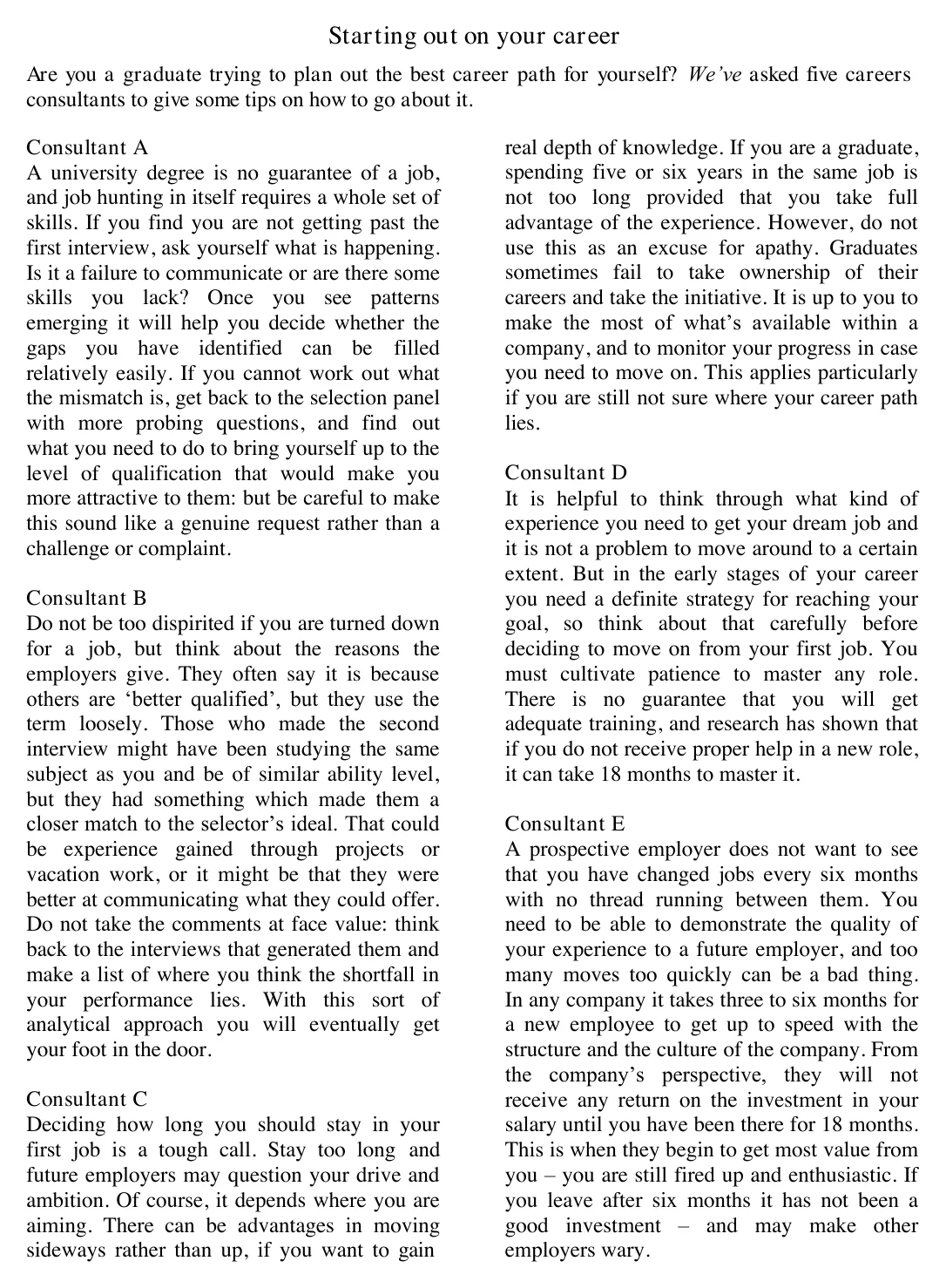
Tap a page to see it full size. Official C1 Advanced sample paper (Sample Paper 1, Reading and Use of English). © Cambridge University Press & Assessment. Text: Irene Krechowiecka and Marianne Curphey, © Guardian News & Media Ltd 2004.
Show answers
- D: You need a definite strategy for reaching your goal before deciding to move on from your first job. Goal = final objective.
- E: three to six months… to get up to speed with the structure and the culture of the company. Careful with D: its 18 months are about mastering a role, not getting to know the company.
- C: Stay too long and future employers may question your drive and ambition; then do not use this as an excuse for apathy and take the initiative: you have to show drive.
- A: a genuine request rather than a challenge or complaint: the request for information should sound constructive.
- D: There is no guarantee that you will get adequate training: nobody promises you proper support at the start.
- B: Do not be too dispirited if you are turned down for a job. Not being dispirited is staying optimistic, and being turned down is the setback.
- C: There are advantages in moving sideways rather than up to gain real depth of knowledge. Moving up = promotion; depth of knowledge = expertise.
- A: get back to the selection panel with more probing questions: ask directly what you’re missing. B also deals with your weak points, but tells you to work them out yourself (make a list), not to ask anyone.
- B: Employers say ‘better qualified’, but they use the term loosely, so Do not take the comments at face value: what you’re told isn’t the whole story.
- E: The company gets no return on the investment in your salary until you have been there 18 months. A return on the investment in your salary = their money’s worth. Once again, D’s 18 months are a trap: they refer to something else.
What this part teaches you. Cambridge builds more than one trap out of a single detail: 18 months appears in both D and E, but in D it’s how long it takes to master a role and in E how long before the company gets a return on your salary. And in 54, two consultants talk about your weak points, yet only one tells you to ask. The statement has to match in full, not just in topic.
How to split the hour and a half
Cambridge doesn’t set times for each part, and the handbook suggests each student works out which parts take them longest and plans around that. Here’s a starting point for your practice, to adjust as you go:
| Block | Suggested time |
|---|---|
| Parts 1 to 4 | 25-30 minutes |
| Part 5 | 15 minutes |
| Part 6 | 10 minutes |
| Part 7 | 15 minutes |
| Part 8 | 10-12 minutes |
| Checking (and, on paper, the answer sheet) | 5 minutes |
On paper you can do the parts in any order, though Cambridge advises following the order of the question paper so you don’t put answers in the wrong section of the answer sheet.
Strategies that work across the whole paper
- Read the title and the introductory line. Cambridge includes them to guide you: they tell you where the text comes from and what it’s about, which already hints at the tone.
- Look for ideas, not words. The right answer nearly always paraphrases the text (dispirited for optimistic, depth of knowledge for expertise). If an option repeats a word from the text, be suspicious.
- Find the evidence before you choose. In Part 5, locate the part of the text that answers the question first, and only then compare the options. With questions that are unfinished sentences, the whole sentence has to match the text.
- Pay attention to attitude. Words such as commendable, daunting, given to making extraordinary claims or not particularly new are what decide Parts 5 and 6.
- Let the marks guide you. If you’re short of time, make sure Part 7 doesn’t go unfinished: it’s worth 12 marks.
- Don’t leave anything blank. Wrong answers don’t lose marks.
Common mistakes in C1 Reading
- Stopping at every unknown word. A C1 text will always have a few. Keep reading and work them out from context; the handbook stresses that the overall meaning is what matters.
- Choosing the option that sounds sensible. In Part 5, the answer isn’t what you think is true, it’s what the writer says.
- Solving Part 7 by looking only at the text before the gap. The handbook names this as the most frequent error, and the extra paragraph in the sample paper is designed to catch it.
- Confusing topic with opinion in Part 6. Two reviews discussing the same thing don’t necessarily think the same about it.
- Forgetting the answer sheet. On paper, transferring 56 answers takes a while and there’s no extra time.
How to prepare for C1 Advanced Reading
Practice tests help you master the format, but what really raises your score is reading a lot and widely: opinion pieces, book reviews, popular science and, of course, fiction. Cambridge even recommends keeping a record of new vocabulary with its collocations, which will also pay off in Part 1.
If you’re looking for reading at your level with tasks similar to the exam, my book Short Stories in English C1 has 20 original stories with audio, a glossary and C1 Advanced-style exercises. My guide to learning English with short stories explains how to get the most out of them.
For Part 7, revise the C1 linkers: spotting them quickly is half the job. And if you’re studying without a teacher, how to prepare for C1 on your own gives you a complete plan, while my pick of the best books for C1 Advanced lists the materials I’d use.
C1 Reading FAQ
Which parts are Reading in C1 Advanced?
Parts 1, 5, 6, 7 and 8 of Reading and Use of English. Parts 2, 3 and 4 are Use of English. That’s how Cambridge lists them in its score conversion tables and on the answer sheet.
Is Part 1 Reading or Use of English?
Officially, Reading. Its format (a gapped text with options) looks like Use of English, and until 2015 it counted as such, but today it goes towards your Reading score.
How many marks is C1 Reading out of, and how many do I need?
It’s out of 50. In the official tables for practice tests, 32 marks convert to 180 on the Cambridge English Scale, the minimum for C1. Remember that passing depends on the average of all five skills, not on each one separately.
Can I pass C1 if I fail Reading?
Yes. What counts is the average of Reading, Use of English, Writing, Listening and Speaking, so a low Reading score can be made up for elsewhere, although it’s not something to rely on. My post on the minimum score to pass a Cambridge exam explains it with examples.
How much time do I get for Reading?
There’s no separate time: you have 1 hour 30 minutes for the whole Reading and Use of English paper, and you decide how to divide it.
Is Reading the same on paper and on computer?
The tasks are the same. What changes is how you answer (on screen or on an answer sheet) and a few layout details; on computer you can highlight text and there’s a timer on screen.
Keep preparing for C1 Advanced
- C1 Advanced Use of English, with Parts 1 to 4.
- C1 Advanced Listening, with the official sample test and its audio.
- C1 Advanced Writing.
- C1 Advanced Speaking.
- C1 score calculator.
- What to expect on exam day.
- Everything about the exam on the C1 Advanced (CAE) page.
If anything in the sample paper left you puzzled, or you can’t see why an answer is right, leave me a comment and I’ll explain it.
See you in the next guide. Until then, don’t forget to keep smiling! 🙂
