
Table of contents
If you’re thinking of getting the English certificate from an Escuela Oficial de Idiomas (EOI), Spain’s official language schools, you’ve probably noticed that the information is scattered across dozens of PDFs, one per region, each with its own names, acronyms and tables. And once you finally find yours, you’re left wondering which parts are the same all over Spain and which parts change.
That’s what this guide is for. I’ve read the official guides, specifications and sample exams of all 17 autonomous communities plus Ceuta and Melilla, and here I explain how the EOI certification exams work: the parts, how you pass, what changes from one region to another and how to prepare. All from my experience as an official exam trainer. Let’s get started! 🙂
What is the EOI exam?
The Escuelas Oficiales de Idiomas are public schools that teach languages and also certify your level. At the end of levels B1, B2, C1 and C2 there is a certification exam and, if you pass it, you get an official certificate for that level of the Common European Framework of Reference (CEFR). A2 is also certified in some regions, such as the Basque Country or Ceuta and Melilla, but it falls outside the national rules and each region regulates it in its own way. And C2 isn’t offered everywhere: those same regions, for example, don’t have it.
There are two ways to take it:
- As an enrolled student (alumnado oficial): you study the course at the school and take the exam at the end of the level.
- As an external candidate (alumnado libre): you register for the exam only, without studying at the EOI. Lots of people who prepare on their own or at an academy go this way.
To join these courses you need to be 16 in the year you start, or 14 if the language isn’t the one you studied as your first foreign language at secondary school (Royal Decree 1041/2017). Each region then sets its own deadlines, fees and registration rules.
If you can’t decide between the EOI and a Cambridge exam, I compare them in detail in Cambridge vs EOI: which English certificate should you choose?
What the EOI certification exam is like
Here’s the reassuring part: although each region writes its own exam, they all follow the same national framework, Royal Decree 1/2019. So the basic structure is the same everywhere in Spain. The exam has five parts, one for each language activity:
| Part | What it tests | Minimum set by the decree |
|---|---|---|
| Reading (comprensión de textos escritos) | Understanding different kinds of written texts | 3 tasks and 25 items |
| Listening (comprensión de textos orales) | Understanding audio and video | 3 tasks and 25 items |
| Writing (producción y coproducción de textos escritos) | Writing your own texts and replying to others | 2 tasks |
| Speaking (producción y coproducción de textos orales) | Speaking on your own (monologue) and with someone else (dialogue) | 2 tasks |
| Mediation (mediación) | Passing on the information in a text to someone else, adapted to what they need | 2 tasks |
All five parts carry the same weight: 20% or 1/5 of the mark each. The first four are usually done on the same day, in a written session, and the speaking test takes place on another day, in pairs or groups.
Mediation is the part that surprises people coming from Cambridge, because it doesn’t exist there. You read or listen to a text (sometimes in Spanish, sometimes in English) and pass on the important points to someone who needs them: a friend from abroad, a colleague, a group of classmates. It isn’t translating: it’s selecting, rephrasing and adapting. I explain it in detail on the B2 written mediation page.
How you pass the EOI exam
The general rule is set by Royal Decree 1/2019, and it has two conditions you have to meet at the same time:
- At least 50% in each of the five parts.
- At least 65% of the total mark.
In other words, doing brilliantly in four parts isn’t enough: if one falls below half marks, you fail. And scraping through all five isn’t enough either if your total doesn’t reach 65%. Each region expresses this on its own scale (out of 10, 20 or 100 points per part), and some add their own details, but that’s the idea.
Two more things worth knowing:
- If there’s an ordinary and an extraordinary sitting in the same school year, in the extraordinary one you don’t retake the parts you’ve already passed, and your mark is kept.
- Passing only some parts doesn’t give you a partial certificate for the level. At most, you can ask for an academic certificate showing which parts you passed.
Is the EOI exam the same in every region?
The structure, yes. The details, no. Every school year each region publishes its own specifications, and that’s where it decides the exact number of tasks, the timing, how many words you write, what the mediation looks like and the marking criteria. In every region, though, the exam is the same for all the schools in that region: individual EOIs don’t write their own.
Having read the documents for all of them, these are the differences that most affect how you prepare:
- The language of the mediation text. In some regions the source text is in English and in others it’s in Spanish, and you don’t prepare for them in the same way. In Madrid and Murcia, for example, the written mediation starts from a text in Spanish.
- Whether there’s written and spoken mediation. The usual set-up is one task of each. But in Asturias mediation is spoken only, and in the Balearic Islands it’s written only.
- How much you write. At B2, for example, the two writing tasks add up to anything from about 210-230 words in Castile-La Mancha to 350-400 in Extremadura.
- What the speaking test is like. The monologue usually lasts between 2 and 5 minutes, with more or less preparation time, and in some places the conversation is in groups of three rather than pairs.
- The dates. The ordinary sitting is usually between May and June, and in most regions the extraordinary one is in September.
My advice: prepare the common core (which is almost everything) and, before the exam, check the candidate’s guide for your region and school year, because the formats are reviewed every year. On each page in this section I tell you what changes in that particular part.
EOI guides by level
I’ve started with B2, the level most people prepare for:
- EOI B2 English: what the exam is like, with all five parts explained.
- EOI B2 Writing: the two tasks, word counts and a worked example.
- EOI B2 Speaking: monologue, dialogue and spoken mediation.
- EOI B2 Written Mediation: what it is, how to do it and a worked example.
The C1 guides are coming very soon.
How to prepare for the EOI exam
- Start with mediation. It’s the least familiar part, and the one that gives away the most marks once you understand it: it isn’t translating or simply summarising, but passing on what the other person needs.
- Practise with your region’s format. Almost every region publishes sample exams. Use them towards the end of your preparation, against the clock.
- Stick to the word count. In several regions, going well over or under costs you marks or means the task isn’t marked at all.
- Don’t neglect any part. With the 50%-per-part rule, one bad day in a single skill leaves you without a certificate.
- Practise speaking out loud. You get very little time to prepare the monologue, so practise talking for 3 or 4 minutes non-stop about everyday topics.
KSE Academy books for the EOI
I’m putting together a collection of EOI books designed for every region, with worked and fully explained examples. These are already available:
- Mediación Escrita EOI B1 Inglés: 36 worked and explained written mediation tasks.
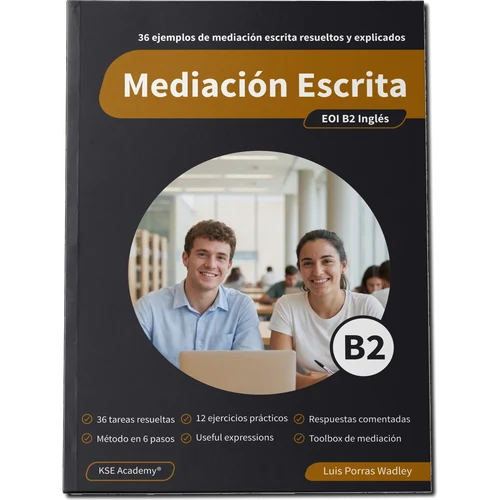
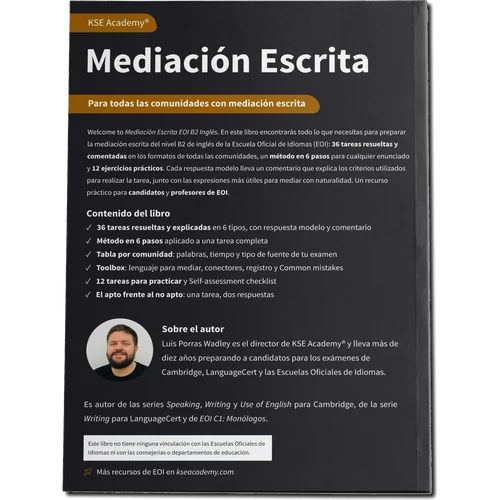
- Mediación Escrita EOI B2 Inglés: 36 worked and explained written mediation tasks.
- Mediación Escrita EOI C1 Inglés: 36 worked and explained written mediation tasks.
- EOI C1 Monólogos: 30 complete monologues with audio and video, plus 120 topic cards to prepare for the speaking test.
And if you’d like someone to check your writing, you can send me your texts with the writing correction service for your level: B1, B2, C1 or C2.
You’ll find all the EOI products in the KSE Academy shop.
EOI exam FAQs
Can I take the exam as an external candidate without studying at the EOI?
Yes. You register as an external candidate (libre) during the period your region sets and you sit the same exam as enrolled students. You can go straight for the level you want to certify.
What mark do I need to pass?
At least 50% in each of the five parts and 65% overall. Both conditions at once.
Can I practise with a sample exam from another region?
For reading and listening, it’s fairly useful. For writing, speaking and especially mediation, be careful: the word counts, the timing and the language of the source text change, and that’s exactly where marks are lost. Always practise with your own region’s format.
Does the EOI certificate expire?
No. It’s an official certificate with no expiry date, although some employers or institutions may ask for a recent one.
Did you find this guide useful? Share it with anyone preparing for the EOI. And if you’d like more content like this, subscribe to my newsletter and follow me on Facebook, Twitter, Pinterest, Instagram and YouTube.
Good luck with your preparation and, until next time, don’t forget to keep smiling! 🙂
