
Table of contents
Written mediation is the EOI B2 task that raises the most questions, and with good reason: it doesn’t exist in Cambridge, hardly anyone has done it before and, at first sight, it looks like a summary or a translation. It’s neither. And once you understand what’s really being assessed, it becomes one of the most rewarding tasks in the exam.
In this guide I explain what EOI B2 written mediation is, what the task looks like in different regions, how it’s marked and how to do it step by step, with a worked example and commentary. Let’s get started! 🙂
If you’d like to see the whole exam first, it’s in my guide to EOI B2 English.
What is written mediation?
Mediating means acting as a bridge: someone needs information that’s in a text they can’t (or don’t want to) read, and you pass it on to them. In the exam you’re given:
- A source text: an article, a leaflet, a news item, an infographic, an email…
- A situation: who needs the information, what for and what they want to know.
- A type of text to write: almost always an email or a message, although sometimes it’s a note, a summary or a forum post.
What’s assessed is your ability to select the information that person needs, rephrase it in your own words and adapt it to the reader and the purpose. That’s why it isn’t a translation (you don’t pass on everything) or a summary (you don’t tell them the most important points of the text, but the most useful ones for that person).
There are two types, depending on the language of the source text:
- Intralinguistic mediation: the source text is in English and you write in English. This is the most common type.
- Interlinguistic mediation: the source text is in Spanish and you write in English. That’s the case in Madrid and Murcia, for example.
What B2 written mediation looks like in each region
The technique is the same all over Spain, but the format varies quite a lot. Three examples from the official specifications:
| Region | Source text | What you write |
|---|---|---|
| Canary Islands | A text in English of about 150-170 words | A text of 70-80 words (35 minutes) |
| Andalusia | An infographic or text in English | An email of 125-150 words, which is also the coproduction writing task, but marked separately |
| Madrid | A text in Spanish of 500-600 words | A text of 150-180 words (45 minutes) |
And two special cases: in Asturias there’s no written mediation (the exam’s mediation is spoken only), and in the Balearic Islands mediation consists of two written tasks, because there’s no spoken mediation there.
Check your region’s candidate’s guide for your school year: that’s where you’ll find the length, the time and the type of source text.
How written mediation is marked
The scales vary from region to region, but they all assess these four things:
- Selecting information: including what the reader needs and leaving out what they don’t.
- Adapting: a register, tone and format that suit the person and the situation.
- Rephrasing: explaining the information in your own words, without copying sentences from the text.
- Language: a well-organised text written with the accuracy and range expected at B2.
How to do written mediation step by step
- Read the situation first, not the text. Who’s going to read what you write? What do they need to know? What for?
- Read the text looking only for that. Underline the ideas that are useful to the reader and mentally cross out the rest.
- Group the information. Two or three blocks (for example, what they need to know, what they need to do and a piece of advice).
- Write in your own words. Change the sentence structure and use synonyms. If you copy, you lose marks.
- Add your touch as a mediator. An explanation, a piece of advice or a link to the person’s situation.
- Check the length and register.
EOI B2 written mediation example
The task
I wrote this task for this guide, with a source text in English:
Your friend Tom is coming to your city for four days next month. He loves art and history. Read the information below from the city’s tourism website and write an email to Tom (120-140 words) telling him what he needs to know about the Museum Pass.
Source text:
City Museum Pass
The City Museum Pass gives free entry to 25 museums and monuments, including the Fine Arts Museum, the Roman Theatre and the Cathedral Tower. Passes are valid for 48 hours (€25) or 96 hours (€40) from the first visit. They can be bought online or at the Tourist Office in Plaza Mayor, and digital passes are activated by scanning the QR code at the first museum. Pass holders can skip the ticket queue at all participating venues, although the Cathedral Tower requires booking a time slot in advance. Most museums close on Mondays. The pass also includes a 20% discount on the hop-on hop-off tourist bus. Children under 12 enter all museums free of charge and do not need a pass. Passes cannot be refunded once activated.
Before you write, think about Tom: he’s a friend (informal register), he’s coming for four days (so the 96-hour pass is the one for him) and he likes art and history. What he needs to know is what the pass includes, which one suits him, how much it costs, where to buy it and what to bear in mind when planning. The details about children or refunds are no use to him.
Model answer
Hi Tom,
Great news: there’s a Museum Pass here that’s perfect for you! It gets you into 25 museums and monuments for free, including the Roman Theatre, which you’ll love.
Since you’re staying for four days, I’d get the 96-hour pass, which costs €40. You can buy it online, and it only starts counting from the first museum you visit, so don’t worry if you arrive late on the first day.
Another good thing is that you don’t have to queue for tickets. Just one warning: if you want to go up the Cathedral Tower, you need to book a time in advance. Also, most museums are closed on Mondays, so plan your visits carefully. Oh, and you get 20% off the tourist bus too!
See you soon!
Marta
Commentary
- Selection: only what’s useful to Tom is included (what the pass covers, the 96-hour pass and its price, where to buy it, when it starts counting, no queues, booking the tower, Mondays and the bus discount). The 48-hour pass, the tourist office address, the QR code, children and refunds have been left out.
- Adaptation: an informal email to a friend, with a greeting and sign-off, contractions and a friendly tone (Great news, Just one warning, Oh, and…).
- Rephrasing: nothing is copied. Gives free entry to becomes gets you into… for free; valid for 96 hours from the first visit becomes it only starts counting from the first museum you visit; can skip the ticket queue becomes you don’t have to queue for tickets; requires booking a time slot in advance becomes you need to book a time in advance.
- The mediator’s contribution: it recommends the right pass (Since you’re staying for four days, I’d get…), connects with his interests (which you’ll love) and gives advice (don’t worry if you arrive late, plan your visits carefully).
- About 125 words in the body of the email, within the required range.
Useful expressions for your mediation tasks:
- Great news: there’s… that’s perfect for you!
- It gets you into…
- Since you’re…, I’d get / I’d recommend…
- It only starts counting from…
- Another good thing is that…
- Just one warning: …
- …, so plan your… carefully.
- Oh, and … too!
The answer is written to reflect a B2 level, without reaching C1: relative clauses (which costs €40, which you’ll love), conditionals and linkers such as since and so, and well-chosen everyday vocabulary, without anything far-fetched.
What if the source text is in Spanish?
The technique is the same, with two extra dangers:
- Don’t translate sentence by sentence. It’s the strongest temptation, and it produces long, unnatural texts with everything jumbled together. Read the Spanish text, decide what your reader needs and write straight in English, as if you were telling them.
- Explain the cultural bits. If the text mentions something very Spanish (a piece of paperwork, a local festival, opening hours), your foreign reader may need a quick explanation. In Madrid, for example, the official guide rewards adding sociocultural information that helps the mediation.
Common mistakes in written mediation
- Including everything. If you put in all the information, you haven’t selected, and you’ll go over the word count too.
- Copying sentences from the text. This is the mistake that costs the most marks. Always rephrase.
- Forgetting the reader. An email to a friend in the register of a report, or the other way round, lowers your mark for adaptation.
- Giving your opinion on the topic when you’re not asked for it. Mediating isn’t writing an essay: anything you add has to help the reader.
- Going outside the word count. In several regions it costs marks or means the task isn’t marked.
A written mediation book for EOI B2
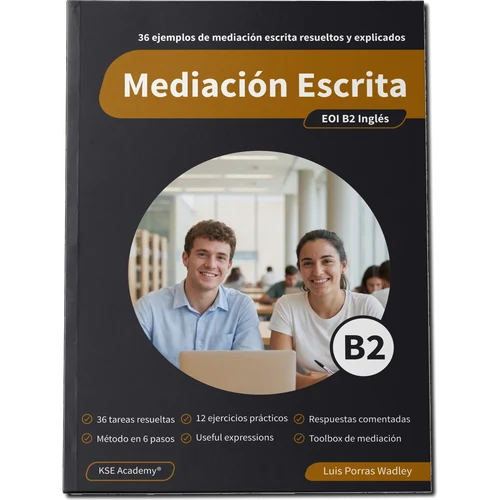
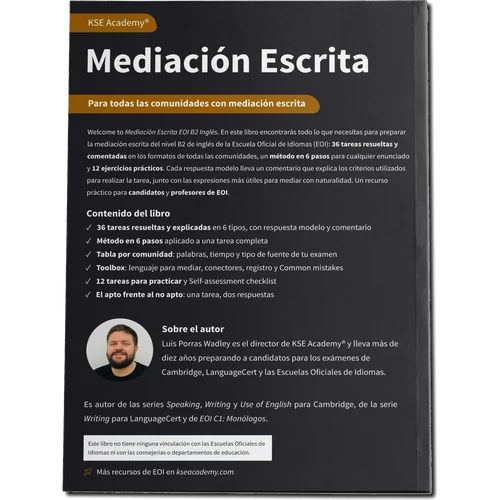
If you want to practise written mediation thoroughly, I’ve written a whole book on it: Mediación Escrita EOI B2 Inglés, with 36 worked and explained written mediation tasks. It’s designed for every region: it has source texts in English and in Spanish, different lengths and different types of text, so you can practise whichever format you’ll get. The explanations are in Spanish, and the tasks and model answers are in English.
And if you’d like me to check your mediation tasks, there’s the EOI B2 Writing and Mediation Correction service.
Did you find this guide useful? Share it with anyone preparing for B2. And if you’d like more content like this, subscribe to my newsletter and follow me on Facebook, Twitter, Pinterest, Instagram and YouTube.
Good luck with mediation and, until next time, don’t forget to keep smiling! 🙂
