
Table of contents
EOI B2 (in the schools’ own terms, Nivel Intermedio B2) is probably the most sought-after English certificate in Spain: it’s required for many public-sector exams, master’s degrees and jobs, and it’s the level most people prepare for as external candidates.
In this guide I explain what the EOI B2 certification exam is like: the level expected, all five parts one by one, how you pass and what changes depending on the region where you take it. At the end of each part you’ll find a link to its detailed guide, with worked examples. Let’s get started! 🙂
If you’re looking for the big picture (what the EOI is, who can take the exam or how external registration works), you’ll find it in my guide to the EOI exam.
What level is expected at B2
B2 is the level of the independent user at its upper stage. According to the Common European Framework of Reference, someone at B2:
Can understand the main ideas of complex text on both concrete and abstract topics, including technical discussions in his/her field of specialisation. Can interact with a degree of fluency and spontaneity that makes regular interaction with native speakers quite possible without strain for either party. Can produce clear, detailed text on a wide range of subjects and explain a viewpoint on a topical issue giving the advantages and disadvantages of various options.
In exam terms, that means you need to understand real texts and recordings (news, articles, interviews, conversations) even when you don’t know every word, write well-organised texts in the right register, speak fluently for several minutes and give your opinion with reasons.
What the EOI B2 exam is like
The exam has five parts that carry the same weight, 20% or 1/5 of the mark each. They’re usually done in two sessions: a written one, with reading, listening, writing and written mediation, and a speaking session on another day, with the speaking tasks and spoken mediation.
| Part | What you do |
|---|---|
| Reading | You read several texts and answer different kinds of questions (multiple choice, matching, gap filling…). |
| Listening | You listen to several recordings or videos and answer questions. |
| Writing | You write two texts: one replying to someone (an email, a forum post) and one of your own (an article, an essay, a review…). |
| Speaking | You give a monologue on a topic and have a conversation with another candidate. |
| Mediation | You pass on the information in a text to someone else, in writing and out loud, adapted to what they need. |
Reading and Listening
Each has at least three different tasks and at least 25 questions in total, because the national decree requires it. The question types are the usual ones: choosing the right option, matching texts to headings or people, true or false and gap filling. The texts are authentic or adapted from real sources: newspapers, blogs, leaflets, radio programmes or interviews.
The differences between regions are small here (how many tasks, how much time, how many times you hear each recording), and the way to prepare is the same everywhere: plenty of B2-level reading and listening, plus sample exams to get used to the question types.
Writing
Writing
Almost every region asks for two tasks: a coproduction task (replying to an email, a message or a forum post) and a production task (writing a text of your own, such as an article, an opinion essay or a review). What changes most is the length: between the two tasks, you usually write around 300 words, although some regions ask for quite a bit less and others quite a bit more.
👉🏻 Everything in detail, with a worked example, in my guide to EOI B2 Writing.
Speaking
Speaking
The usual format is a monologue of about 3 or 4 minutes on a topic given on a card, with a few minutes to prepare, and a dialogue with another candidate in which you have to talk, give opinions and often reach an agreement.
👉🏻 What each task involves, with a sample monologue, in my guide to EOI B2 Speaking.
Mediation
Mediation
This is the new part for almost everyone. There are at least two tasks, and in most regions one is written and the other spoken. In both, you read (or listen to) a text and explain the important points to someone who needs them: a friend coming to visit, a colleague, a student’s host family. The text may be in English or in Spanish, depending on the region.
👉🏻 What’s assessed and how to do it, with a worked example, in my guide to B2 written mediation. I cover spoken mediation in the Speaking guide, because it takes place in the same session.
How you pass EOI B2
To pass, you need at least 50% in each of the five parts and at least 65% overall. Both at once. For example, if each part is marked out of 10, you need a minimum of 5 in each and an average of 6.5.
If you fail a part in the ordinary sitting, in the extraordinary sitting of the same school year you only retake the parts you didn’t pass. Each region adds its own rules about which parts you can retake to raise your mark, so check yours.
What changes at B2 depending on the region
I’ve gone through the B2 specifications of all 17 regions plus Ceuta and Melilla. I won’t list them all here, but these examples give you an idea of what changes most from one region to another:
- The length of the writing. In Castile-La Mancha the two tasks add up to 210-230 words. In Madrid, it’s 120-130 plus 180-200. In Extremadura, 350-400 in total.
- The language of the mediation text. In Madrid and Murcia, for example, the written mediation starts from a text in Spanish. In the Canary Islands, Navarre or the Valencian Community, from a text or infographic in English.
- Which mediation tasks there are. In Asturias there’s no written mediation, only spoken. In the Balearic Islands and in the English exam in Extremadura, it’s the other way round: no spoken mediation. In Andalusia, written mediation is built into one of the writing tasks, although it’s marked separately.
- The speaking test. Preparation time ranges from 1 minute to about 20, depending on the region, and in some places the conversation is in groups of three.
Since these details are reviewed every school year, always check the candidate’s guide for your region for the year you’re taking the exam.
How to prepare for EOI B2
In my experience as an exam trainer, what works is combining three things: raising your general level of English, learning the technique for each part and practising with your region’s exact format. Here it is, part by part.
Before you start: diagnosis and plan
- Download your region’s candidate’s guide and sample exams. That’s where you’ll find the length of each task, the timing and the marking criteria. You need them from day one, not at the end.
- Do a full sample exam at the start, with real timing. That way you’ll know where you stand in each of the five parts.
- Give more time to your weakest part. With the 50%-per-part rule, your weakest skill decides: a 9 in reading is no use if mediation stays at 4.
- Make a weekly plan that covers all five parts every week. A little every day beats a whole afternoon once a week.
Reading and listening
- Read and listen to real English every day: newspapers, blogs, podcasts, interviews or YouTube videos. Twenty or thirty minutes a day makes a big difference.
- Practise every task type (multiple choice, matching, gap filling, true or false) and, above all, work out why you get answers wrong: vocabulary, a trap in the question, or not understanding the text properly.
- Get used to different accents, not just British or American, and to understanding the first time, even if you hear it twice.
- Master the text types you’ll be asked for: formal and informal emails, forum posts, articles, opinion essays and reviews. Each has its own structure and register.
- Write to your region’s word count from the start, not in the last week.
- Build a bank of B2 linkers and expressions (however, on the other hand, as a result, I’d strongly recommend…) and use them naturally, without forcing them.
- Get someone to correct your work and rewrite your texts with the corrections. Writing a lot without feedback just reinforces the same mistakes.
- Record 3- or 4-minute monologues on common topics (work, technology, travel, health, the environment, education) and listen back. Structure each one with an introduction, two or three ideas with examples and a conclusion.
- Prepare with your region’s timing. Having 1 minute to prepare is very different from having 15: train with yours.
- Practise the dialogue with another person. Ask for their opinion, react to what they say, agree and disagree, and reach a conclusion. The dialogue also assesses how you interact, not just how much you talk.
- Learn the method: identify who’s receiving the information and why they need it, select only what’s useful to them, rephrase it in your own words and adapt the register.
- Avoid the mistakes that cost most: copying sentences from the text, listing facts without connecting them, making up information, leaving out key points, or translating word for word when the text is in Spanish.
- Check whether your region wants your opinion. In Madrid, for example, adding your own information is rewarded, while other regions penalise it. That’s why it’s worth checking your region’s criteria.
In the last few weeks
- Do full mock exams with your region’s sample papers, with real timing and in the same order as the exam.
- Mark your mock exams with the official criteria: that way you’ll know what the examiners look for.
- Don’t leave any part unrevised, even the one you’re best at.
Books for EOI B2
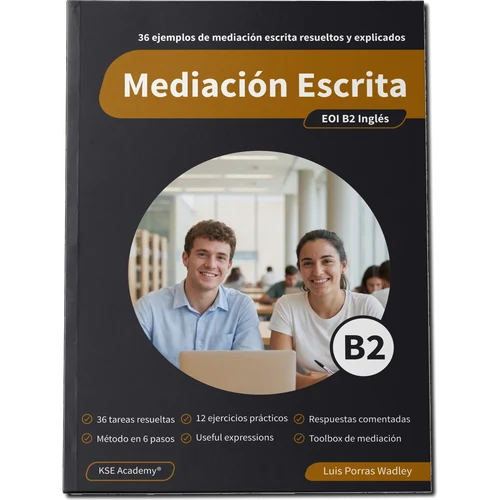
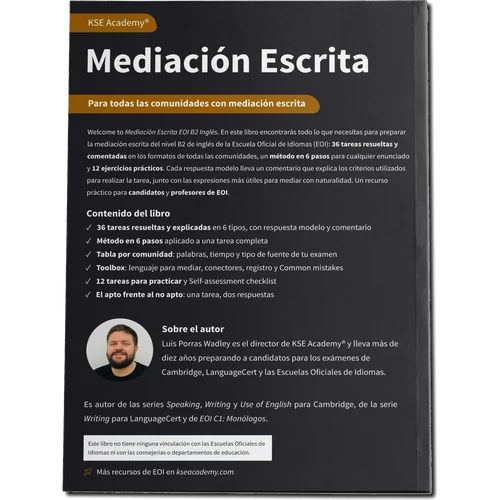
My book Mediación Escrita EOI B2 Inglés is designed for every region. I analysed the official B2 written mediation sample tasks and built it around the task types that come up most often. This is what’s inside:
- 36 worked and explained written mediation tasks, with source texts in English and in Spanish, so you can practise whichever format you’ll get.
- A 6-step method for tackling any mediation task, from reading the instructions to the final check, applied to a complete task.
- 12 tasks to practise on your own.
- A commentary on every model answer explaining why it works, with the most useful expressions for mediating naturally.
And if you’d like me to check your texts, there’s the EOI B2 Writing and Mediation Correction service: you send me your writing or written mediation tasks (1 or 3) and within 72 hours I send you back a PDF report with your mark and comments, plus your corrected text in Google Docs.
If you’re at another level, there are also written mediation books for B1 and C1.
EOI B2 FAQs
Can I go straight for B2 without having B1?
As an external candidate, generally yes: you register for the level you want to certify. Check your region’s call for applications all the same.
How long is the B2 exam?
It depends on the region. The written session usually takes several hours, with breaks between parts, and the speaking test lasts a few minutes per candidate, normally on another day.
Is EOI B2 harder than Cambridge B2 First?
It isn’t harder, it’s different. The EOI has mediation and requires 50% in each part, whereas in Cambridge the skills make up for each other. If you’d like to know more about the differences, I compare them in detail in Cambridge vs EOI.
Did you find this guide useful? Share it with anyone preparing for B2. And if you’d like more content like this, subscribe to my newsletter and follow me on Facebook, Twitter, Pinterest, Instagram and YouTube.
Good luck with B2 and, until next time, don’t forget to keep smiling! 🙂
