
Table of contents
EOI B2 Speaking is the part that makes people most nervous, and I get it: you’re speaking in front of examiners, with very little time to prepare and, quite often, with someone you’ve never met. But there’s a trick to it: the format is very predictable. If you know what you’ll be asked to do and you’ve practised out loud, you go in feeling far more confident.
In this guide I explain what EOI B2 Speaking is like (officially, production and coproduction of spoken texts): the monologue, the dialogue and spoken mediation, which in almost every region takes place in the same session. With a sample monologue and commentary and useful expressions for each task. Let’s get started! 🙂
If you’d like to see the whole exam first, it’s in my guide to EOI B2 English.
What EOI B2 Speaking is like
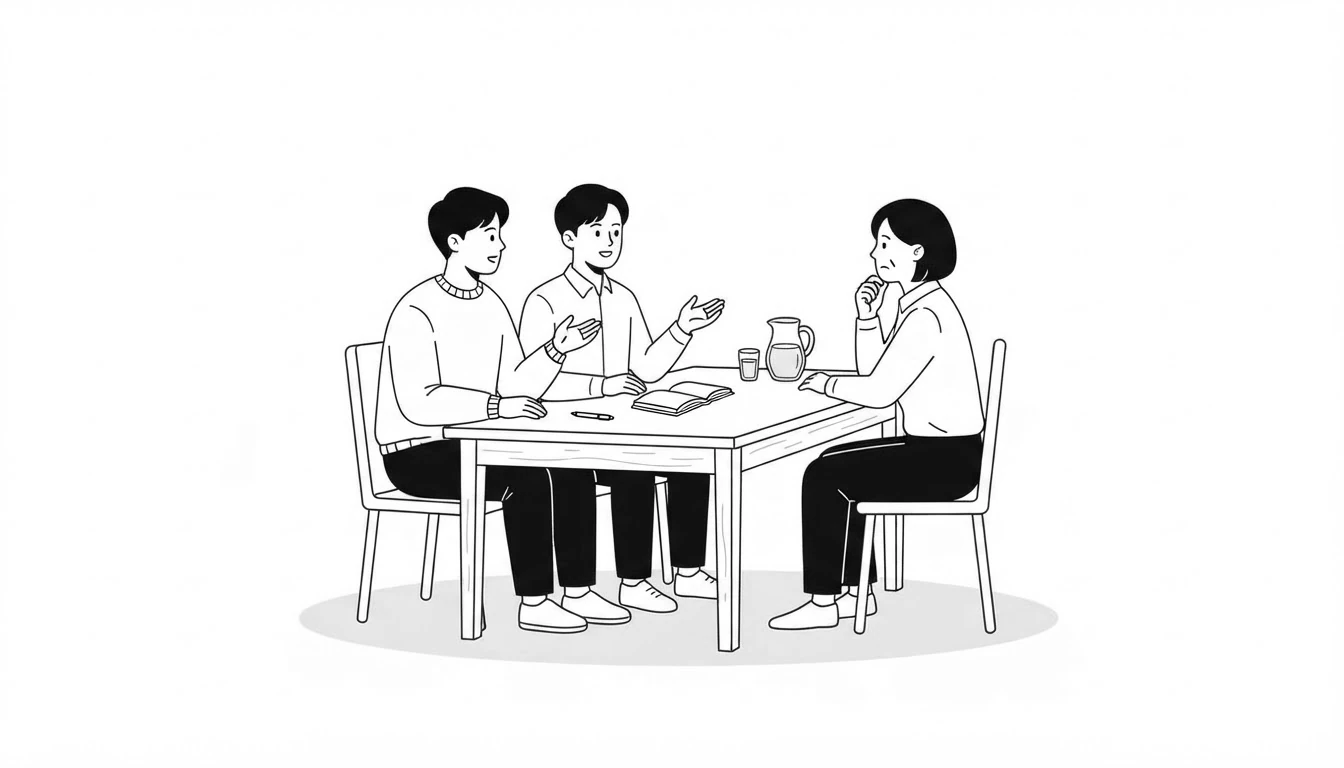
The speaking test takes place on a different day from the written part, usually in pairs (or in a group of three if there’s an odd number) in front of a panel of teachers. In almost every region it has two tasks:
- Monologue: you speak on your own about a topic given on a card, usually with several questions or prompts.
- Dialogue: you talk with the other candidate about a situation: you give your opinions, react to what the other person says and often reach an agreement.
These are the usual timings at B2:
| Task | Preparation | Usual length |
|---|---|---|
| Monologue | 1 to 5 minutes (in some regions, a longer joint preparation for several tasks) | About 3 or 4 minutes per candidate |
| Dialogue | 1 to 3 minutes, or none | About 3 to 7 minutes per pair |
| Spoken mediation | About 4 or 5 minutes | About 2 or 3 minutes per candidate |
What changes depending on the region
- Preparation time. In Navarre you get 1 minute to prepare the monologue; in Madrid, 3 minutes with brief notes; in the Basque Country, 20 minutes shared with the mediation task.
- The prompt. In some regions the card includes photos (which you don’t describe, but use as a starting point) and in others it’s just text with questions.
- The conversation format. Pairs are the norm, but in Catalonia B2 is done in groups of three.
- Spoken mediation. It exists almost everywhere, but not in the Balearic Islands or in the English exam in Extremadura. In Asturias it’s the only mediation in the exam.
Check your region’s candidate’s guide for your school year: that’s where you’ll find the exact timings.
How EOI B2 Speaking is marked
Each region uses its own scales, but the same criteria come up everywhere:
- Task achievement: talking about the topic, covering the prompts on the card and keeping to time.
- Coherence and organisation: a beginning, a middle and an end, held together with linkers.
- Fluency and pronunciation: a natural pace without long pauses, and being easy to understand.
- Range and accuracy: varied vocabulary and B2-level grammar, with few mistakes.
- Interaction (in the dialogue): reacting to what your partner says, asking them questions and not dominating the conversation.
The B2 monologue: a worked example
The card
I wrote this card for this guide, following the typical monologue format:
Living in a big city
Speak for about 3 minutes.
Sample monologue
I’m going to talk about living in a big city, which is something that a lot of young people dream of.
First of all, I’d like to live in a big city, at least for a few years. The main advantage is that there are many more opportunities. For example, my cousin moved to Madrid after university, and she found a job in just two months, which was impossible in our town. Another advantage is that there’s always something to do: concerts, exhibitions, new restaurants… And you can meet people from all over the world, which I find really exciting.
However, big cities also have some problems. In my opinion, the biggest one is the cost of living. Rents are so high that many people have to share a flat until they’re thirty or even older. Another problem is stress. If you spend an hour a day on crowded trains, it’s hard to feel relaxed when you get home, and you hardly have any time for yourself.
As for the future, I think more people will live in cities, because that’s where the jobs, the universities and the hospitals are. But I’d say that some people will move back to smaller towns, especially if they can work online.
So, to sum up, big cities are exciting, but they aren’t for everyone. Personally, I’d love to try it, but I’m not sure I’d want to stay there forever.
Commentary
- It opens by introducing the topic in one sentence, straight to the point. That way the examiners know you’ve understood the card.
- It follows the order of the three questions, with one block for each: opinion, problems and the future. It’s the easiest way to cover everything and never go blank.
- It gives personal examples (my cousin moved to Madrid…). They make the talk sound natural and give you more to say.
- B2-level linkers: First of all, Another advantage is that, However, As for, especially if, So, to sum up.
- A good range of grammar without forcing it: so… that (Rents are so high that…), the first conditional (If you spend an hour a day on crowded trains, it’s hard to…), the future with will and opinion phrases.
- It finishes with a personal conclusion, which leaves a very good impression.
It’s about 240 words: spoken at a relaxed pace, with normal pauses, that’s roughly two and a half minutes. If your region asks for 3 or 4 minutes, add one more example to each block. It’s pitched at B2, without reaching C1: clear language, common but precise vocabulary (opportunities, cost of living, share a flat, crowded) and a well-organised talk.
Useful expressions for the monologue:
- I’m going to talk about…
- The main advantage / problem is that…
- For example, … / Take my cousin, for example.
- In my opinion, the biggest one is…
- As for the future, I think…
- I’d say that…
- So, to sum up, …
- Personally, I’d love to…, but I’m not sure…
The B2 dialogue: how to interact
The dialogue isn’t about delivering two monologues one after the other, but about having a real conversation. Here’s what good interaction sounds like, based on a typical situation (choosing a leaving present for a classmate):
A: So, we need to choose a present for Laura, who’s leaving the course. What do you think about a book?
B: That sounds nice, but I’m not sure what kind of books she likes. What about something more personal, like a photo album of the class?
A: Hmm, that’s a good point. An album would be a lovely memory. But isn’t it a lot of work?
B: Maybe, but if everyone sends me a couple of photos, I can make it online in an evening. Shall we go for that?
A: OK, I agree. Let’s ask the others for their photos, then.
Look at what both speakers do: they make suggestions, react to the other person’s ideas, give reasons, ask questions and reach an agreement. Expressions that will get you out of trouble:
- What do you think about…? / What about…?
- That sounds nice, but… / That’s a good point.
- I’m not sure about that, because…
- I see what you mean, but…
- Shall we go for…? / Let’s…
- OK, I agree.
B2 spoken mediation
In spoken mediation you’re given a short text (a leaflet, an infographic, an advert, an article) and you have to explain the important points to someone in a specific situation. Depending on the region, that text is in English (Andalusia, the Canary Islands, Navarre or the Valencian Community, for example) or in Spanish (Madrid or Aragon, among others). In Castile and León, interestingly, you choose the language yourself at the start of the test.
A short example: imagine you have a leaflet in Spanish for an escape room, and an Irish friend asks you what they need to know before going. Good mediation doesn’t translate the whole leaflet; it selects and adapts:
OK, so the most important thing is that you have to book online at least a day before, so don’t just turn up. The game lasts an hour and it’s for groups of two to six people, so we could go with Sam and Ana. Oh, and you have to arrive fifteen minutes early, because they explain the rules first. And one more thing: you can’t take your phone inside, so I’d leave it in the locker.
Notice that it only passes on what the friend needs, in the speaker’s own words, and adds a personal touch (don’t just turn up, we could go with Sam and Ana, I’d leave it in the locker). That’s exactly what’s assessed. The technique is the same as in written mediation, and I explain it step by step in my guide to EOI B2 written mediation.
Tips for EOI B2 Speaking
- Use the questions on the card as your plan. One question, one block. That way you’re never stuck for something to say.
- Jot down key words, not sentences. There’s no time to write out the monologue, and in almost every region you’re not allowed to read from your notes.
- Time yourself at home. Three minutes can fly by or feel endless: practise until you know how long it feels.
- In the dialogue, listen. Reacting to what your partner says counts as much as what you say.
- If you make a mistake, keep going. Correcting yourself naturally (sorry, I mean…) is fine; stopping to think about every word isn’t.
Books for EOI B2
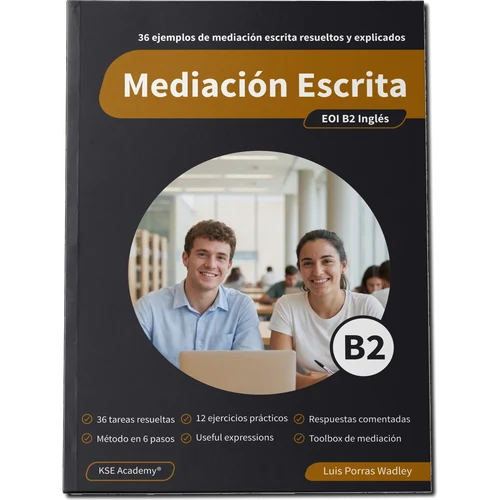
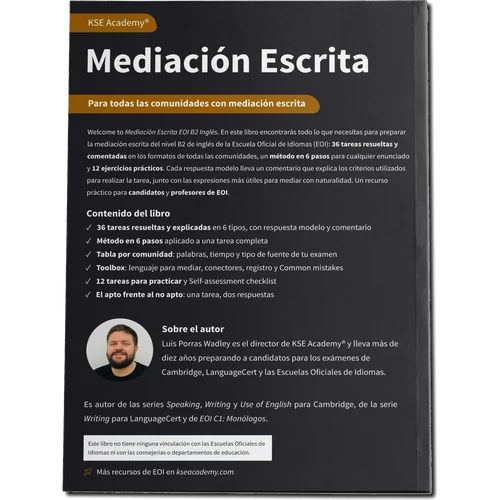
For mediation, which uses the same technique in the written and the spoken test, there’s my book Mediación Escrita EOI B2 Inglés, with 36 worked and explained tasks for every region. And if you’re going on to C1 afterwards, have a look at EOI C1 Monologues.
Did you find this guide useful? Share it with anyone preparing for B2. And if you’d like more content like this, subscribe to my newsletter and follow me on Facebook, Twitter, Pinterest, Instagram and YouTube.
Good luck with your speaking test and, until next time, don’t forget to keep smiling! 🙂
