
Table of contents
B1 Preliminary Listening Part 1 looks like the easiest part of the exam at first glance: seven short recordings, three pictures, pick one. And yet it’s where most students lose silly points, because Cambridge mentions all three pictures in the recording almost every time. The trap isn’t whether a word sounds familiar, it’s whether what’s said describes something that actually happened.
In this guide I’ll explain exactly what B1 Listening Part 1 looks like, and we’ll solve the seven questions from an official Cambridge sample test together, with the real audio so you can listen yourself before reading my explanation. 🙂
What B1 Listening Part 1 looks like
The B1 Preliminary Listening paper has four parts, 25 questions and about 35 minutes (including 6 minutes to transfer your answers), and it’s worth 25% of the final score. This is the first part:
| Fact | B1 Listening Part 1 |
|---|---|
| What you have to do | Listen to 7 short recordings and choose, for each one, the correct picture out of 3 |
| Number of questions | 7 (numbered 1 to 7) |
| Options per question | 3 pictures (A, B or C) |
| Scoring | 1 point per correct answer |
| Recordings | Each recording is played twice |
| What it tests | Understanding of specific information: what actually happened, not just what’s mentioned |
Listen to the sample test for this part
Here’s the real audio for all seven questions from an official Cambridge sample test, cut exactly to this part:
Try answering them yourself as you listen, before reading the explanations.
The seven questions, commented one by one
Question 1: what the girl bought
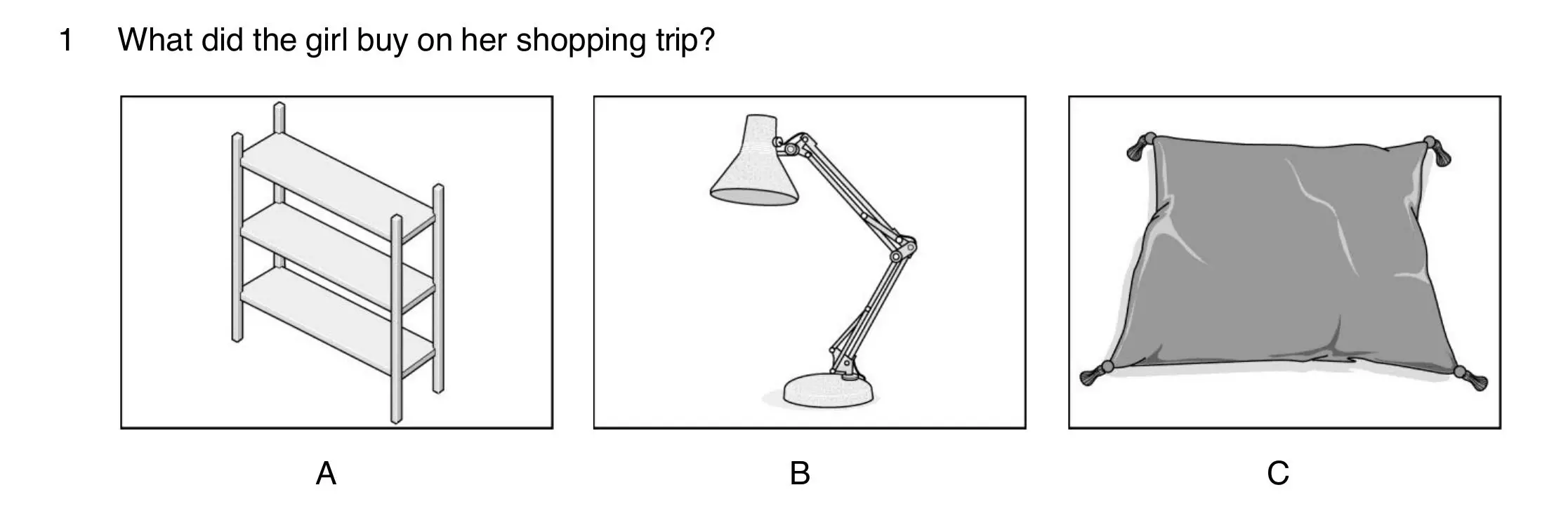
The girl says her room only has one light in the ceiling and she’d like a lamp for her desk: «so that’s what I got today», so that’s what she bought today. She’ll get the bookshelves next week if she has enough money, and about the cushion she says «I nearly got one today actually»: she almost bought it, but didn’t.
Correct answer: B. A and C are both mentioned, but one is a future plan and the other a purchase she didn’t actually make.
Question 2: why the plane was late
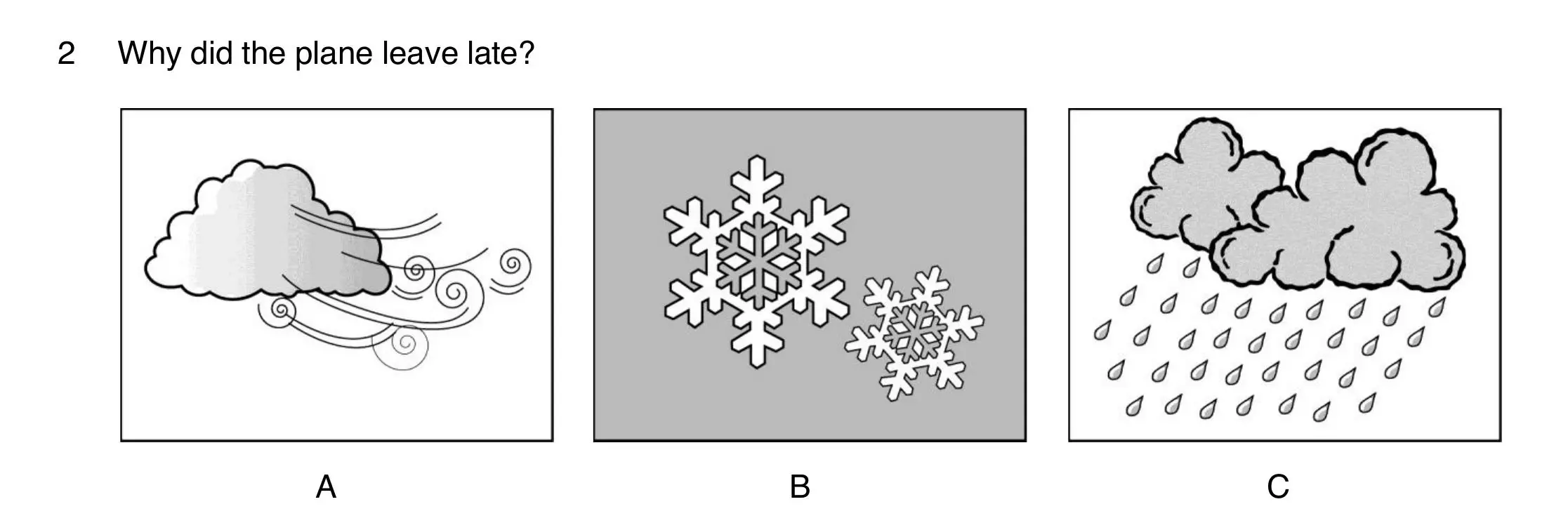
The pilot explains they had to wait for «the runway to be cleared of snow» before they could take off. He then warns that Manchester has heavy rain and they’re expecting strong winds on landing.
Correct answer: B. The rain and wind are mentioned, but they’re the arrival conditions, not the cause of the departure delay.
Question 3: the weekend activity
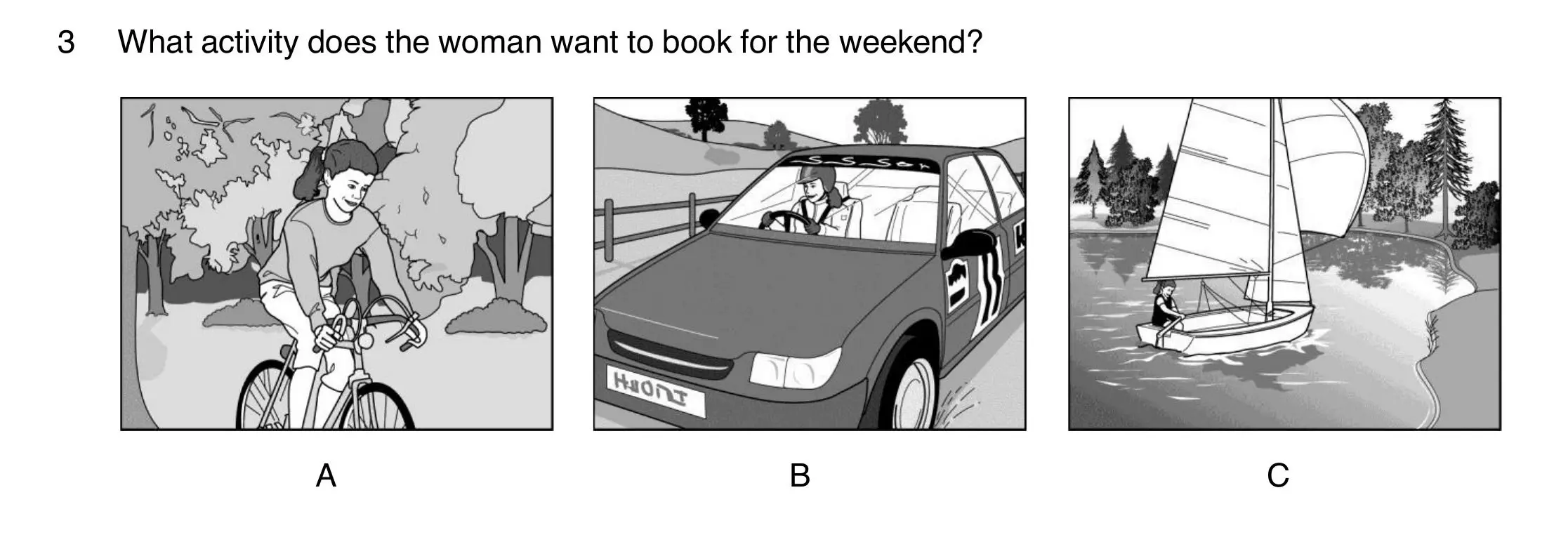
The woman wanted to book sailing, but «I understand from your website they’re all full» (it’s booked up), so she asks about cycles instead: she’d like to join a group ride through the forest, which she thinks she’d enjoy more than «the car racing I tried last time».
Correct answer: A. Sailing (C) is no longer available, and car racing (B) is something from the past she’s comparing to, not what she wants to book now.
Question 4: the cake the girl orders
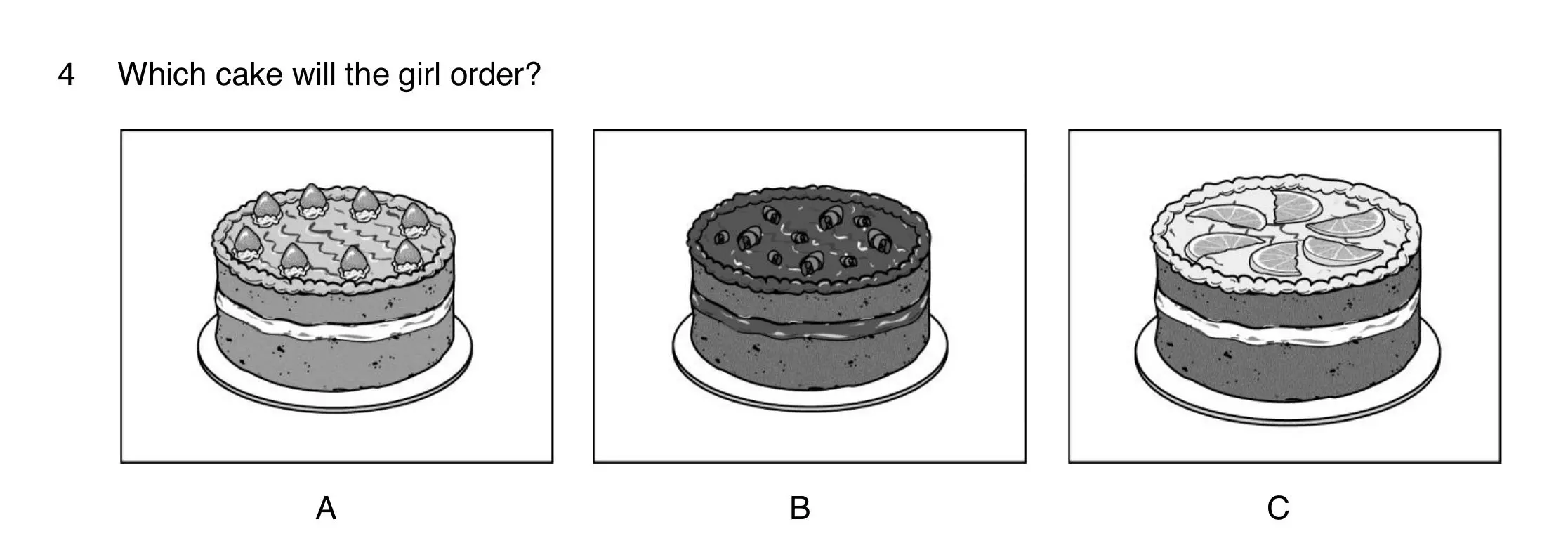
The boy always has the lemon one. She’s torn between the strawberry one (which she tried last time and, according to him, wasn’t keen on) and the chocolate one, which tempts her but «might be a bit sweet». In the end she decides: «I think I’ll have the same as you», the same as him.
Correct answer: C (lemon). Strawberry (A) and chocolate (B) are both considered and ruled out, one because of past experience and the other because of last-minute doubt.
Question 5: how much to spend for a free gift
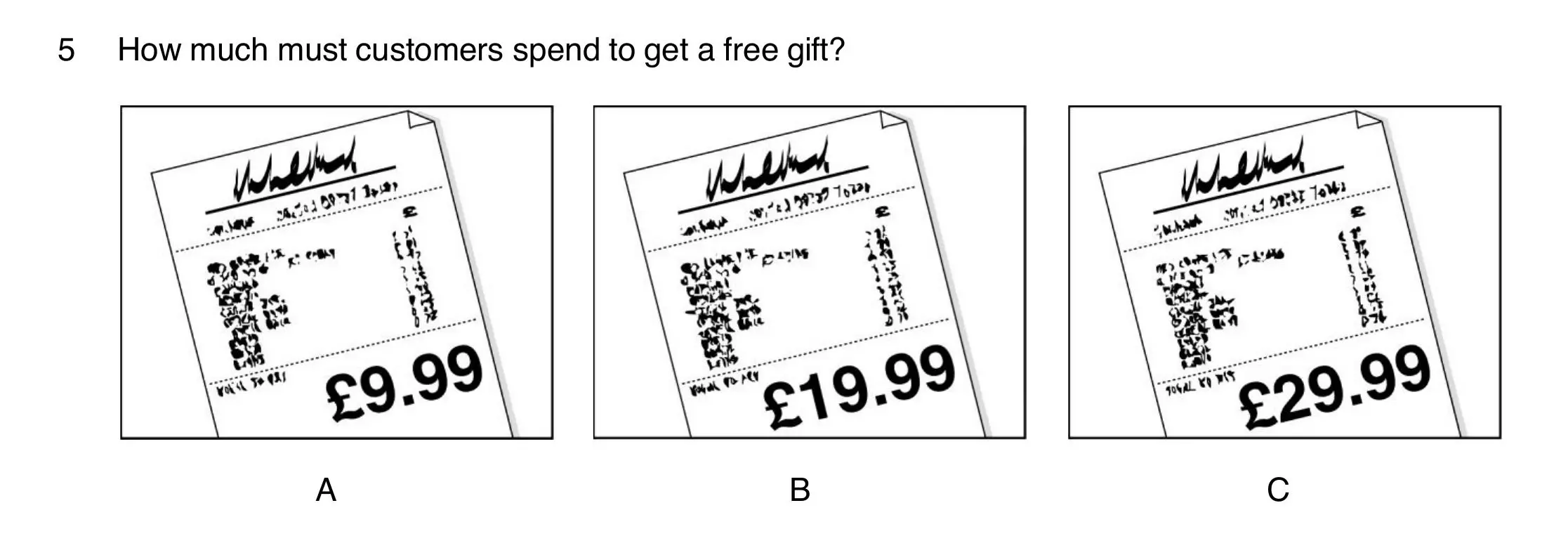
The advert mentions three figures: £9.99 is the price of six bottles of juice, £19.99 is what you need to spend in total to get «a mystery present» (the free gift) and £29.99 is the price of a full birthday meal.
Correct answer: B. Only one of the three figures is tied to the free gift; the other two are prices of specific products with nothing to do with the question.
Question 6: the family’s Sunday
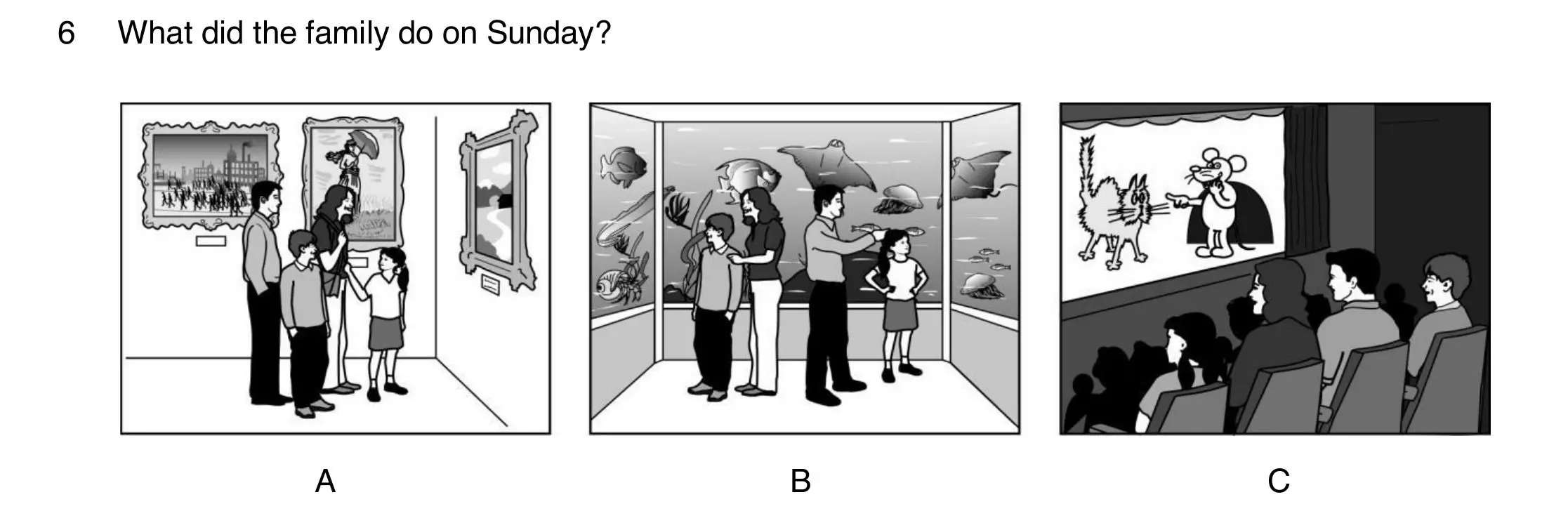
They’d planned to go to the Sea-Life Centre to see the fish and then to the cinema. They got to the Sea-Life Centre and «it was worth the wait», much more fun for the children than the art gallery they visited some weeks ago. As for the cinema, they «couldn’t get to» it.
Correct answer: B. The art gallery (A) was a past visit, and the cinema (C) was the plan that didn’t happen.
Question 7: which programme is on first
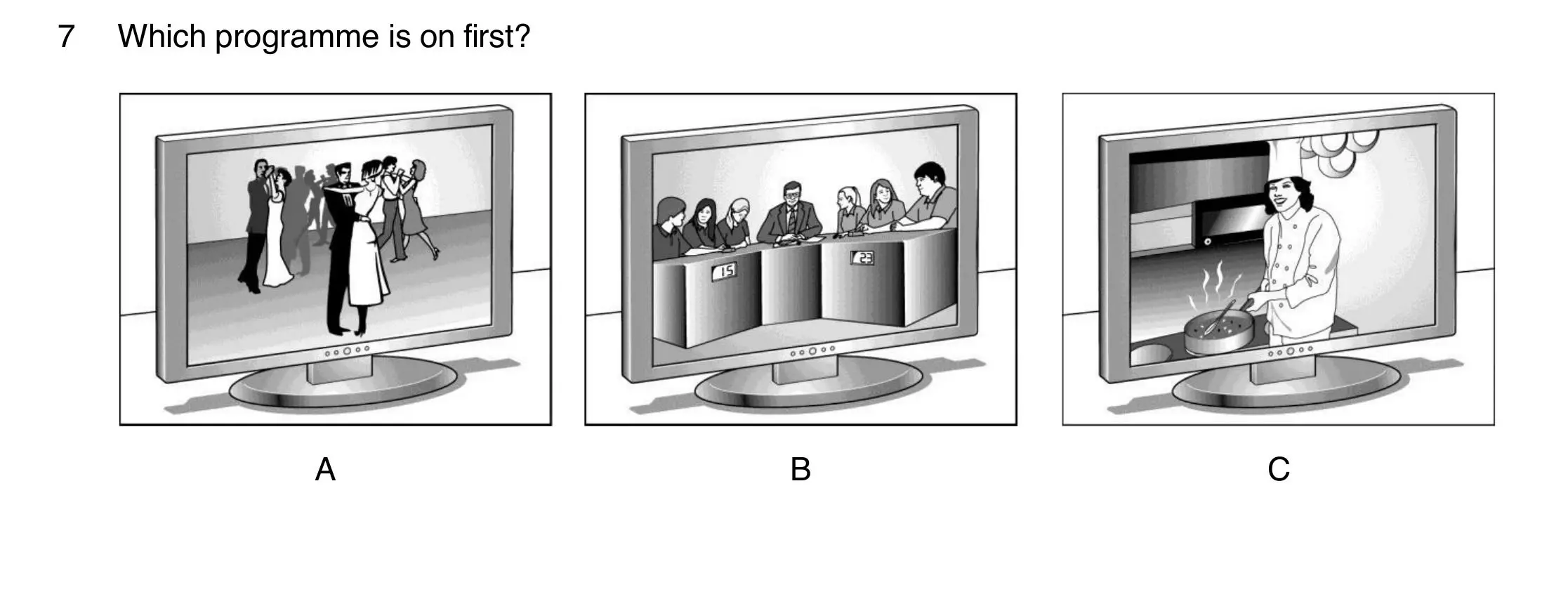
After the eight o’clock news, the presenter announces the running order: first you can watch Lucas Wilson cooking traditional Polish dishes («before that», before the quiz), then the quiz show Quiz Challenge, and later that night, a repeat of the dance programme.
Correct answer: C. This is the one question in this part where the order things happen in, not an isolated fact, decides the answer.
Answers, in case you were keeping track: 1B, 2B, 3A, 4C, 5B, 6B, 7C.
Classic distractors in Listening Part 1
Go back over the seven questions and you’ll notice almost every strong distractor follows one of these patterns:
- It’s a future plan, not something already done. «I’ll buy it next week» isn’t the answer to «what did she buy?». Question 1.
- It’s something that almost happened, but didn’t. «Nearly got one» means she didn’t get it. Question 1.
- It’s a rejected or ruled-out option. It’s mentioned, considered, and then something else is chosen instead. Questions 3 and 4.
- It’s a past event, not the one the question asks about. «Some weeks ago» isn’t «on Sunday». Question 6.
- The order of events decides the answer. It’s not enough to recognise the three things mentioned: you need to know which one comes first. Question 7.
Strategy for Listening Part 1
- Before listening, look at the three pictures and think about what’s different between them. If they’re three cakes, the difference is the ingredient (strawberries, chocolate, lemon); if they’re three reasons, it’s the specific cause. That tells you what vocabulary to listen out for.
- On the first listen, rule out what you can. If a picture isn’t mentioned at all, you can already eliminate it.
- On the second listen, confirm with the verb and the tense. «I bought», «I’m going to buy» and «I almost bought» aren’t the same thing, even when they’re about the same object.
- Don’t settle for the first option that sounds right. Cambridge deliberately places the correct answer in any position, and the other two options often come up earlier in the recording.
Common mistakes in Listening Part 1
- Choosing the picture that’s mentioned first. The order the three options come up in the recording has nothing to do with which one is correct.
- Not distinguishing past, present and future. This is the most common mistake in this part: mixing up what was done with what will be done or what was almost done.
- Focusing only on isolated nouns. Hearing «strawberry cake» isn’t enough if you don’t also catch that it gets ruled out right afterwards.
- Deciding on the first listen without confirming on the second. With only seven short questions, the second listen is quick and saves you from rushed mistakes.
Frequently asked questions about B1 Listening Part 1
How many questions does B1 Listening Part 1 have?
Seven questions (numbered 1 to 7), each with three pictures to choose from (A, B or C).
Why are all three pictures mentioned if only one is correct?
That’s the usual design of this part: all three options tend to come up in the recording in some form, and the correct answer is the one that describes what actually happened, not simply what’s named.
Are wrong answers penalised?
There’s no penalty in the B1 Preliminary, so answer all seven even if you’re unsure.
Can I take notes while I listen?
Yes, you can write directly on the question booklet as you listen. If you’re taking the digital version of the exam, you can take notes on the sheet with your login credentials, or ask the supervisor or invigilator for an extra sheet of paper.
Keep preparing B1 Listening
This is the first in a series dedicated to each part of B1 Preliminary Listening. You can carry on with the guides to Listening Part 2, Part 3 and Part 4, go back to the general guide to Listening to see all four parts together, or review the rest of the exam on the main B1 Preliminary page.
Did you find this guide useful? Share it with other students and teachers preparing for the PET. And if you’re left with any doubts, leave them in the comments. I read every one.
See you in Part 2. Until then, don’t forget to keep smiling! 🙂
