

Table of contents
B1 Preliminary Listening Part 4 is the last part of the paper and the longest: an interview lasting a few minutes and six multiple-choice questions, where you choose between three sentences (A, B or C). The key here isn’t understanding every word, but following the thread of a conversation in which the person being interviewed mentions almost every option.
So how do you spot the right one? The wrong ones do come up, but straight after them comes a but that cancels them out. In this guide I’ll explain what B1 Listening Part 4 looks like, and we’ll go through the six questions of an official Cambridge sample test together, with the real audio so you can try them before reading my explanation. 🙂
What B1 Listening Part 4 looks like
B1 Preliminary Listening has four parts, 25 questions and takes about 35 minutes, and it’s worth 25% of your final mark. This is the fourth and final part:
| Detail | B1 Listening Part 4 |
|---|---|
| What you do | Listen to an interview and answer 6 questions, choosing the correct option out of 3 for each one |
| Number of questions | 6 (numbered 20 to 25) |
| Options per question | 3 written sentences (A, B or C) |
| Reading time | 45 seconds before the recording starts |
| Marks | 1 mark per correct answer |
| Recordings | You hear the interview twice |
| What it tests | Detailed understanding of the facts, opinions and attitudes of the person being interviewed |
Before you listen: make the most of the 45 seconds
It’s the longest reading time in the whole Listening paper, and for good reason: there are six questions with three options each. Use it to read the questions, not just the options, because each question tells you which moment of the interview to watch out for.
In the sample test, the key words in each question are: first (20), as a teenager (21), hard (22), national finals (23), best at (24) and why… started (25). The questions follow the same order as the interview, so they work like a map: when the interviewer changes topic, you know you’re moving on to the next one.
Listen to the sample test for this part
Try to answer them from the recording before you read the explanations.
The six questions, one by one
Question 20: why she started competing

Vicky says her parents are interested in sport, but «they aren’t great swimmers themselves». She learnt to swim at school, turned out to be good at it, «so my teacher persuaded me to go in for competitions». And she adds: «I did join a swimming club later, but that wasn’t where it all started».
Correct answer: C. Persuaded is the recording’s way of saying encouraged. The club (A) came later, and she rules it out herself. And her parents (B) are interested in sport in general, not in swimming.
Question 21: her training as a teenager

She got up at five to go to the pool, had breakfast in the car on the way to school, did «exercises in the school gym to build my strength» after classes, and later went «back to the pool for another three hours».
Correct answer: A. Gym plus pool means training on land as well as in the water. B is false: she did have breakfast, even if it was in the car. C doesn’t work either, because she went to the pool twice a day, in the morning and in the afternoon.
Question 22: the hardest part of training
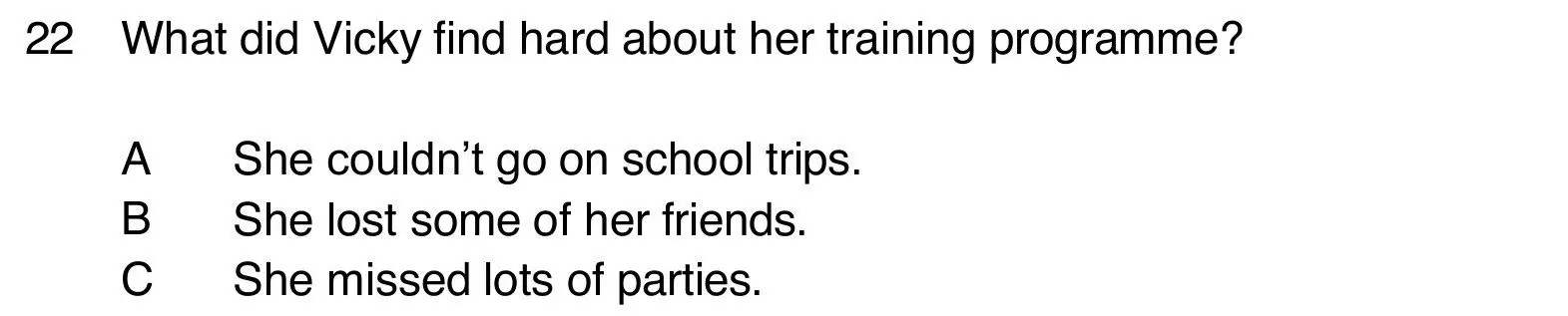
Vicky mentions all three options. She couldn’t go to parties, «but I got used to that». She missed school trips to France, «though I did get to go there later, so it didn’t matter in the end». And in between comes the key sentence: «Much harder was losing two of the friends I’d known since I was very young… That was tough».
Correct answer: B. This question is a perfect example of how Part 4 works: all three things are said, but two of them are played down in the same breath. Notice the comparative much harder: it’s telling you which one was the toughest.
Question 23: the national finals
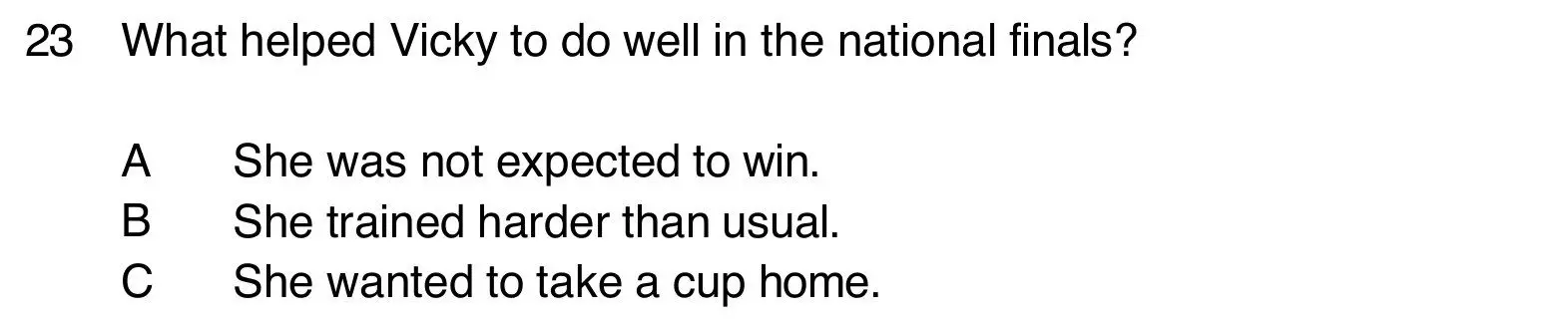
She hadn’t swum very well in the semi-finals, «so I guess the crowd were more interested in the other swimmers in my race. So that made it easier to do well». About training she says: «Of course, I’d trained hard too, but I always did». And the cup came as a surprise: «I always swam for enjoyment, so I was surprised to find myself holding up a cup!»
Correct answer: A. The crowd focusing on the others is another way of saying nobody expected her to win, and that took the pressure off. B falls because of «but I always did»: she trained hard, but no harder than usual. C falls because the cup was a surprise, not a goal.
Question 24: what she teaches best as a coach
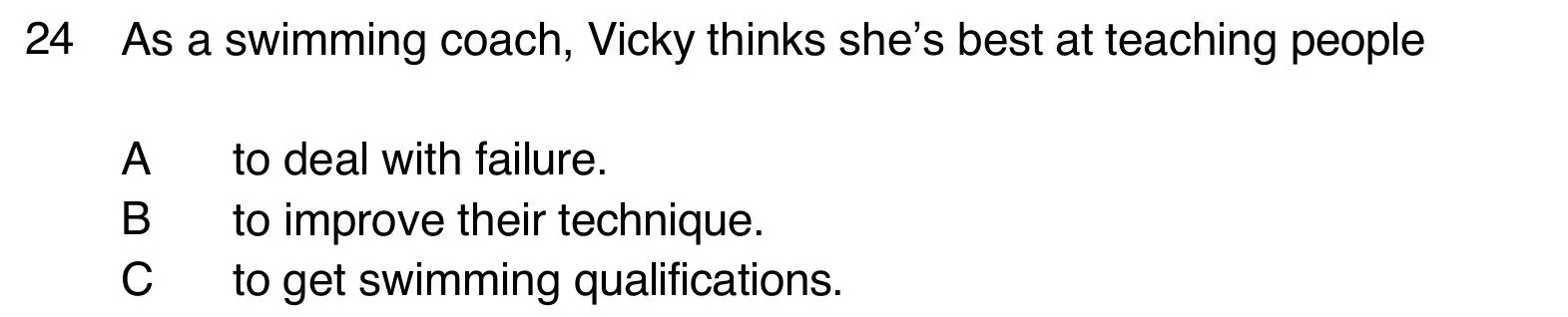
Vicky has just done a coaching qualification, «but passing on my own experience is how I can really help them». And she explains what that experience is: «because I’ve both won and lost in competitions, and recovered from that, it’s something I can share with people. Winning isn’t just about technique».
Correct answer: A. Having lost and recovered means knowing how to deal with failure. C is a word-for-word trap: qualification appears, but it’s hers, not something she teaches others. And B is ruled out by the last sentence: winning isn’t just about technique.
Question 25: long-distance swimming
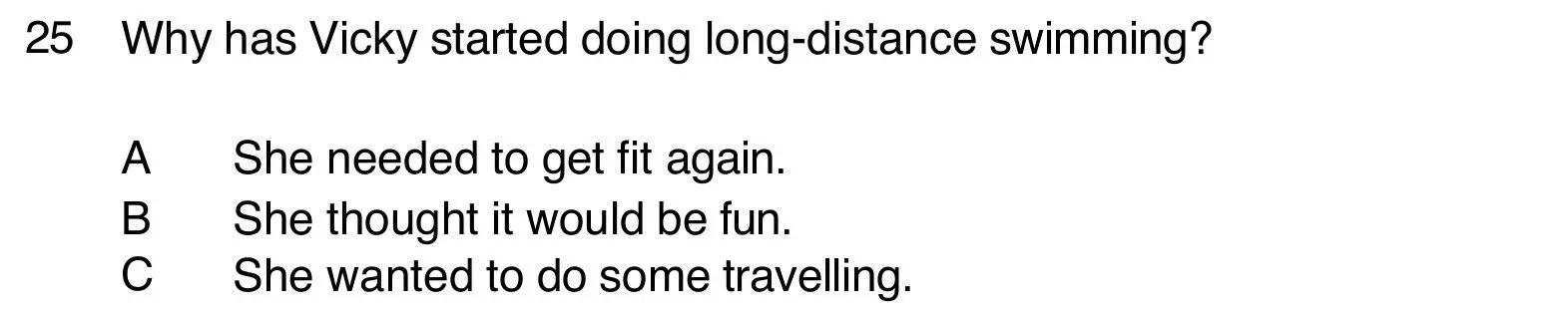
She does it as a hobby. «I do want to maintain my fitness levels, but that wasn’t the main reason for choosing it». It isn’t for fun either: «long-distance swimming in the sea isn’t all fun, it can be hard work». The real reason comes at the end: «you do get to see some wonderful places, and that’s what attracted me to it».
Correct answer: C. Seeing wonderful places means travelling. A is ruled out twice: fitness isn’t the main reason, and she wants to maintain it, not regain it (get fit again). B is the opposite of what she says.
Answers, in case you’ve been keeping track: 20C, 21A, 22B, 23A, 24A, 25C.
Typical distractors in Listening Part 4
- Something that happened, but later. The swimming club was real, but it wasn’t the beginning: «later, but that wasn’t where it all started». Question 20.
- Something mentioned and played down in the same sentence. The parties («I got used to that») and the school trips («it didn’t matter in the end»). Question 22.
- Something true that doesn’t change anything. She trained hard, «but I always did», so it doesn’t explain why that final went better. Question 23.
- A word lifted from the recording with a different meaning. Qualification appears, but it’s about hers, not her students’. Question 24.
- A secondary reason presented as the main one. «I do want to maintain my fitness levels, but that wasn’t the main reason». Question 25.
Notice what almost all of these distractors have in common: they’re followed by but, though or that wasn’t…. When you hear one of those words right after something that matches an option, be suspicious of that option.
Strategy for Listening Part 4
- Read the questions before the options. In the 45 seconds, underline the key word in each question (first, hard, why…). It tells you which part of the interview goes with each one.
- Use the interviewer’s questions as signposts. Each new question from the interviewer usually marks the move to the next question on the paper.
- Don’t choose as soon as you hear a word from the options. Almost all of them come up in this part. Wait for the speaker to finish the idea: the but usually comes afterwards.
- Listen for meaning, not words. The correct answer hardly ever repeats the recording: persuaded is encouraged, wonderful places is travelling, won and lost… recovered is deal with failure.
- On the second listening, confirm what you ruled out. For each answer, try to find why the other two don’t work. If you can’t find the reason, think again.
Most common mistakes in Listening Part 4
- Choosing the option you hear in the recording. The fact that qualification or swimming club come up doesn’t make them the answer; often it means the opposite.
- Ignoring comparatives and sequence words. Much harder, later or the main reason are exactly the words that decide the answer.
- Missing a detail in the option. Once a day versus twice, harder than usual versus as always, get fit again versus staying fit: one detail is enough to make an option false.
- Getting stuck on one question. The interview keeps moving. If you’re unsure, pick the most likely option, move on and check it on the second listening.
Frequently asked questions about B1 Listening Part 4
How many questions are there in B1 Preliminary Listening Part 4?
Six questions (numbered 20 to 25), each with three sentences to choose from (A, B or C).
How is it different from Part 2?
In both you choose between three written sentences, but Part 2 has six separate short dialogues, while Part 4 is a single long interview. Here you have to follow the thread of the same conversation for several minutes.
Do wrong answers lose marks?
There’s no penalty in B1 Preliminary, so answer all six even if you’re not sure.
Can I take notes while I listen?
Yes, you can write directly on the question paper while you listen. If you’re taking the digital exam, you can make notes on the sheet with your login details, or ask the invigilator for an extra sheet of paper.
What happens when Part 4 ends?
In the paper-based exam, you get 6 minutes to transfer all your answers from the question paper to the answer sheet. Use them to copy calmly and check your Part 3 spelling, not to change answers you were already sure about. In the digital exam you answer directly on screen, so there’s no answer sheet to fill in.
Keep preparing for B1 Preliminary
This guide completes the series dedicated to each part of B1 Preliminary Listening. If you’ve missed any, check out the guides to Part 1, Part 2 and Listening Part 3. You can also go back to the general guide to Listening, or review the rest of the exam on the main B1 Preliminary page.
Did you find this guide useful? Share it with other students and teachers preparing for the PET. And if you’re left with any doubts, leave them in the comments. I read every one.
See you in the next guide. Until then, don’t forget to keep smiling! 🙂
