

Table of contents
B1 Preliminary Listening Part 2 changes the game compared to Part 1: no more pictures, three written sentences instead, and the recording is no longer a monologue, but a conversation between two people. Cambridge’s favourite trap here is reversal: an option says the exact opposite of what you just heard, using almost the same words.
In this guide I’ll explain what B1 Listening Part 2 looks like, and we’ll solve the six questions from an official Cambridge sample test together, with the real audio so you can try them before reading my explanation. 🙂
What B1 Listening Part 2 looks like
The B1 Preliminary Listening paper has four parts, 25 questions and about 35 minutes, and it’s worth 25% of the final score. This is the second part:
| Fact | B1 Listening Part 2 |
|---|---|
| What you have to do | Listen to 6 short dialogues between two people and choose, for each one, the correct sentence out of 3 |
| Number of questions | 6 (numbered 8 to 13) |
| Options per question | 3 written sentences (A, B or C) |
| Scoring | 1 point per correct answer |
| Recordings | Each dialogue is played twice |
| What it tests | Telling apart what’s actually said from what’s already sorted out or is the exact opposite |
Listen to the sample test for this part
Try answering them yourself as you listen, before reading the explanations.
The six questions, commented one by one
Question 8: the new clothes shop
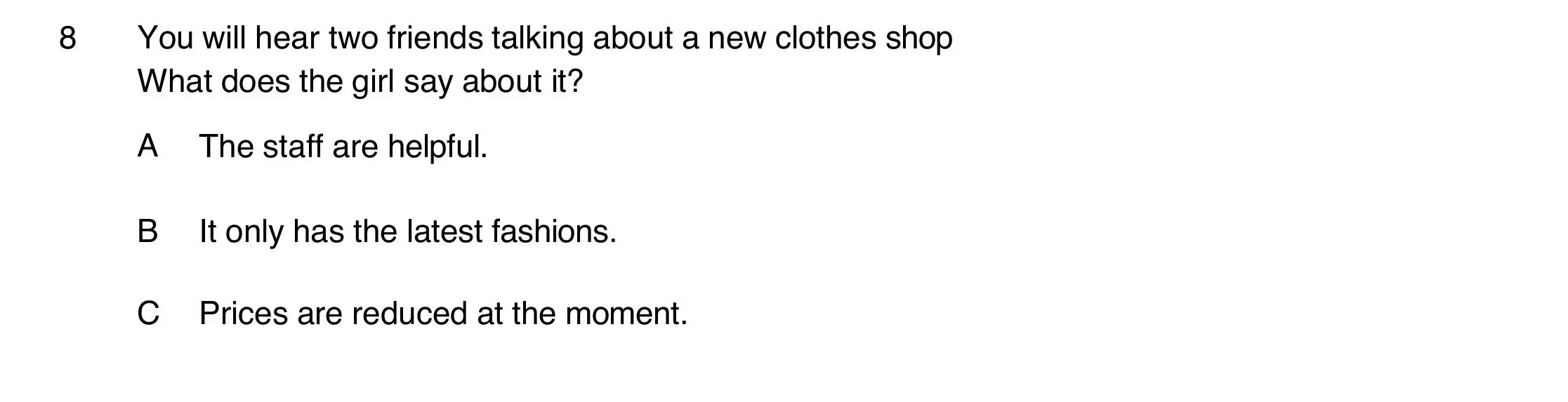
She says «the assistants were nice», that the coolest stuff «has already gone», and that she found things that «didn’t cost too much» compared to other things in the shop.
Correct answer: A. B reverses the meaning: the trendiest stock is gone, not «only has the latest fashions». C confuses «not too expensive compared to» with an active sale, which isn’t mentioned.
Question 9: the band’s website
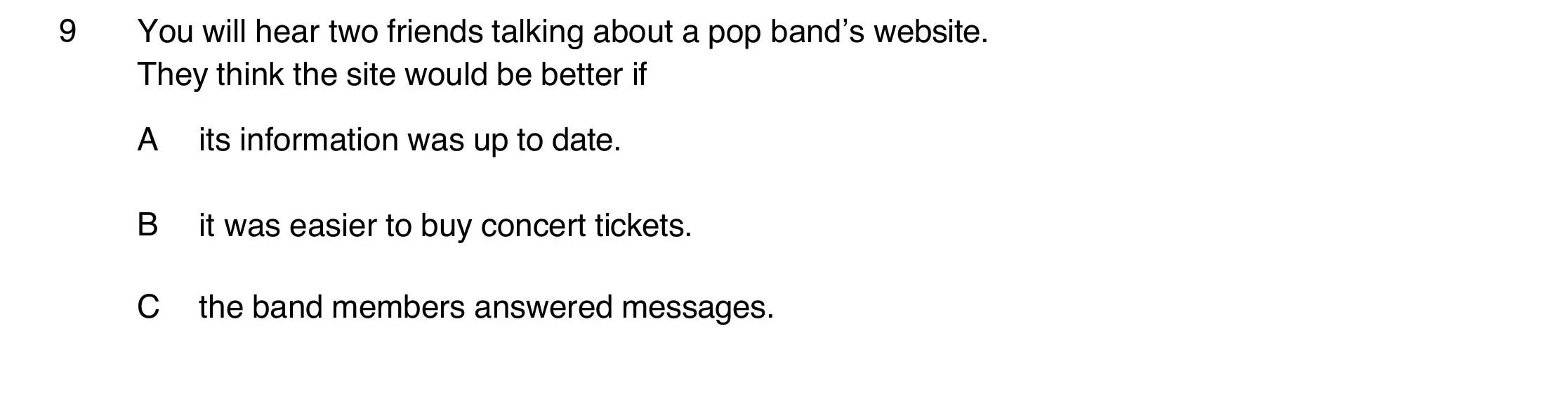
The problem was buying the ticket: «it wouldn’t let me pay», so he had to phone the help line. That’s why he says «they should just make it simpler». He has no complaint about the rest of the site: «it posts new stories nearly every day», and the guitarists reply to fans with funny messages.
Correct answer: B. A and C describe things the site already does well, the exact opposite of a complaint: the information is up to date and the band does answer messages.
Question 10: the art competition
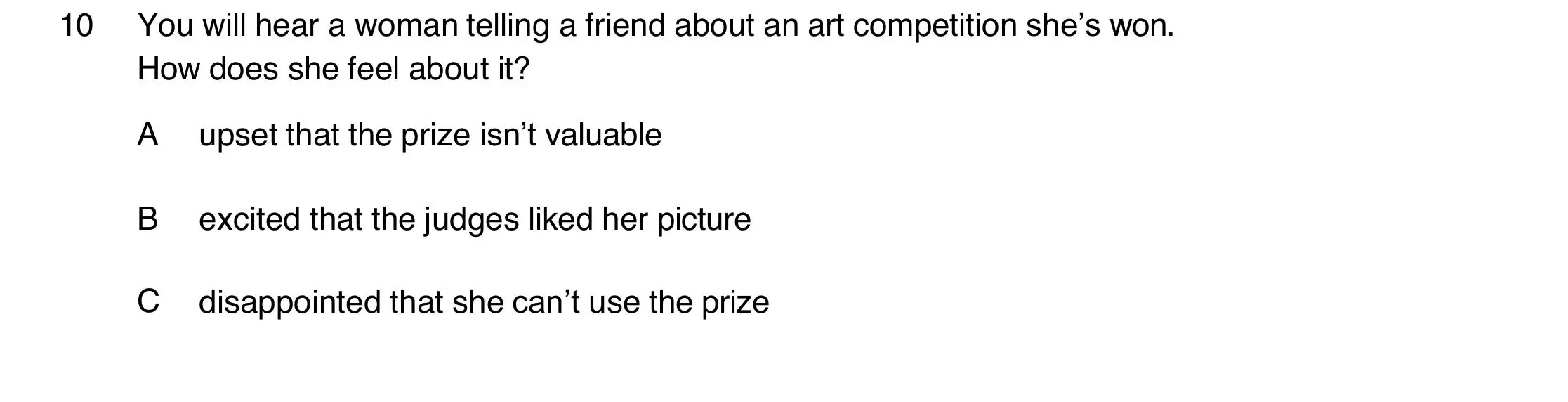
She’s won a weekend in New York, but «I have to go before the end of the month and I can’t get the time off work». Her friend tries to cheer her up: «at least you know the judges thought highly of your work», and she answers without much enthusiasm: «I suppose so, but it wasn’t one of my best pictures».
Correct answer: C. The prize is clearly valuable (rules out A), and she plays down the judges liking her work (rules out B): what actually bothers her is not being able to use the prize.
Question 11: the flatmate
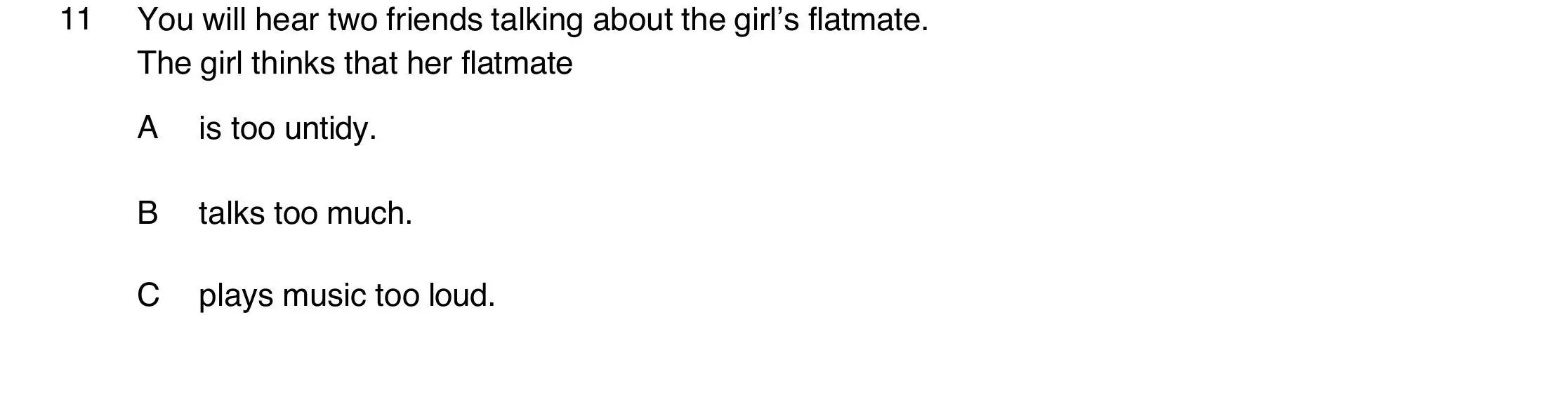
The boy suggests two theories, and she rules out both: «she’s so shy… never says a word» (not talkative) and about the music, «her music helps me concentrate, so I don’t mind that» (not bothered by it). What actually bothers her is something else: «it’s the way she never picks anything up… her stuff is all over the living room».
Correct answer: A. B and C are exactly the two ideas her friend suggests, and she corrects each one in turn.
Question 12: the football match
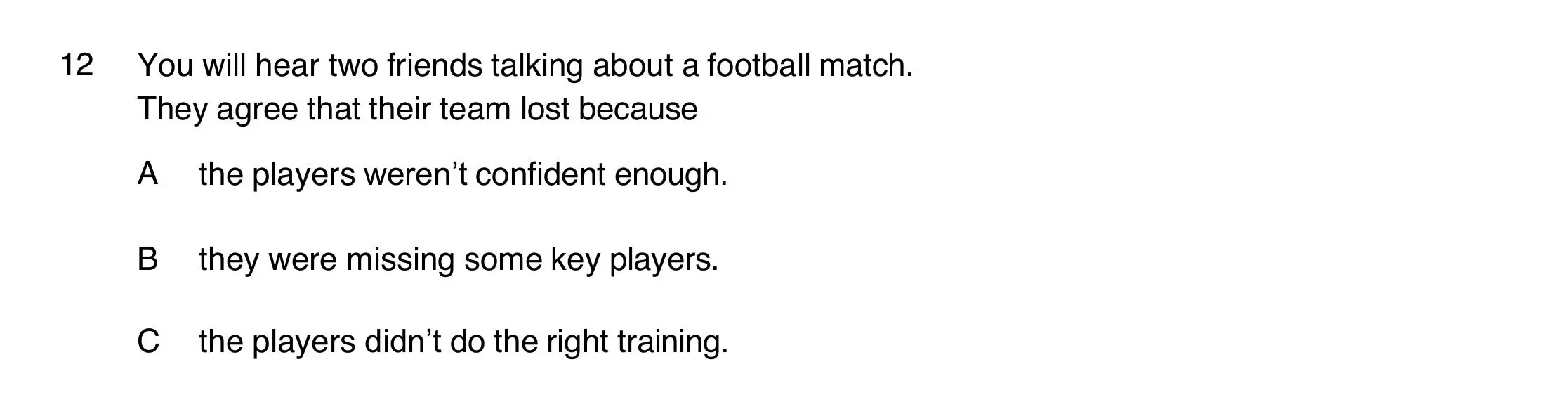
One mentions the injuries, but plays them down: «considering how many guys couldn’t play… they didn’t do so badly». The other praises the training: «we’re beginning to see the benefits». They both agree on the real reason: «the main trouble they had tonight is that they just don’t believe enough in their own ability». And he replies: «That’s right».
Correct answer: A. This is the one question where you need to wait for both speakers to agree, not just for an idea to come up.
Question 13: the tennis match
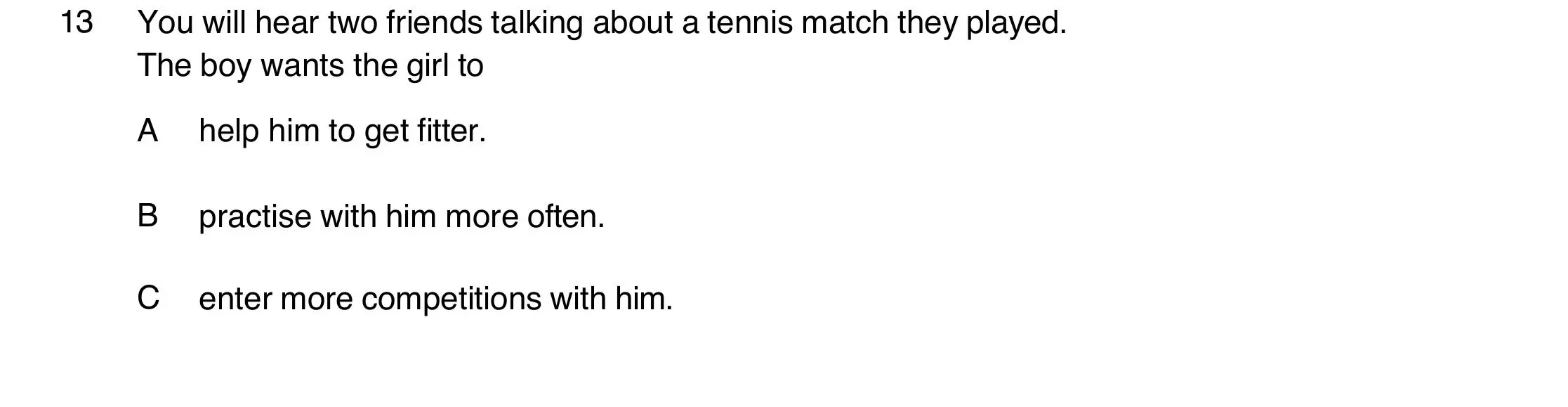
They do mention it’s hard to find time to practise together, and that he wants to be fit for «our next competition». But his actual request comes at the end: she goes to the gym four times a week, and he says «that’s what I need! Can I come with you?».
Correct answer: A. Practising more (B) and entering more competitions (C) are both mentioned in passing; what he actually asks for, at the end of the dialogue, is her help getting fit by going to the gym together.
Answers, in case you were keeping track: 8A, 9B, 10C, 11A, 12A, 13A.
Classic distractors in Listening Part 2
- They reverse the meaning. «The trendiest stock already sold out» becomes «only has the latest fashions». Question 8.
- They describe something that already works well, not a complaint. If the site already posts news daily, it can’t be what would «improve» the site. Question 9.
- They’re an idea that’s suggested and then corrected. A friend proposes a theory, and the other person explicitly rules it out. Question 11.
- They’re mentioned but played down, almost like an excuse. The injuries are cited and immediately minimised: they’re not the real reason. Question 12.
- They come up in passing, but aren’t the final request. Something said midway through the conversation isn’t always what’s asked for at the end. Question 13.
Strategy for Listening Part 2
- Read the context sentence and the question before listening. They tell you what kind of answer you’re looking for: a fact, an opinion, a feeling, or what one person wants the other to do.
- Be suspicious of the option that echoes the recording’s wording almost word for word. Cambridge often plants the most dangerous distractor using vocabulary copied straight from the audio, but with the meaning reversed or taken out of context.
- Wait until the end of the dialogue before deciding. The actual request, the final opinion, or the agreement between the two speakers usually comes in the last few lines, not at the start.
- For «they agree that…» questions, look for explicit agreement. One person’s opinion isn’t enough if the question asks what both of them think.
Common mistakes in Listening Part 2
- Choosing based on the first idea mentioned. The dialogue moves on and often corrects or qualifies what was said first.
- Not telling apart a complaint from something that already works well. Cambridge places positive aspects of the same topic so you confuse them with the actual problem being asked about.
- Only paying attention to one of the two voices. In «they both agree» questions, you need to confirm the second speaker says it too, not just the first.
- Losing track of who’s saying what. With two voices of the same gender it’s sometimes easy to get confused, so pay attention to who’s speaking in each turn.
Frequently asked questions about B1 Listening Part 2
How many questions does B1 Listening Part 2 have?
Six questions (numbered 8 to 13), each with three sentences to choose from (A, B or C).
What’s the difference from Part 1?
In Part 1 the options are pictures and the recording is a short monologue; in Part 2 the options are written sentences and the recording is a dialogue between two people, usually longer.
Are wrong answers penalised?
There’s no penalty in the B1 Preliminary, so answer all six even if you’re unsure.
Can I take notes while I listen?
Yes, you can write directly on the question booklet as you listen. If you’re taking the digital version of the exam, you can take notes on the sheet with your login credentials, or ask the supervisor or invigilator for an extra sheet of paper.
Keep preparing B1 Listening
This is the second in a series dedicated to each part of B1 Preliminary Listening. You can check out the guide to Listening Part 1 if you haven’t already, carry on with the guides to Listening Part 3 and Part 4, go back to the general guide to Listening, or review the rest of the exam on the main B1 Preliminary page.
Did you find this guide useful? Share it with other students and teachers preparing for the PET. And if you’re left with any doubts, leave them in the comments. I read every one.
See you in Part 3. Until then, don’t forget to keep smiling! 🙂
