
Table of contents
The first thing you learned about the future in English was probably will: I will, you will, he will… It is the simplest form (it does not change with the person) and, at the same time, the one that does the most things: it promises, offers, predicts, guesses, threatens, asks, invites and even refuses. That is why it is also the future simple that is most often asked in exams and the one that causes the most mistakes when you try to mix it with other modals. A single auxiliary verb for so many functions deserves an in-depth guide.
In this guide I explain how the future simple is formed (will + verb), all its uses with examples (including those that hardly anyone mentions, such as guessing about the present or talking about habits), what happens with shall and won’t, how it works in conditionals and time clauses, the typical mistakes of Spanish speakers, how it helps you in Cambridge and a fortune teller who is wrong a lot. At the end there are thirty practice sentences with answers. Let’s get started! 🙂
The future simple at a glance
| Future simple | |
|---|---|
| Form | will + verb in the infinitive (without to) |
| What it is for | Decisions at the moment, promises, offers, predictions, future facts, requests |
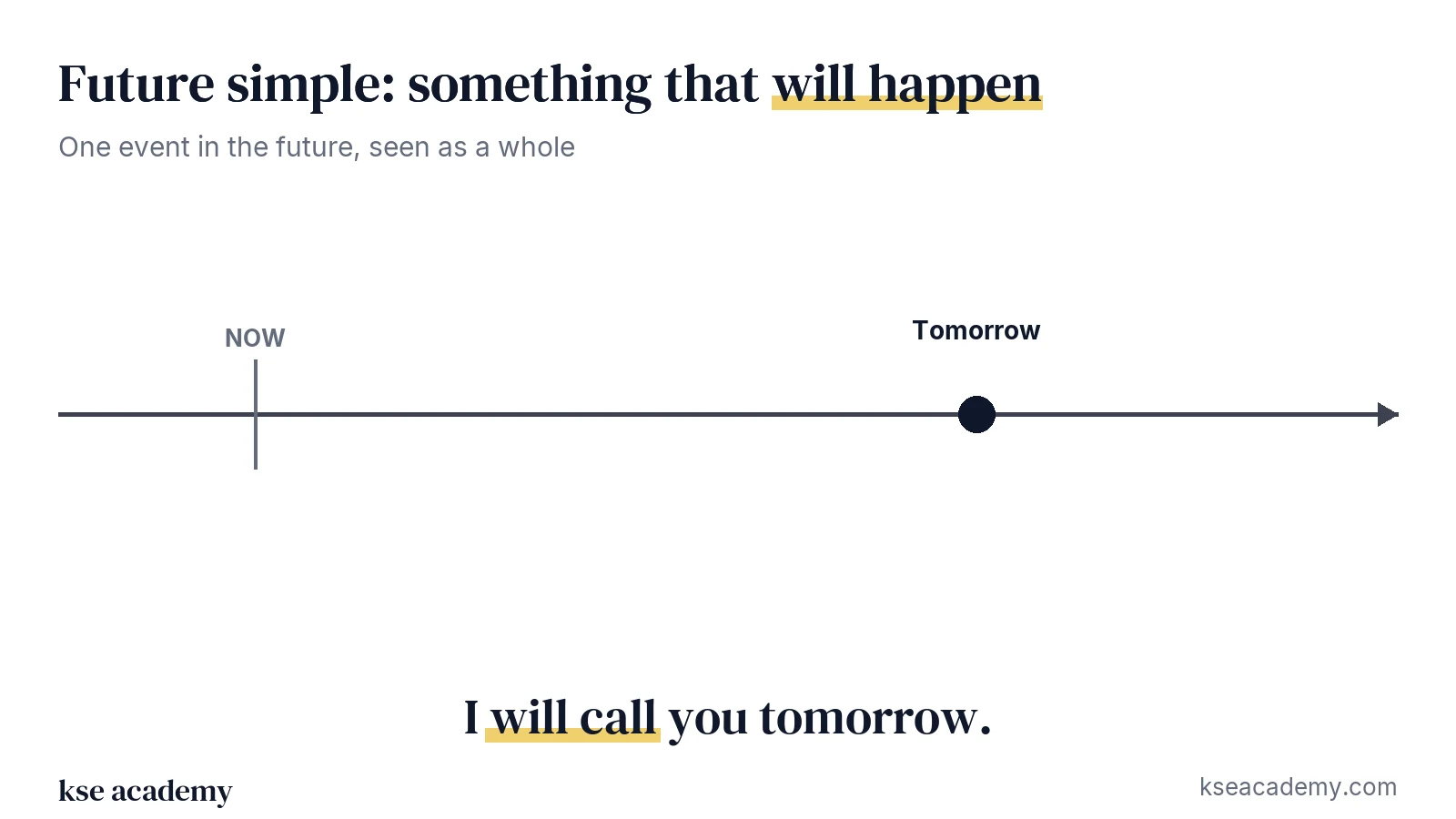
| Example | I will call you tomorrow. / I’ll call you tomorrow. |
| Spanish | futuro simple: «te llamaré mañana» |
| Words that go with it | tomorrow, next week, soon, probably, I think, I promise, perhaps |
How the future simple is formed
The form is always will + verb in the infinitive without to, for all persons. There is no -s in the third person and nothing to conjugate:
| Form | Structure | Example |
|---|---|---|
| Affirmative | subject + will + verb | She will help us. |
| Negative | subject + will not (won’t) + verb | She won’t help us. |
| Question | Will + subject + verb…? | Will she help us? |
| With a question word | question word + will + subject + verb…? | When will she help us? |
| Short answer | Yes, she will. / No, she won’t. | Will you come? Yes, I will. |
Contractions and pronunciation
| Full form | Contraction |
|---|---|
| I will, you will, he will, she will, it will, we will, they will | I’ll, you’ll, he’ll, she’ll, it’ll, we’ll, they’ll |
| will not | won’t /wəʊnt/ |
| that will, there will | that’ll, there’ll |
In speech, will sounds weak, /wəl/ or /l/ (I’ll /aɪl/, she’ll /ʃiːl/). It is a function word: I explain it in the guide to the schwa and weak forms. One detail: won’t does not follow the rule (will not → won’t, not willn’t).
When the future simple is used
1. Decisions at the moment
You decide something at the instant of speaking, without having thought about it before:
- The phone’s ringing. I’ll answer it.
- It’s cold. I’ll close the window.
- I’m hungry. I think I’ll make a sandwich.
2. Promises and threats
- I promise I’ll call you every day.
- I won’t tell anyone your secret.
- If you touch that, you’ll regret it. (A threat or a warning.)
3. Offers, invitations and requests
- That looks heavy. I’ll carry it for you. (An offer.)
- Will you come to my party? (An invitation.)
- Will you pass me the salt, please? (A request.)
4. Predictions based on an opinion
- I think it will be a great year.
- She’ll probably win.
- Tomorrow will be sunny.
They usually include I think, I’m sure, probably or perhaps. If the prediction is based on something you can see now, going to is used (see the guide to will vs going to).
5. Future facts that do not depend on anyone
- The sun will rise at 7:15.
- I’ll be 40 next year.
- The train will arrive at 6. (A timetable.)
6. Guesses about the present
A use that hardly anyone mentions: will can be used to guess something that is happening now, just like in Spanish («será el cartero»):
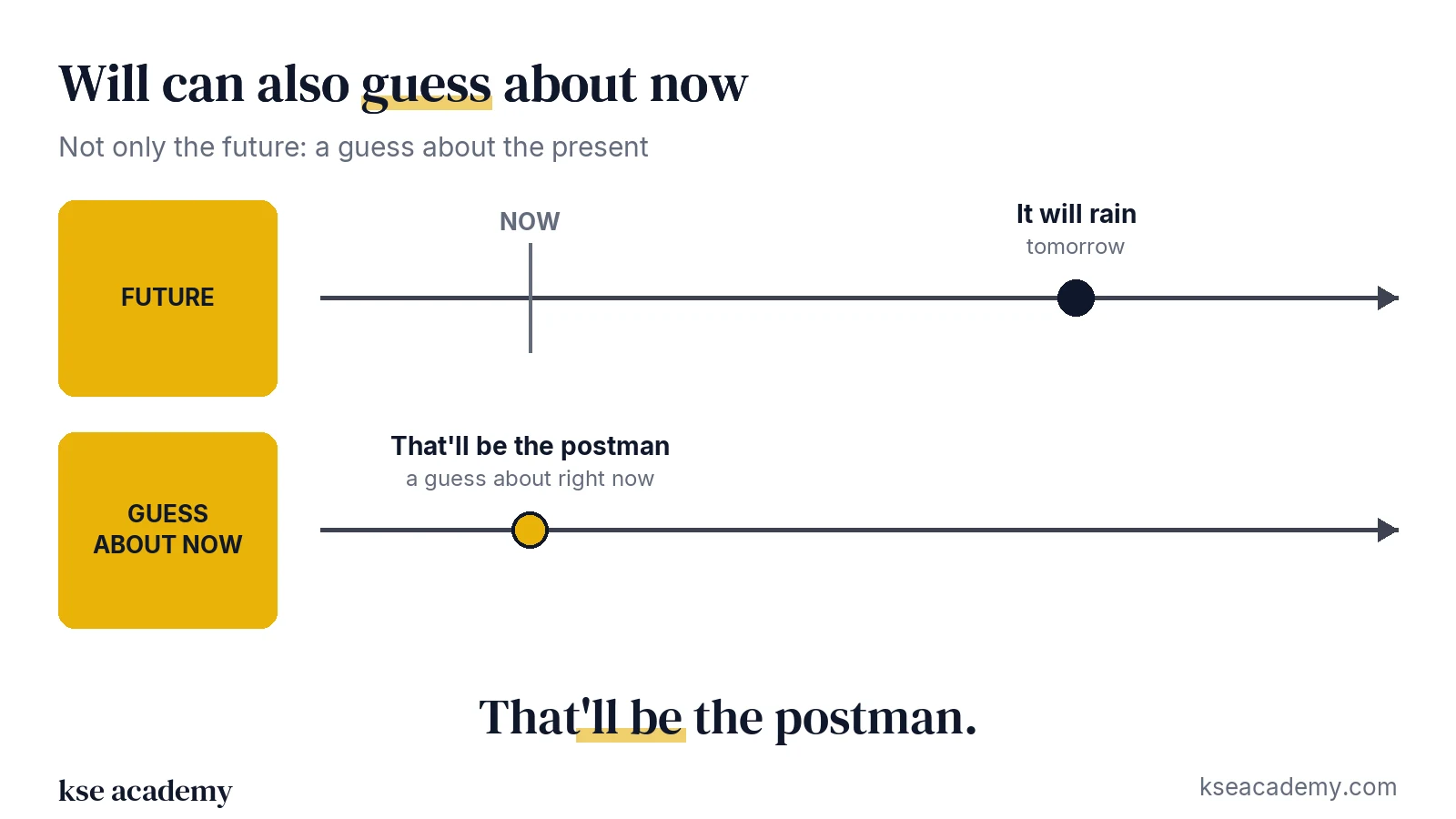
- That’ll be the postman.
- It’s Friday night. She’ll be at the cinema.
- Don’t ring him: he’ll be at work.
7. Habits and typical behaviour
With will we also describe what someone habitually does, as a characteristic of theirs:
- On Sundays she’ll sit for hours reading in the garden.
- Accidents will happen.
- Boys will be boys.
8. The refusal negative: «won’t»
- The car won’t start. (It refuses to start.)
- He won’t listen to anyone. (There is no way he will listen.)
Will in conditionals and time clauses
This is where most mistakes happen. Will goes in the main clause, but not after if, when, as soon as, before, after or until: there the present simple is used.
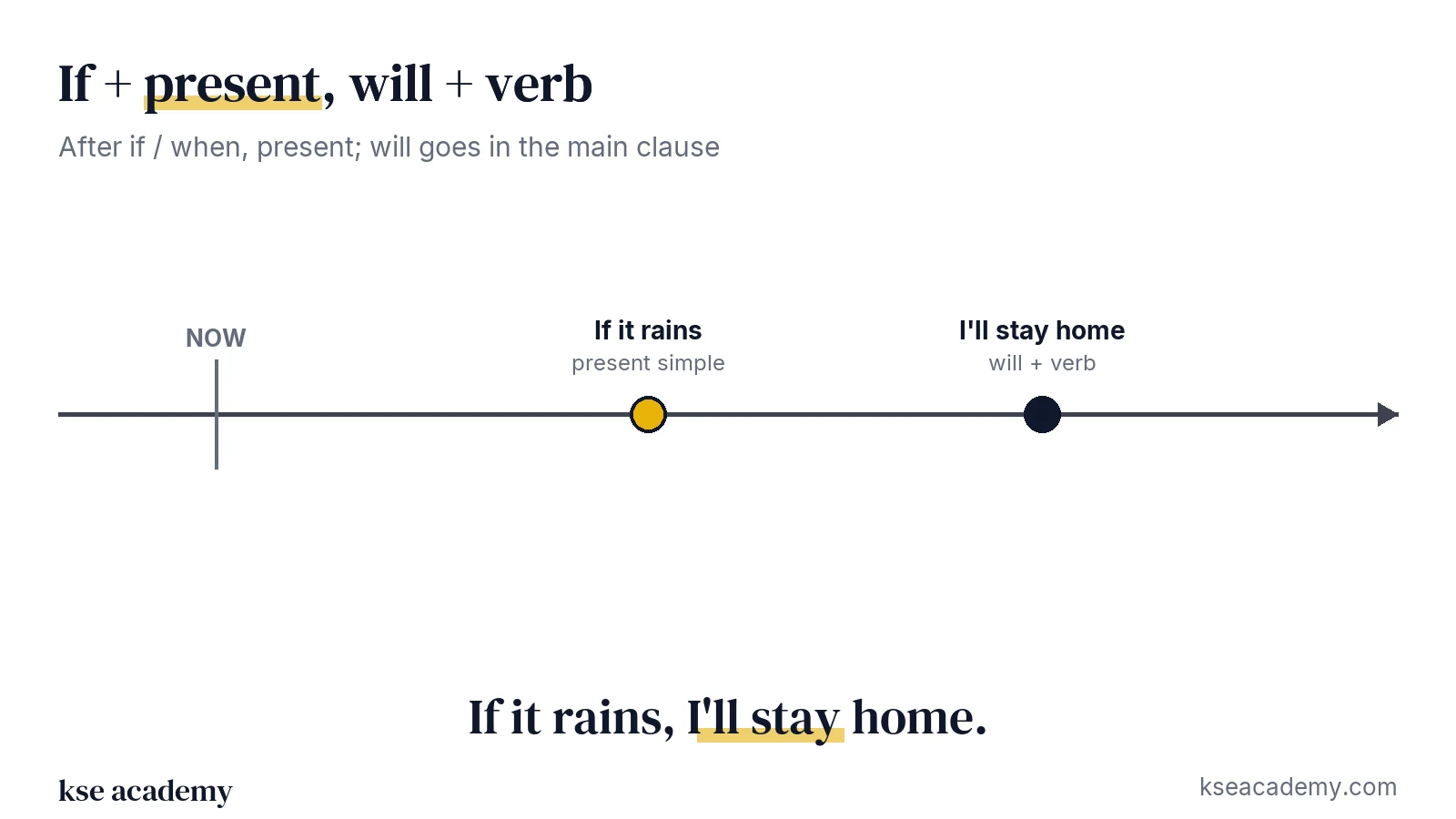
| Part | Tense | Example |
|---|---|---|
| Condition or moment (if / when / as soon as…) | Present simple | If it rains… / When I get home… |
| Result | will + verb | …I’ll stay home. / …I’ll call you. |
More examples: If you study, you’ll pass. As soon as she arrives, we’ll start. I won’t go until he calls. You have conditionals in depth in the guide to conditional sentences.
One exception: will can go after if in very polite, formal requests: If you will follow me, please… It is not the normal use.
Shall: when it is used
Shall exists, but it is used little. You will usually find it like this:
- Offers with I / we: Shall I open the window?
- Suggestions with we: Shall we go?
- In formal or legal English («the tenant shall pay…») and I shall as a formal variant of I will in British English.
In everyday English, will is the norm and shall is kept for offers and suggestions.
Will and other modals
Will is a modal verb, so it is not combined with other modals. The equivalent phrase is used:
| ❌ Incorrect | ✅ Correct | Why |
|---|---|---|
| I will can help you. | I will be able to help you. | Can has no future: will be able to. |
| We will must leave early. | We will have to leave early. | Must has no future: will have to. |
| She will may come. | She may come. / She will probably come. | May already talks about the future. |
Modals and their phrases, in depth, in my guides to modal verbs and can, could and be able to.
Spanish versus English: where we get confused
Spanish has a future simple («cantaré») and it looks a lot alike, but there are differences that matter:
| 🇪🇸 Spanish | 🇬🇧 English | What happens |
|---|---|---|
| Te llamaré mañana. | I will call you tomorrow. | Direct equivalent. |
| Cuando llegue, te llamaré. | When I arrive, I will call you. | Spanish: subjunctive; English: present. Never when I will arrive. |
| Será el cartero. | That’ll be the postman. | The future of probability exists in both languages. |
| Mañana voy a ir al médico. | I’m going to see the doctor tomorrow. | If you had already decided it, English uses going to, not will. |
| Si puedo, iré. | If I can, I’ll go. | After if, present. |
Common mistakes with the future simple
| ❌ Incorrect | ✅ Correct | Why |
|---|---|---|
| I will to go to the party. | I will go to the party. | After will, infinitive without to. |
| He will goes tomorrow. | He will go tomorrow. | After will, base verb, no -s. |
| If it will rain, we’ll stay. | If it rains, we’ll stay. | After if, present. |
| I’ll call you when I will arrive. | I’ll call you when I arrive. | After when, present. |
| Will you to help me? | Will you help me? | In questions, Will + subject + base verb. |
| I won’t to go. | I won’t go. | Same as in the affirmative: base verb. |
| I will can come. | I will be able to come. | Can is not combined with will. |
The future simple in Cambridge exams
It is the basis of the future in Cambridge, from A2 Key to C1 Advanced:
- Reading and Use of English: in B2 First, Part 4 (key word transformations) often asks for will versus going to, or conditionals.
- Speaking: predictions, promises and decisions in the questions about the future.
- Writing: in emails and letters, I’ll send you the details tomorrow or We will contact you soon sound natural.
Two examples in the style of Use of English Part 4:
- I promise to call you as soon as I arrive. WILL
I promise that I ______ you as soon as I arrive. → will call - I expect she is at home now. WILL
She ______ at home now. → will be
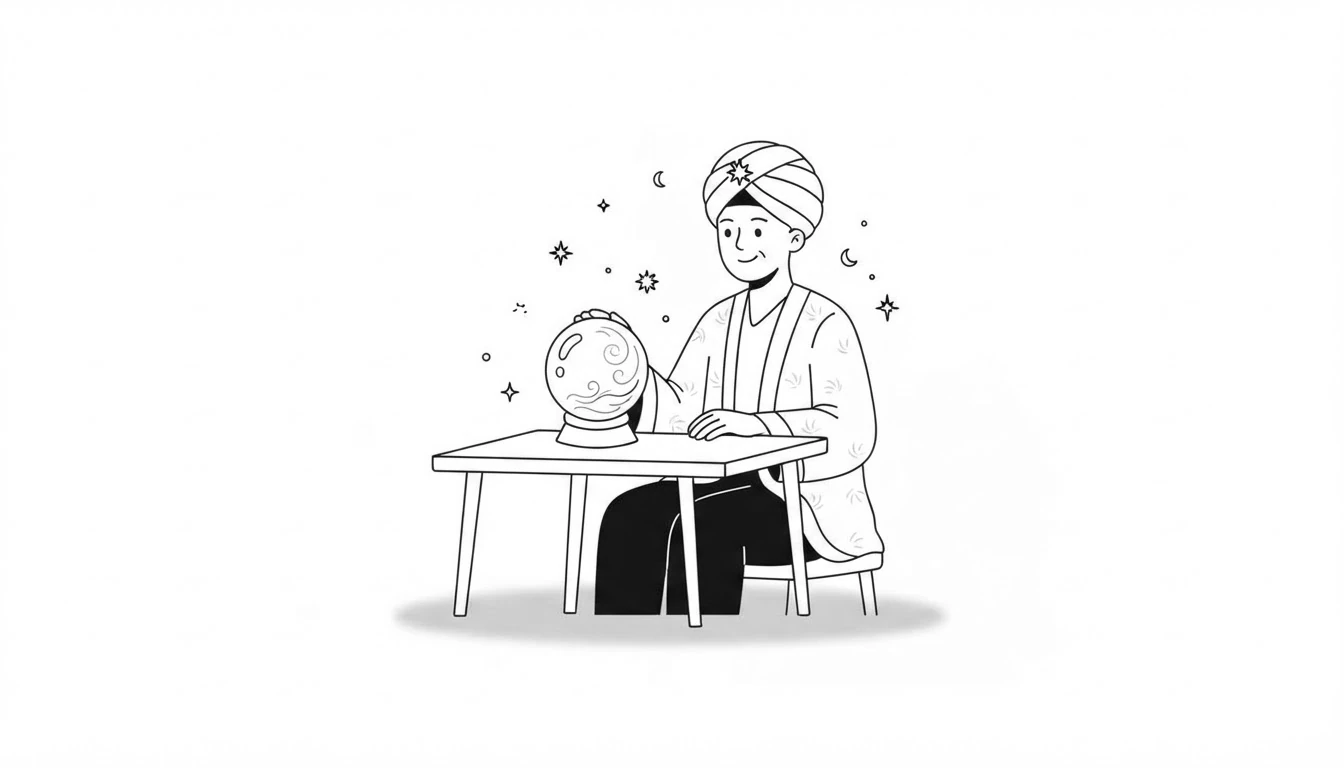
Fun uses: the fortune teller who is always wrong
The future simple is the tense of fortune tellers. A small repertoire of prophecies (which almost never come true):
| The fortune teller says… | Translation |
|---|---|
| You will meet a tall, dark stranger. | Conocerás a un desconocido alto y moreno. |
| You will be rich and famous. | Serás rico y famoso. (Algún día.) |
| You will travel to a distant land. | Viajarás a una tierra lejana. (A Valencia.) |
| You won’t pass your next exam. I’m joking! | No aprobarás tu próximo examen. ¡Es broma! |
| The lottery will be yours next week. | La lotería será tuya la semana que viene. |
| Your boss will give you a pay rise. One day. | Tu jefe te subirá el sueldo. Algún día. |
Future simple summary table
| Function | Example |
|---|---|
| Decision at the moment | I’ll answer it. |
| Promise | I won’t tell anyone. |
| Offer | I’ll carry it for you. |
| Request or invitation | Will you come to my party? |
| Prediction (opinion) | I think it will be fine. |
| Future fact | The sun will rise at 7. |
| Guess about now | That’ll be the postman. |
| Typical habit | She’ll sit for hours reading. |
| Refusal | The car won’t start. |
FAQ: the future simple
When is the future simple used?
For decisions at the moment, promises, offers, requests, predictions based on opinion, future facts and guesses about the present.
How is the future simple formed?
With will + verb in the infinitive without to: I will go. For the negative, won’t; for questions, Will you go?
What is the difference between will and going to?
Will is for decisions at the moment, promises and opinions; going to for plans already decided and predictions with evidence in front of you. You have it in detail in the guide to will vs going to.
Can will be used after «if»?
No, except in very formal requests (If you will follow me…). The normal use: If it rains, I’ll stay home.
What is «shall» and when is it used?
It is the variant of will with I and we, and today it is kept for offers and suggestions (Shall I help? Shall we go?) and for formal English.
Why don’t you say «I will can»?
Because can and will are modals and are not combined. Will be able to is used. The same with must → will have to.
Is «won’t» always the negative of will?
Yes: it is the contraction of will not. With things, it can also express refusal (The door won’t open).
Future simple exercises
Thirty sentences to check you have understood. Below you have three interactive exercises that mark themselves, so you will know straight away how you did.
And if you prefer a version in text that you can copy and paste, you have it down here 👇
Exercise 1: choose the correct form
Choose the correct option to complete each sentence.
- If it (rains / will rain) tomorrow, we’ll stay at home.
- When I (get / will get) home, I’ll call you.
- «Is that the doorbell?» «Yes, that (will be / is being) the postman.»
- I’m sure you (will can / will be able to) do it.
- Tomorrow I (will must / will have to) get up early.
- (Will you / Do you) open the window, please?
- (Shall I / Will I) open the window? It’s very hot in here.
- I promise I (won’t / don’t) tell anyone.
- If you (will study / study) hard, you’ll pass the exam.
- «Don’t worry.» «I (will / am going to) help you. I promise.»
Show answers
- rains
- get
- will be
- will be able to
- will have to
- Will you
- Shall I
- won’t
- study
- will
Exercise 2: complete the sentences
Complete each sentence with will (or won’t) or the present simple, and the verb in brackets. Write only the missing words.
- I think it _______________ (be) a great party.
- If you miss the bus, you _______________ (be) late.
- I promise I _______________ (not / tell) anyone.
- _______________ (you / lend) me your pen, please?
- The shop _______________ (open) at 9 tomorrow.
- «It’s getting dark.» «I _______________ (turn on) the light.»
- When she _______________ (arrive), we’ll have dinner.
- She _______________ (not / pass) the exam if she doesn’t study.
- I _______________ (be able to) help you tomorrow.
- What time _______________ (the concert / start) tomorrow?
Show answers
- will be
- will be
- won’t tell
- Will you lend
- will open
- will turn on
- arrives
- won’t pass
- will be able to
- will the concert start
Exercise 3: correct or incorrect?
Decide whether each sentence is correct. If it is incorrect, rewrite it correctly.
- I will can help you tomorrow.
- If it will rain, we’ll stay at home.
- I’ll call you when I will arrive.
- She won’t tell anybody.
- I will to go to the party.
- Will you help me, please?
- He will goes to school tomorrow.
- I think it will be cold tonight.
- We will must leave early.
- Don’t worry. I’ll be there at eight.
Show answers
- I will be able to help you tomorrow.
- If it rains, we’ll stay at home.
- I’ll call you when I arrive.
- Correct
- I will go to the party.
- Correct
- He will go to school tomorrow.
- Correct
- We will have to leave early.
- Correct
Conclusion
To sum up in three ideas: the future simple (will + verb) is used for decisions at the moment, promises, offers, requests and predictions based on opinion, and also to guess what is happening now and for typical habits; after if, when and as soon as the present is used, never will; and will is not combined with other modals: will be able to and will have to are used.
If you want to continue with the future, see the guides to the future in English, will vs going to and the future continuous. Do you have doubts about the future simple? Write to me and I will help.
Did you find this post useful? Share it with other English students and teachers. And if you want more content like this, subscribe to my newsletter and follow me on Facebook, Twitter, Pinterest, Instagram and YouTube.
See you in the next post. Until then, don’t forget to keep smiling! 🙂
