
Table of contents
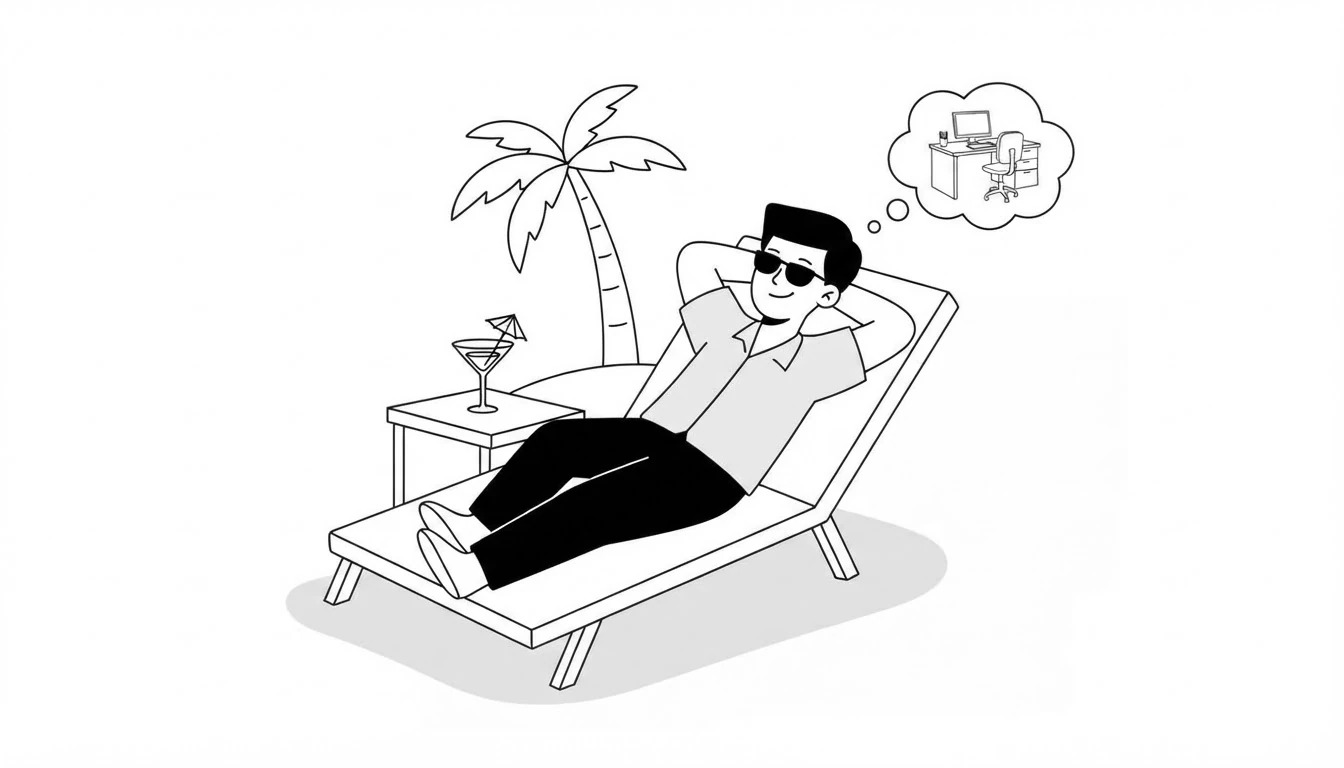
Monday, nine in the morning. You are in a meeting that could have been an email. But the colleague next to you, the one you get on so well with, whispers: This time next week I’ll be lying on a beach and you’ll be answering emails. And instead of crying, you take note of the grammar: will be lying and will be answering. That is the future continuous (also called the future progressive): the tense we use to talk about what will be in progress at a specific moment in the future.
Native speakers use it a lot and Spanish speakers find it hard, because Spanish has «estaré + gerundio» but we use it far less than English does. In this guide I explain how it is formed, when it is used (seven uses with examples), how it differs from the future simple, from going to and from the future perfect, the typical mistakes, how it helps you in Cambridge exams and how to use it to show off about your holidays or sound formal in an announcement. At the end there are thirty practice sentences with answers. Let’s get started! 🙂
The future continuous at a glance
| Future continuous | |
|---|---|
| Form | will be + verb + -ing |
| What it is for | Talking about an action that will be in progress at a moment in the future |
| Example | This time tomorrow I will be flying to Madrid. |
| Spanish | «Mañana a esta hora estaré volando a Madrid» (estar + gerundio) |
| Words that go with it | this time tomorrow / next week, at 8 tomorrow, when, while, all day, still |
What the future continuous is
With the future continuous you do not talk about the moment an action starts, but about the fact that it will already be happening when you get to that moment. Imagine the future as a timeline: you pick a point and say «at that time, I’ll be in the middle of…».
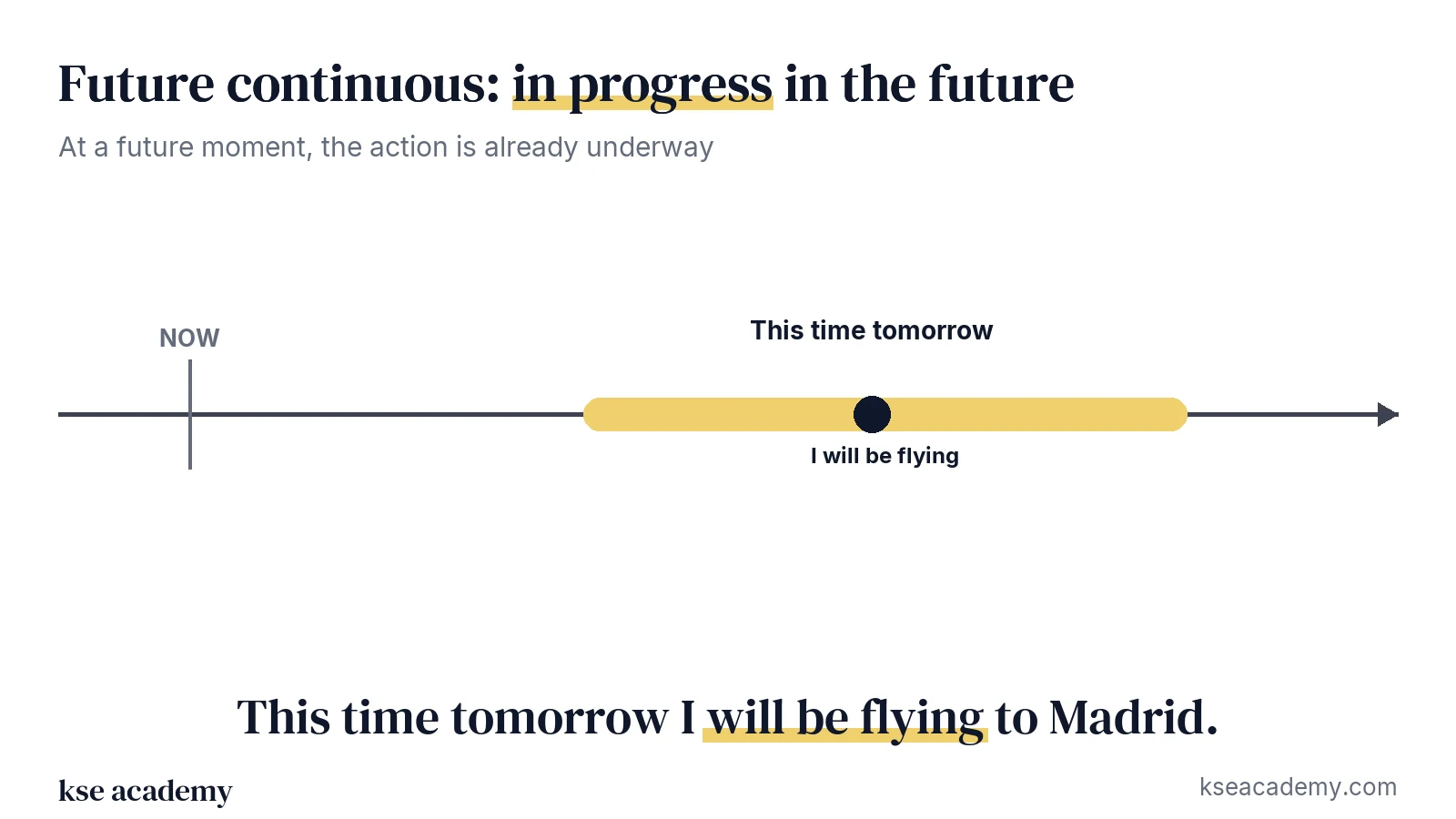
The action starts before that moment and ends after it. That is why it is called «continuous»: at that point of the line, the action is «half way through».
How the future continuous is formed
The form is always will be + verb with -ing, for all persons. There is nothing to conjugate: only the -ing of the main verb.
Affirmative, negative and questions
| Form | Structure | Example |
|---|---|---|
| Affirmative | subject + will be + -ing | I will be working. |
| Negative | subject + will not be (won’t be) + -ing | I won’t be working. |
| Question | Will + subject + be + -ing…? | Will you be working? |
| With a question word | question word + will + subject + be + -ing…? | What will you be doing? |
| Short answer | Yes, I will. / No, I won’t. | Will you be working? Yes, I will. |
Contractions
| Full form | Contraction |
|---|---|
| I will be sleeping | I’ll be sleeping |
| She will be working | She’ll be working |
| They will not be coming | They won’t be coming |
How to spell the -ing
| Rule | Examples |
|---|---|
| Normally, add -ing | work → working, play → playing |
| If it ends in -e, drop the -e | make → making, write → writing |
| If it is short and ends in vowel + consonant, double it | run → running, sit → sitting |
| If it ends in -ie, it becomes -y | lie → lying, die → dying |
| In British English, a final -l is doubled | travel → travelling |
It is the same rule as in the Present Continuous, so if you already know it, you save time there.
When the future continuous is used
1. An action in progress at a specific moment in the future
This is the main use. At that time, the action will already have started and will go on afterwards:
- This time tomorrow I will be flying to Madrid.
- At nine on Saturday morning I’ll be sleeping. Don’t even think about calling.
- In ten years’ time, I’ll be living in Scotland.
2. A long action that will be interrupted by another
- When you arrive, I’ll be cooking.
- I’ll be waiting for you outside when the film finishes.
Notice: after when, the verb is in the present (when you arrive), not will. It is a very typical mistake for Spanish speakers, and you will see it in the mistakes table.
3. Two actions in progress at the same time in the future
- Tomorrow at ten, I’ll be working and you’ll be sleeping.
- While I’m cooking, you’ll be setting the table.
4. Something that will happen «because it was due», not as a decision
The future continuous is used to talk about events that will happen in the normal course of events, not as a decision you are taking now:
- I’ll be seeing Ana tomorrow, so I can give her the book. (I am seeing her anyway.)
- I’ll be going to the supermarket later. Do you need anything?
With I’ll see Ana it would sound as if you had just decided to see her; with I’ll be seeing Ana, it is a fact that was already in the diary.
5. Polite questions about someone’s plans
It is a very kind way to ask, because it does not sound like a request or put pressure on the other person:
- Will you be using the car tonight? (If you are not, I’ll take it.)
- Will you be needing anything else? (Said by a waiter or a shop assistant.)
- Will you be staying long?
6. Guesses about what is happening now
As well as talking about the future, will be + -ing is used to guess what someone is doing right now:
- Don’t call Paula now. She’ll be sleeping.
- It’s eight o’clock. They’ll be having dinner by now.
7. Formal notices and announcements
At an airport, a station or in a corporate email, the future continuous sounds professional and polite:
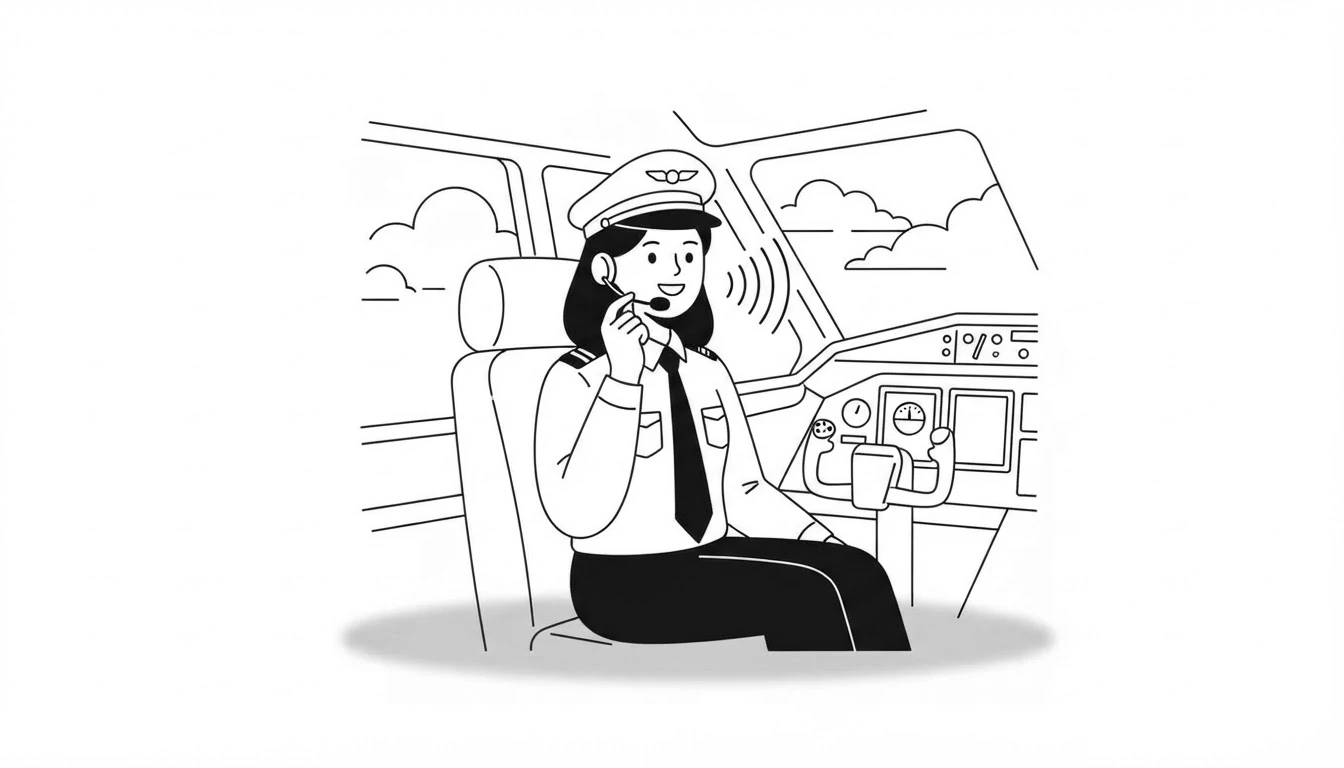
- Ladies and gentlemen, we will be landing in about twenty minutes.
- The meeting will be starting shortly.
- I will be arriving at 6 p.m.
Time expressions that go with the future continuous
| Expression | Example |
|---|---|
| this time tomorrow / next week / next year | This time next year I’ll be living abroad. |
| at 8 tomorrow / on Saturday at noon | At 8 tomorrow I’ll be taking a train. |
| when + present | When you call, I’ll be driving. |
| while | While you’re sleeping, I’ll be working. |
| all day / all evening / all week | I’ll be studying all day tomorrow. |
| still | Next year I’ll still be working here. |
| in two hours / in a week | In two hours we’ll be sitting on the plane. |
Future continuous versus future simple (will)
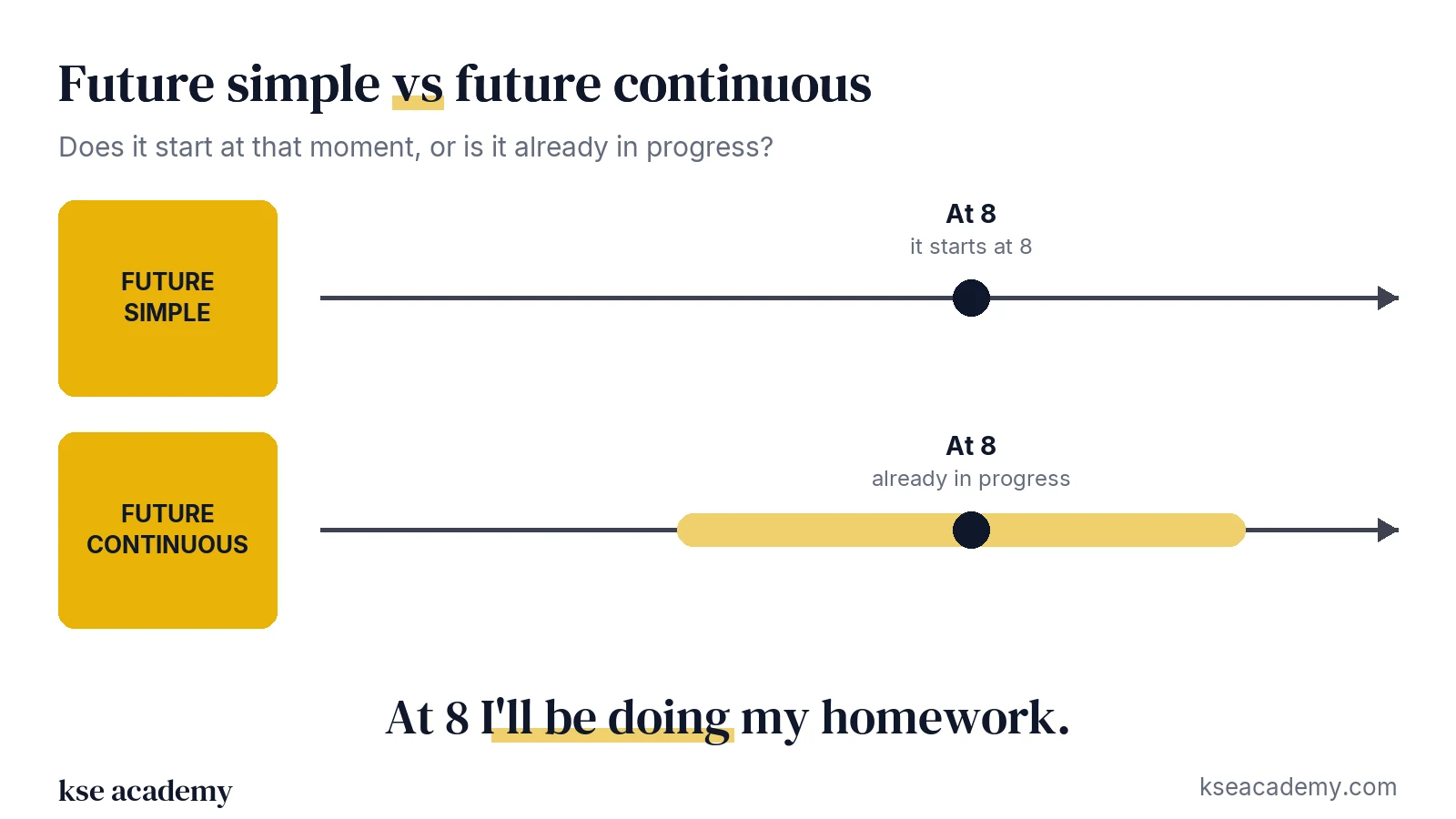
It is the most typical doubt: will do or will be doing. The difference is a matter of viewpoint. With will you talk about the whole action (or about it starting at that moment); with will be + -ing, it is already under way:
| Future simple | Future continuous |
|---|---|
| I’ll call you at 8. (I’ll make the call at 8.) | I’ll be calling clients at 8. (At 8 I’ll be in the middle of calls.) |
| I’ll help you. (An offer, I decide now.) | I’ll be helping Anna tomorrow. (It was already planned.) |
| At midnight I’ll fly to Greece. (The flight leaves at midnight.) | At midnight I’ll be flying to Greece. (At midnight I’ll already be flying.) |
Watch out for the two cases where only will works: promises (I’ll call you as soon as I land) and instant decisions (The phone’s ringing! I’ll get it). In those, the future continuous does not work.
Future continuous versus going to and the present continuous
Going to and the present continuous talk about plans and intentions: I’m going to watch the match. The future continuous does not talk about the intention, but about what you will be doing at a moment: I’ll be watching the match at 8. See the guide to the future in English: will, going to and the present continuous to see the three forms together.
Future continuous versus future perfect
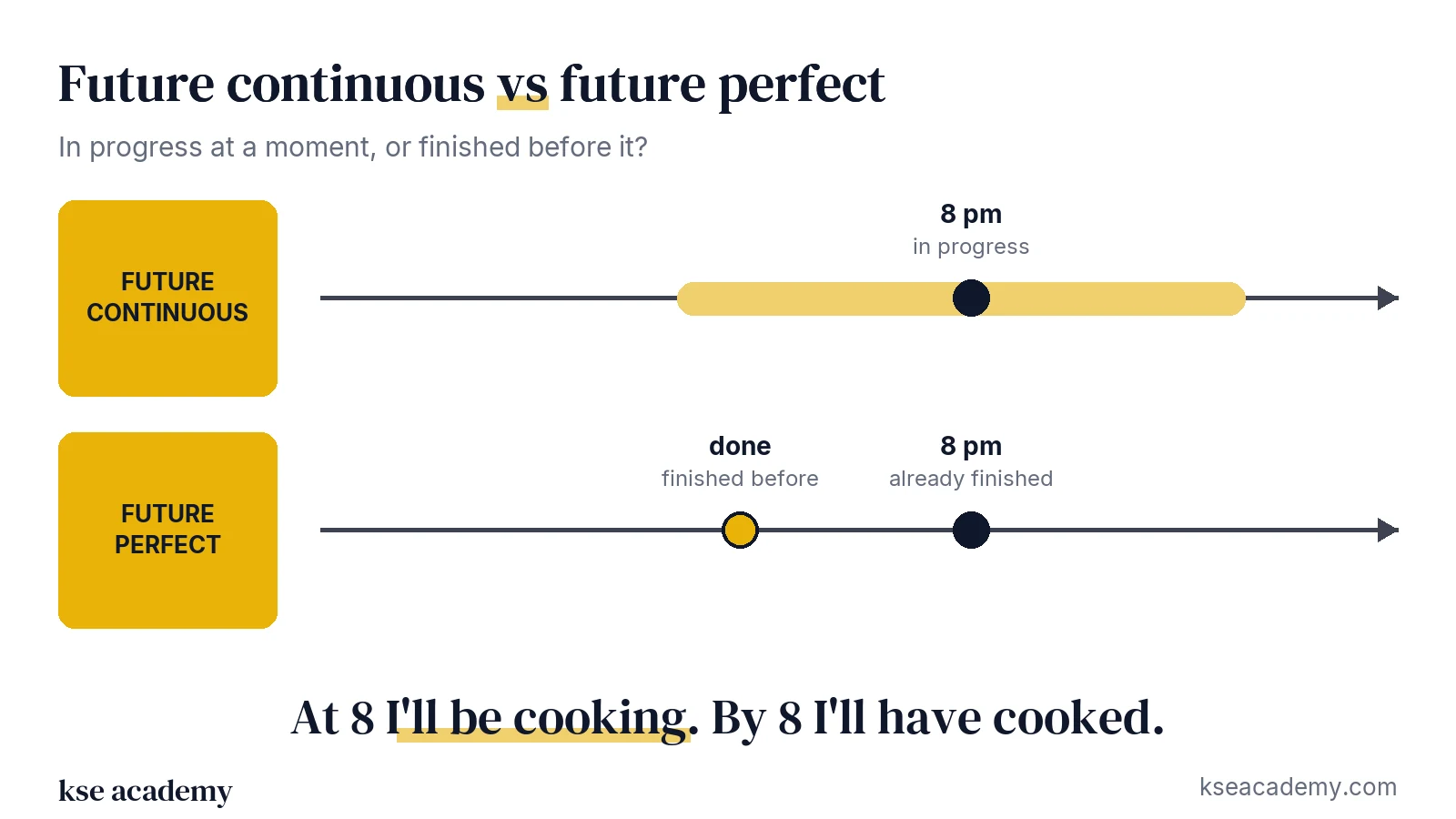
This comparison has a lot of searches, and it is simple if you think of the timeline: with the future continuous, the action is in progress at that moment. With the future perfect, it has already finished before that moment:
| Tense | Example | Meaning |
|---|---|---|
| Future continuous | At 8 I’ll be cooking. | At 8 I’ll be cooking (in the middle). |
| Future perfect | By 8 I’ll have cooked. | By 8 I’ll have already cooked (finished). |
Verbs that are not used in the continuous
State verbs (know, like, love, want, need, understand, believe, belong…) are not normally put in -ing. With these, the future simple is used: This time tomorrow I’ll know the results (and not will be knowing). You have the full list in the guide to stative and dynamic verbs.
Spanish versus English: where we get confused
Spanish has «estaré + gerundio» and it looks very similar, but we use it less. These are the differences that matter most:
| 🇪🇸 Spanish | 🇬🇧 English | What happens |
|---|---|---|
| Mañana a esta hora estaré volando a Madrid. | This time tomorrow I will be flying to Madrid. | Direct equivalent: will be + -ing. |
| Estará durmiendo. (a guess) | She’ll be sleeping. | Same as Spanish: the future to guess something about the present. |
| ¿Vas a usar el coche esta noche? | Will you be using the car tonight? | In Spanish we ask with «ir a»; in English, the continuous sounds more polite. |
| Cuando llegues, estaré esperando. | When you arrive, I’ll be waiting. | After when comes the present (in Spanish, the subjunctive). |
| Mañana trabajaré todo el día. | I’ll be working all day tomorrow. | In English, with «all day» the continuous is the natural choice. |
Common mistakes with the future continuous
| ❌ Incorrect | ✅ Correct | Why |
|---|---|---|
| At nine tomorrow I will working. | At nine tomorrow I will be working. | Be is missing: it is will be + -ing. |
| I will be work tomorrow. | I will be working tomorrow. | After be, the verb takes -ing. |
| When you will arrive, I’ll be cooking. | When you arrive, I’ll be cooking. | After when, present, not will. |
| I will be knowing the results tomorrow. | I will know the results tomorrow. | Know is a state verb: not used in the continuous. |
| Will be you travelling next week? | Will you be travelling next week? | In questions: Will + subject + be. |
| I’ll being at home all evening. | I’ll be at home all evening. | Be does not take -ing here: will be + complement. |
| She will be sleep when we call. | She will be sleeping when we call. | The -ing is missing. |
The future continuous in Cambridge exams
You are expected to master this tense from B2 First onwards, and it earns points for naturalness in C1 Advanced:
- Use of English (Part 4, key word transformations) in B2 First and C1 Advanced: with key words that require the -ing.
- Writing in B2 First and C1 Advanced: in formal emails and letters, I will be arriving at… or We will be offering… sound professional.
- Speaking: to describe your plans («this time next year I’ll be…») fluently and precisely.
Two examples in the style of Use of English Part 4:
- I’m going to sunbathe on a beach in Bali this time next week. SUNBATHING
I ______ on a beach in Bali this time next week. → will be sunbathing - Don’t phone me at nine tomorrow because I will be in a meeting. HAVING
Don’t phone me at nine tomorrow because I ______ a meeting. → will be having
Fun uses: the future continuous of envy
If there is one thing that makes the future continuous happy, it is showing off (and complaining). A small repertoire:
| Situation | Sentence |
|---|---|
| Holidays | This time next week I’ll be lying on a beach and you’ll be answering emails. |
| Saturday at noon | On Saturday at noon I’ll be sleeping. Don’t even think about calling. |
| Monday at 9 | At 9 on Monday I’ll be sitting in a meeting that could have been an email. |
| The exam | This time next month I’ll be sitting my exam. Wish me luck. |
| The lottery | If I win the lottery, this time next year I’ll be living on a yacht. |
| The mother-in-law | Don’t worry, I’ll be waiting outside. |
Future continuous summary table
| What | How | Example |
|---|---|---|
| Form | will be + -ing | I’ll be working. |
| Negative | won’t be + -ing | I won’t be working. |
| Question | Will + subject + be + -ing | Will you be working? |
| Main use | Action in progress at a future moment | This time tomorrow I’ll be flying. |
| Politeness | Asking about the other person’s plans | Will you be using the car? |
| Guess | What someone is doing now | She’ll be sleeping. |
FAQ: the future continuous
When is the future continuous used?
To talk about an action that will be in progress at a specific moment in the future, to ask politely about someone’s plans, to guess what someone is doing now and in formal announcements.
How is the future continuous formed?
With will be + verb + -ing: I will be working. For the negative, won’t be; for questions, Will you be working?
What is the difference between «will do» and «will be doing»?
Will do presents the whole action or it starting at that moment; will be doing presents it as already under way at that moment. At 8 I’ll do my homework: I start at 8. At 8 I’ll be doing my homework: I’ll already be doing it at 8.
Can «going to» be used instead of «will be» + -ing?
Not always. Going to expresses an intention or plan; will be + -ing expresses that something will be in progress at a moment. I’m going to watch the match versus I’ll be watching the match at 8.
Do you say «when I will arrive»?
No. After when, while, as soon as or before the present is used: When I arrive, I’ll call you.
Which verbs are not used in the future continuous?
State verbs: know, like, love, want, need, understand, believe, belong… The future simple is used: I’ll know tomorrow.
Is it the same as the present continuous for the future?
No. The present continuous talks about arranged plans (I’m meeting Ana at 8). The future continuous talks about what will be in progress at a moment (I’ll be meeting Ana at 8), and sounds more neutral, with less of a «plan» behind it.
Future continuous exercises
Thirty sentences to check you have understood. Below you have three interactive exercises that mark themselves, so you will know straight away how you did.
And if you prefer a version in text that you can copy and paste, you have it down here 👇
Exercise 1: choose the correct form
Choose the correct option to complete each sentence.
- This time tomorrow I (will fly / will be flying) to Rome.
- «The phone’s ringing!» «I (will answer / will be answering) it.»
- Tomorrow at 10 a.m. the students (will take / will be taking) their exam, so please be quiet.
- I promise I (will call / will be calling) you as soon as I land.
- Don’t ring Mum now. She (will sleep / will be sleeping).
- At this time next week, we (will lie / will be lying) on the beach.
- (Will you use / Will you be using) the car tonight? I need it for the shop.
- When you (will arrive / arrive), I’ll be waiting outside.
- This time tomorrow I (will know / will be knowing) the results.
- At midnight tonight, the party (will still go / will still be going) on.
Show answers
- will be flying
- will answer
- will be taking
- will call
- will be sleeping
- will be lying
- Will you be using
- arrive
- will know
- will still be going
Exercise 2: complete the sentences
Complete each sentence with the future continuous of the verb in brackets. Write only the missing words.
- This time next week, I _______________ (lie) on a beach in Tenerife.
- Don’t call at ten tomorrow. We _______________ (have) a meeting.
- At midnight tonight, she _______________ (sleep).
- _______________ (you / use) the car this evening?
- They _______________ (not / work) tomorrow because it’s a holiday.
- When you arrive, we _______________ (cook) dinner.
- At nine tomorrow morning I _______________ (sit) my driving test.
- What _______________ (you / do) this time next year?
- He _______________ (not / play) football tomorrow because of his injury.
- Ladies and gentlemen, we _______________ (land) in about ten minutes.
Show answers
- will be lying
- will be having
- will be sleeping
- Will you be using
- won’t be working
- will be cooking
- will be sitting
- will you be doing
- won’t be playing
- will be landing
Exercise 3: correct or incorrect?
Decide whether each sentence is correct. If it is incorrect, rewrite it correctly.
- This time tomorrow I will be working at the office.
- At nine tomorrow I will working.
- When you will arrive, I will be waiting.
- Will you be using the car tonight?
- I will be knowing the results tomorrow.
- She will be sleep when we call.
- They won’t be coming to the party.
- Will be you travelling next week?
- I’ll being at home all evening.
- At eight tonight we’ll be watching the match.
Show answers
- Correct
- At nine tomorrow I will be working.
- When you arrive, I will be waiting.
- Correct
- I will know the results tomorrow.
- She will be sleeping when we call.
- Correct
- Will you be travelling next week?
- I’ll be at home all evening.
- Correct
Conclusion
To sum up in three ideas: the future continuous (will be + -ing) talks about what will be in progress at a specific moment in the future; it is also used to ask politely about someone’s plans, guess what is happening now and make formal announcements; and it is not the same as will + verb (the whole action) or the future perfect (already finished before that moment).
If you want to continue with verb tenses, see the guides to the future in English, the Present Continuous and the Past Perfect. Do you have doubts about the future continuous? Write to me and I will help.
Did you find this post useful? Share it with other English students and teachers. And if you want more content like this, subscribe to my newsletter and follow me on Facebook, Twitter, Pinterest, Instagram and YouTube.
See you in the next post. Until then, don’t forget to keep smiling! 🙂
